Key Takeaways
- A crockery unit is dining-room joinery, not a bought piece of furniture. Design it with the wall, the lighting, and the dining table as one composition.
- Glass choice does the styling for you: fluted or frosted tempered glass hides everyday clutter; clear glass demands a curated shelf.
- Depths are standard: 12 to 15 inches for a wall-hung unit, 18 to 22 inches for floor-standing units and sideboards.
- Close more than you display. Our happiest clients show 30% and hide 70%.
The best crockery unit designs today pair a closed storage base with a glass display section above — fluted or frosted tempered glass, warm LED light inside, soft-close hardware — sized 12 to 15 inches deep if wall-hung and 18 to 22 inches deep if floor-standing.
This gallery collects 30 crockery units across every kind of dining space in Indian homes: modern dining room crockery unit designs, glass units, wooden cabinets and crockery almirah styles, wall-hung space-savers, and kitchen crockery units. Each of these design ideas comes with the reasoning — where it works, what it's made of, and what to tell your carpenter. Brand galleries will show a homeowner the photos. We'll also tell you which crockery units survive a real Indian dining room with kids, guests, and a pressure cooker twenty feet away — because good interior design is decided by daily use, not by the render.
Choosing the Right Crockery Unit for Your Dining Room & Dining Area
Most people pick a crockery unit from photos, order it, and only then discover the drawer won't clear the dining chair. Choosing the right crockery unit starts with the room, not the catalogue — this is a piece of furniture that has to balance storage and display for a decade. We sequence it the same way on every interior project:
- Fix the wall and the depth. Confirm the unit's wall, check switchboards and windows, and decide floor-standing (18 to 22 inches deep) or wall-hung (12 to 15 inches).
- Fix the closed-to-display ratio. Count your everyday crockery, then your display-worthy pieces. Most families need 70% closed, practical storage.
- Then pick the design. Material and glass type last, once the sizes are honest.
That ratio question is real. One of our Hyderabad clients, Manikantha, briefed us for a 3 BHK with zero open shelves — everything behind shutters, nothing collecting dust. His dining storage is design 30 in this list. The opposite brief exists too, and both are correct. Design for how your family actually eats and entertains.
30 Crockery Unit Design Ideas With Photos
The gallery is grouped by the decision that actually splits clients: modern dining-room compositions, glass units, wooden units, wall-hung crockery units, and kitchen or corner placements. Fitted and freestanding units both appear — the crockery display logic is the same either way.
Modern Crockery Unit Design Ideas for Dining Rooms
These eight modern crockery unit design ideas are what we spec most often in contemporary homes: clean lines, concealed lighting, closed bases. If you're hunting trendy modern crockery cabinet designs for an apartment dining room, start here — every one of these crockery units scales up or down a size, and they all sit comfortably in modern interiors.
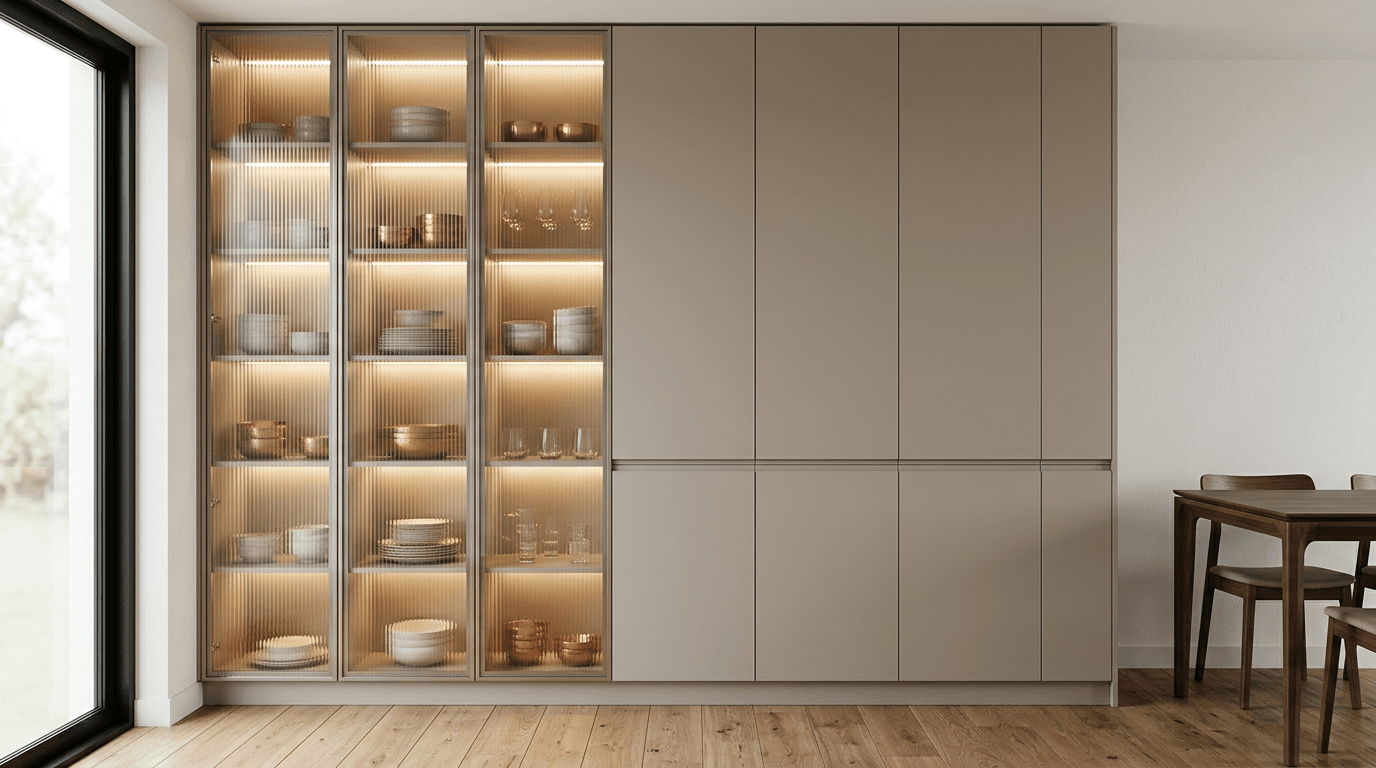
1. Fluted-glass column with closed base. A tall display column of fluted glass beside a run of closed cabinets. The fluting blurs whatever sits behind it, so the shelf never has to be perfect.
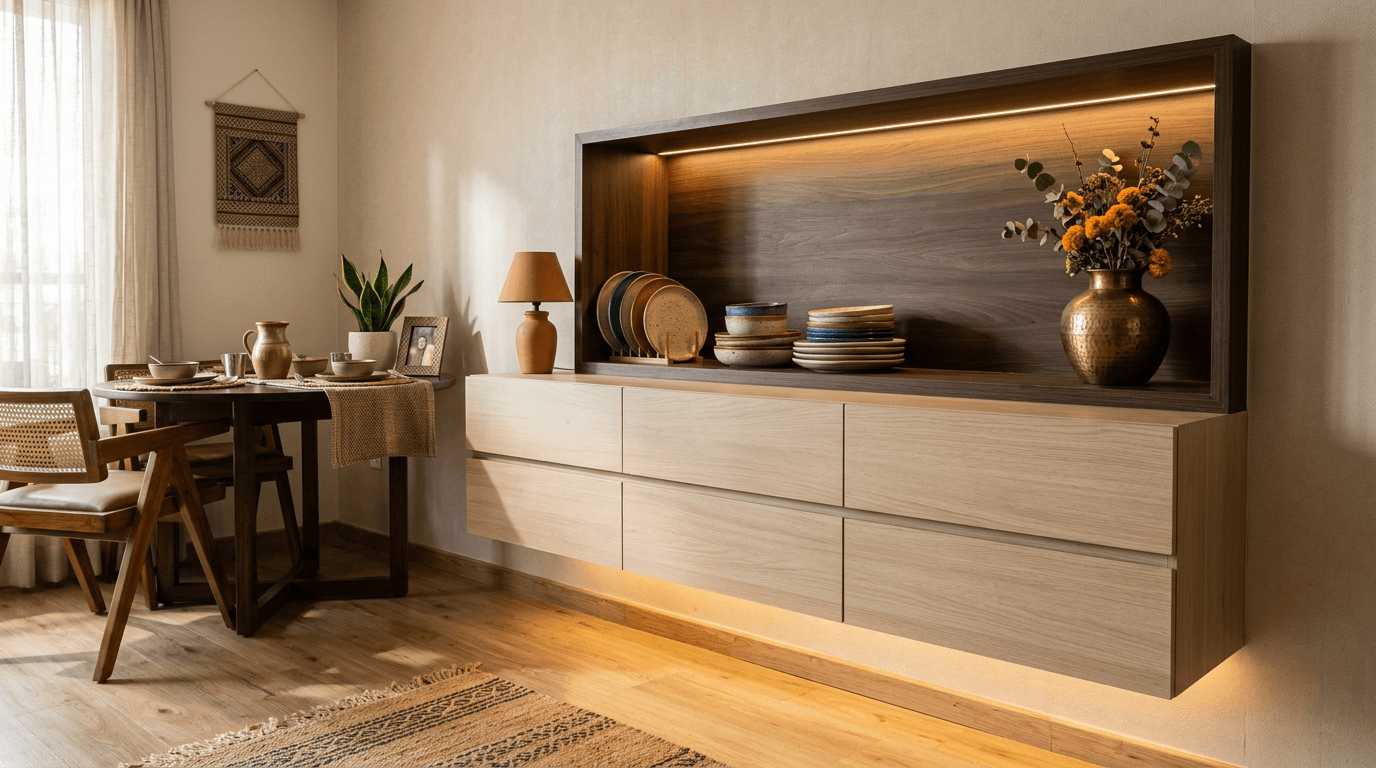
2. Floating buffet with backlit hutch. A wall-hung buffet cabinet below, an open backlit niche above. The float keeps the floor visible and mopping easy — the small-dining-room favourite among modern crockery units.
3. Two-tone closed-below, glass-above unit. The workhorse crockery unit design: laminate shutters below the counter line, framed glass doors above. Everyday steel and plastics hide low; the good ceramics display high.
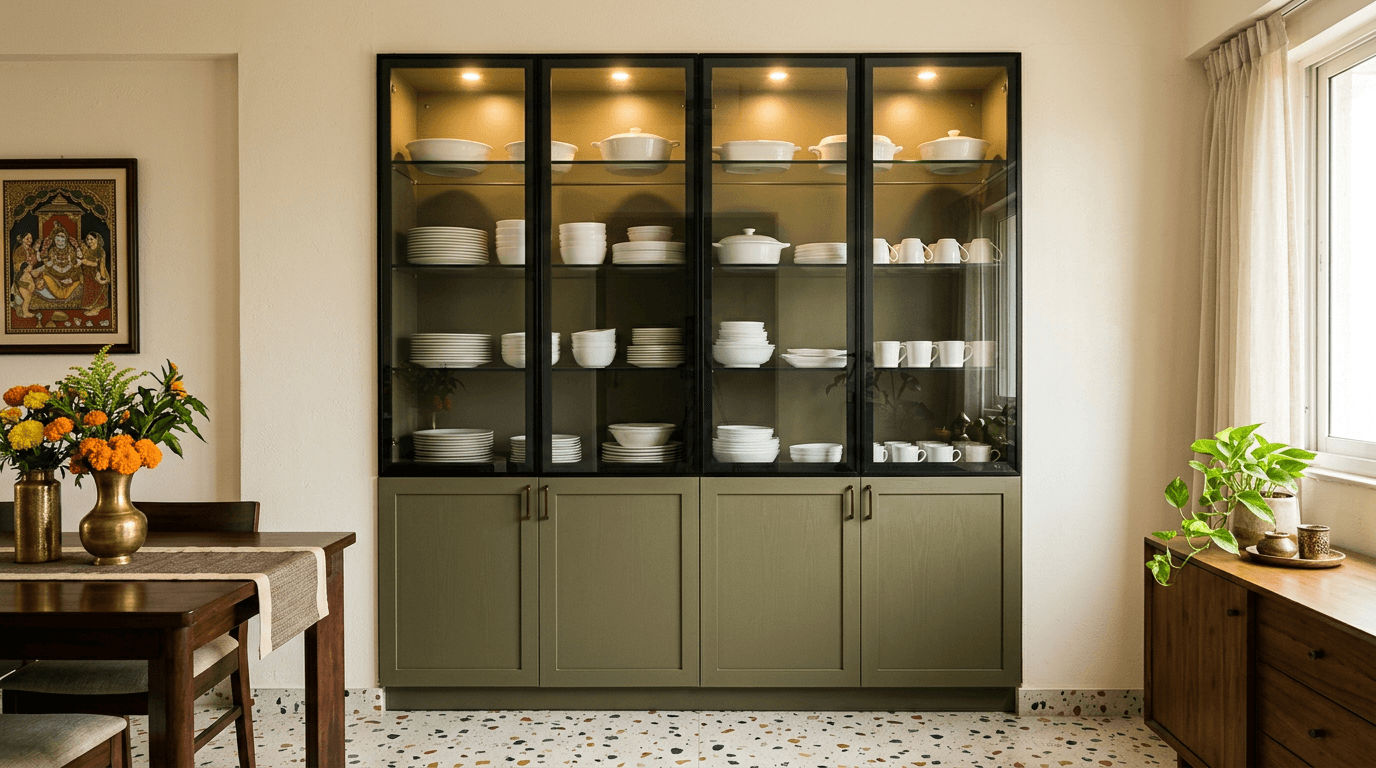
4. Full-height handleless wall. Floor-to-ceiling crockery storage reading as a panelled wall, one glass bay breaking the run. This modern cabinet wall costs more, but it replaces a sideboard and two cupboards.
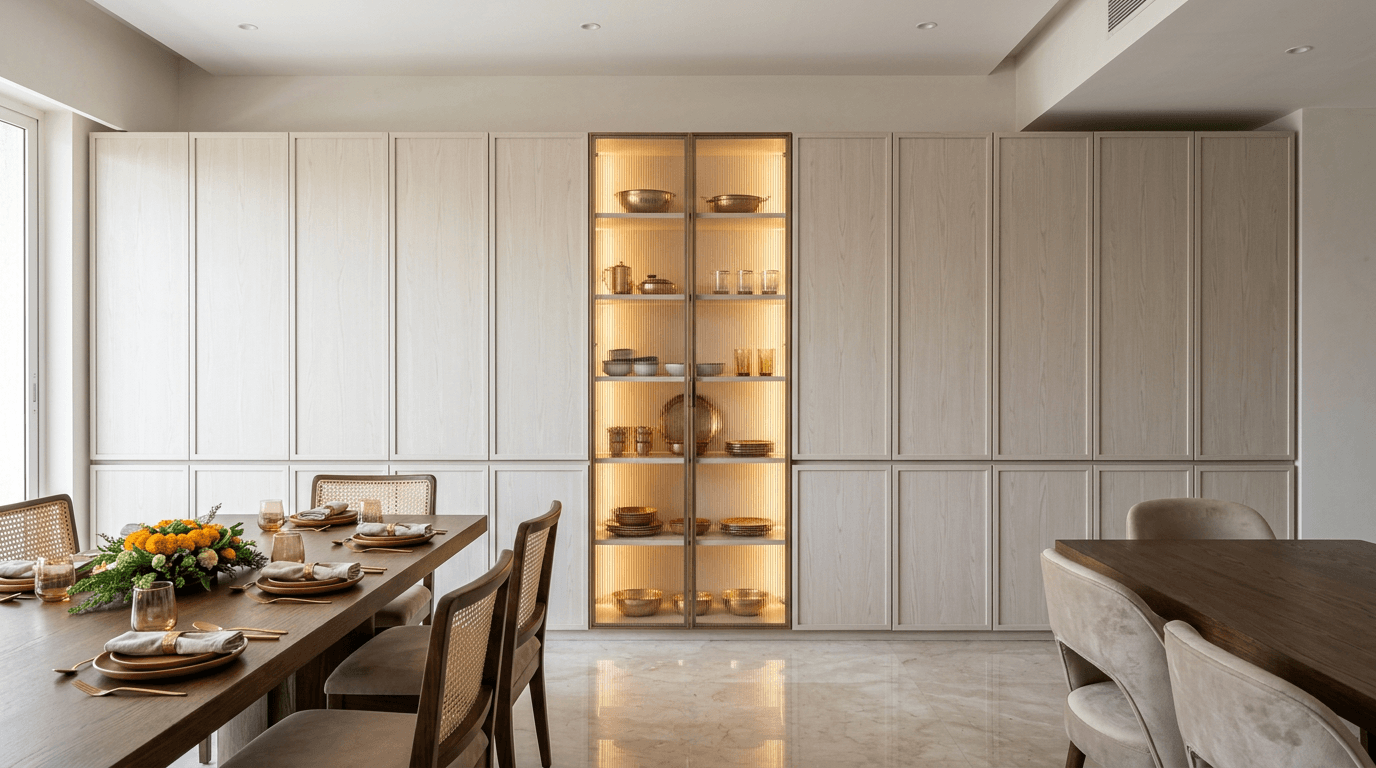
5. Arched display niche unit. A softly arched niche wrapped in wood veneer, shelves lit from above, storage below. Pairs with arched doorways and softens a boxy dining room.
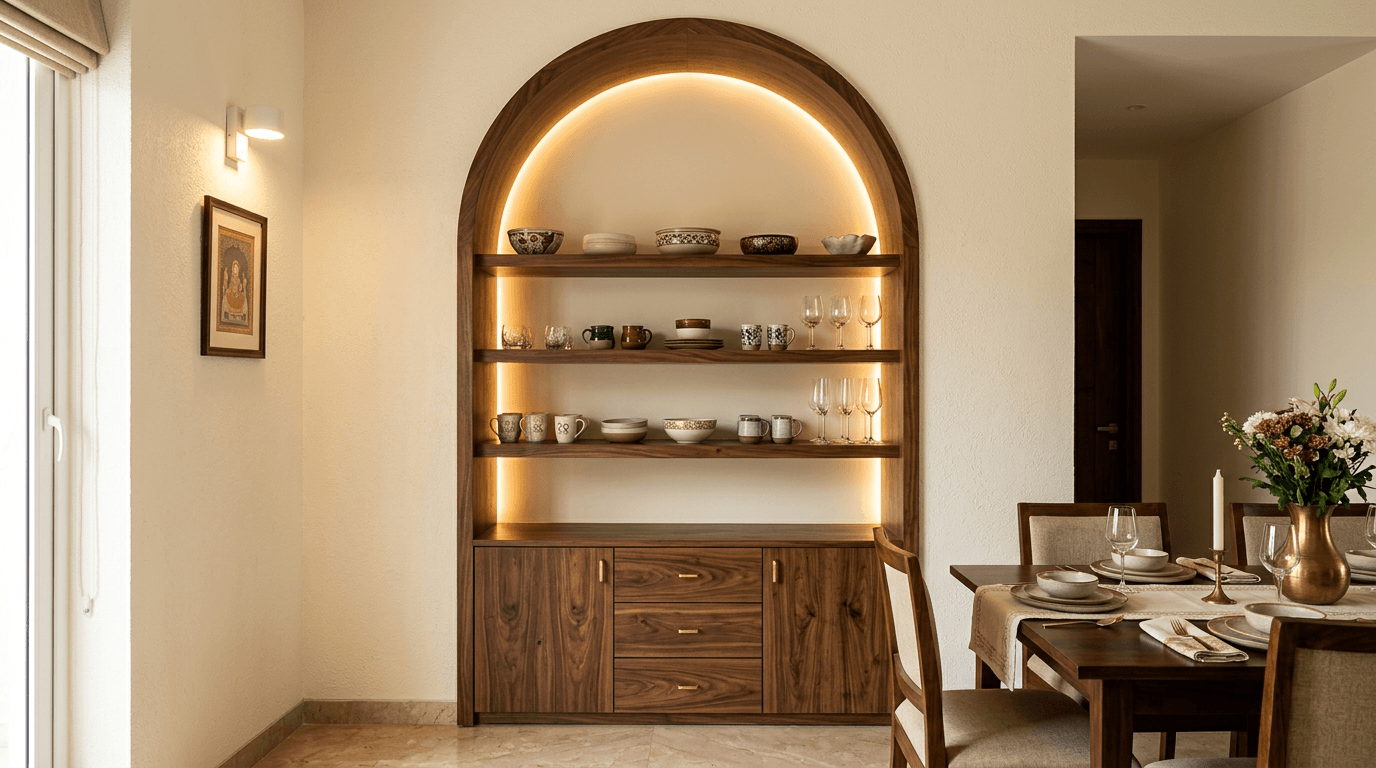
6. Sideboard with open ledge. A long low sideboard plus one open ledge above for daily-use pieces. The difference from a plain sideboard: the ledge, the wall decor around it, and the lighting are designed as one composition.
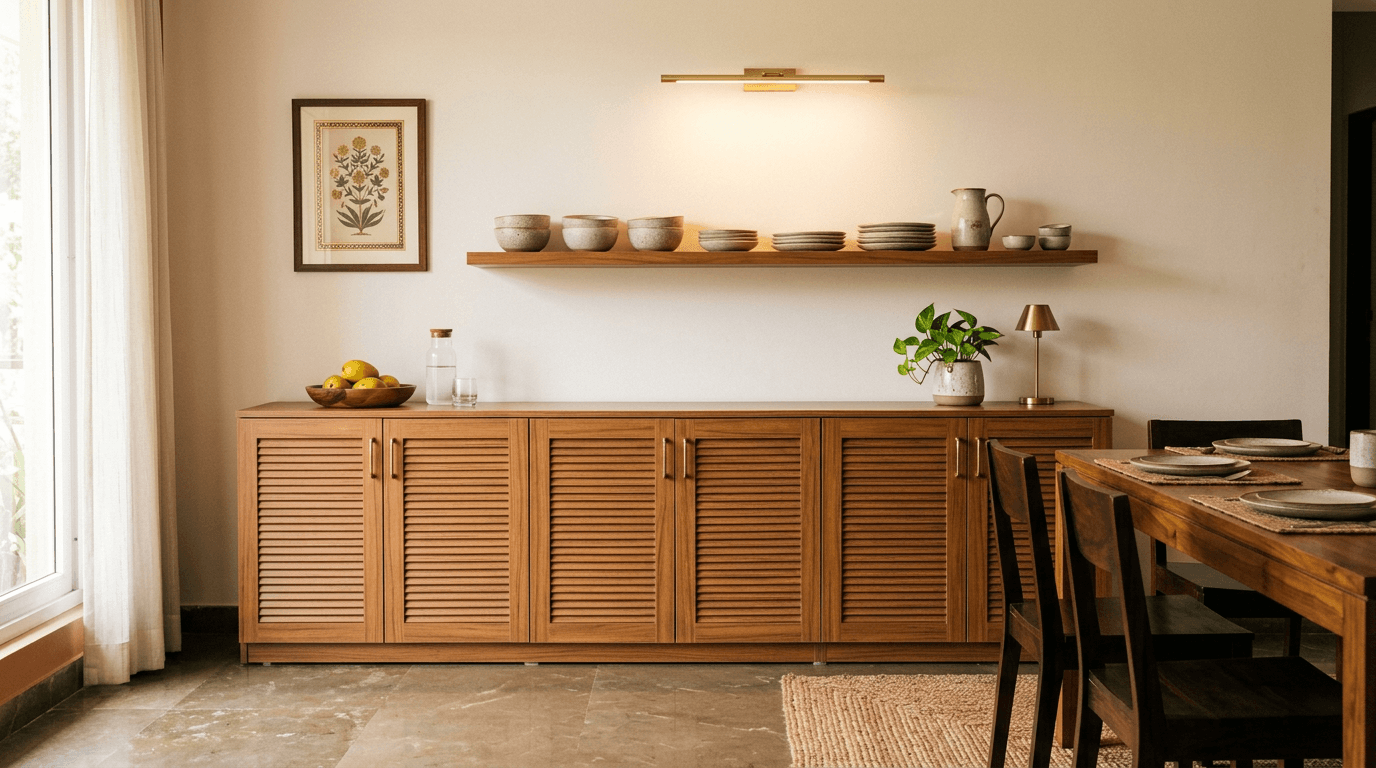
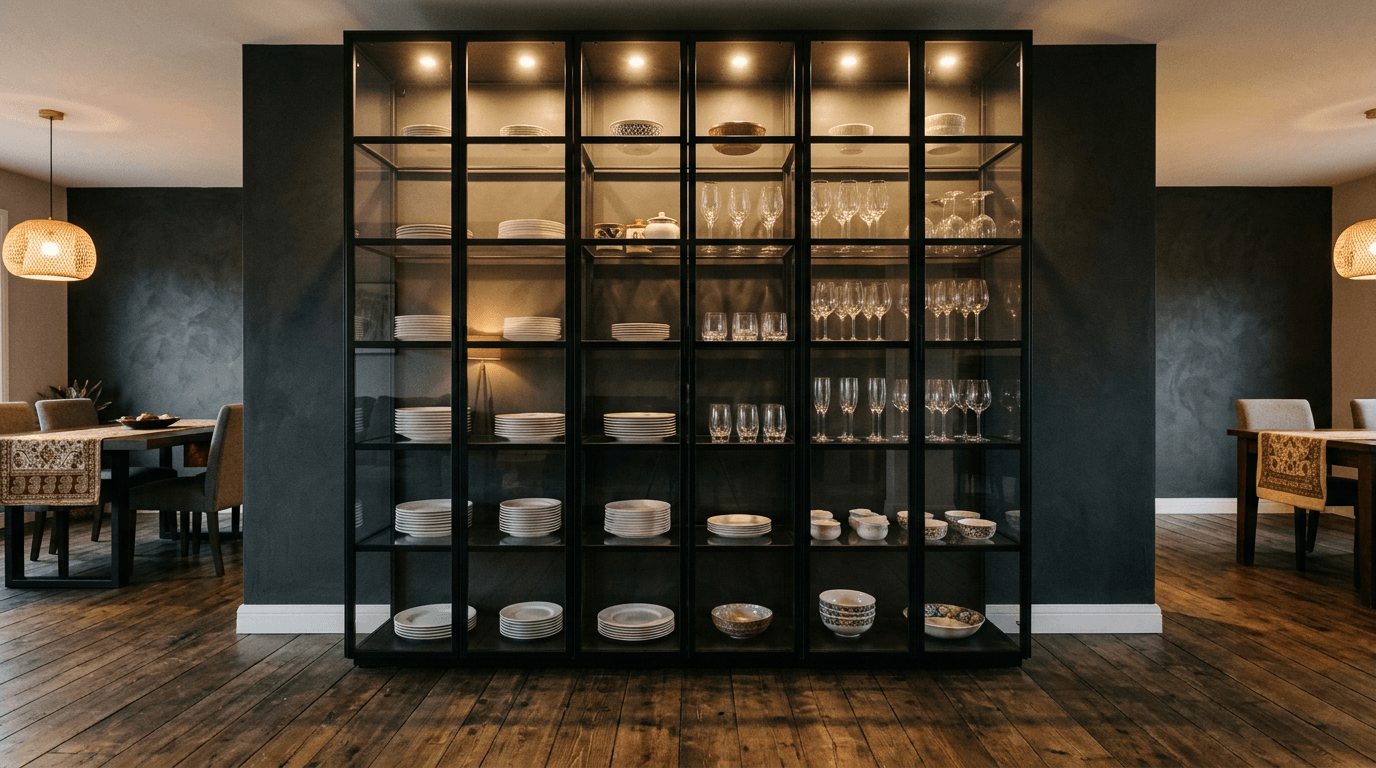
7. Black metal-and-glass grid unit. A steel-framed grid display cabinet with clear glass — café energy for dining rooms that entertain. Needs disciplined shelves; the grid forgives nothing.
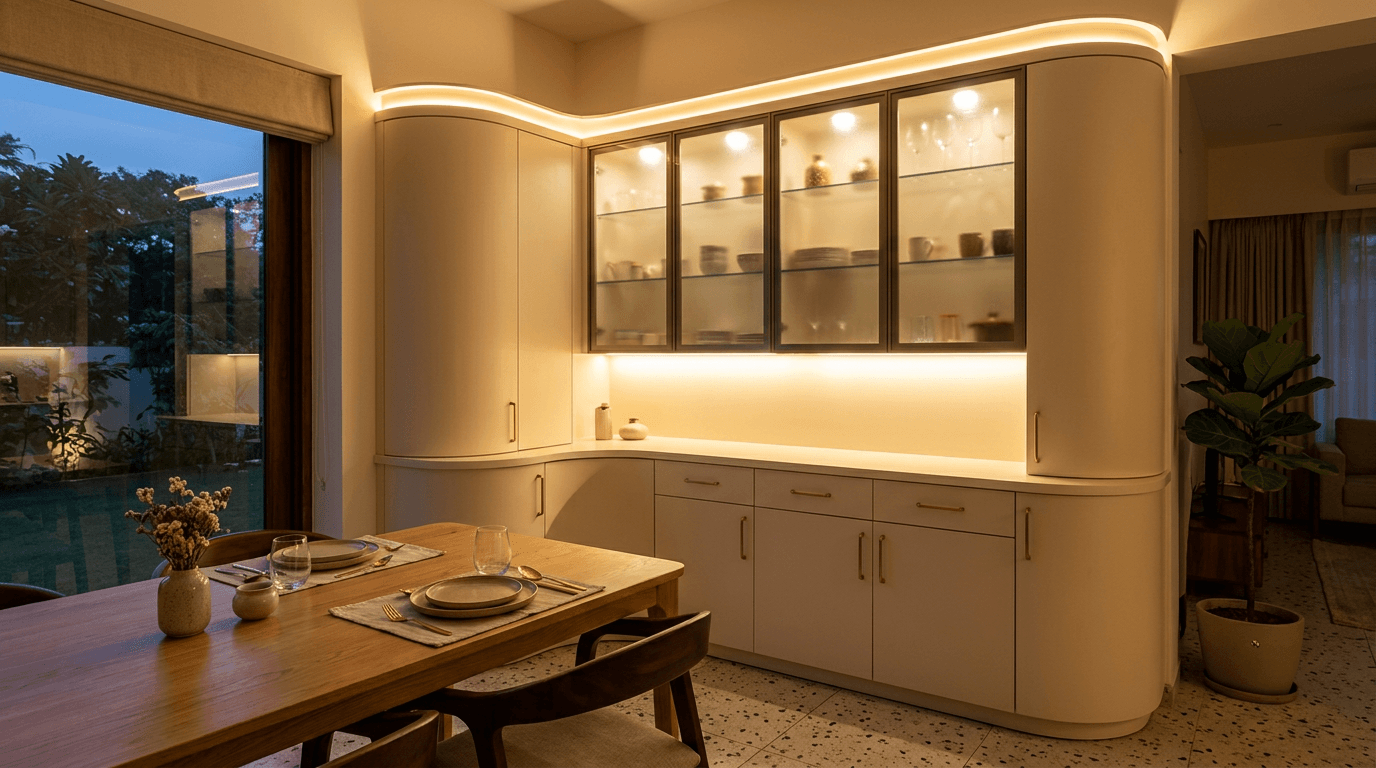
8. Curved-corner unit with LED coves. Rounded end panels and a continuous warm LED cove line. The curve invites traffic past it without bruised hips — worth it beside a busy passage.
Glass Units, Glass Shelves & Glass Crockery Unit Designs
Glass is what separates crockery cabinets from wardrobes. Glass units bring elegance and light into dining rooms, and the glass panels you choose — clear, fluted, frosted, or smoked — decide how curated your crockery collection has to be. Six ways to do it.
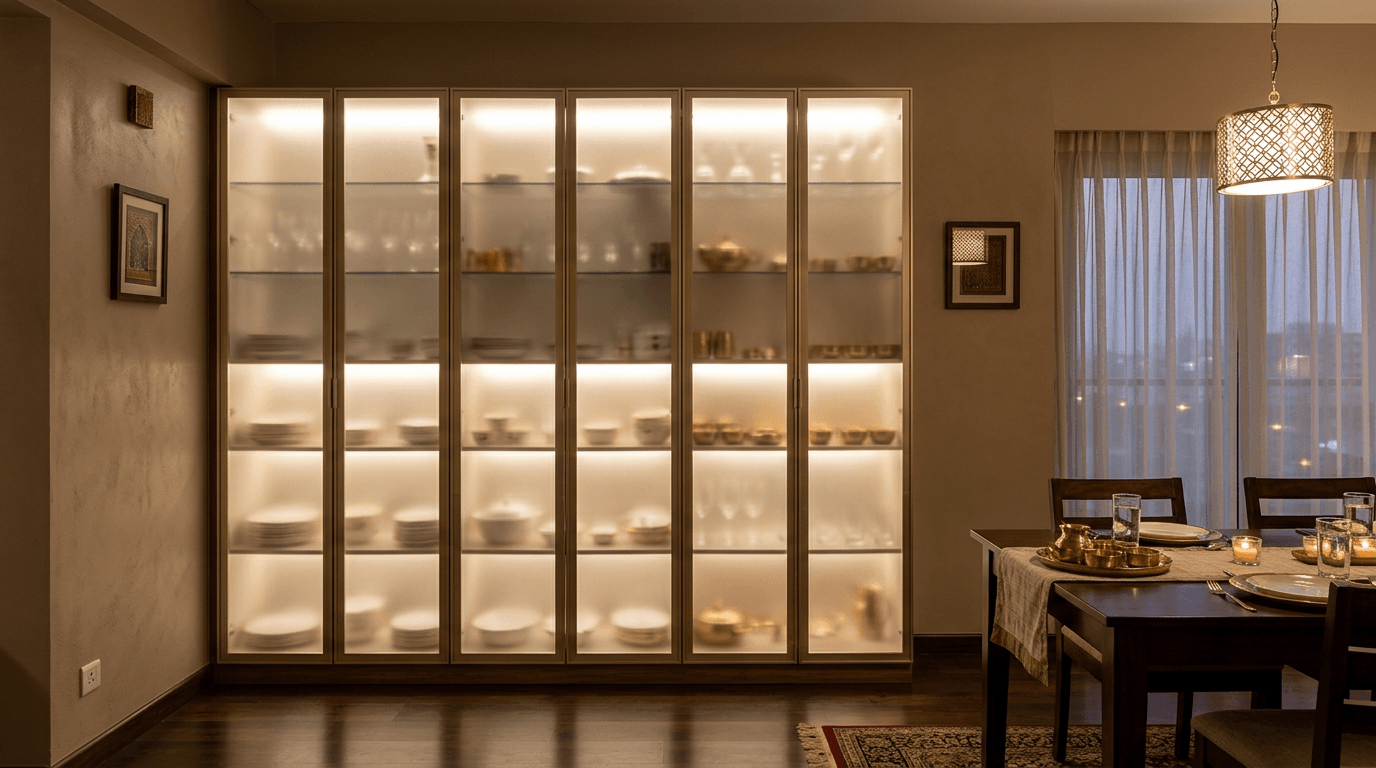
9. Frosted-glass full-height cabinet. Frosted tempered glass turns contents into soft silhouettes. The most forgiving glass crockery unit design for real households.
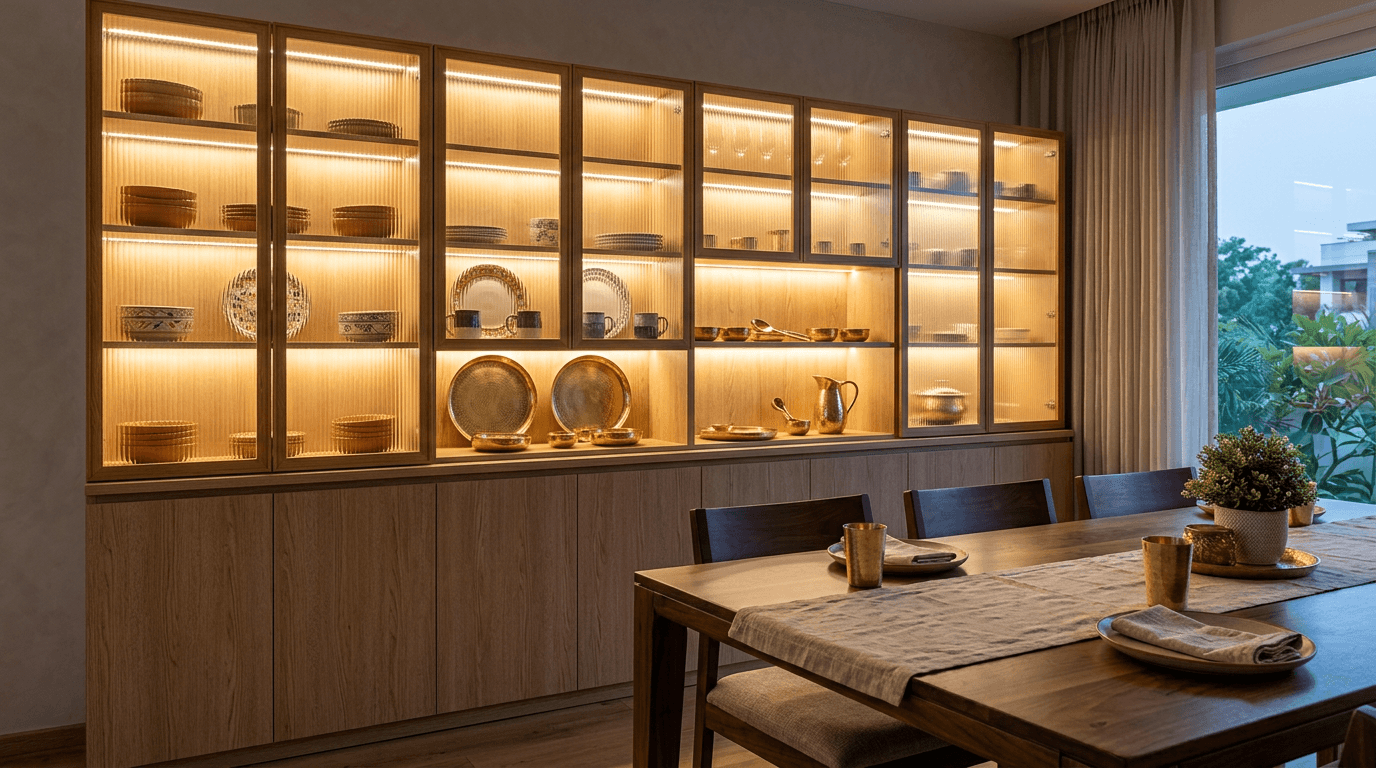
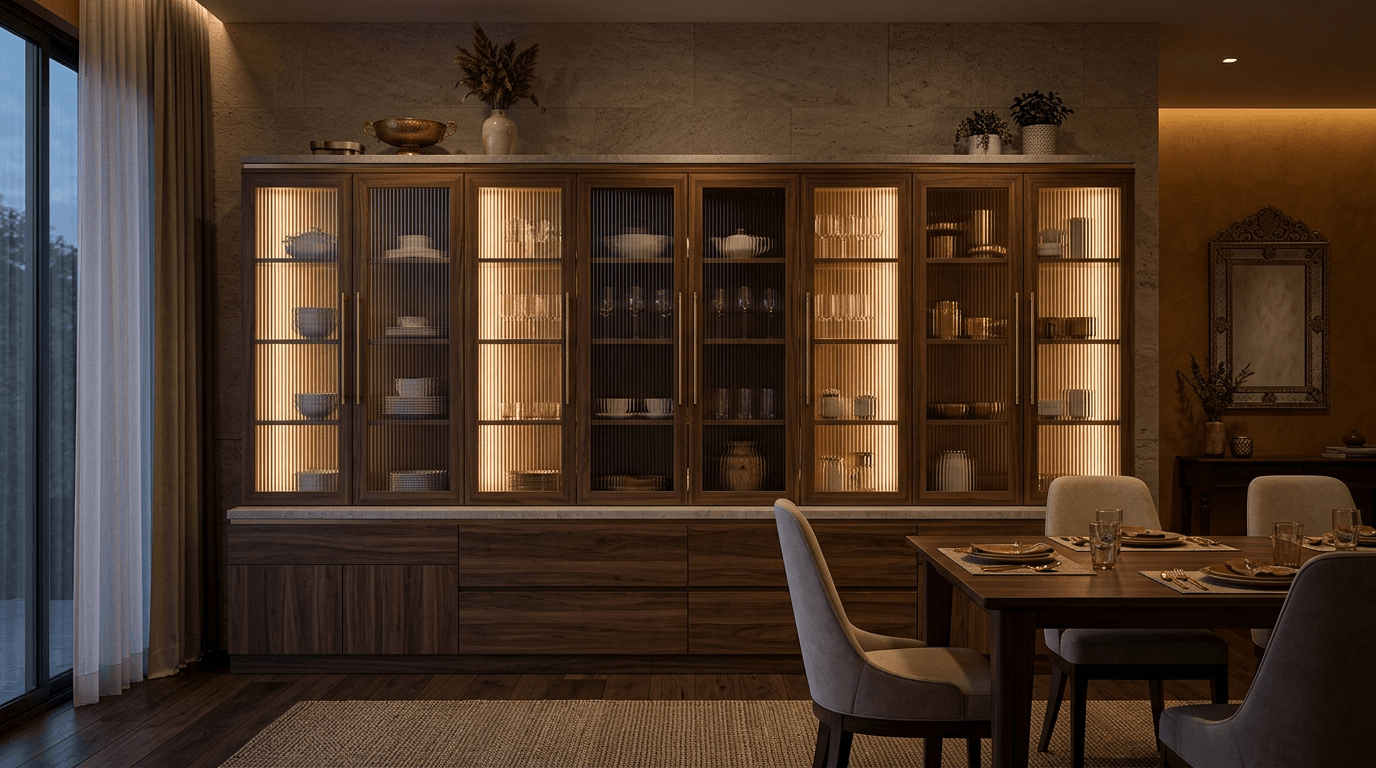
10. Fluted glass with warm LED strips. The current default: vertical fluting, 3000K LED strips inside, wood frame. Texture by day, lantern by night.
11. Clear-glass display cabinet. Museum treatment for genuinely good crockery — clear glass on all faces, glass shelves, one spotlight per shelf. Choose it only if you'll curate it.
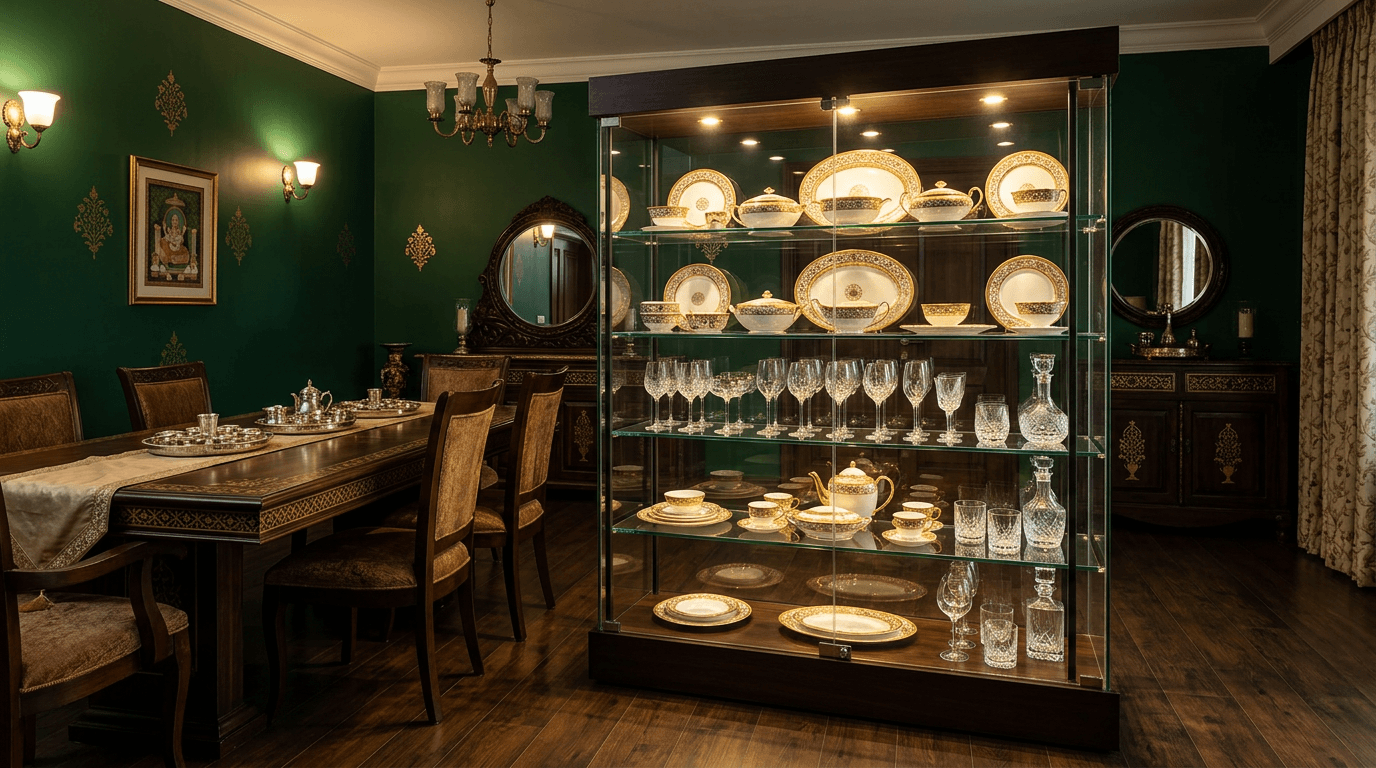
12. Glass-and-aluminium frame unit. Slim aluminium profiles with glass shutters — light, precise, durable. We used exactly this glass-with-aluminium-frame spec across the huge kitchen of a 4,000 sft My Home Bhooja apartment we designed for Dr. Kirti Goud, because it stays timeless and takes almost no maintenance in a rental.
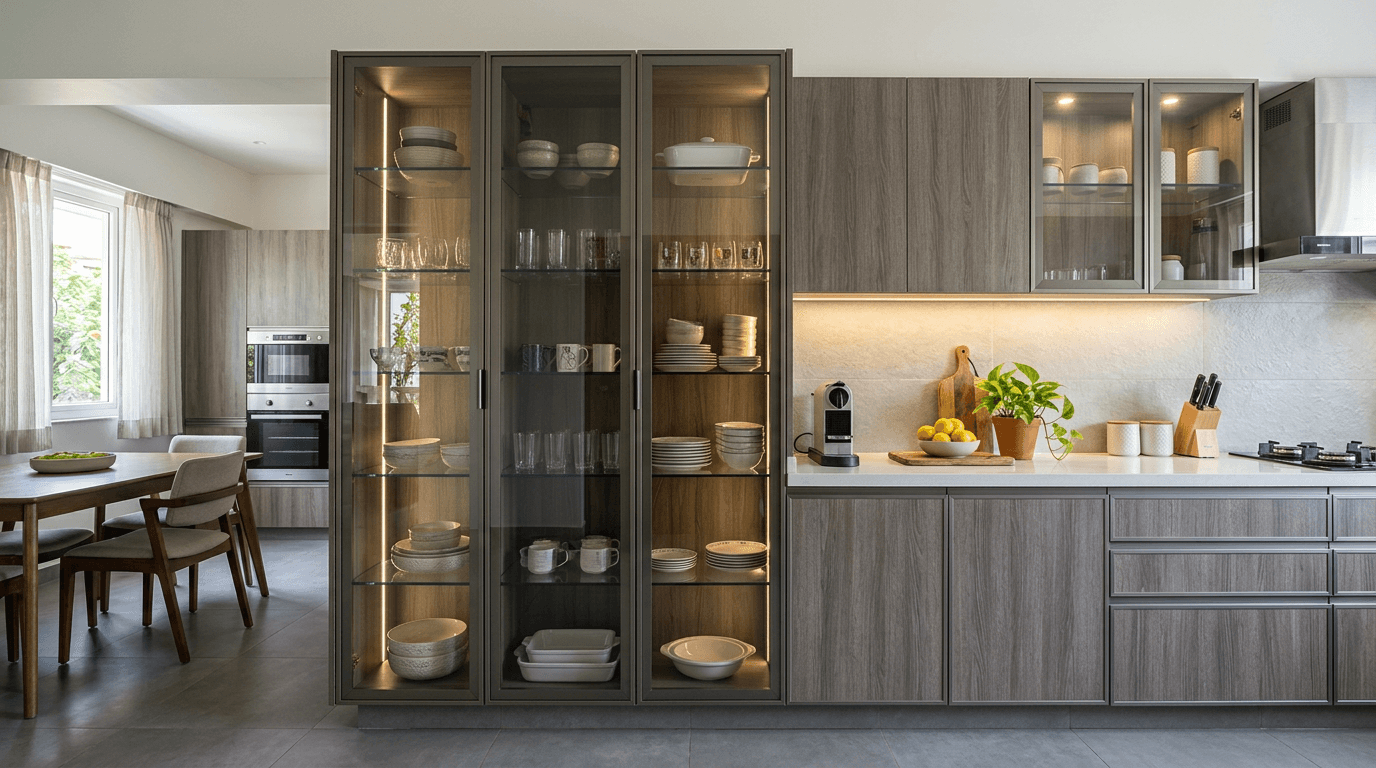
13. Smoked-glass evening unit. Grey or bronze tinted glass hides half of what plain glass would show, and looks its best after sunset next to a bar shelf.
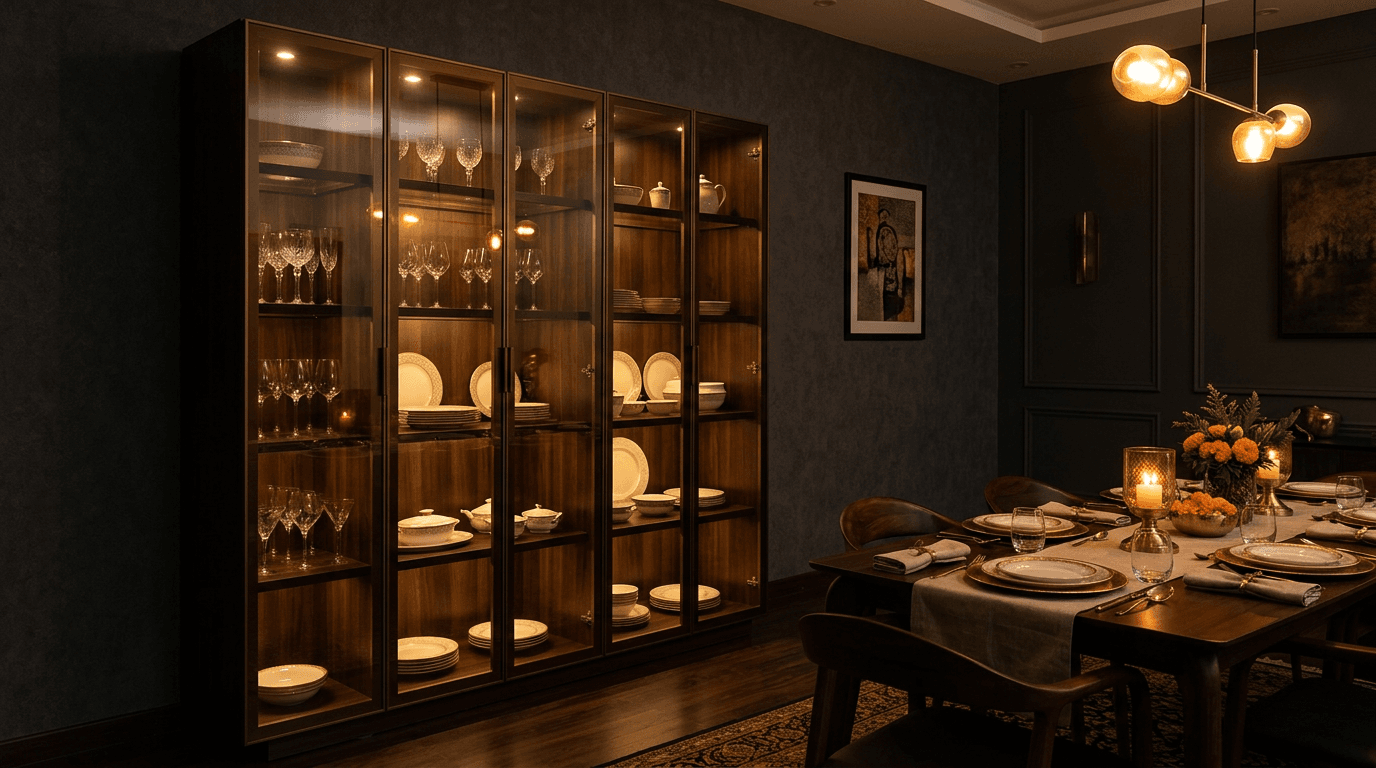
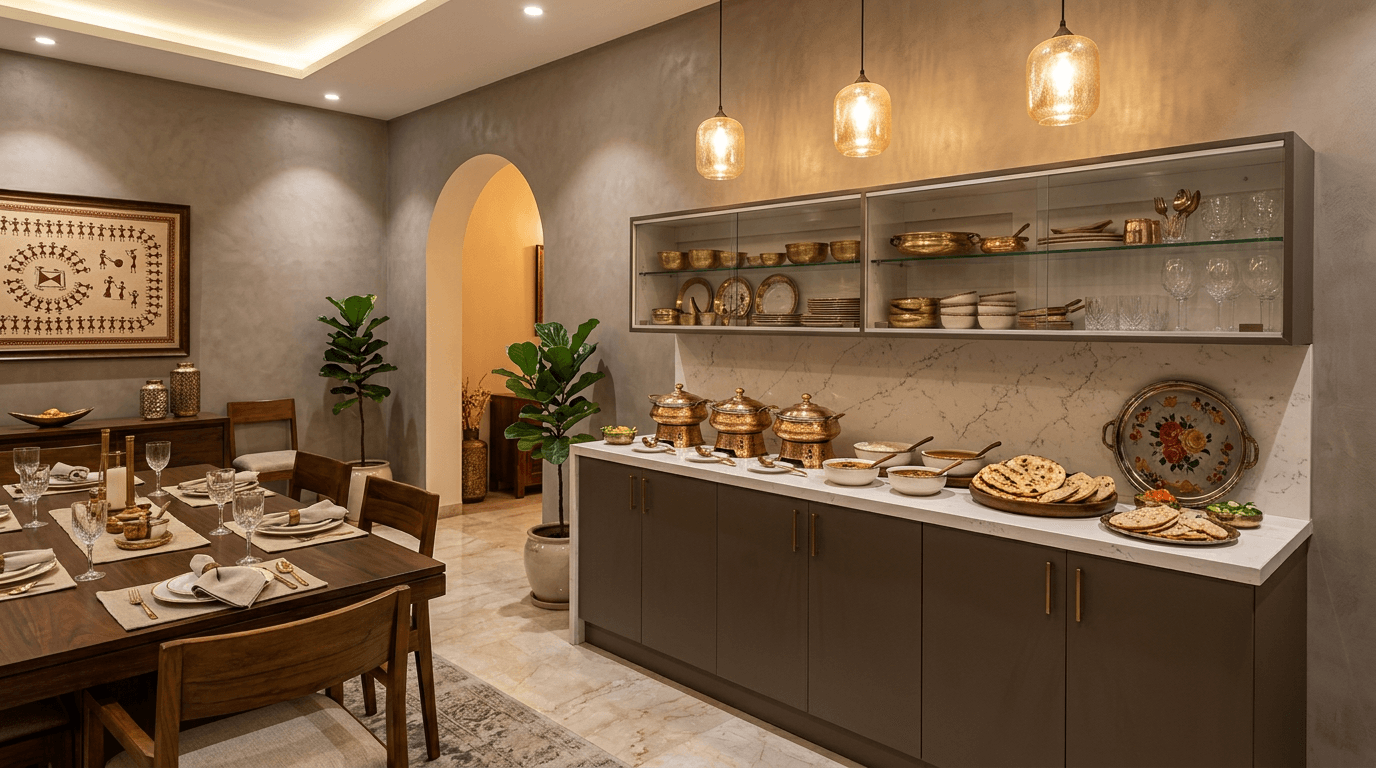
14. Stone-top glass buffet counter. Closed base, stone or quartz serving top, low glass display case above. The counter doubles as a serving station at parties.
Wooden Crockery Units, Crockery Almirah & Modern Cabinet Designs
Wood carries tradition, and the aesthetics age well. These six wood-built crockery units run from heritage almirah to mid-century sideboard, in solid wood, veneer, and engineered wood builds.
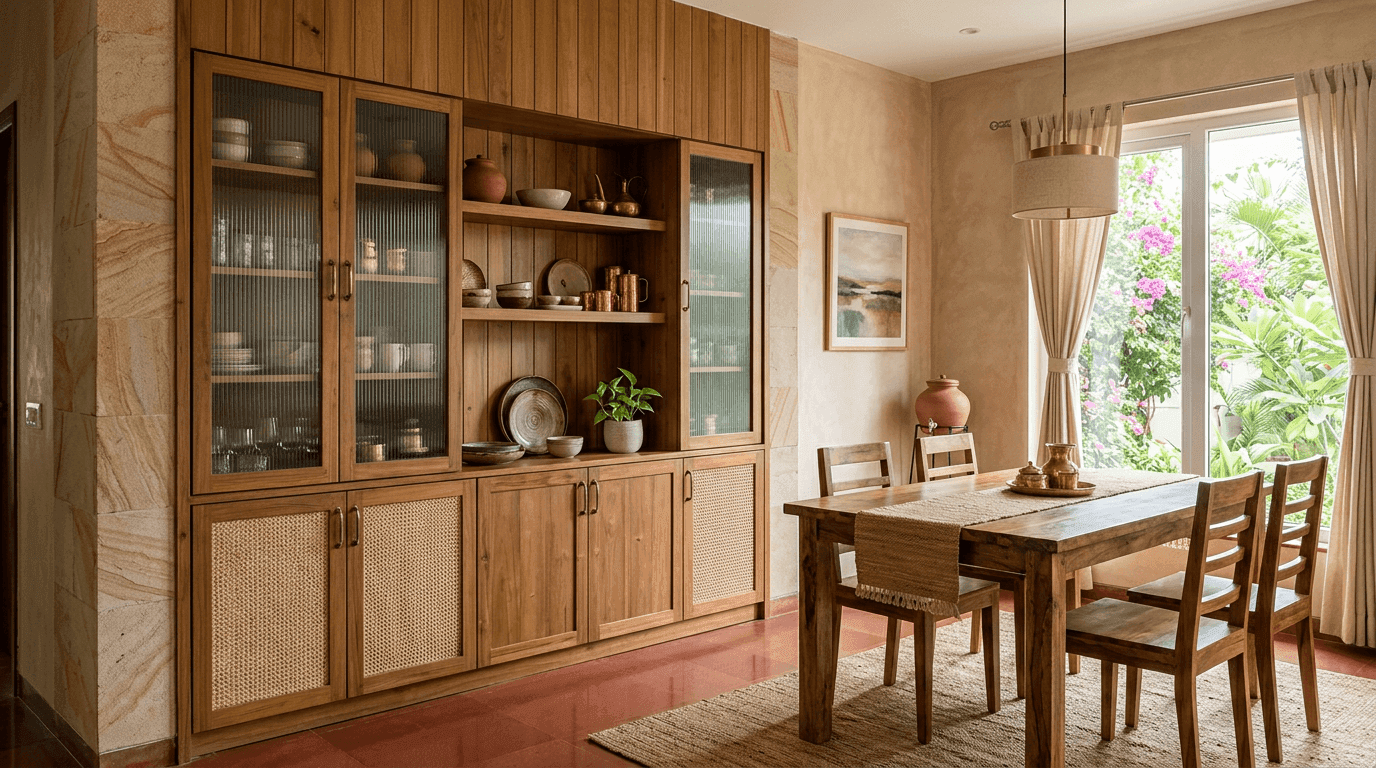
15. Solid-wood traditional almirah. The classic freestanding crockery almirah — solid or engineered wood, glass uppers, deep drawers. Freestanding units move with you when you shift homes, which built-ins never do.
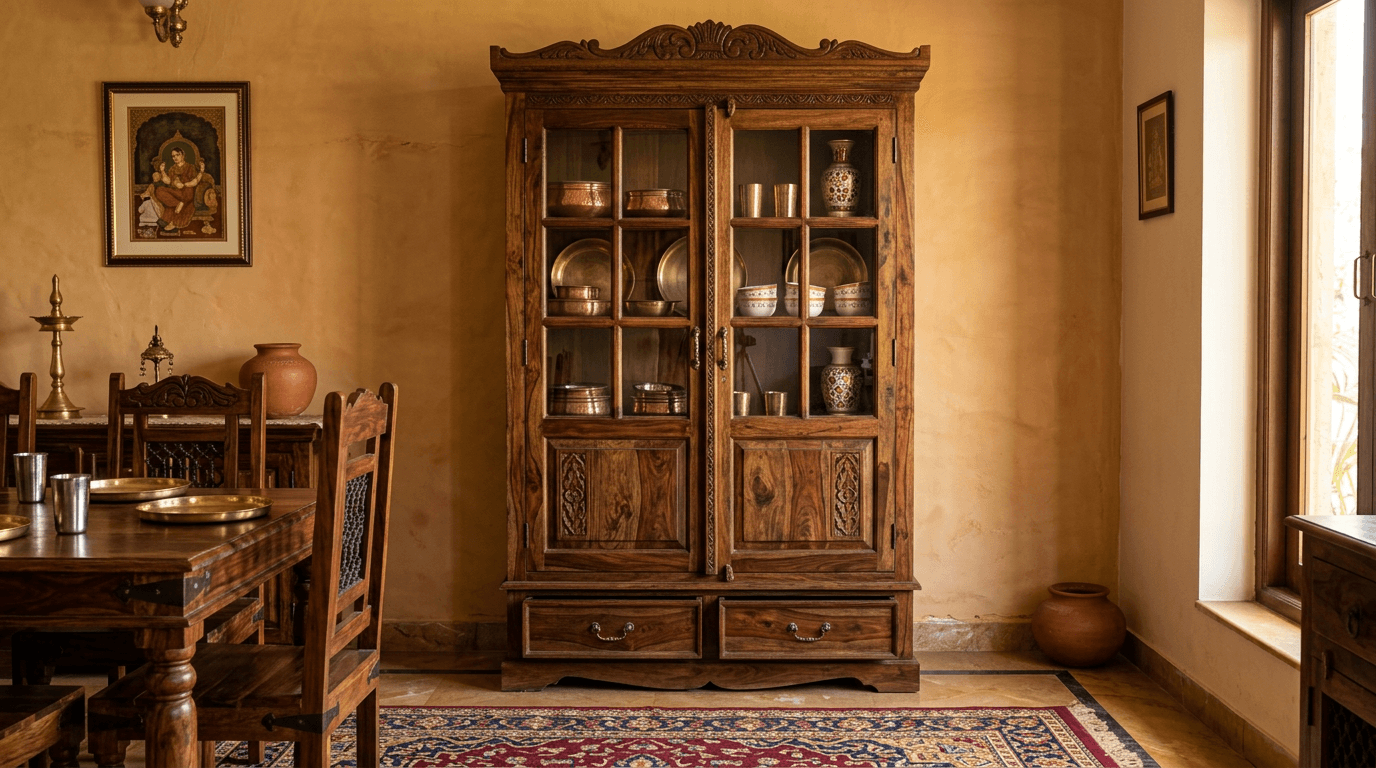
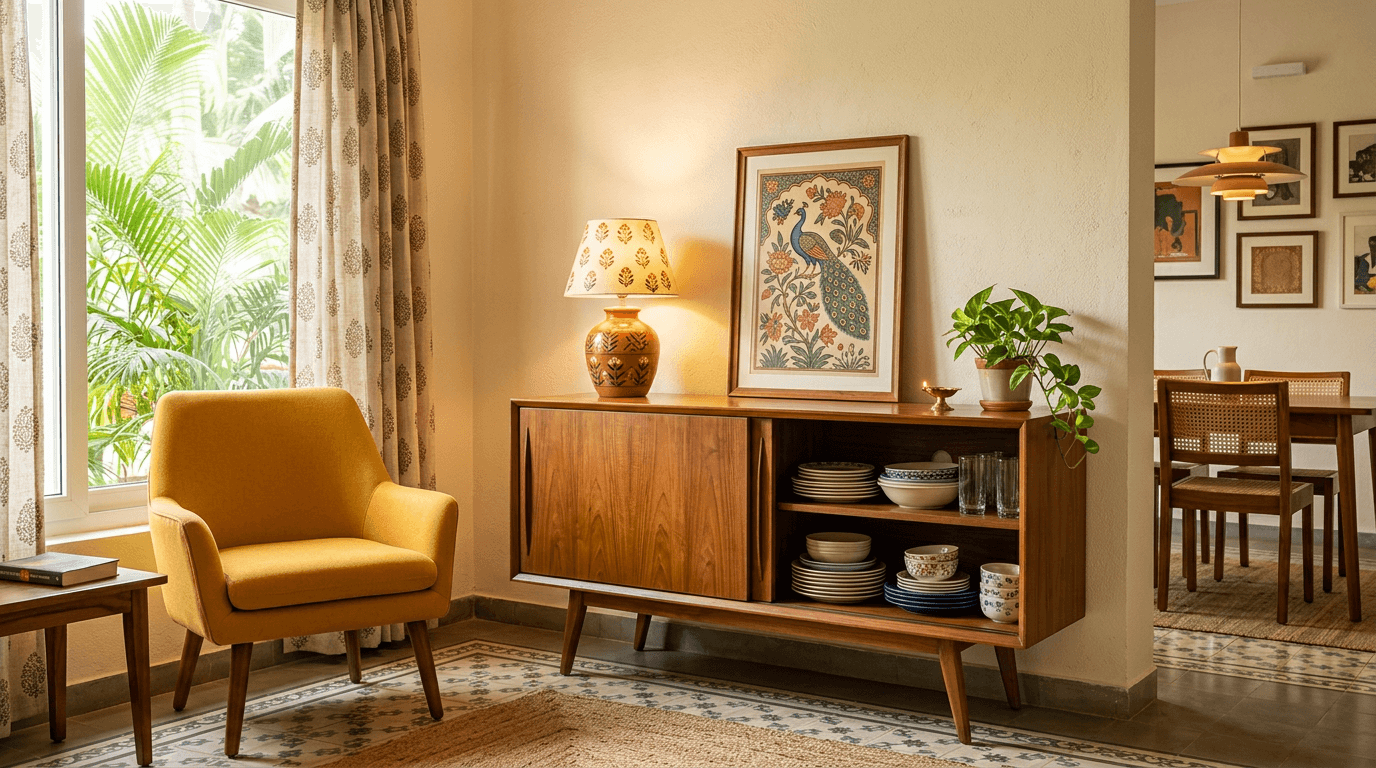
16. Mid-century sideboard on legs. Tapered legs, warm veneer, sliding doors. Air under the unit makes small dining rooms feel bigger than any floor-hugging cabinet will.
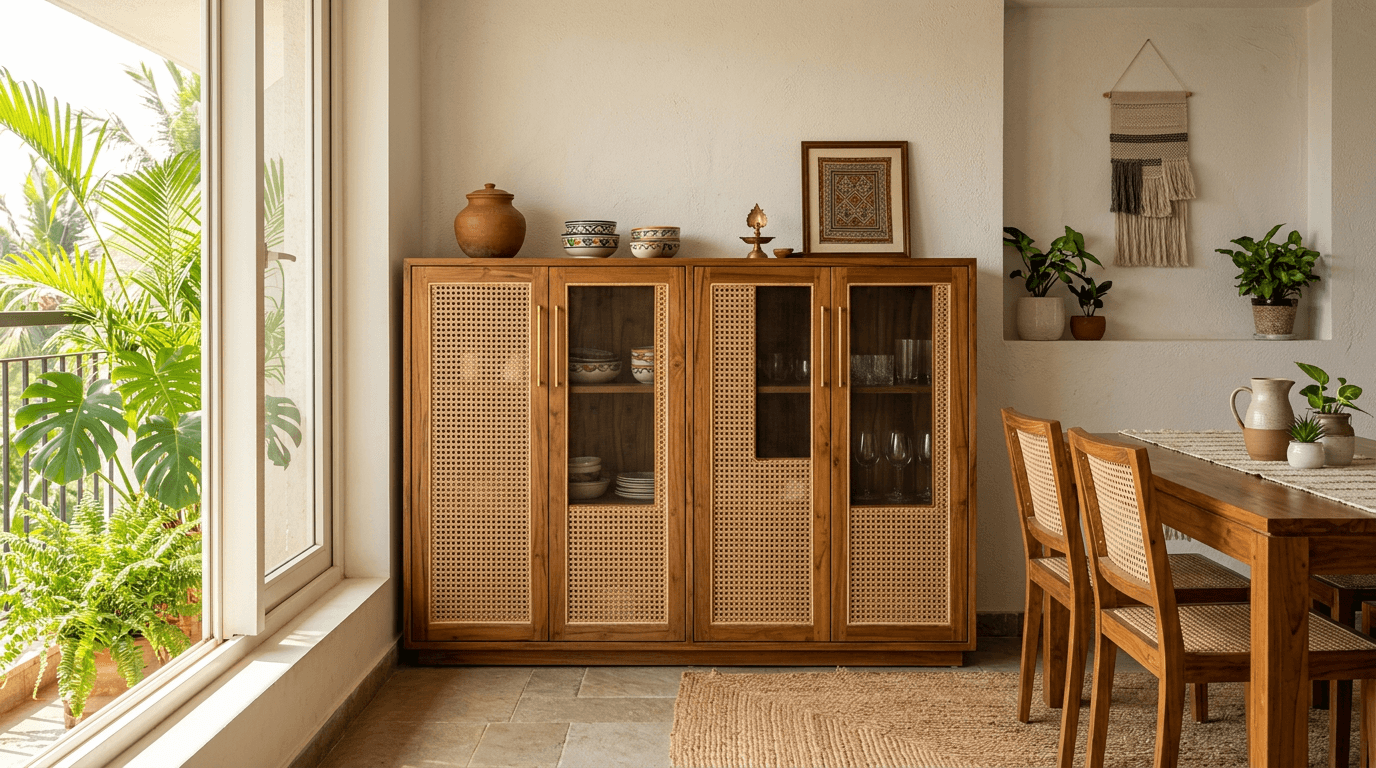
17. Cane-and-teak cabinet. Cane-webbing shutters ventilate naturally and screen contents without glass. Earthy, budget-friendly, very forgiving in Indian light.
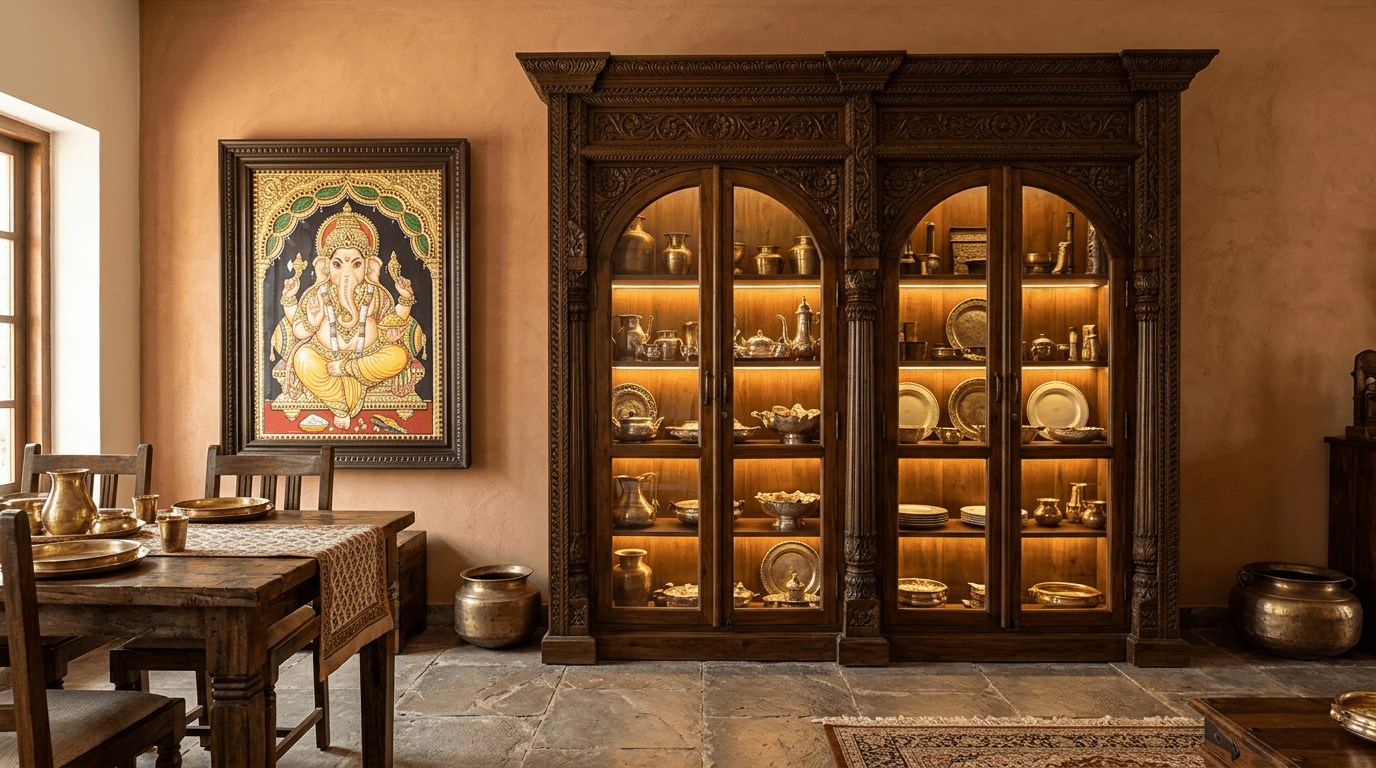
18. Carved heritage unit. Hand-carved detail on frame and cornice, modern lit interior. For homes holding inherited brassware, this is the honest frame for it.
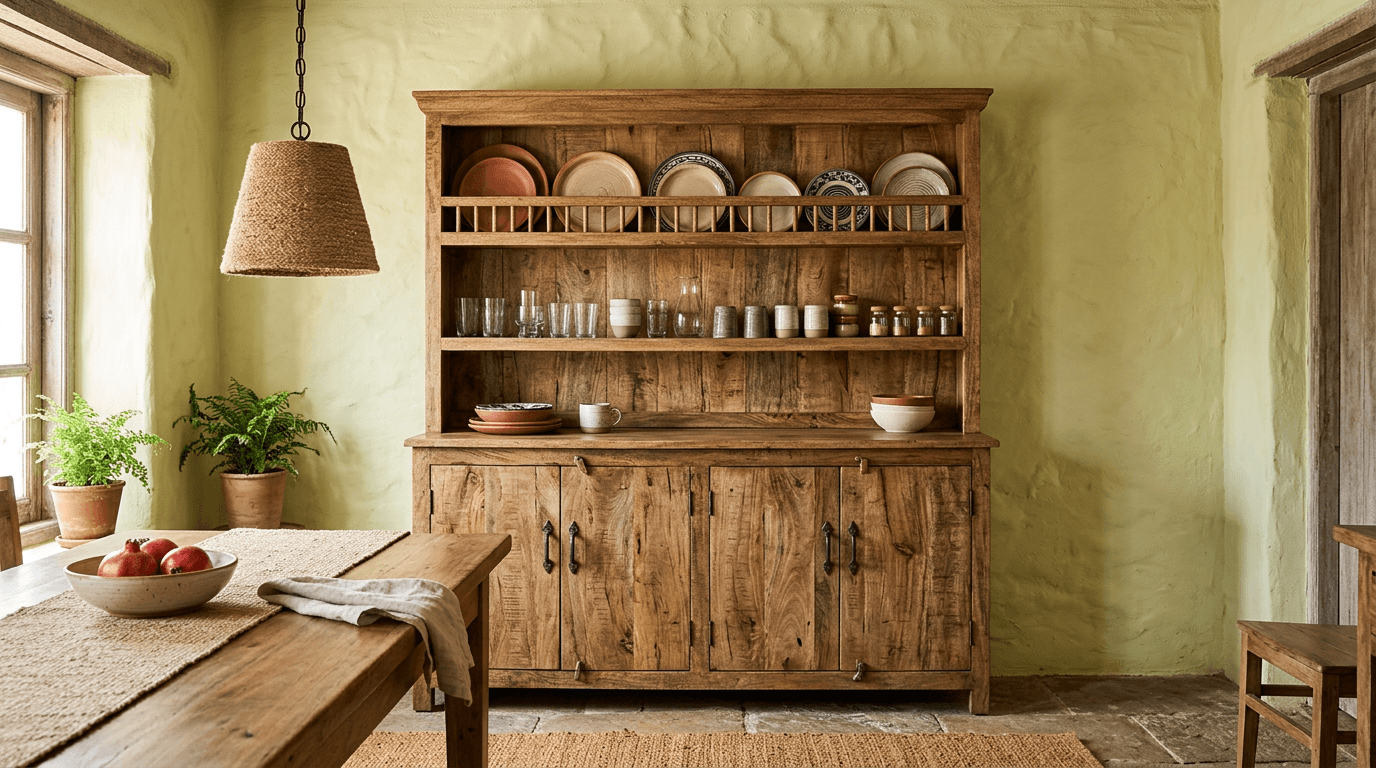
19. Rustic open hutch. Mango-wood open hutch with plate rails above closed doors. Farmhouse warmth; dust is the tax, so keep daily-use pieces on this open shelving.
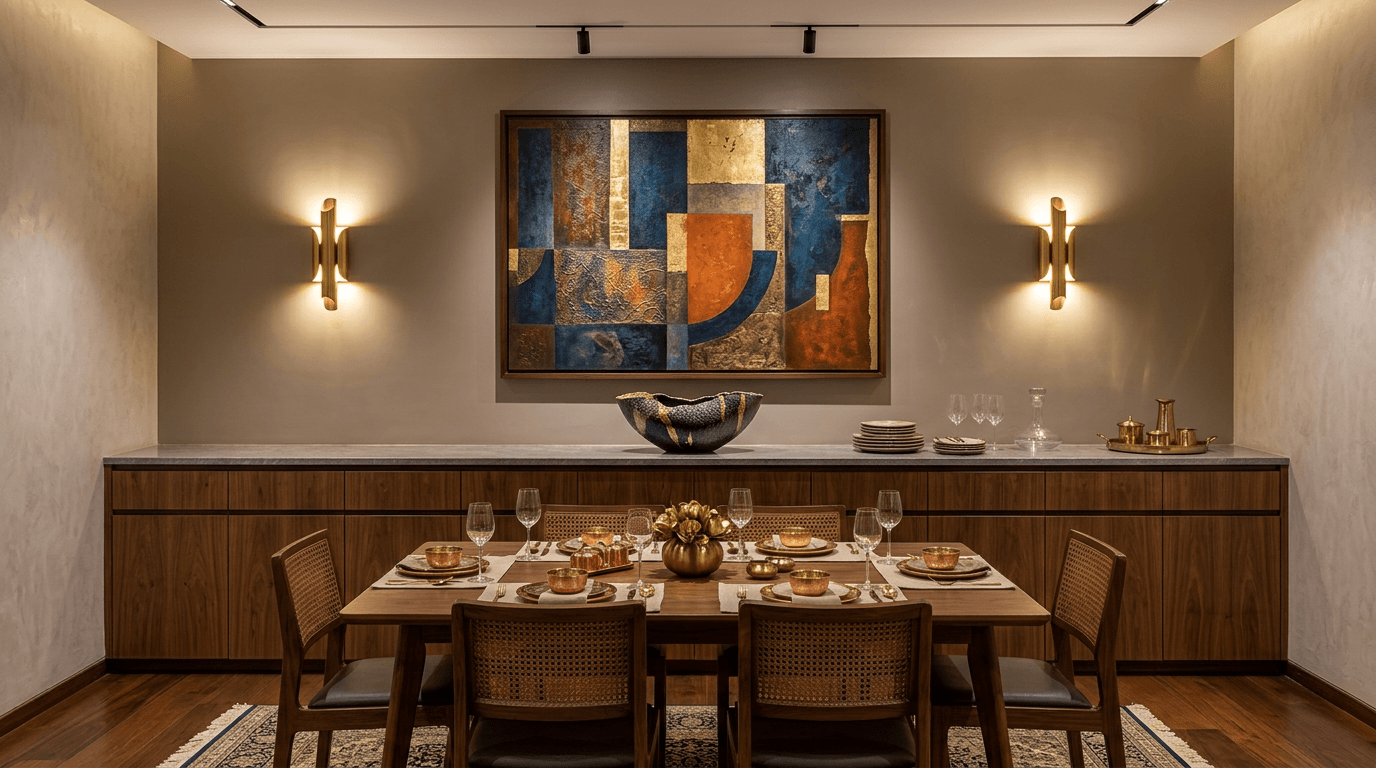
20. Walnut wall-to-wall buffet. A wooden crockery unit run the full width of the dining wall, low and architectural, art above. The most grown-up modern look per rupee in this section.
Wall-Mounted Crockery Unit & Space-Saving Designs
Compact homes still deserve display. A wall-mounted crockery unit frees floor space, keeps the living space visually open, and costs less than full-height joinery. Five space-saving solutions — including the spot most Indian homes waste entirely.
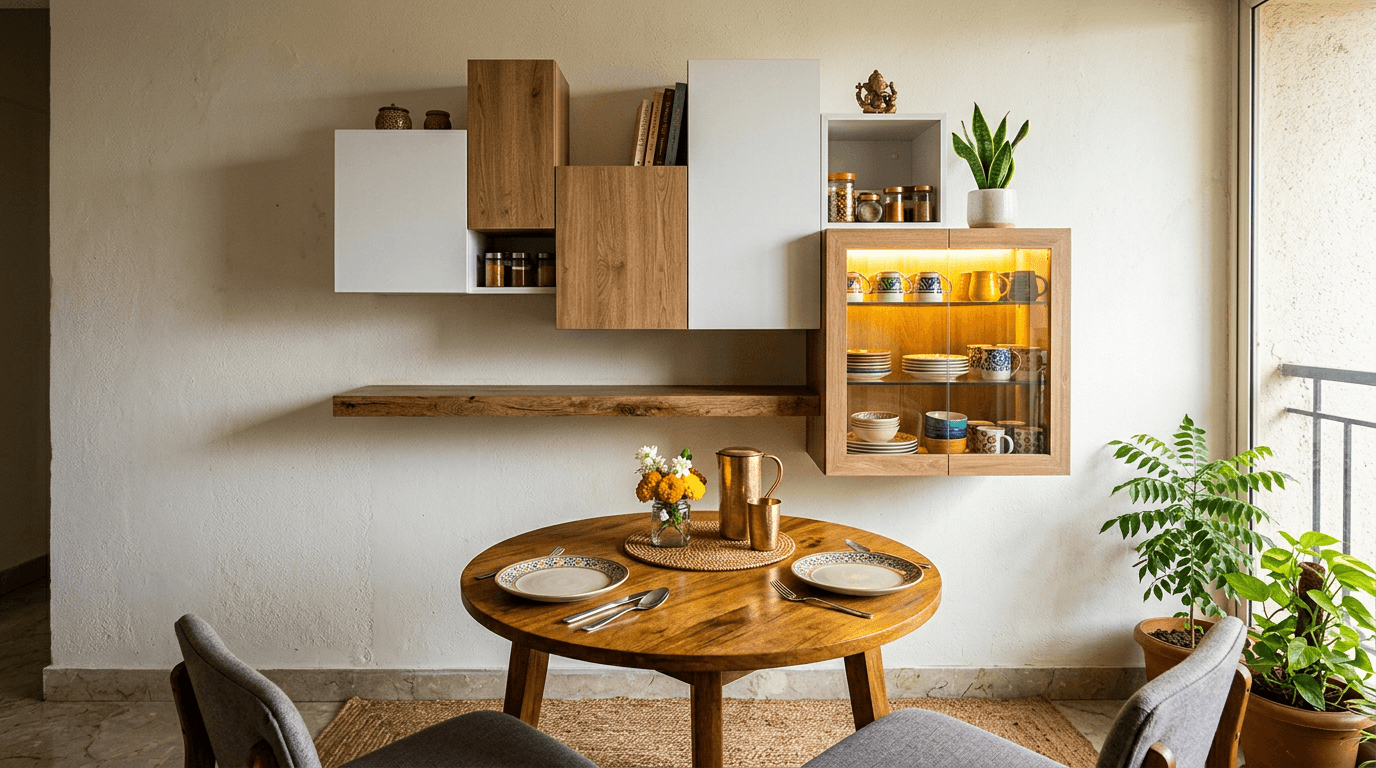
21. Wall-hung box composition. Staggered closed boxes and one glass box around a ledge. Storage where the floor plan has none.
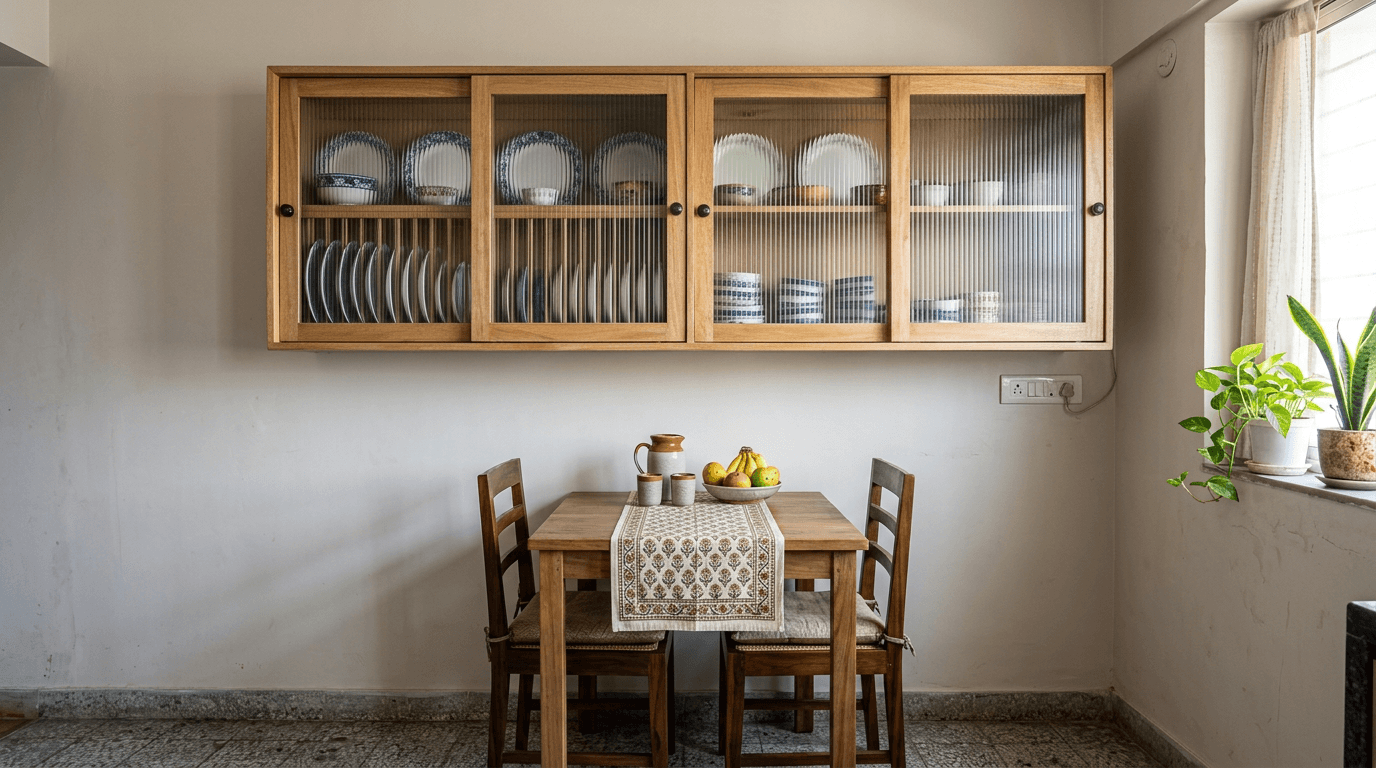
22. Slim rail unit for tight walls. A 10 to 12 inch deep wall-hung cabinet with sliding fluted-glass doors — plates stored on edge, not stacked deep. Sliding doors need no clearance from dining chairs, which makes this the simple crockery unit we recommend for a small house.
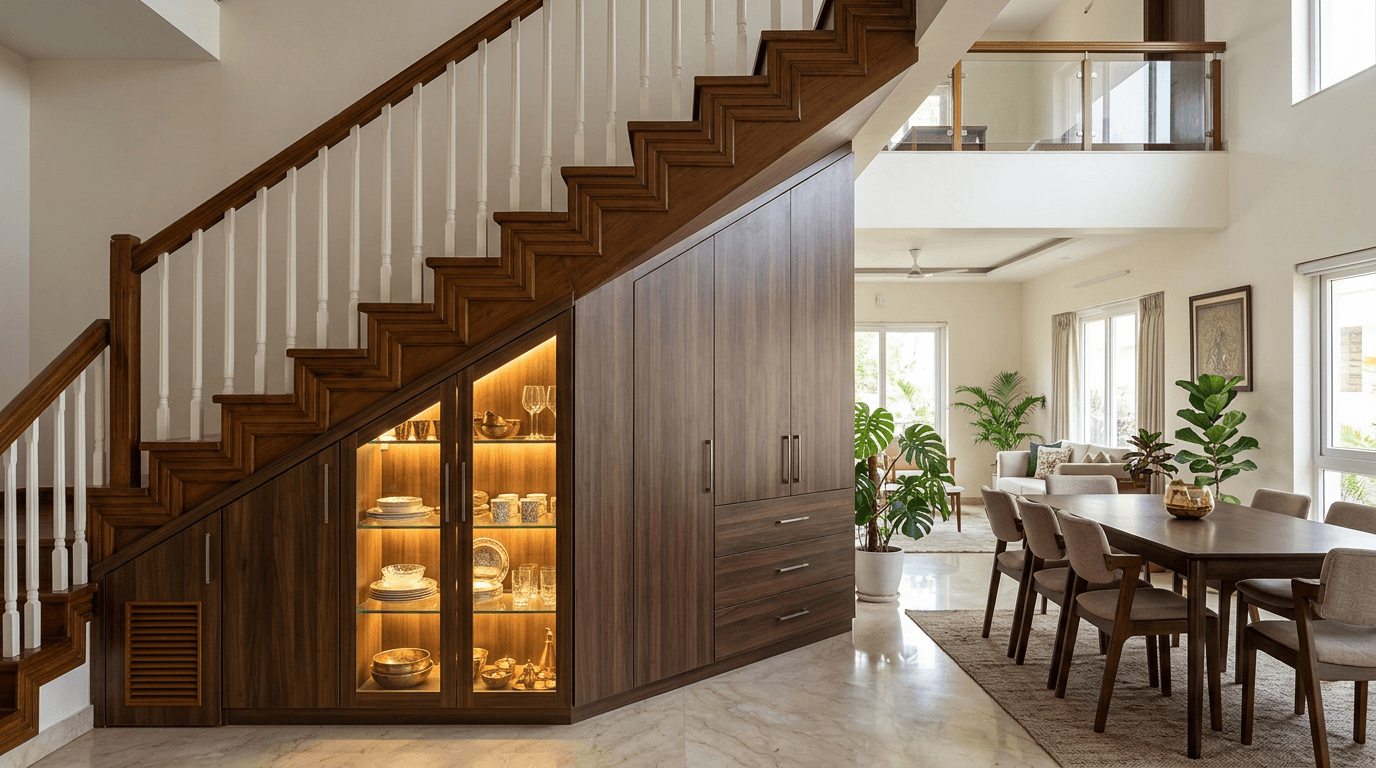
23. Under-staircase crockery unit. Dead space, solved. For Hamsini's three-storey Hyderabad joint-family home, we designed the crockery storage under the staircase — sharing the space with the inverter, which meant planning real ventilation into the joinery, not just shelves. If your dining area sits near a stair, this is free storage.
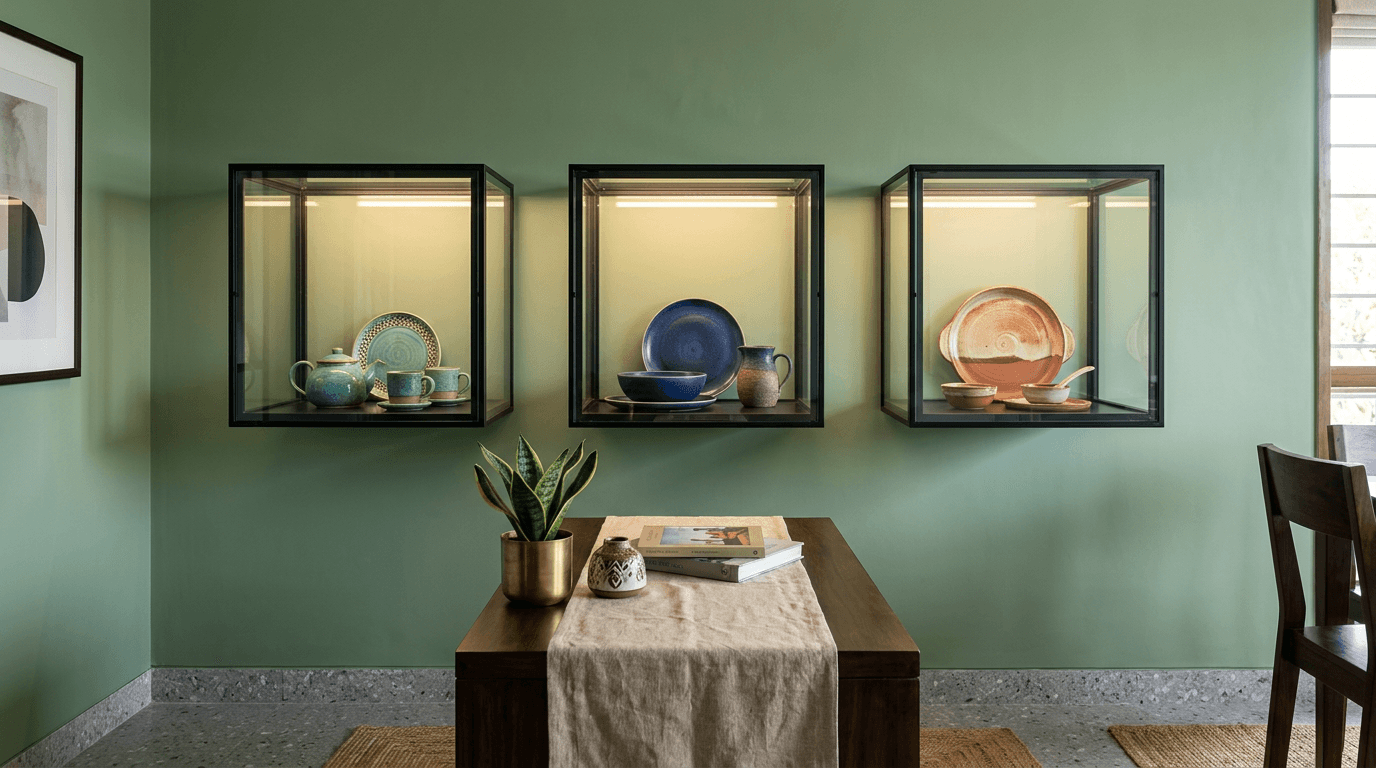
24. Glass box trio. Crockery units at their most modular: three identical wall-hung glass cubes in a row, each individually lit. Budget-flexible — start with one, add two later.
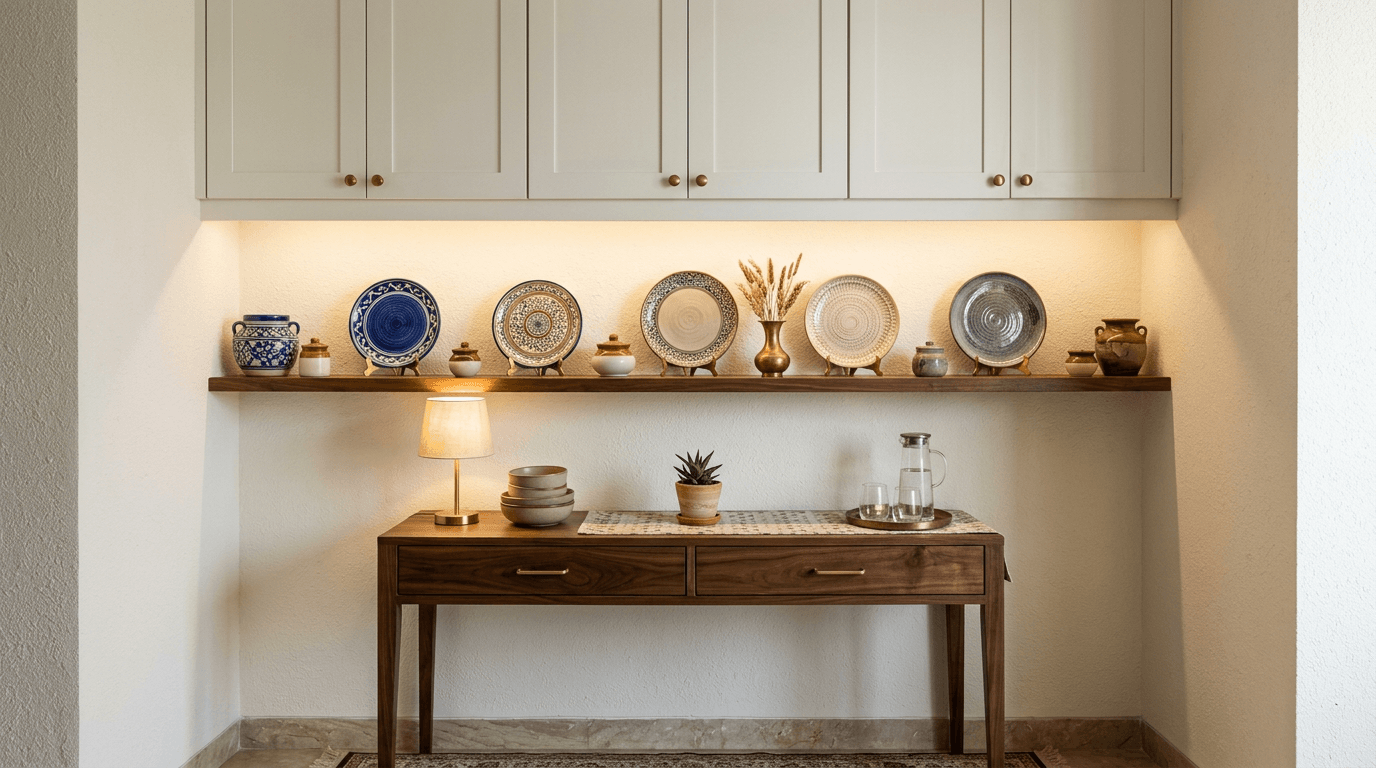
25. Ledge-and-cabinet over console. A closed wall cabinet above, long display ledge mid-height, slim console below — three layers of storage on one narrow wall. One of the best interior design ideas we know for rented homes, since only the wall pieces need drilling.
Kitchen Crockery Unit Design, Corner & Unique Crockery Units
The last five crockery units solve placement problems: the kitchen interior, corners, zone dividers, and the fully-closed brief.
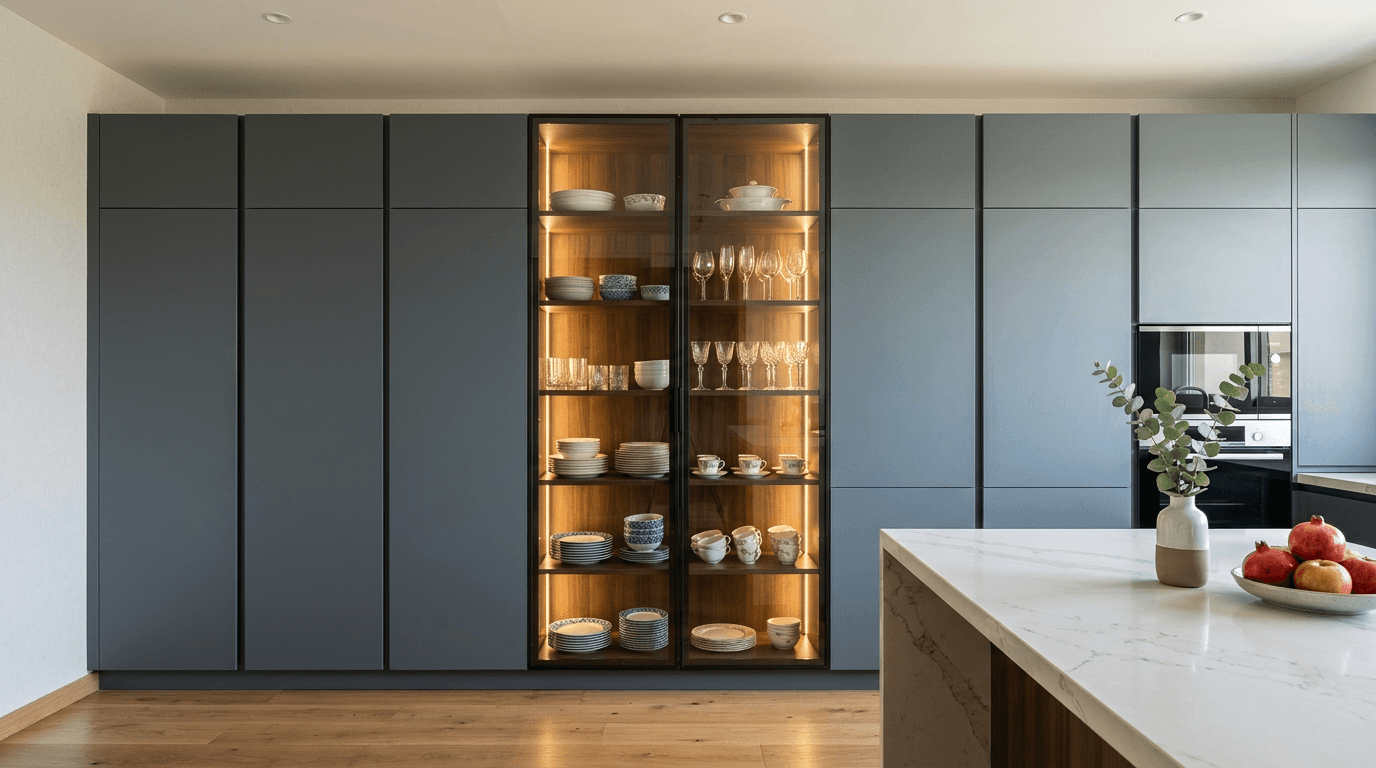
26. Kitchen crockery unit in tall units. A kitchen crockery unit design that folds display into the tall-unit line — one glass bay in the pantry run, lit like the dining pieces deserve. In most modern kitchen designs this costs less than a separate kitchen cabinet for crockery, because the carcass is already there.
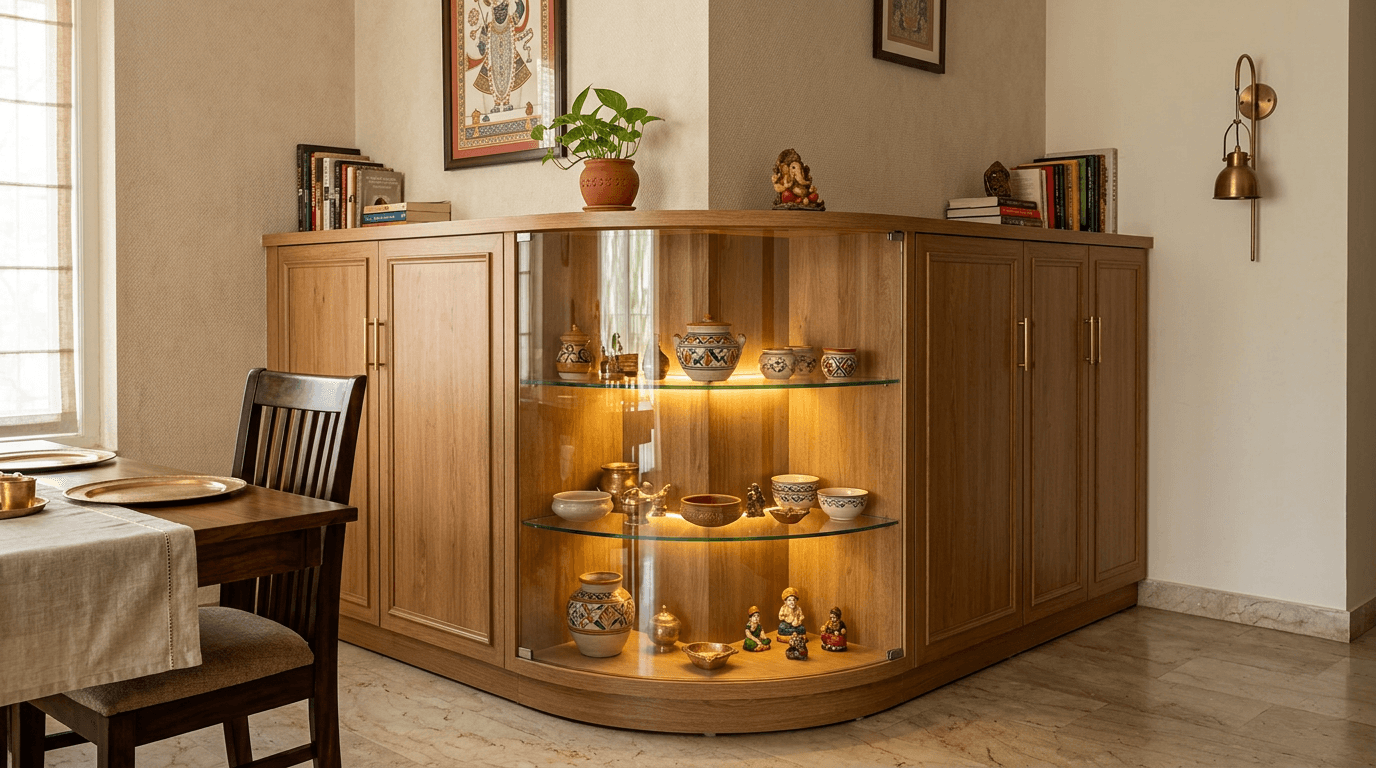
27. Corner crockery unit. An L-shaped corner crockery unit with a curved or angled glass face turns the dining room's dead corner into its display moment.
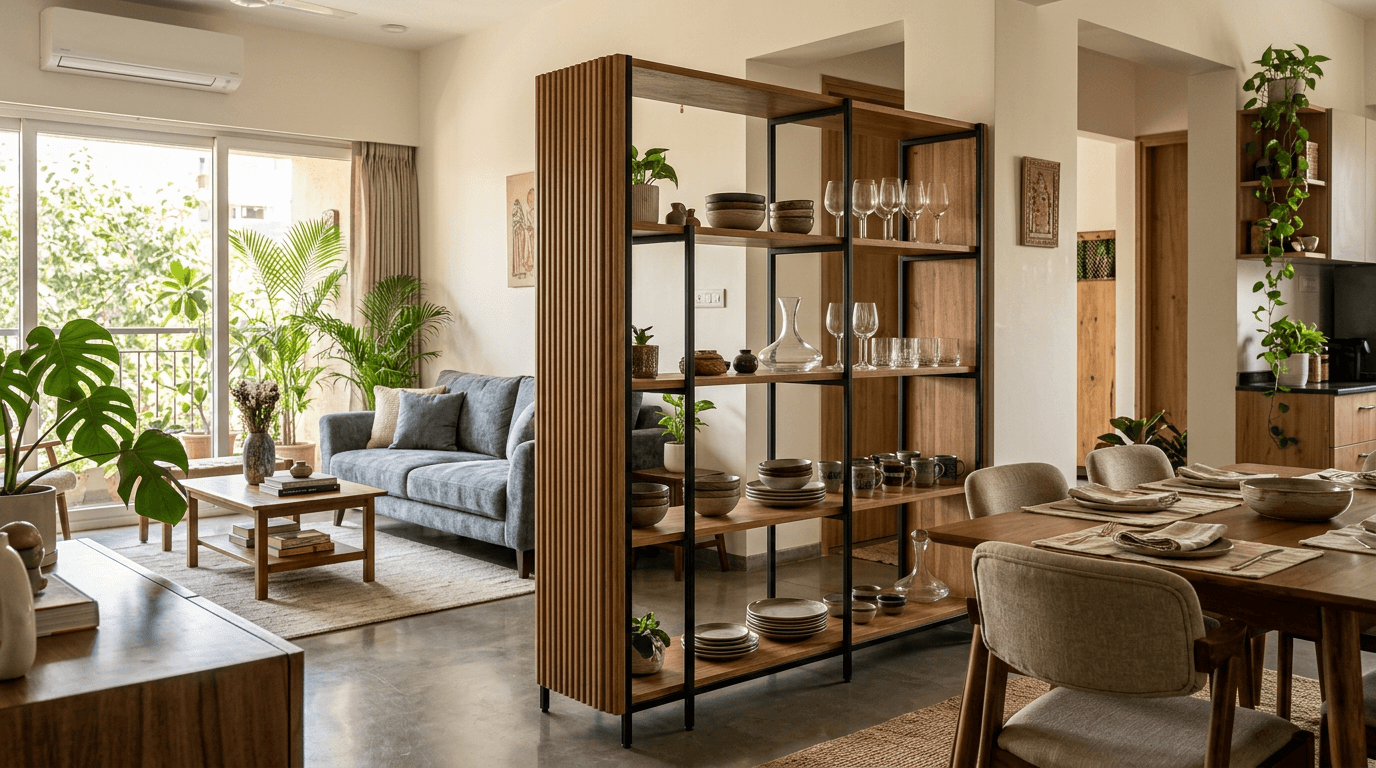
28. Open-shelf divider unit. A double-sided open-shelf unit standing between the living room and dining zones — crockery on the dining face, books and decor on the other, light passing through both.
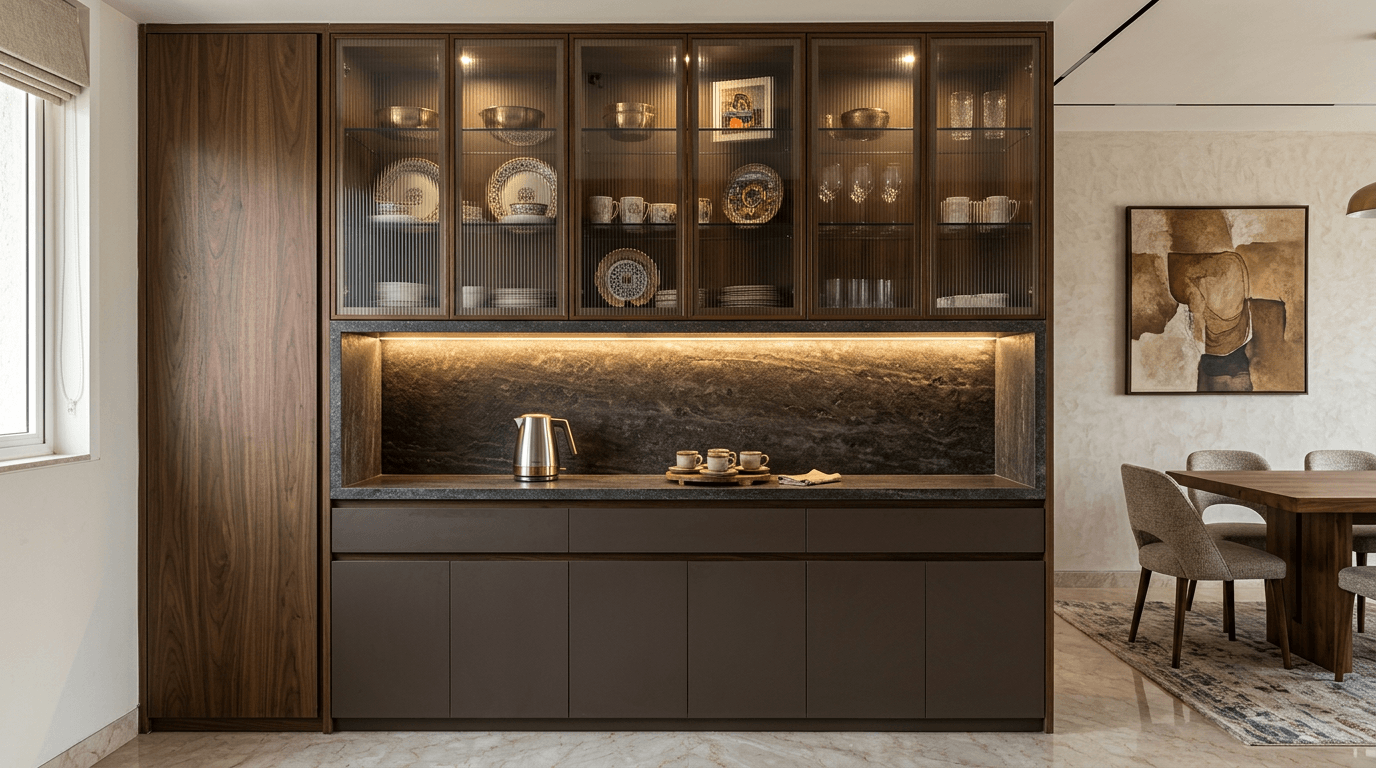
29. Crockery unit with serving counter. Display above, closed storage below, and a recessed counter between — kettle, coffee station, or party bar as needed. One unit, three storage solutions.
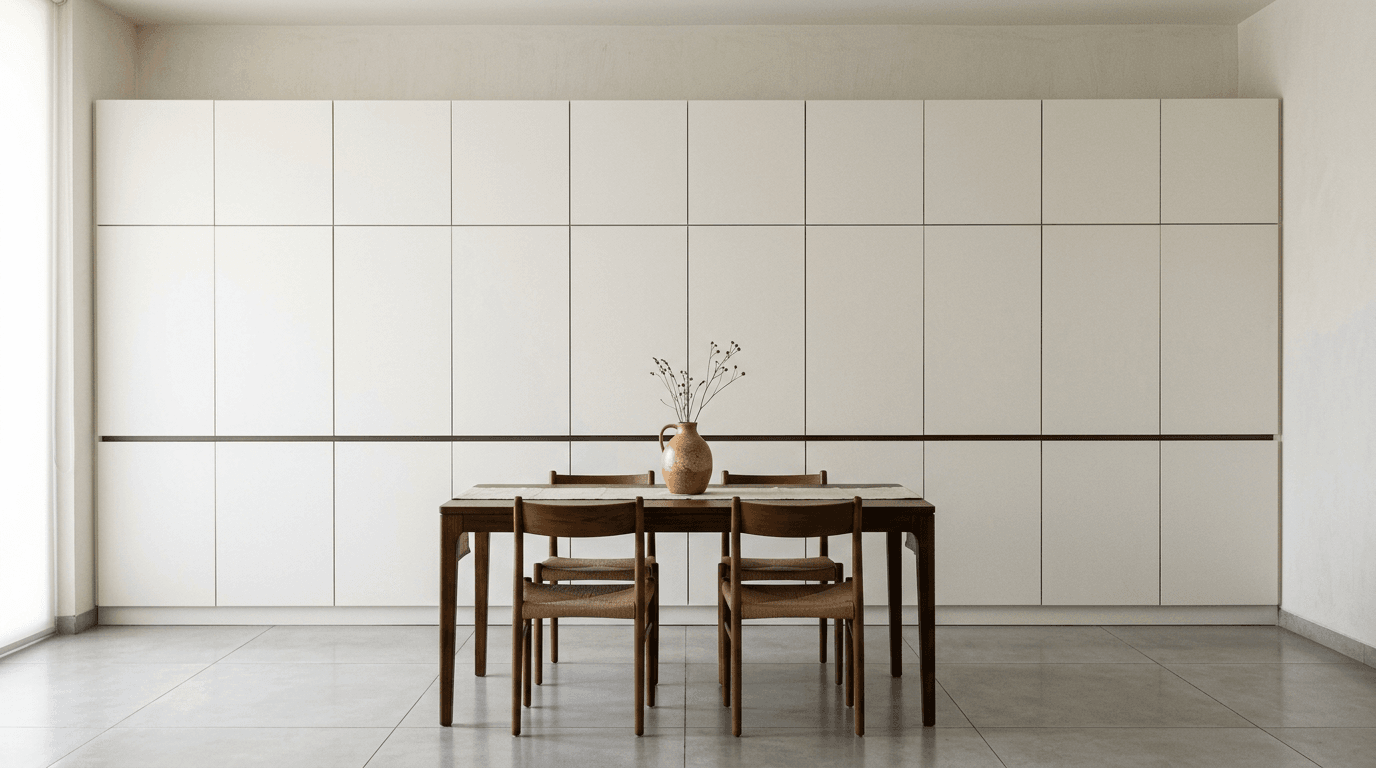
30. Fully closed, zero open shelves. The Manikantha brief: a clean, minimalist 3 BHK with zero open shelves and optimum storage. His crockery lives behind handleless shutters — the room stays calm, the cleaning stays light. A unique crockery unit only in its restraint; choose it if display feels like a chore rather than a pleasure.
Trendy Modern Crockery Cabinet Designs & Ideas in 2026
The design trends we're actually specifying in crockery units — not just pinning — for modern homes this year:
- Fluted-glass shutters with warm LED lighting: texture by day, soft lantern glow by night.
- Closed-heavy compositions: more shutters, fewer exposed shelves, calmer dining rooms.
- Aluminium-framed glass cabinets: slim profiles, precise lines, low maintenance.
- Cane and reeded wood fronts: ventilated, earthy, camera-friendly.
- Integrated serving counters: crockery storage that moonlights as a coffee or party station.
The trendy modern design direction in one line: warmer wood, softer glass, less on show.
Materials and Finishes for Crockery Cabinet Design
| Unit Type | Best For | Key Material | Average Depth |
|---|---|---|---|
| Wall-mounted unit | Compact apartments | BWR plywood + tempered glass | 12–14 inches |
| Floor sideboard | Formal dining rooms | Solid wood / veneer | 18–20 inches |
| Full-height fitted unit | Maximum storage | BWR plywood / HDF, laminate or acrylic | 18–22 inches |
For carcass work we specify BWR (boiling water resistant) plywood or HDF in dining spaces — kitchens and dining walls see steam and spills that ordinary particle board won't survive. Display panels should be tempered glass, always: it's several times stronger than annealed glass and crumbles instead of shattering into shards. Fluted and frosted versions add clutter-forgiveness. Finishes run laminate (toughest, widest range), veneer (real wood warmth, needs polish care), and acrylic (high gloss, shows fingerprints); most crockery cabinets mix two of them. Whatever you pick, keep the materials and finishes of the crockery unit in the same family as the rest of the room's interior — a lone high-gloss cabinet in a matte-wood room always looks bought, never designed.
Size & Layout Guidelines for Indian Homes
These numbers hold for most crockery units we build:
- Depth: 12 to 15 inches wall-hung; 18 to 22 inches floor-standing.
- Clearance: keep at least 3 feet between the unit and the dining table edge so chairs and shutters never fight.
- Height: keep the display band between 30 and 60 inches from the floor — that's where eyes actually rest.
- Placement: the wall facing or beside the dining table, never behind the main seating side. Avoid walls that take direct hard sunlight; it fades veneer and heats glassware.
- Wall-hung safety: anchor into brick or a plywood backer with heavy-duty fasteners, never into hollow partition board alone.
What Drives Crockery Unit Costs in Modern Homes
We don't publish rate cards — pricing genuinely depends on your city, sizes, and spec. But the cost levers are the same everywhere:
- Size and built-in vs freestanding. A full-height built-in costs multiples of a freestanding sideboard.
- Carcass and finish. BWR plywood over particle board, veneer over laminate — each step up is real money.
- Glass work. Tempered, fluted, or smoked glass costs more than plain float glass, and it's the one place we tell clients not to economise.
- Hardware. Soft-close hinges and drawer runners are the difference between a cabinet that feels premium for a decade and one that rattles in a year.
- Lighting. Internal LED strips with a driver and switch loop add wiring cost — plan them before the wall is finished, not after.
Get a project-specific estimate on a consultation call rather than trusting a generic per-foot number.
Interior Design Mistakes to Avoid
- Buying before measuring the chair-pull zone. Shutters and dining chairs collide in more homes than you'd think.
- All display, no storage. An open unit full of mismatched steel looks worse than a closed one. Decoration ideas fail without storage discipline.
- Ordinary glass. Untempered glass in a home with kids is a genuine hazard.
- Skipping ventilation. Closed units near inverters, or holding warm appliances, need airflow — we learned to plan grilles into the joinery at Hamsini's under-stair unit.
- Lighting as an afterthought. Concealed wiring must go in before panelling. Retrofitting means visible cords forever.
Maintenance Tips for Crockery Cabinets
Wipe glass weekly with a dry microfibre cloth; monthly with glass cleaner sprayed on the cloth, not the panel — spray seeps into laminate edges. Vacuum cane fronts gently. Re-polish veneer yearly. Storing crockery you actually use at the 30-to-60-inch band saves your back and keeps the styling honest. And once a season, empty a shelf, cull what you never use, and restyle — a crockery unit earns its wall only when it's curated.
