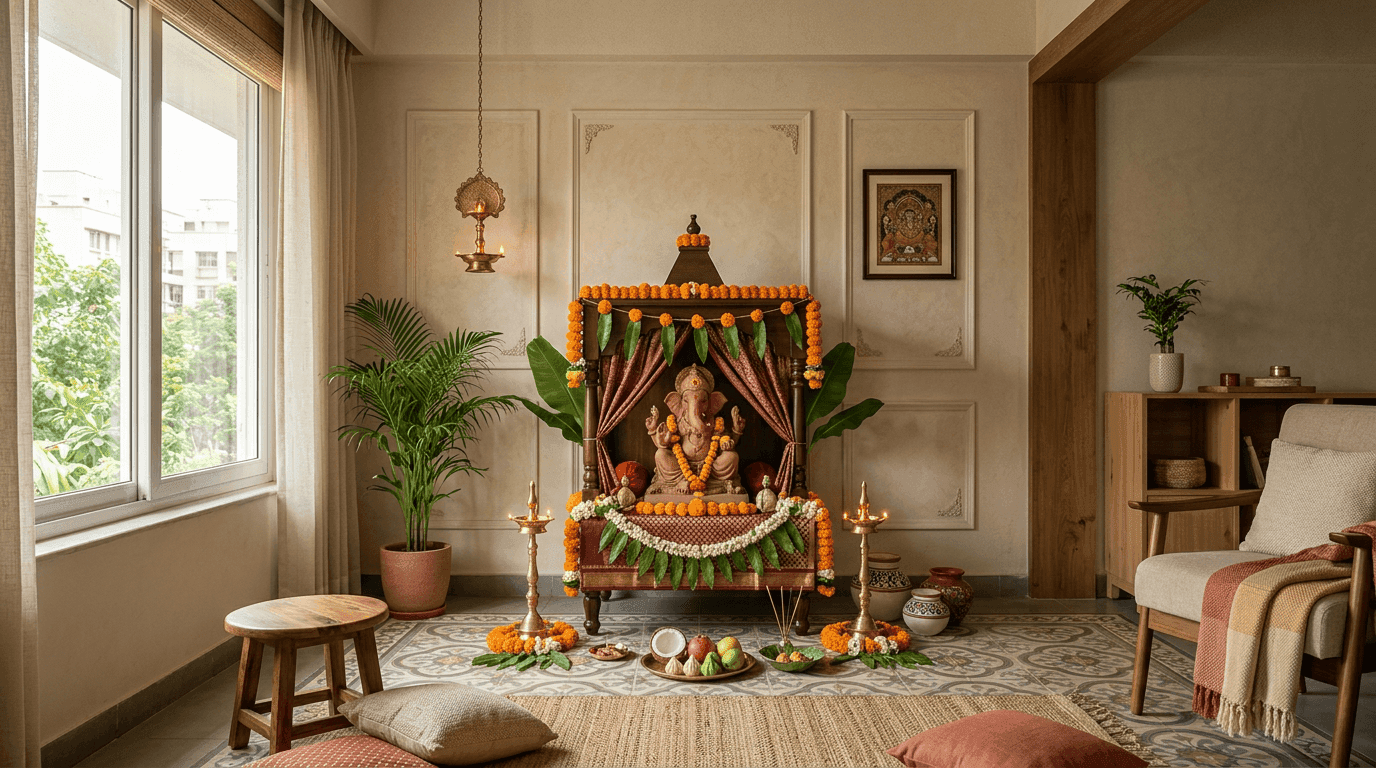
Key Takeaways
- Ganesh Chaturthi falls on Monday, 14 September 2026, with visarjan on Friday, 25 September. Most families start building their Ganpati decorations two to three weeks before.
- The best Ganpati decoration works backwards from one thing: the wall behind the murti. Fix that, and everything else is trim.
- Most Ganpati decorations at home fail the same way — too many competing ideas in one corner, and no single dominant colour.
- Sustainable is now the default, not the alternative. Cardboard, cotton, cane, clay and paper do everything thermocol did, and they leave with the visarjan.
- Compact flats don't need small ideas. A 600 sft apartment can carry a stunning setup if it goes vertical instead of wide.
- Whatever you build, plan the takedown on day one. Ten days later you'll be grateful.
What Makes a Good Ganpati Decoration at Home?
A good Ganpati decoration frames the idol without competing with it. It uses one dominant material — fabric, flowers, wood, or paper — as the background, keeps the Ganesha at seated eye level on a raised platform, lights it warmly from the front, and can be fully dismantled after visarjan without damaging the wall or leaving plastic waste behind.
That's the short version. The longer version is that most Ganpati decorations at home fail for the same reason: too many ideas in one corner, in too many colours. A saree backdrop, plus a flower arch, plus a light curtain, plus a floor pattern, plus a printed banner. Each is fine. Together they turn into noise, and the Ganesha disappears into it.
At Roomantic we design and build homes across Hyderabad and six other regions, and the pooja corner comes up in almost every residential brief. In one project — a luxury single-storey home for the Mettu Prashanth Reddy family on a 320 sq yard plot — the whole ground floor plan was organised around keeping the family's hereditary temple intact. That's the permanent end of the spectrum. The seasonal setup you build for ten days follows exactly the same logic at 1/50th the scale: decide where the sacred thing sits, then design outward.
Celebrating Ganesh Chaturthi in 2026: Your Decoration Timeline
Ganesh Chaturthi begins on Monday, 14 September 2026, and the festival runs to visarjan on Friday, 25 September. Not every family keeps all ten days — 1.5-day, 3-day, 5-day and 7-day observances are common, and the length of your Ganpati celebration should decide how much you build. A 1.5-day Ganesh Chaturthi celebration does not need a built mandap; ten days of hosting probably does.
A working timeline for the Ganpati festival:
- Four weeks out. Decide the corner of your home and the theme. Order the murti now if you want a hand-finished clay one.
- Two weeks out. Buy or build the structure — background panel, chowki, lighting. This is the only part that needs real time.
- Three days out. Dry-assemble everything once. Something will not fit; better to find out now.
- The morning of 14 September. Flowers, floor art, and the sthapana puja. The auspicious madhyahna muhurat for installing Ganpati Bappa falls late morning to early afternoon; check your local panchang for the exact window in your city.
- Visarjan day. Take the setup down the same evening.
However you celebrate Ganesh Chaturthi, the setup should serve the rituals rather than the other way round. A Ganpati home during these days is a busy one — people sit on the floor, plates move in and out, children run past. Decorate around that, not against it.
If you only have a weekend to decorate your home before the festival, skip the built structure entirely and put everything into fabric, flowers and light. Nobody has ever walked into a home and thought the celebration needed more plywood.
How to Create a Simple Eco-Friendly Ganpati Setup at Home
Five steps. Nothing here needs a carpenter.
- Prepare a raised platform. Use a wooden chowki, a low stool, or a sturdy side table. Cover it with a clean cotton cloth. The murti should sit at the eye level of someone seated on the floor.
- Set up a fabric background. Hang a cotton or silk saree flat against the wall using removable adhesive hooks or a tension rod. Red, yellow, and saffron read best in photographs.
- Use flowers to frame it. Run marigold strings along the top and both sides of the fabric to make a frame. Flowers do more visual work per rupee than any other material.
- Add warm lighting. Wrap warm-white LED string lights behind the flowers rather than in front, so you see the glow and not the wire.
- Place the murti and diyas. Centre the clay Ganesha on a banana leaf or a brass plate, and set two oil lamps at the front corners of the platform.
That's a complete setup in an evening. Everything above except the lights is biodegradable.
Ganpati Decoration Ideas at Home: All 50 at a Glance
Fifty ideas for Ganpati decoration is a lot to scroll. Here's the map, so you can jump to the set that matches your space and your patience.
| Category | Best for | Effort |
|---|---|---|
| Eco-friendly setups (1–10) | Families using a clay murti and avoiding plastic | Low to medium |
| Simple setups for compact flats (11–18) | 1BHK and 2BHK flats with one wall to spare | Low |
| Background and backdrop ideas (19–26) | Anyone who wants better festival photographs | Medium |
| Floral setups (27–34) | Traditional setups, and anyone short on build time | Medium |
| Lighting ideas (35–40) | Evening aarti and small spaces that need drama | Low |
| Grand mandap setups (41–45) | Independent houses, joint families, society pandals | High |
| Handmade craft setups (46–50) | Households with children who want to help | Low |
Each of the fifty ideas below is one you could actually finish. None of them need a fabricator, and about half need nothing you don't already own.
50 Ganpati Decorations for Your Home, With Photos
Seven categories of decoration for Ganpati at home, from a ten-minute shelf to a full weekend build. The handmade craft setups come last, and they are the ones children fight over. Each idea notes the material, the space it suits, and the effort involved. If you're short on time, the quickest sets sit in the second and fifth groups.
Eco-Friendly Ganpati Decoration Ideas
Eco-friendly setups start with the Ganesha murti itself. A shadu-clay (mitti) Ganesha dissolves in a bucket of water at home; a plaster-of-paris one does not. Once the murti is clay, everything around it should be able to leave the same way — which rules out thermocol sheets, plastic sheeting, and glitter foam, and rules in materials like paper, cloth, clay and cane — things you can compost, recycle, or fold away. Using eco-friendly materials is not a compromise here; a natural-material setup usually photographs better than a plastic one, because real texture catches light and moulded foam does not. Eco friendly also happens to be the cheaper path in most homes.
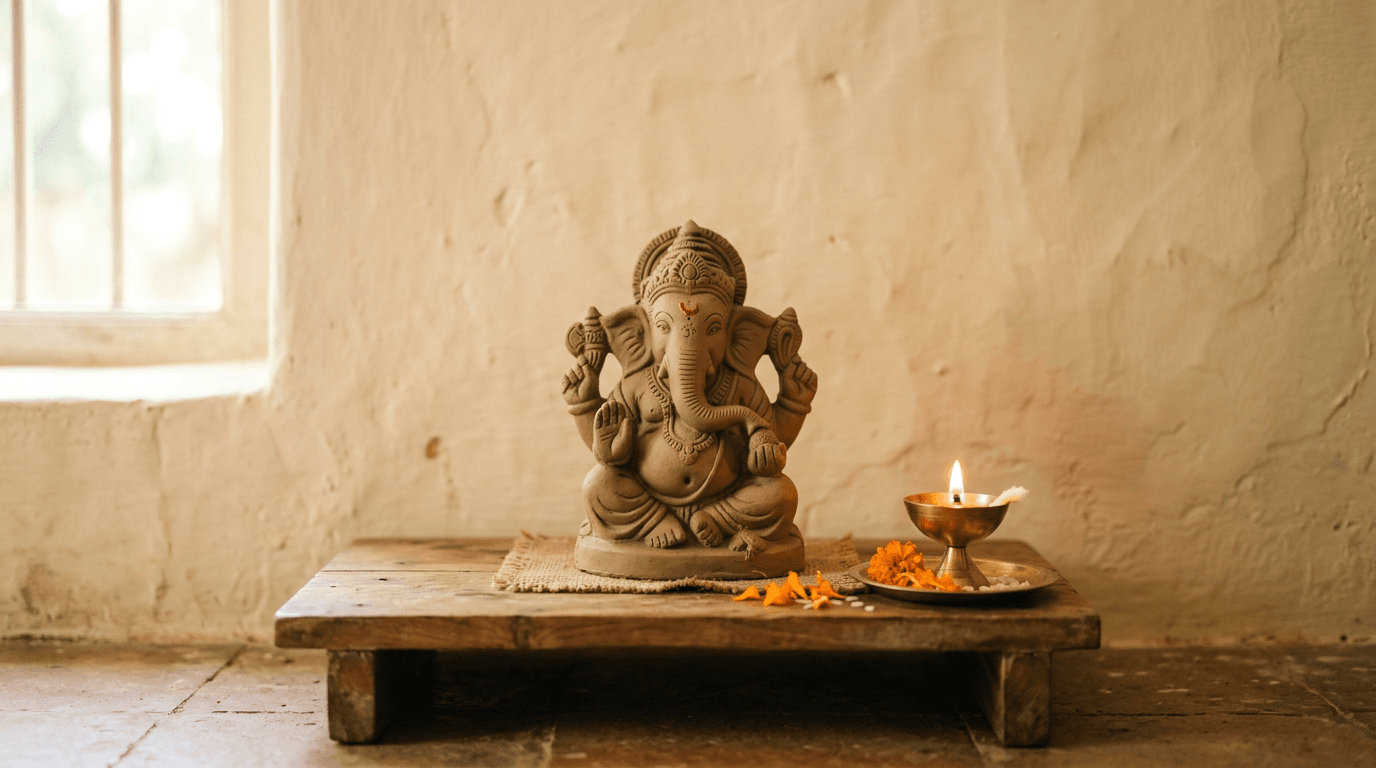
1. Clay Ganpati Murti on a Bare Wooden Chowki
The most restrained option on this list. An unpainted or naturally pigmented clay Ganesha on a plain teak chowki, nothing behind it but a clean wall. Suits minimal homes and photographs beautifully.
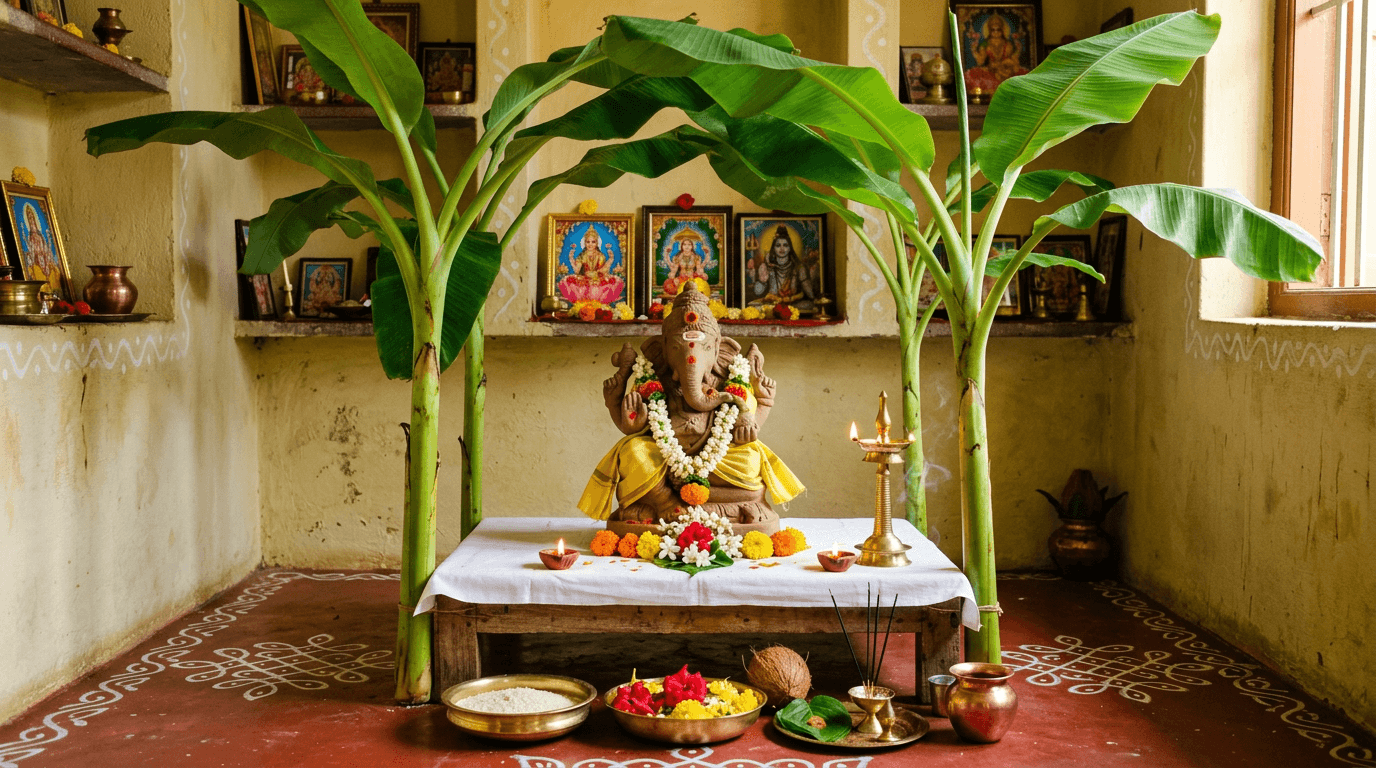
2. Banana Stem and Leaf Frame
Two banana stems as side pillars with fresh leaves fanning across the top. Wholly compostable, deeply traditional in South Indian homes, and it takes about forty minutes to assemble.
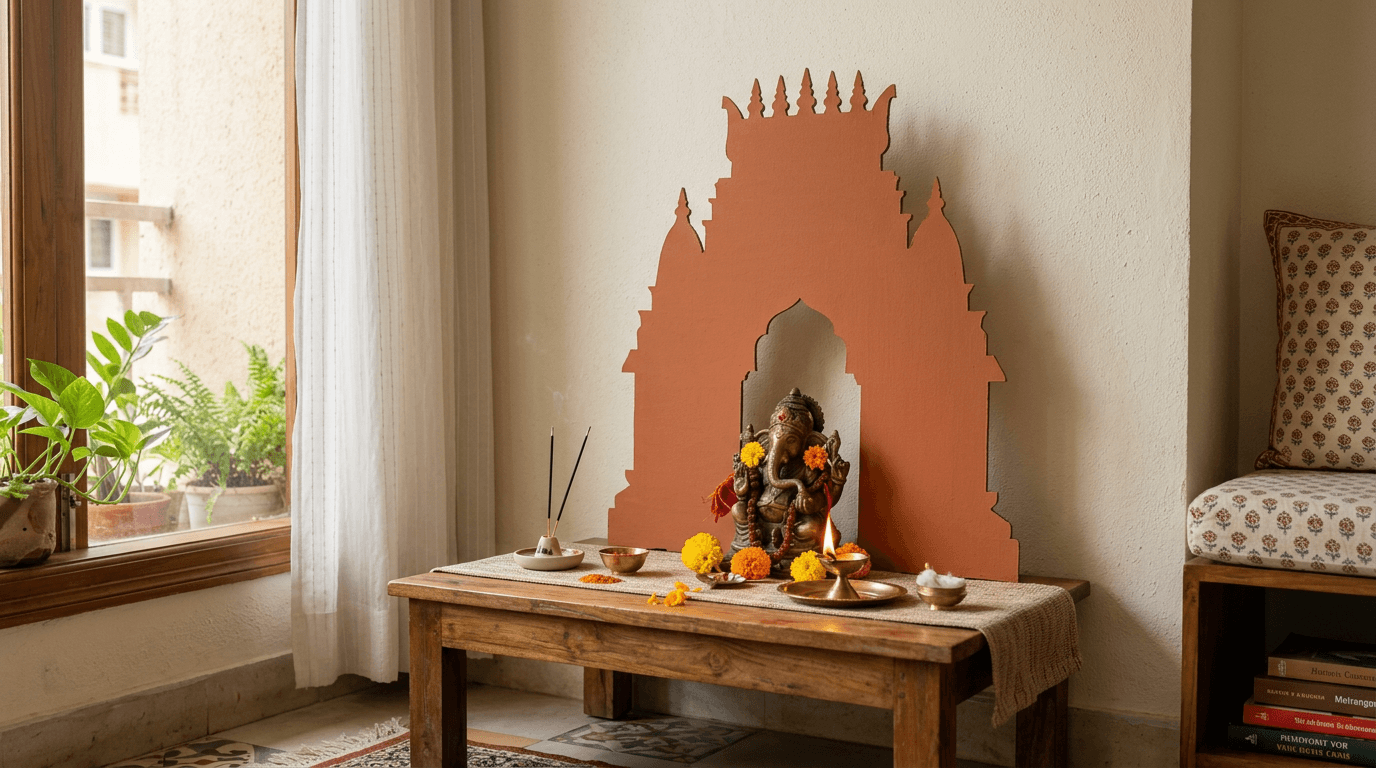
3. Cardboard Cut Temple Arch
A temple silhouette cut from packing cardboard, painted in one flat tone, propped against the wall. Cheap, surprisingly striking, and it goes into the recycling bin on day eleven.
4. Old Saree Drape as a Festival Background
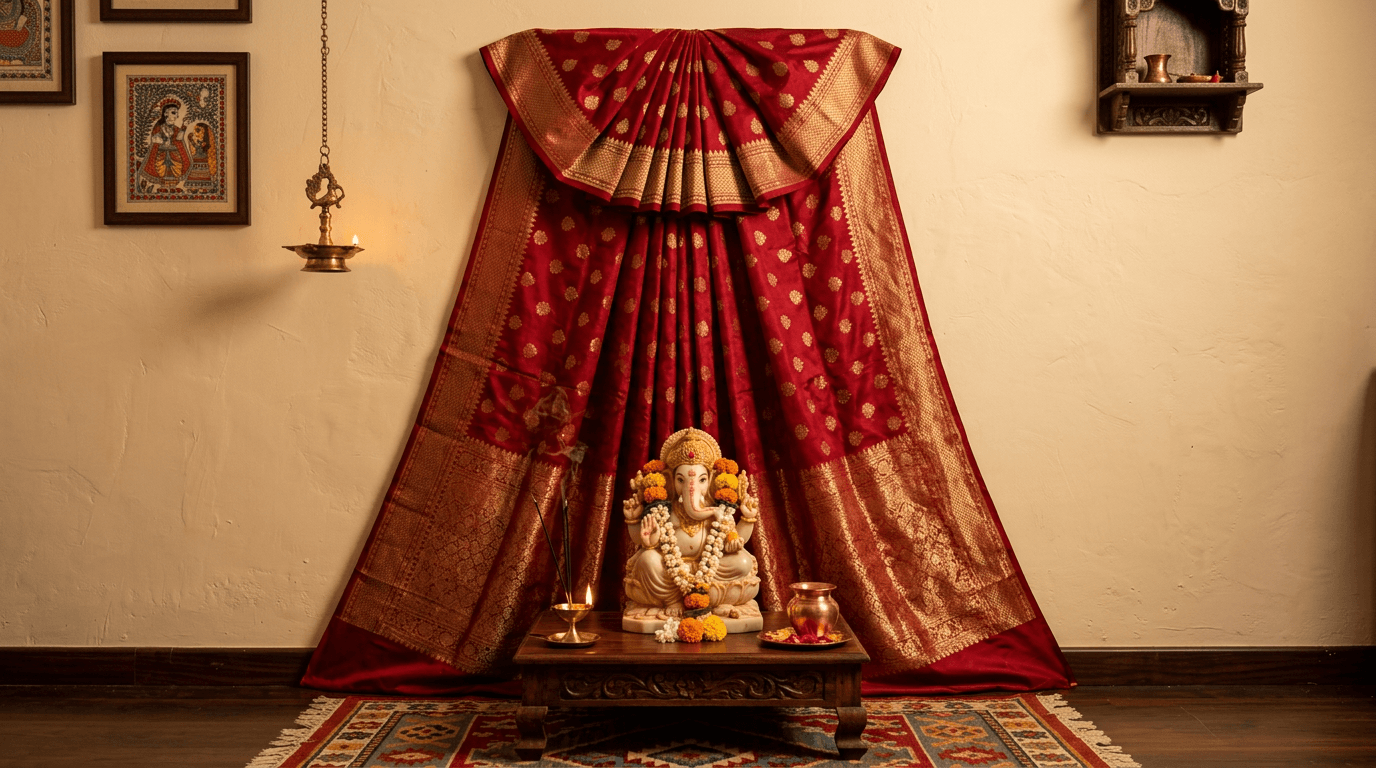
Everyone's first sustainable move, and still the best one. A silk saree pinned flat, pleated at the top, falling loose to the floor. Zero waste, because it goes back in the cupboard afterwards.
5. Paper Flower Wall
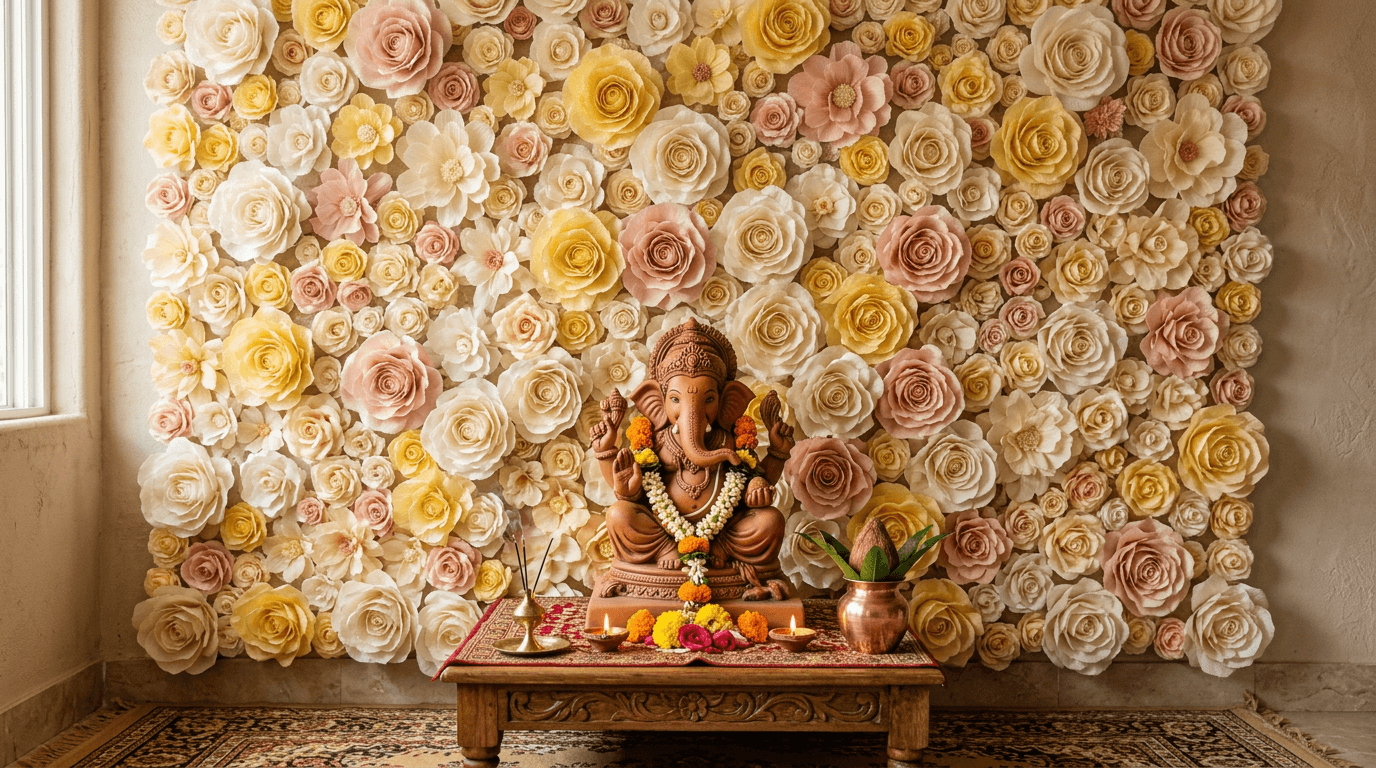
Hand-rolled crepe paper blooms in three sizes, stuck to a fabric base in a loose cluster. It reads as extravagant and costs almost nothing but weekend hours.
6. Terracotta Pot Cluster
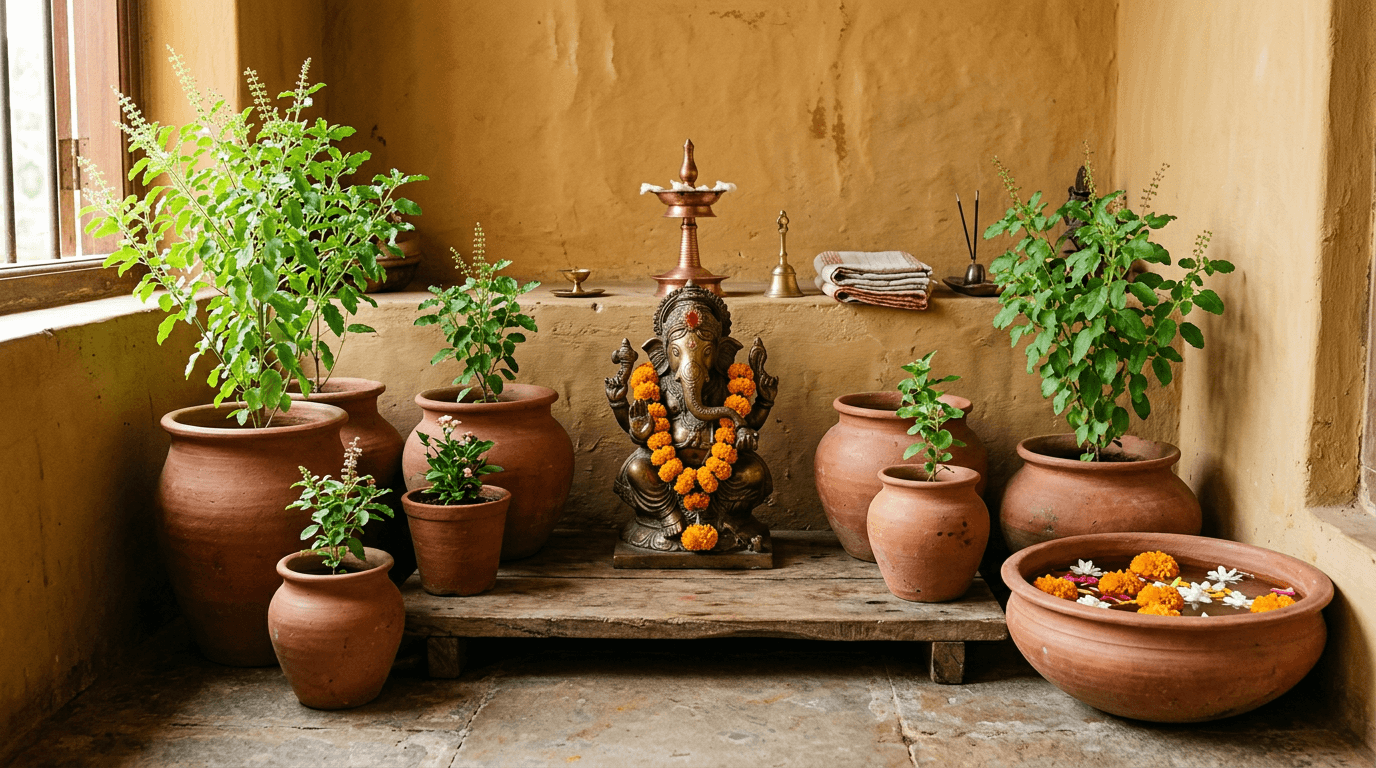
Unglazed pots of three heights grouped on either side of the platform, some planted with tulsi, some holding water and floating blooms. Earthy, calm, and reusable forever.
7. Sugarcane and Bamboo Pillars
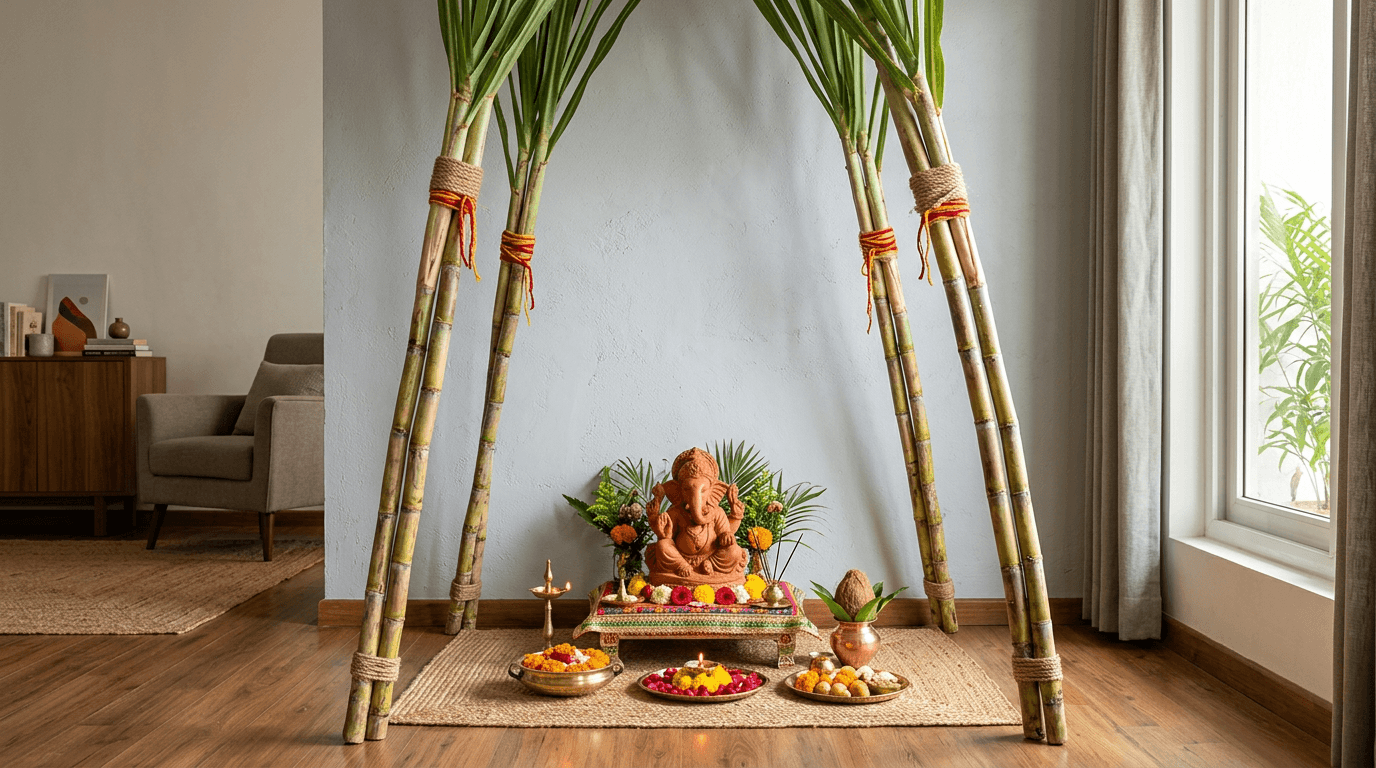
Four sugarcane stalks tied at the top with jute make a light, open pavilion. It is the classic village setup, and it works startlingly well in a modern flat.
8. Seed-Paper Panel You Can Plant
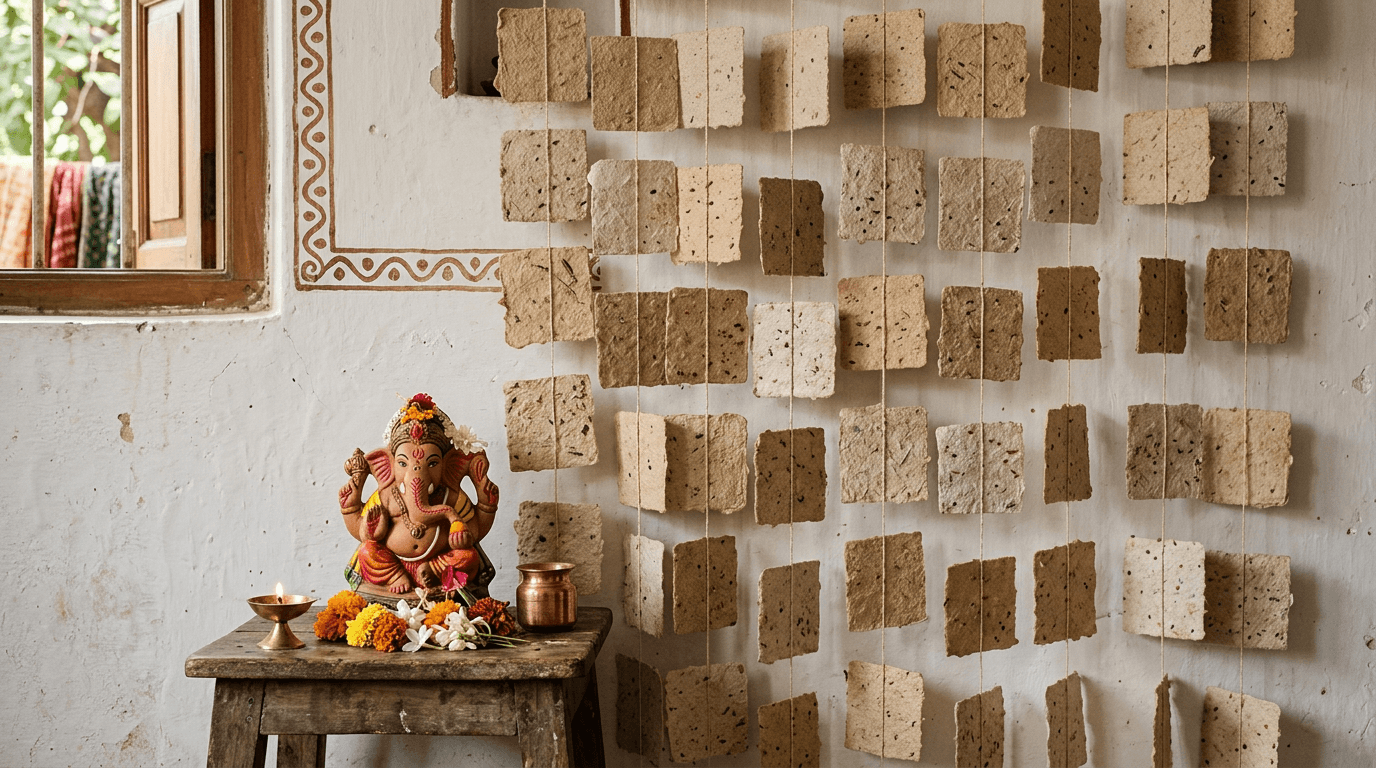
Handmade seed paper cut into panels and strung as a curtain. After the ten days, soak the pieces and plant them. The idea lands with children better than any lecture about waste.
9. Jute and Cane Screen
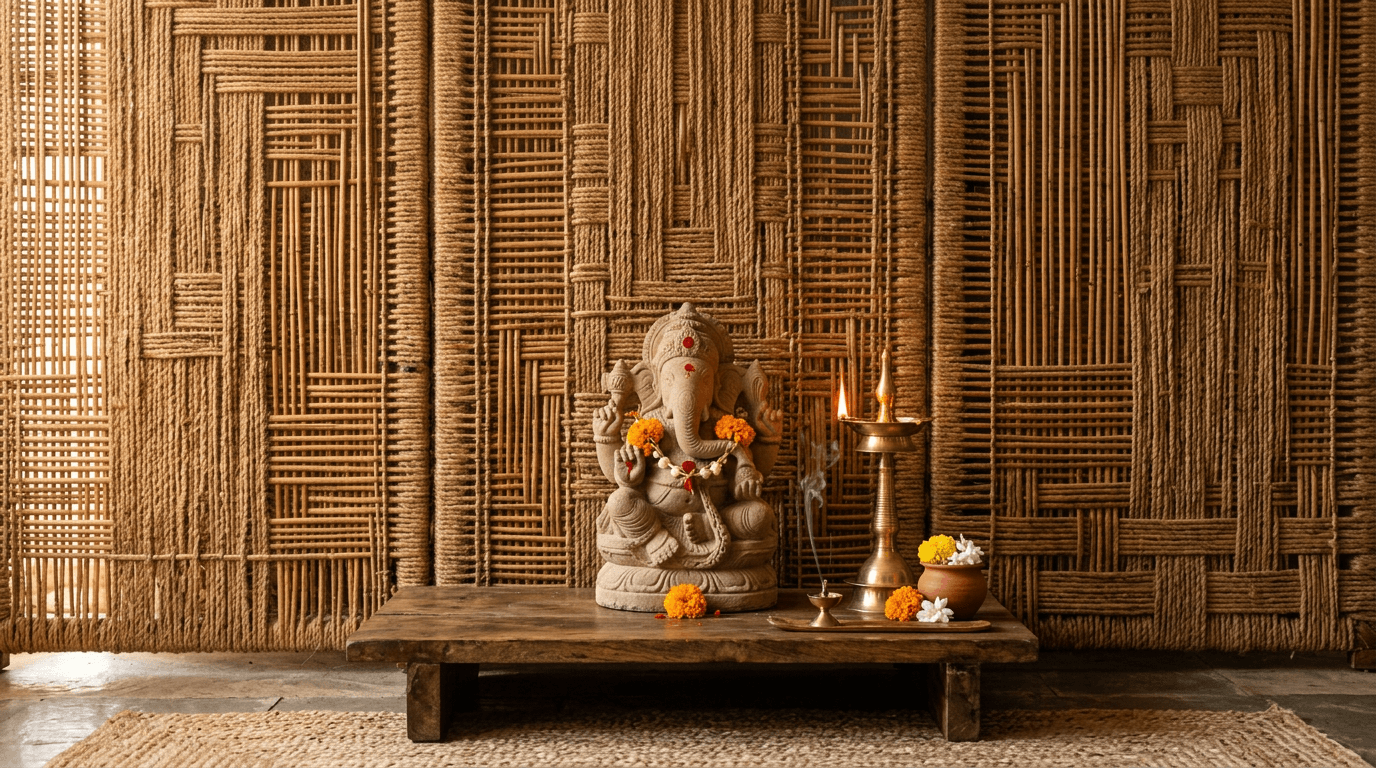
A cane room divider or a jute macrame panel as the whole background. If you already own one, this is a ten-minute setup that looks deliberate.
10. Turmeric and Rice Floor Art
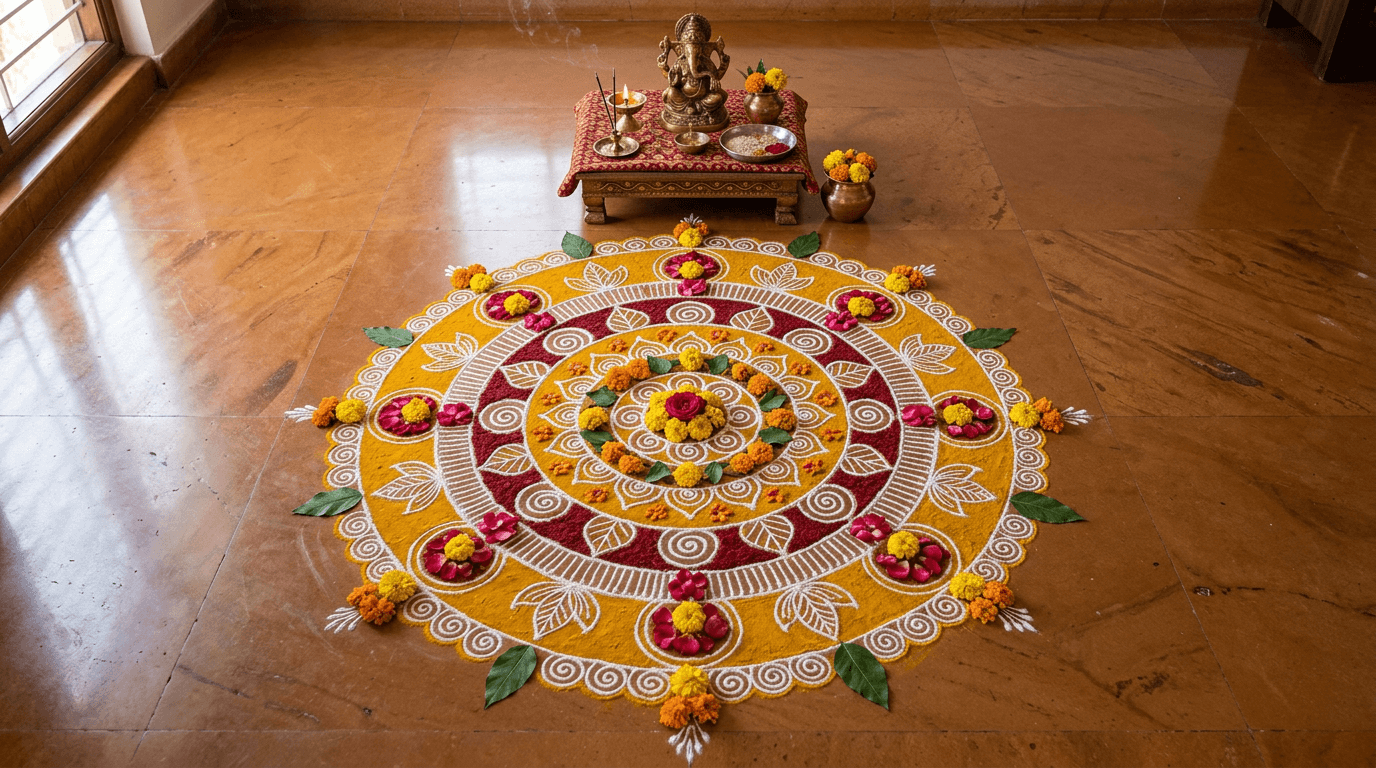
Skip the synthetic powders. Turmeric, rice flour, and dried flower dust make a floor pattern that sweeps away clean and feeds the birds afterwards.
Simple Ganpati Decoration Ideas for a Small Home
A simple Ganesh Chaturthi decoration at home in a one-bedroom flat can look better than a grand one in a hall, and here's the thing nobody says about small flats: the constraint helps you. Simple yet considered beats large yet cluttered, every time. When there's one wall and one metre of floor, you stop debating and start editing. On our Tarnaka studio apartment project — 600 sft, a client who wanted maximum storage and minimum clutter — every decision came down to going vertical. A festival setup in a compact flat works the same way.
11. Single-Shelf Corner Setup
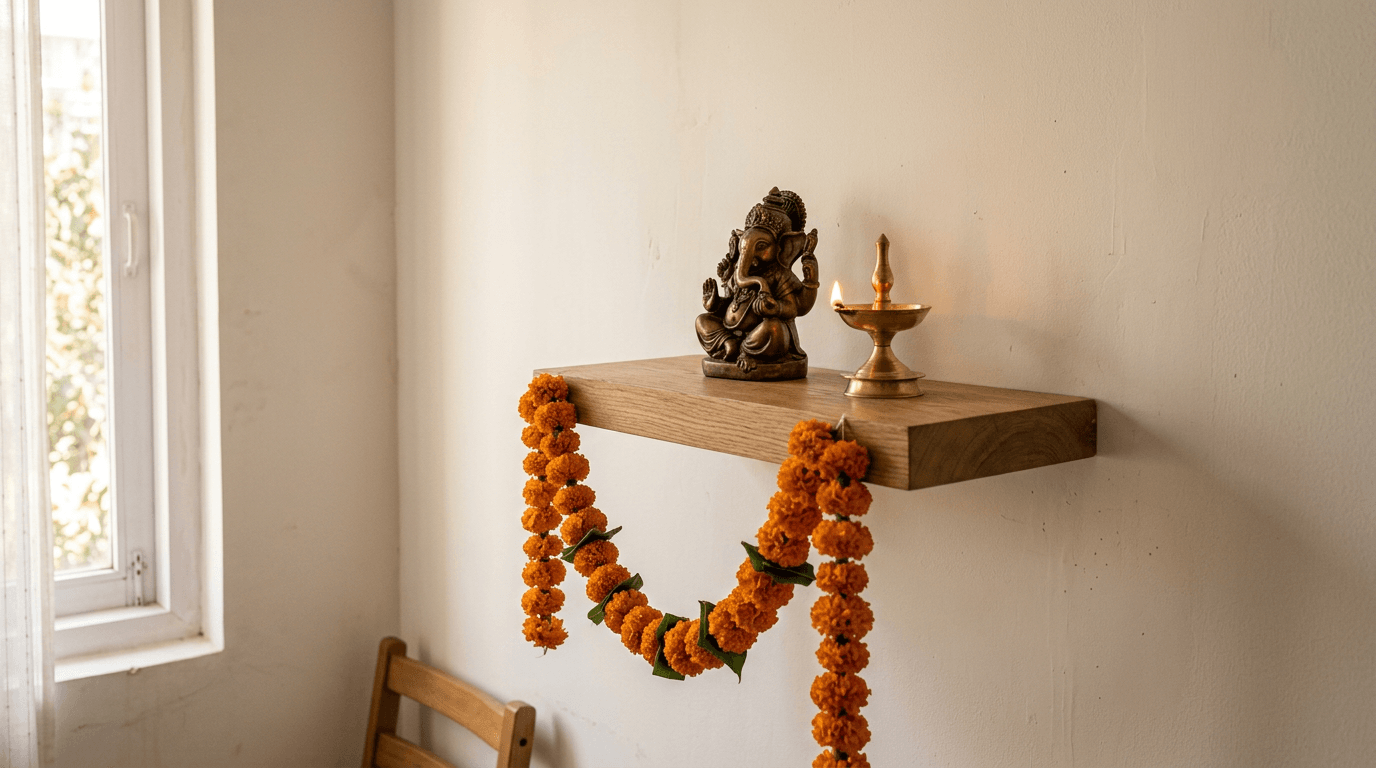
One floating shelf at chest height, one Ganesha, one lamp, one string of flowers falling from the shelf edge. Occupies zero floor.
12. Foldable Chowki with a Fabric Skirt
A folding wooden chowki with cloth pinned around all four sides to hide the legs. It reads as a solid plinth and stores flat in the loft.
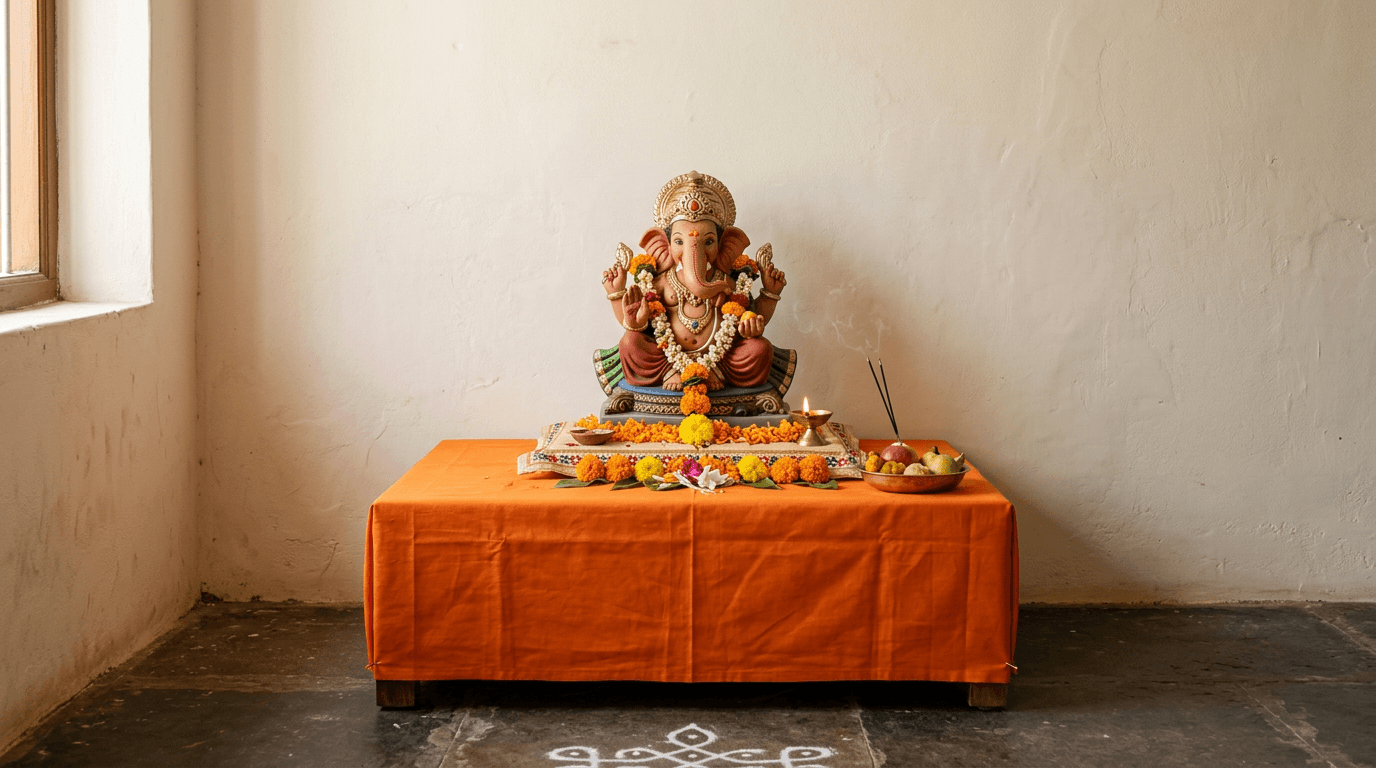
13. Wall-Mounted Floating Ledge
A 900 mm plywood ledge with a concealed bracket. Half the year it holds books; for ten days it holds the setup. This is the small-home move we recommend most.
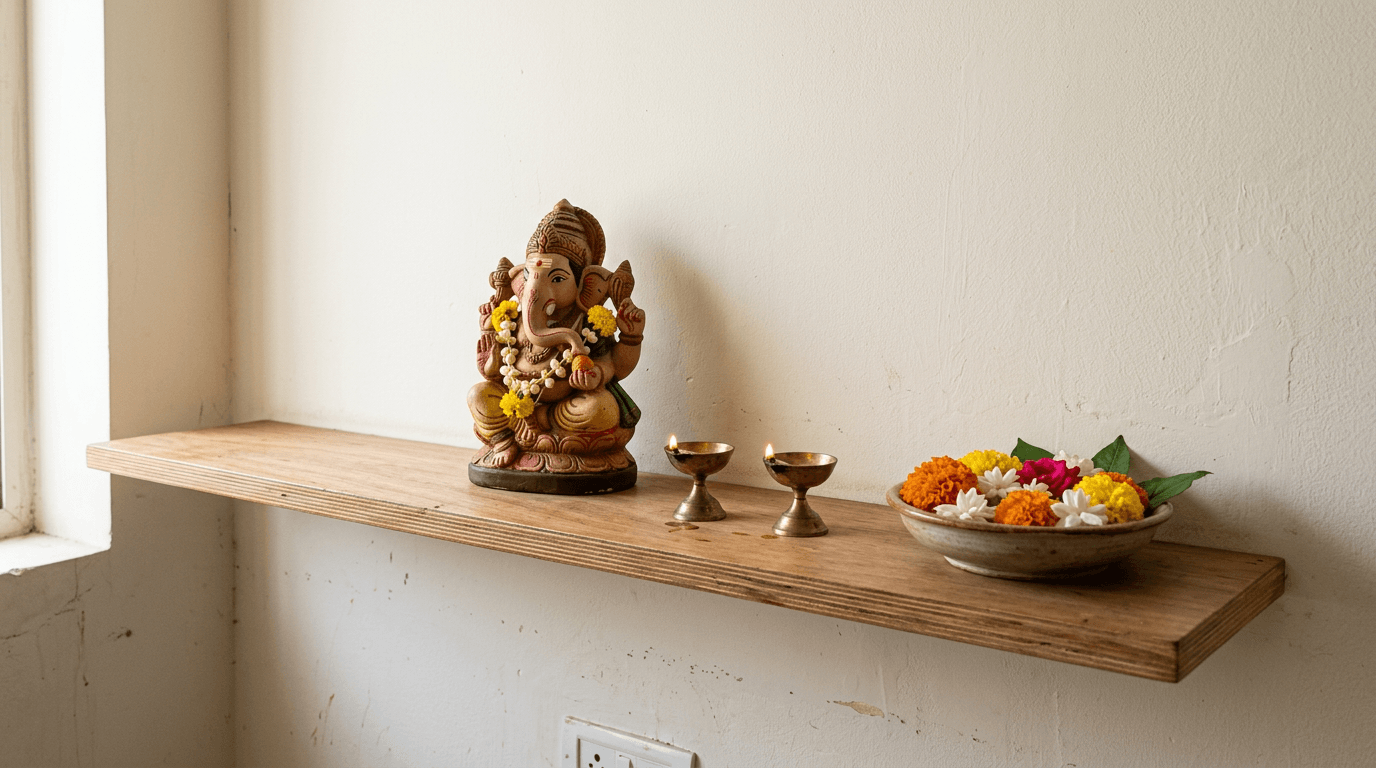
14. Console Table Takeover
Clear the entryway console completely, cover it in cloth, and give it over to the festival. Guests meet the setup before they meet you.
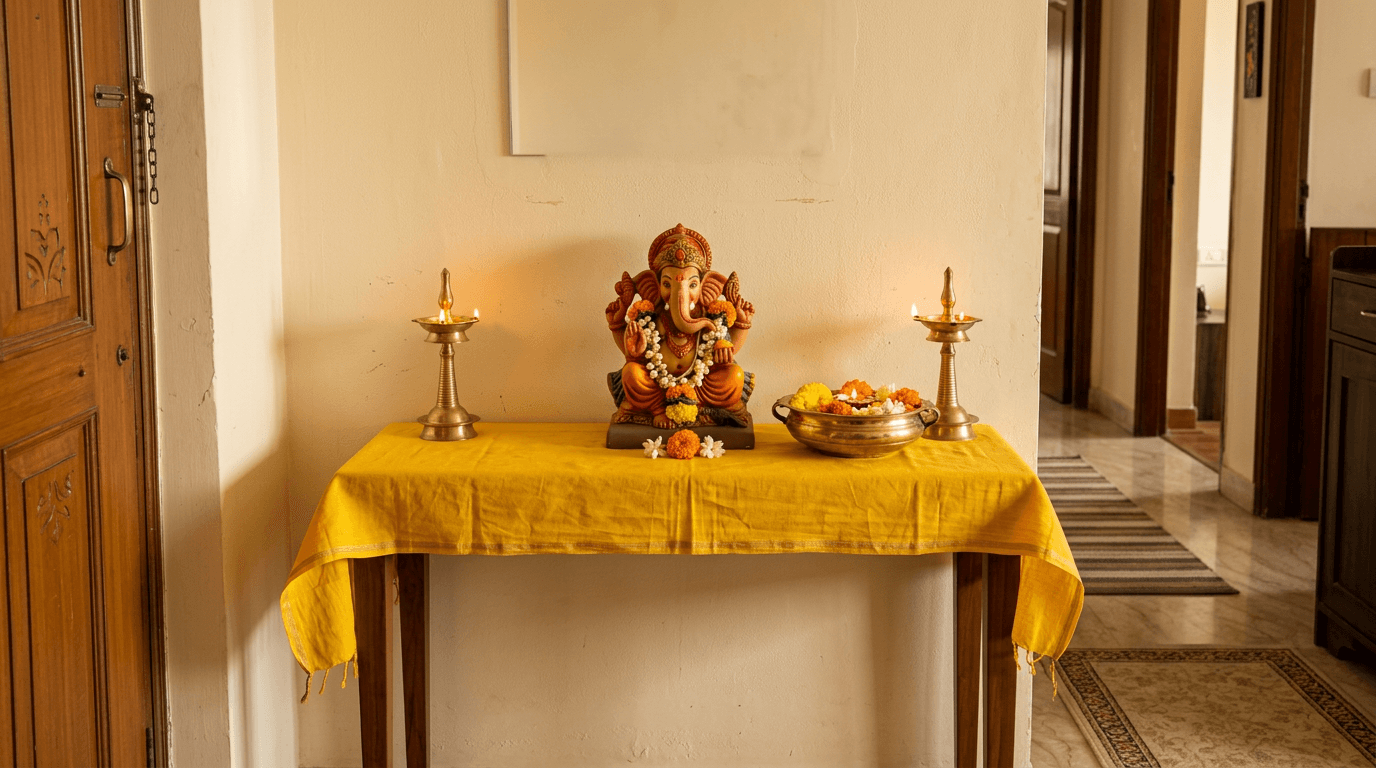
15. Window Sill Setup
A deep sill with a sheer curtain behind it turns daylight into a natural backlight. Best for morning aarti, worst for windy afternoons.
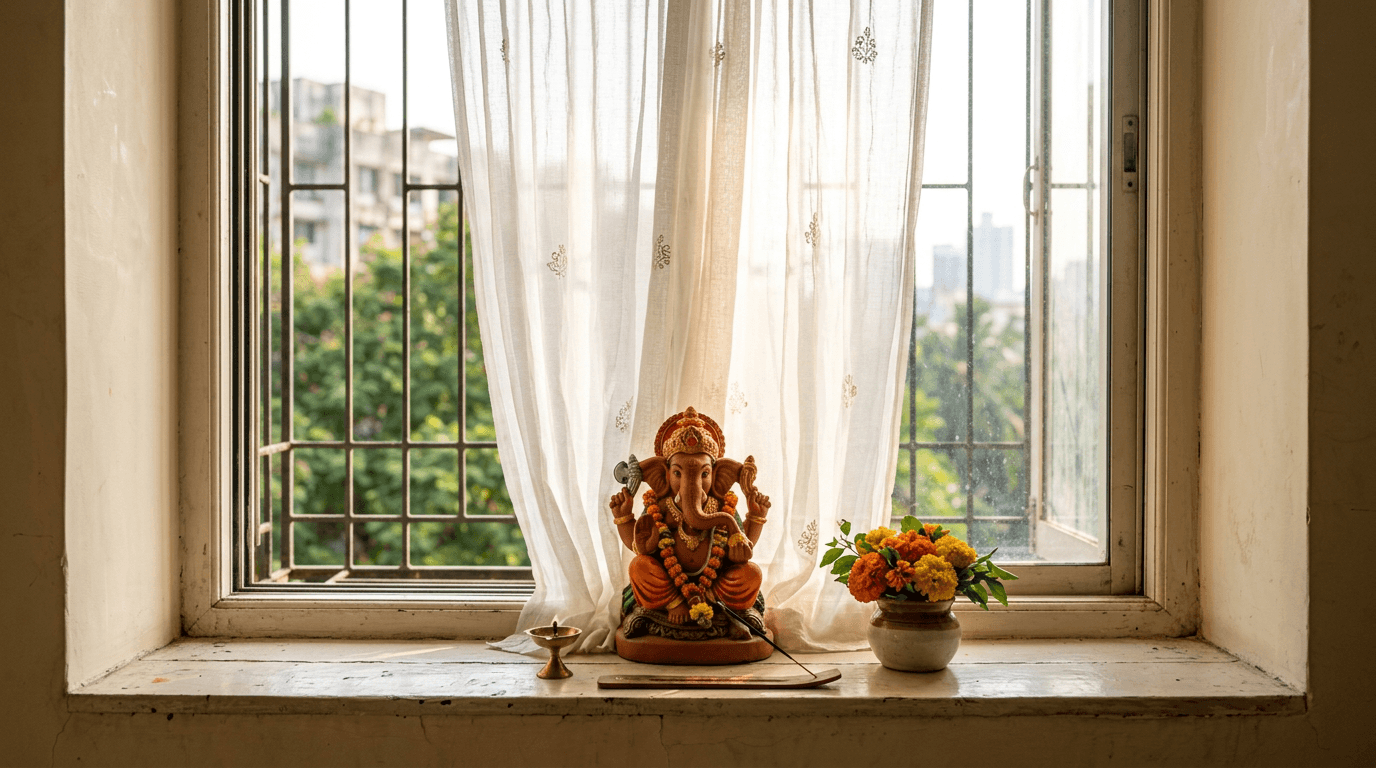
16. Two-Tone Painted MDF Board
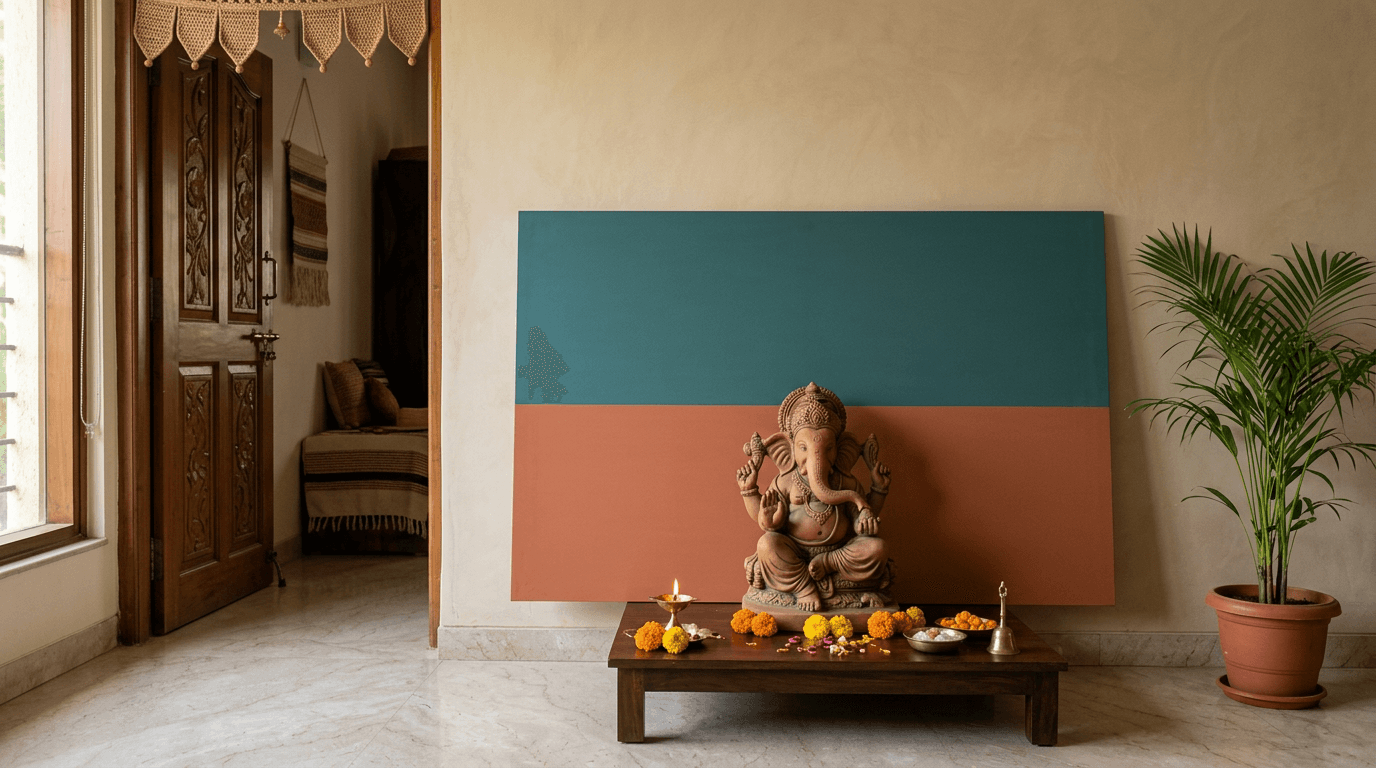
One 4x3 ft MDF board painted in two flat tones with a hard horizon line, leaned against the wall. Stark, modern, and it doubles as next year's base too.
17. Dupatta Ceiling Canopy
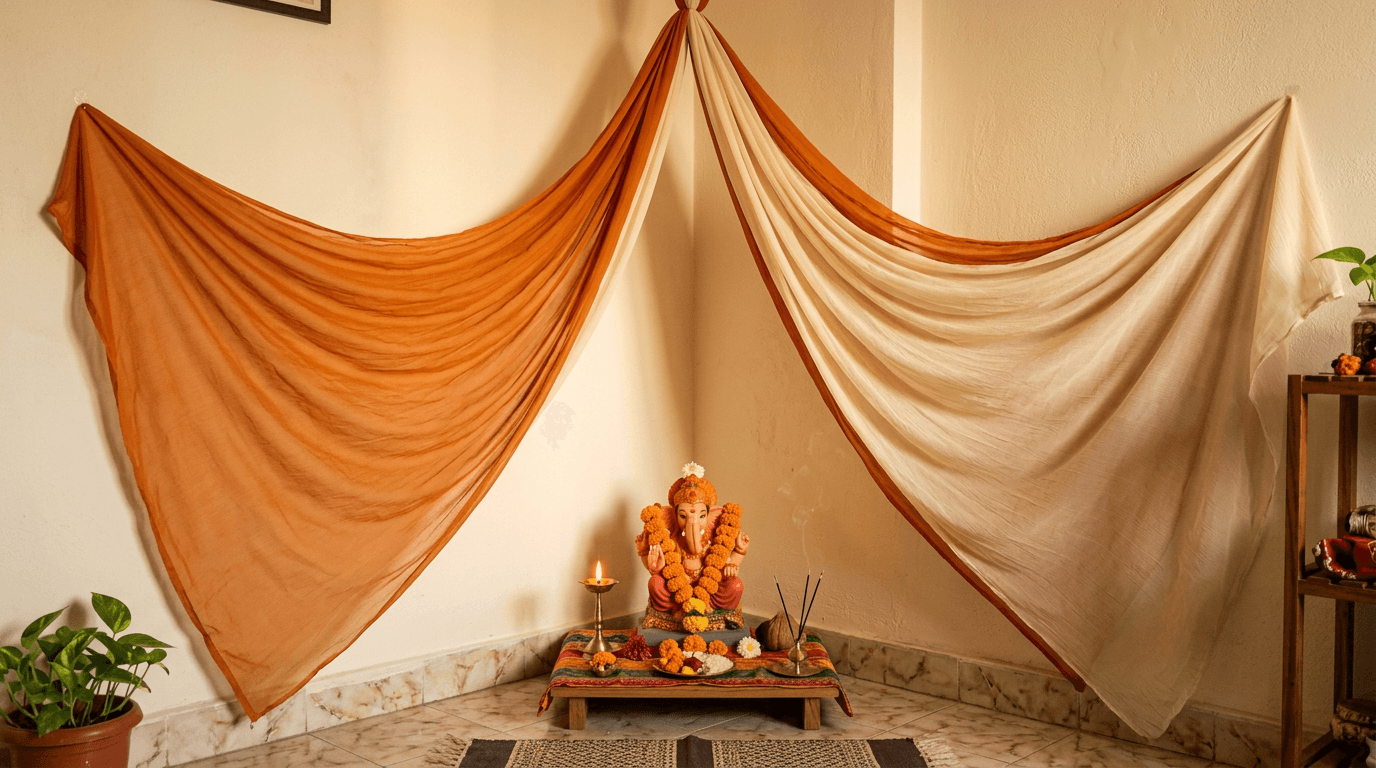
Two dupattas pinned to the ceiling and swept down to the side walls make a tented alcove out of a plain corner. Almost free if you raid the cupboard.
18. Bookshelf Niche Conversion
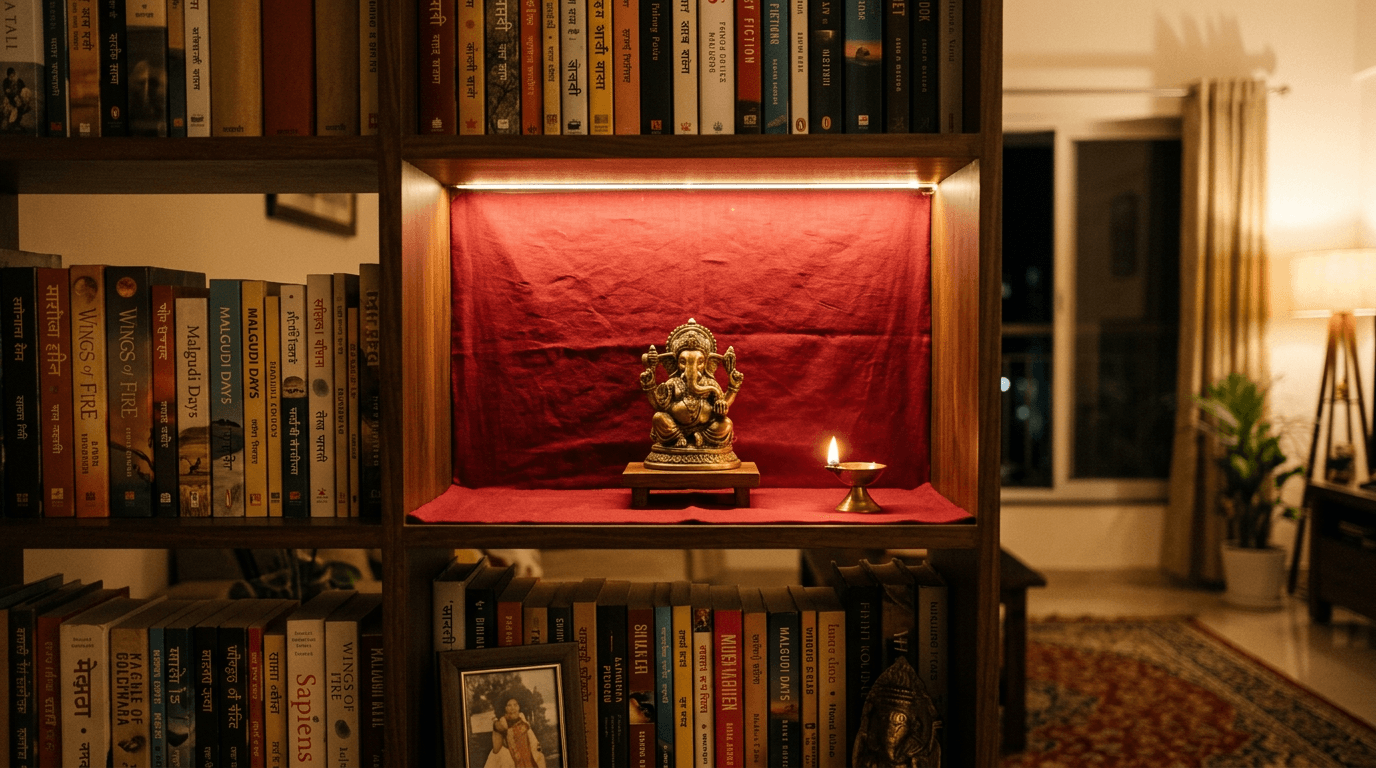
Empty one shelf of an existing bookcase, line the back with paper or fabric, and light it from inside. A built-in niche appears out of nowhere.
Background Ganpati Decoration and Backdrop Ideas
The wall behind the Ganesha is the single highest-leverage surface in the whole setup. Every photograph you take for ten days has it in the frame. Spend your effort here.
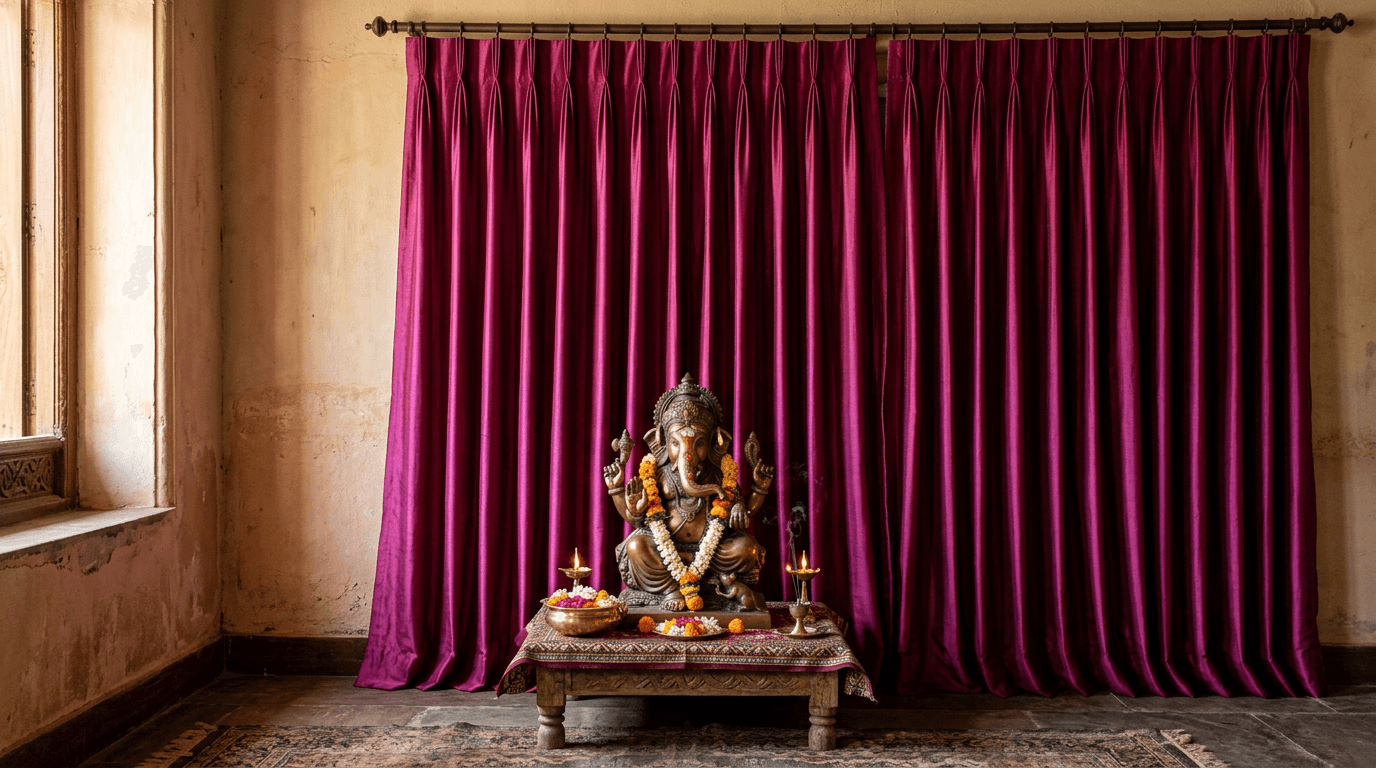
19. Pleated Saree Background
Pleated at the top like a curtain header instead of hung flat. The vertical folds catch light and give the background depth a flat sheet never has.
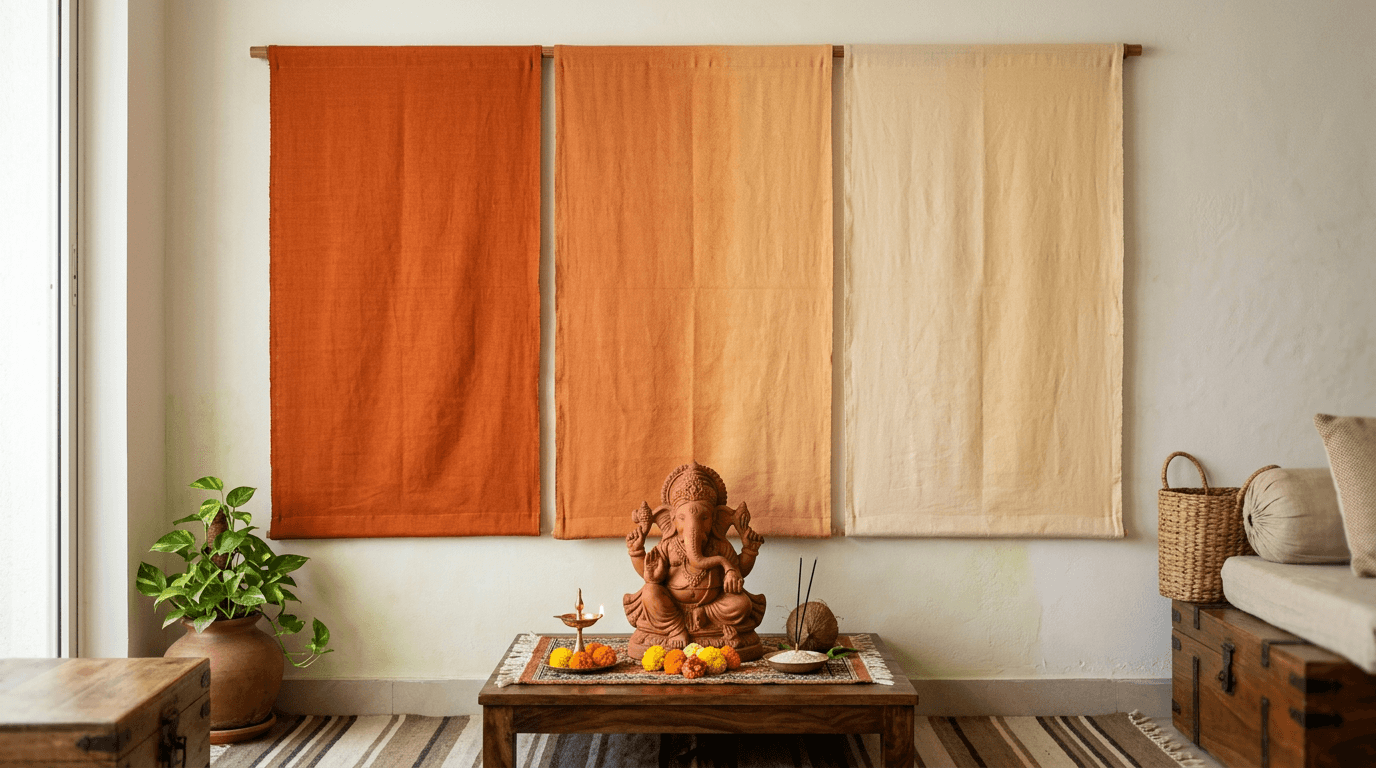
20. Ombre Fabric Wall
Three fabric panels in graded tones of the same hue, hung edge to edge. Reads as one gradient from across the room.
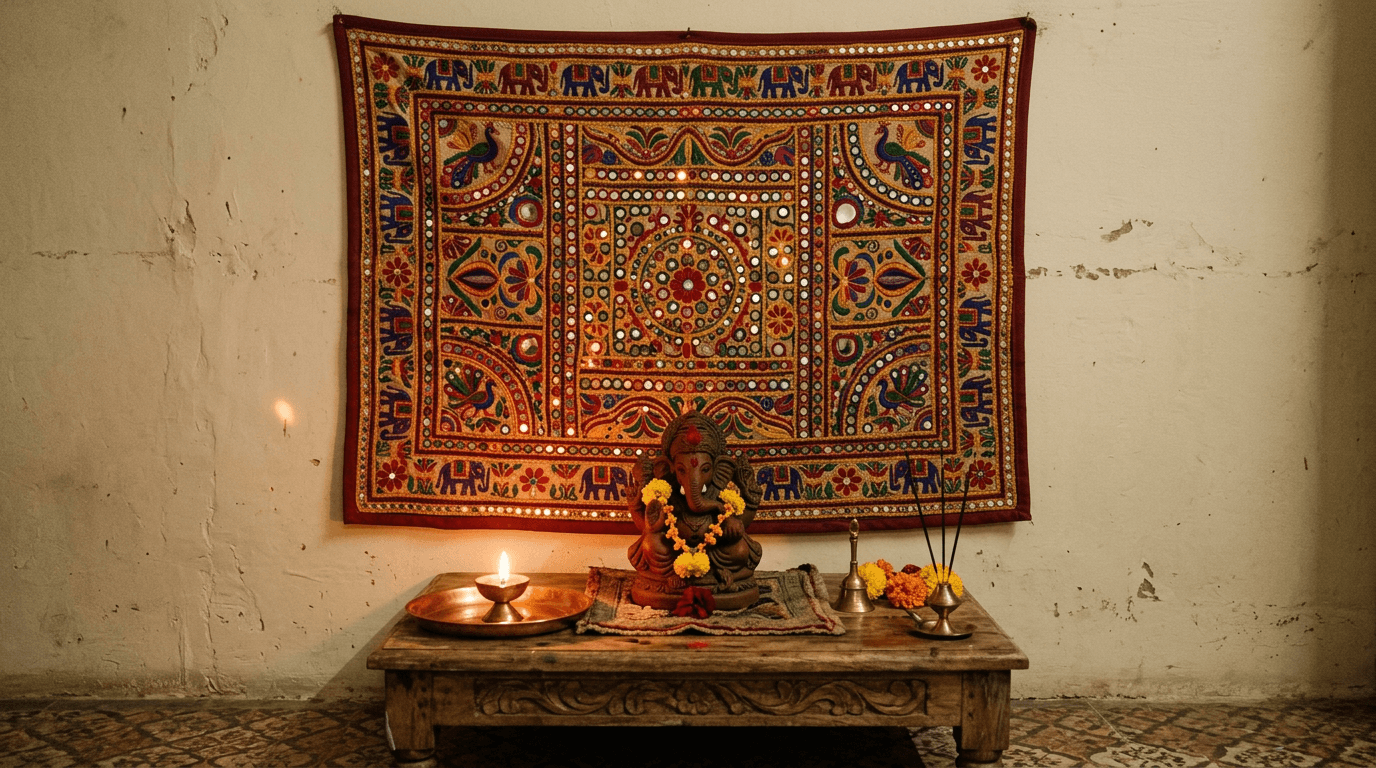
21. Mirror Work Fabric Panel
Rajasthani shisha fabric behind the murti throws back every point of light in the room. Use it with restraint: one panel, nothing else on the wall.
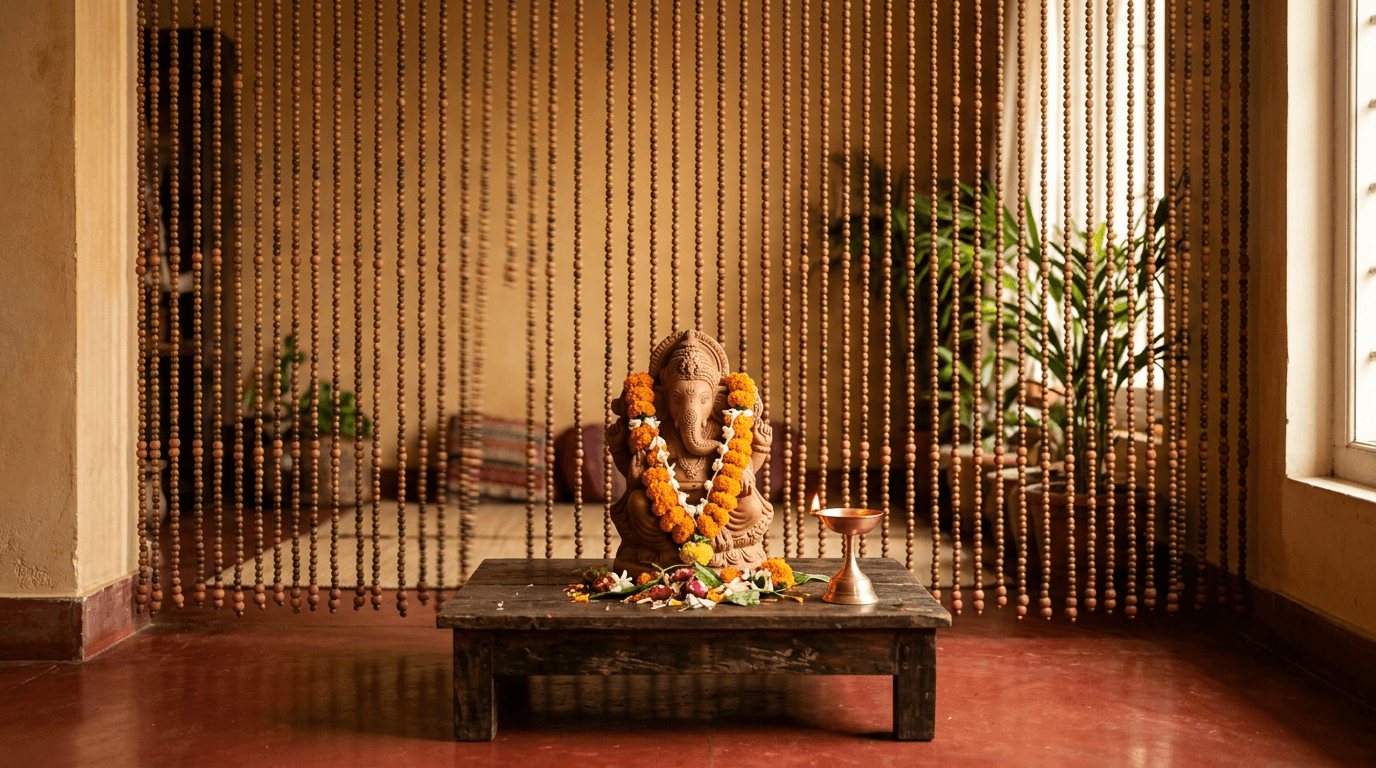
22. Bead Curtain Screen
Wooden or clay bead strands hung floor to ceiling. They move when people walk past, which makes the corner feel alive rather than staged.
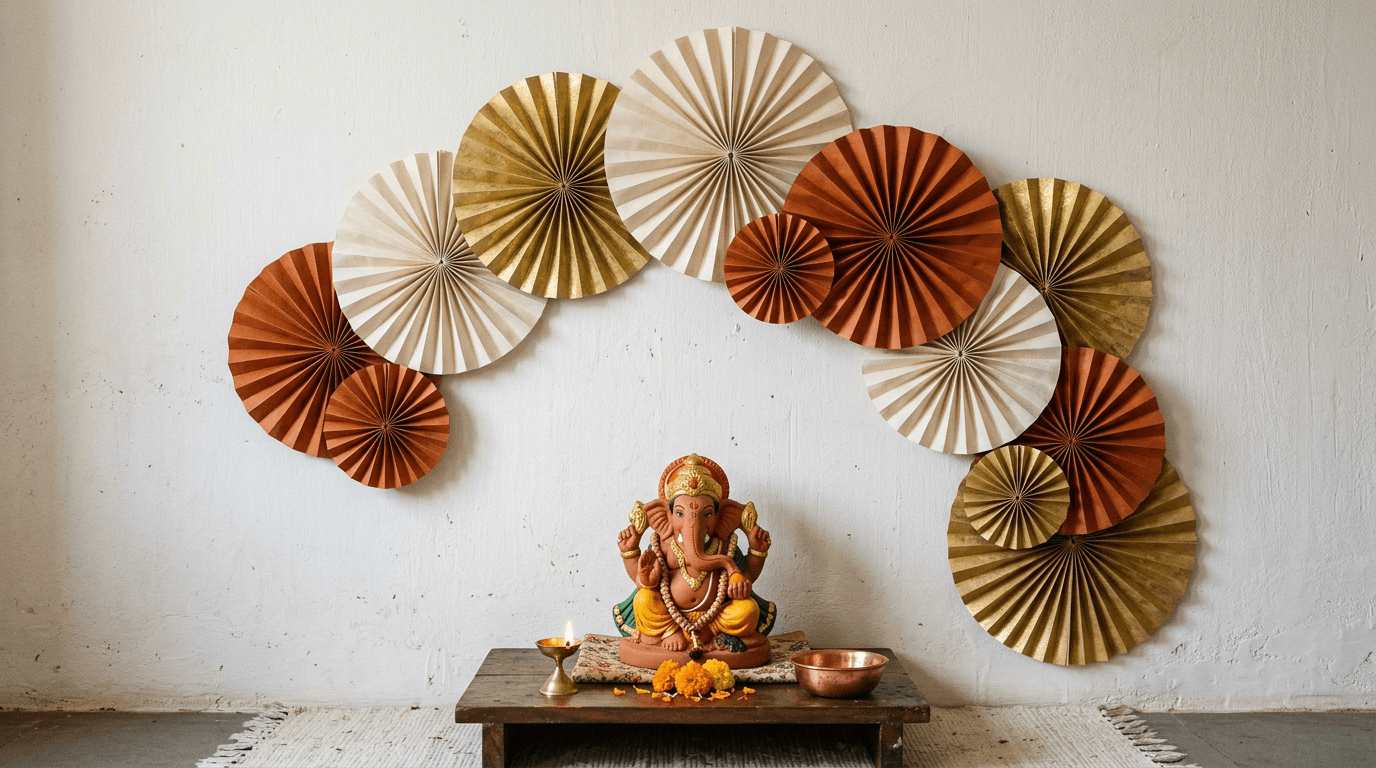
23. Hanging Paper Fans
Concertina paper fans in three sizes arranged in a loose arc. Recyclable, packable, and the most forgiving idea here for anyone who is not crafty.
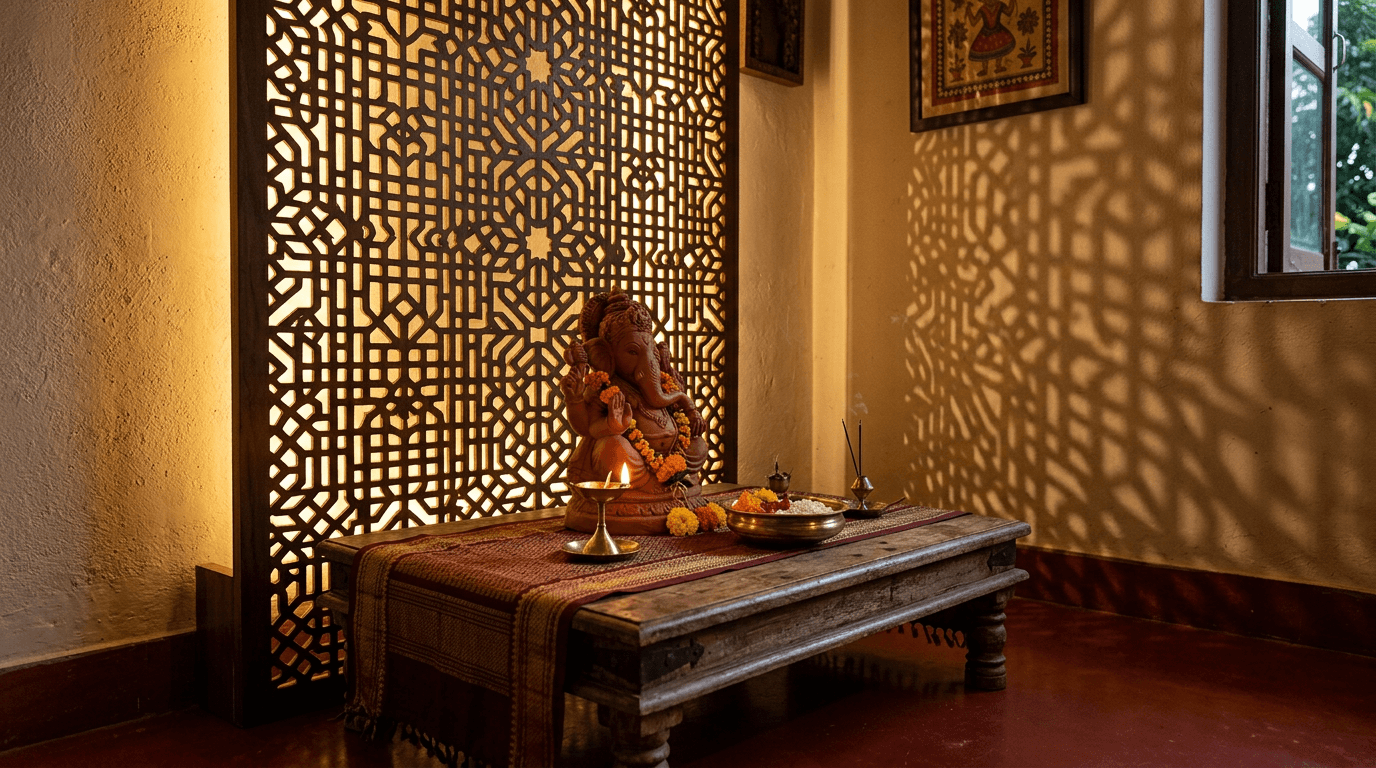
24. Wooden Jali Panel
A laser-cut MDF or plywood jali screen with a light source behind it. The shadow pattern it throws on the wall is the actual design.
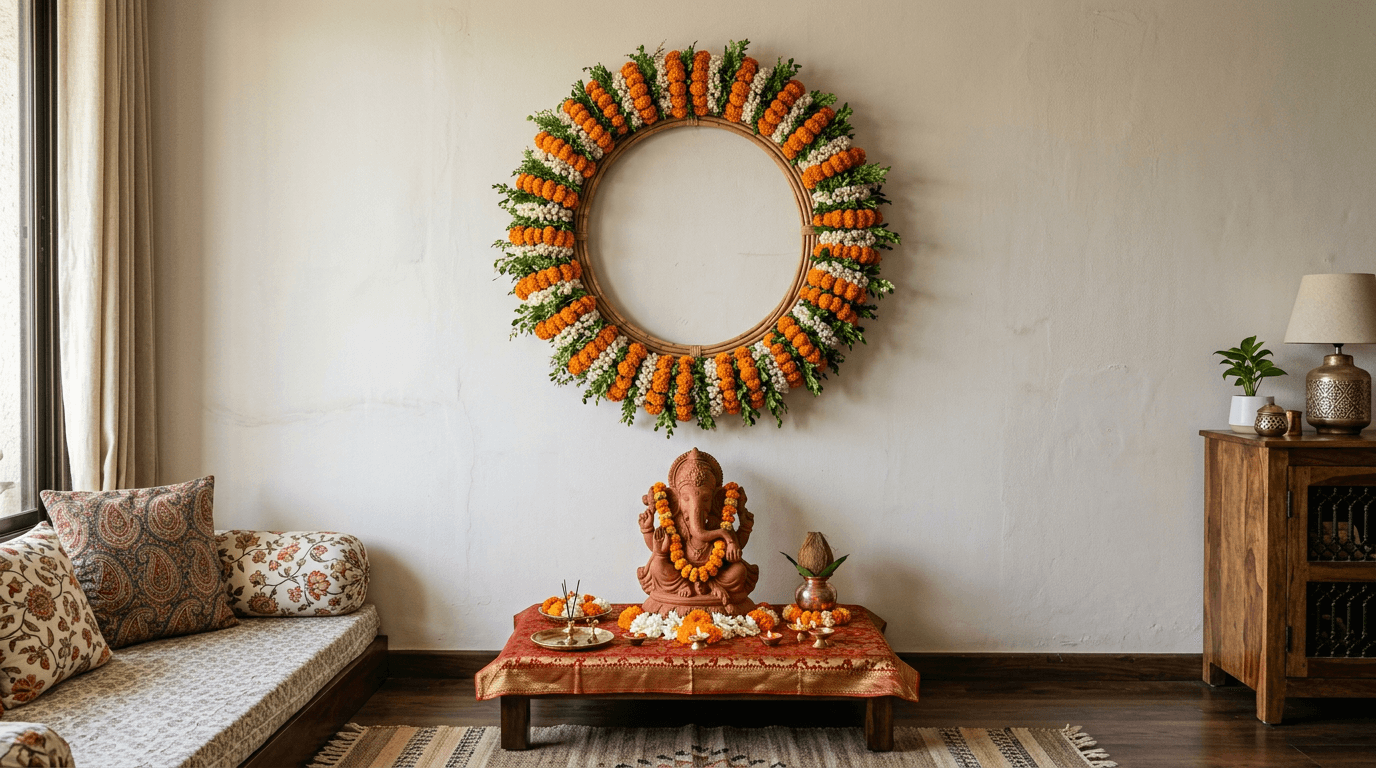
25. Floral Ring Background
A single large cane hoop wrapped in blooms and hung on the wall, centred behind the Ganesha. One shape, done well, beats a crowded wall every time.
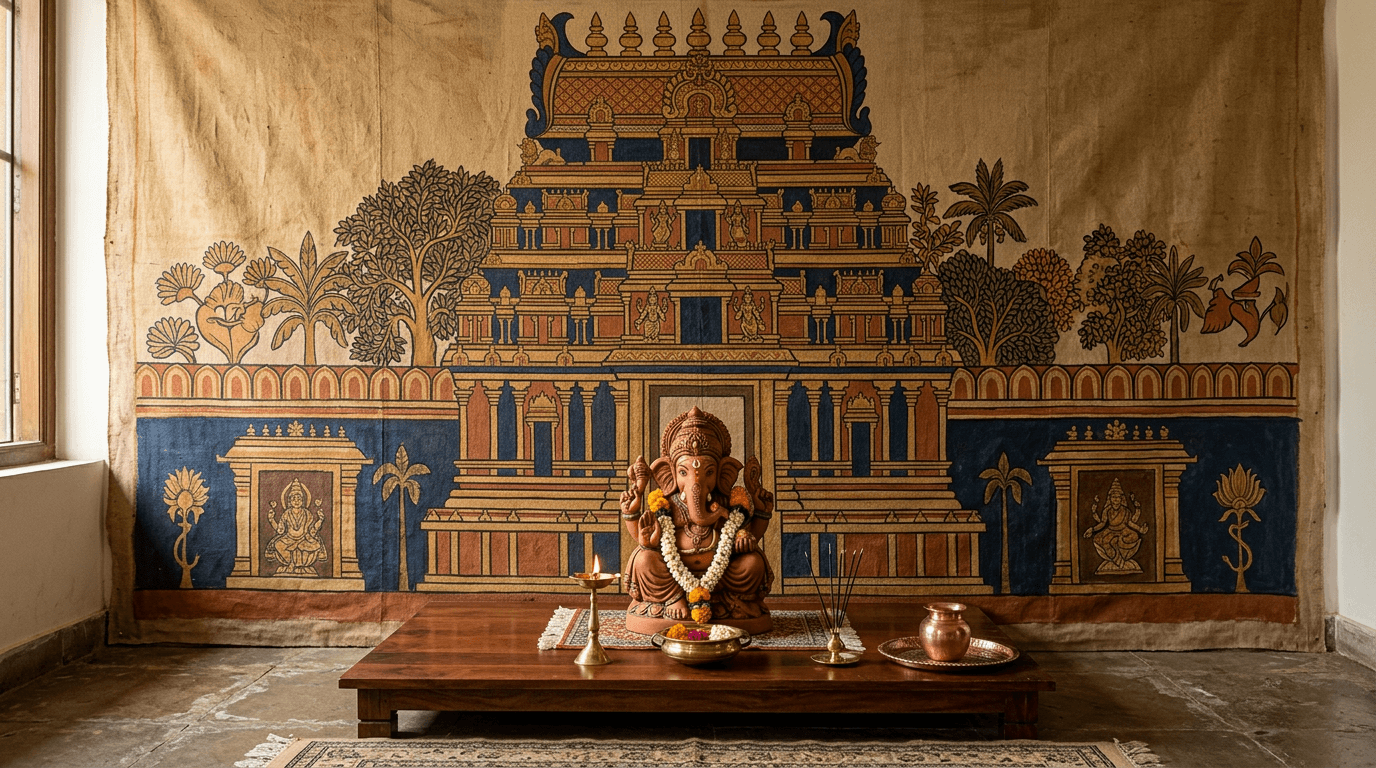
26. Painted Canvas Mural
Commission or paint a plain cotton canvas — a temple gate, a river scene, a mountain line. Roll it up and it lasts a decade of festivals.
Flower Decoration Ideas for Ganesh Chaturthi: Marigold Garland, Jasmine and Lotus
Marigold leads the traditional list, and hibiscus is the bloom most associated with offerings to Lord Ganesha. Durva grass belongs on the platform regardless of what else you do. A fresh flower garland does more visual work per hour than anything else you can buy, and flowers are the only material here that improves the room's smell. These decoration ideas with flowers scale from a single garland to a full flower Ganpati decoration covering the wall — let your budget, not your Pinterest board, decide how far the Ganpati flower decoration goes.
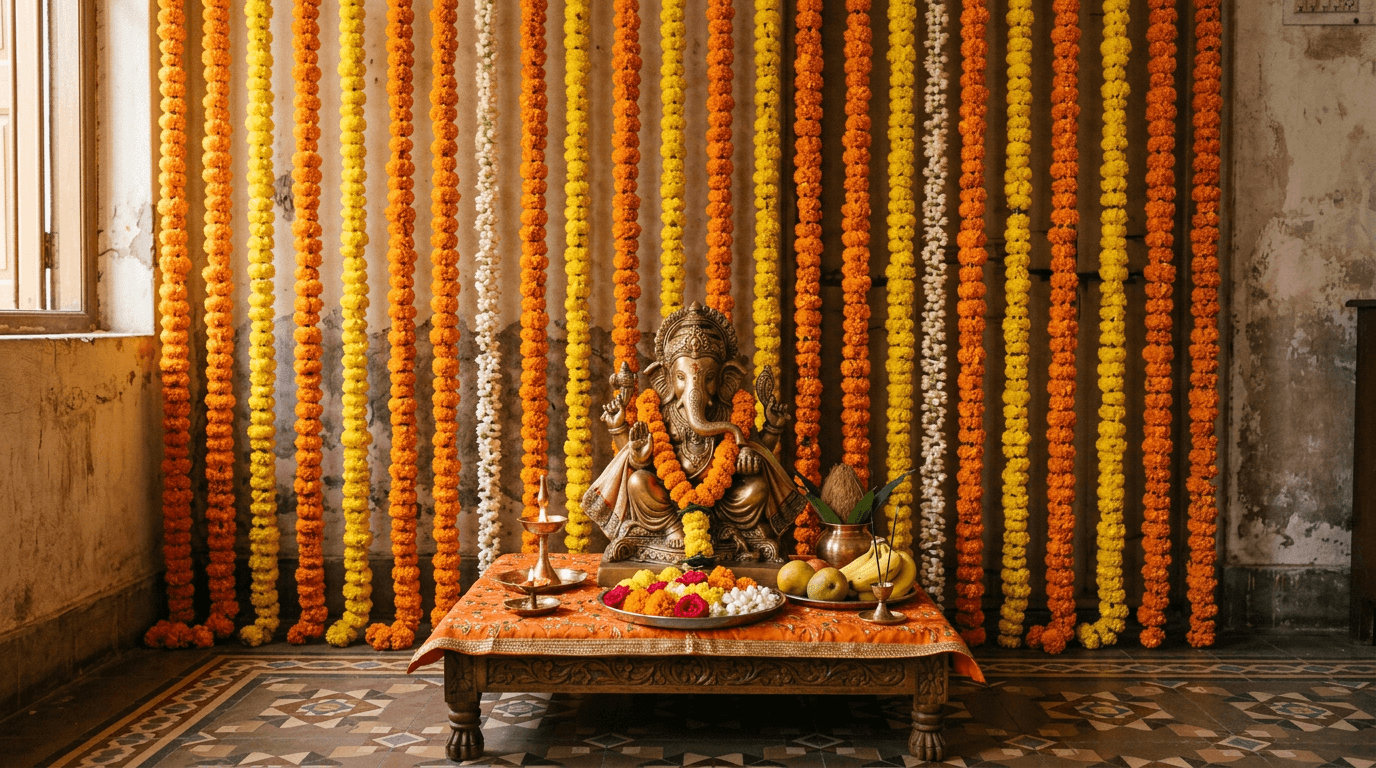
27. Marigold Curtain Strings
Twenty strings hung floor to ceiling at even spacing. Dense, saturated, and unmistakably a festival wall.
28. Mogra Trail
Fine white strands looped along the platform edge and up the sides. Understated, and the scent carries through the whole flat by evening.
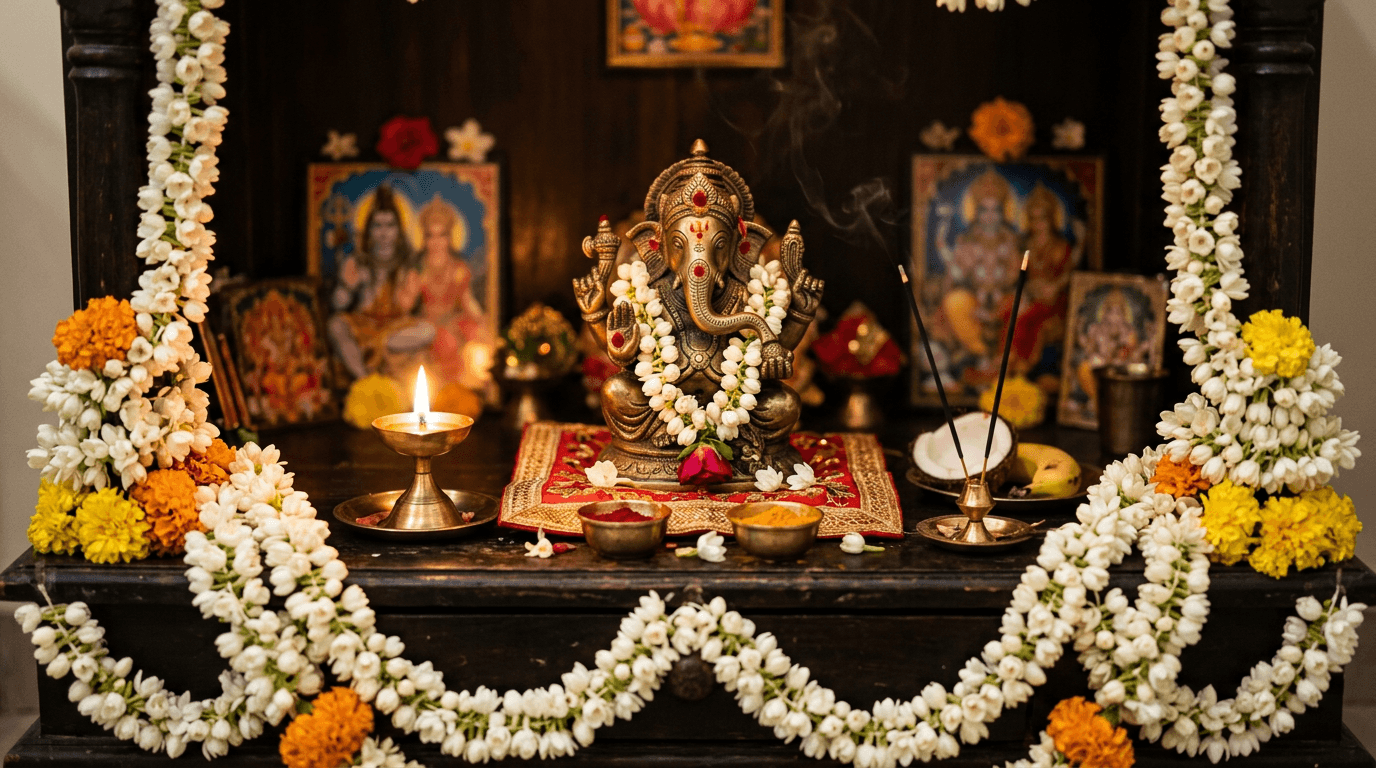
29. Lotus Petal Pedestal
The Ganesha seated on a wide lotus-shaped base built from fresh blooms laid in rings. It lasts two days and is worth every hour.
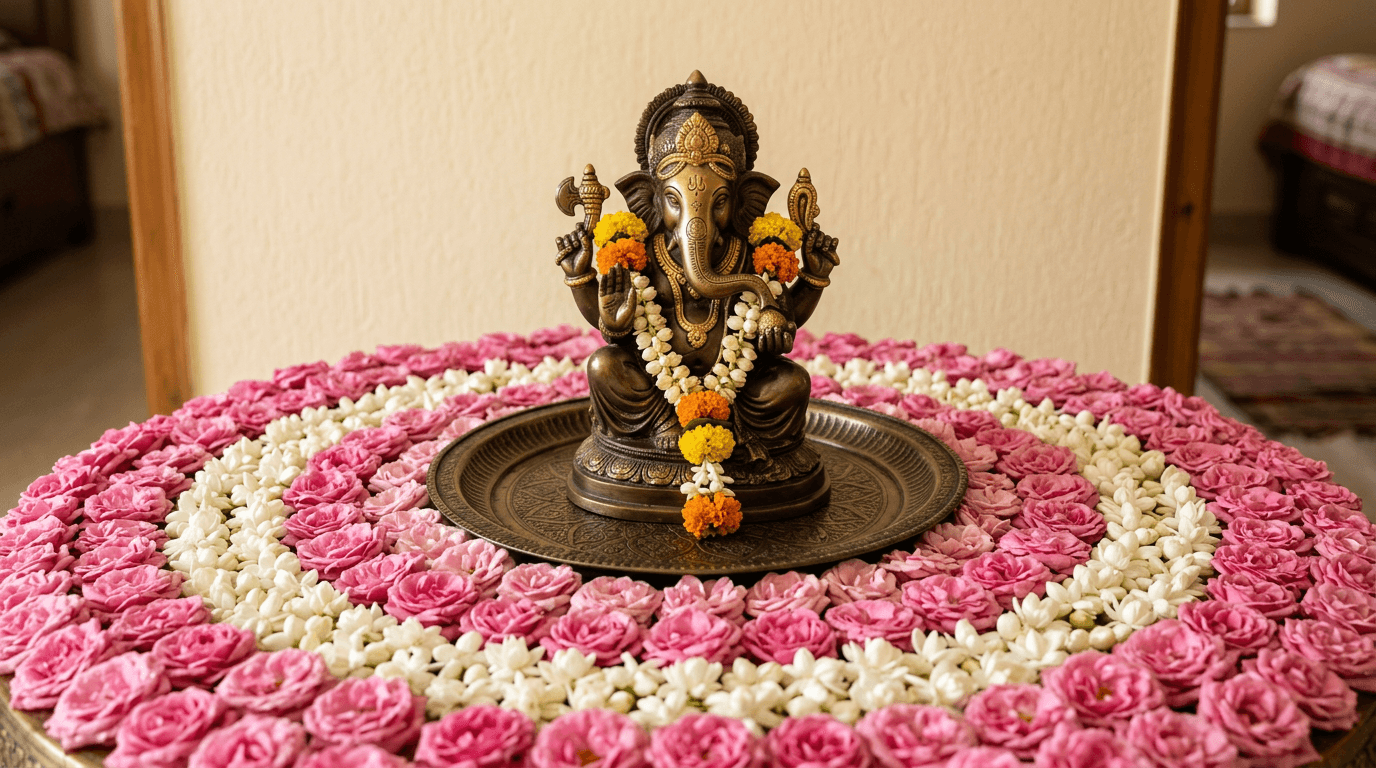
30. Flower Rangoli on the Floor
A circular pattern on the floor made entirely from loose heads and blooms rather than powder. Bolder, faster, and completely compostable.
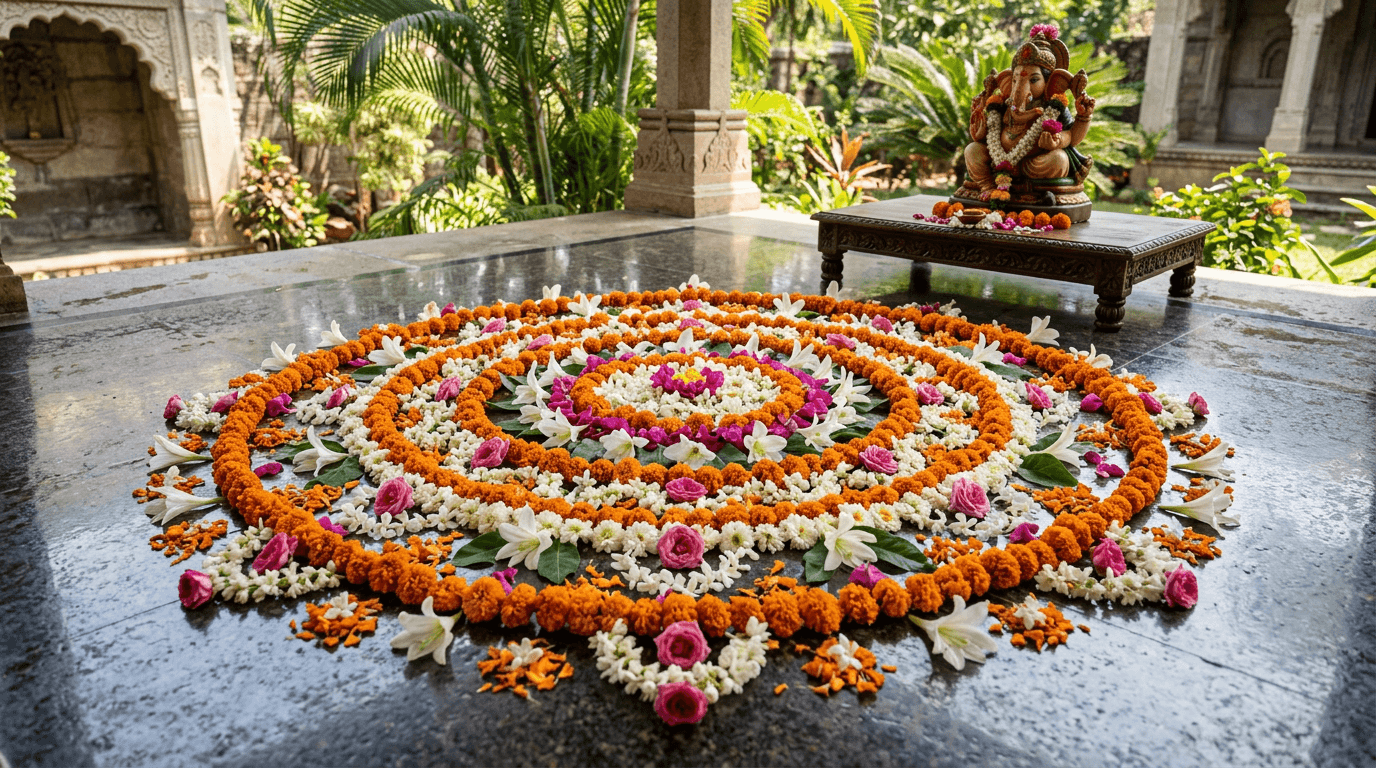
31. Mixed Bloom Carpet
Blooms laid in wide bands of alternating tone leading from the doorway to the platform. Guests walk the path to the Ganesha, which is the entire point.
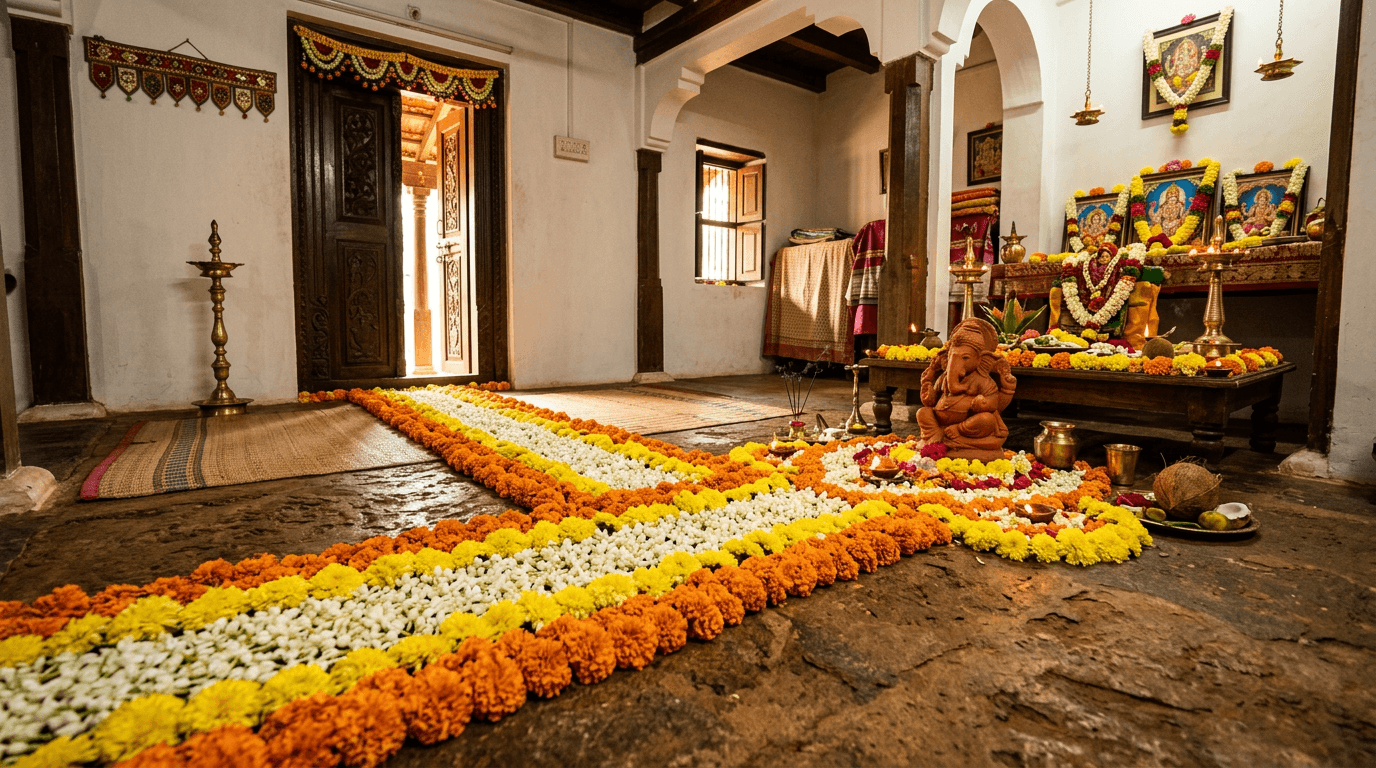
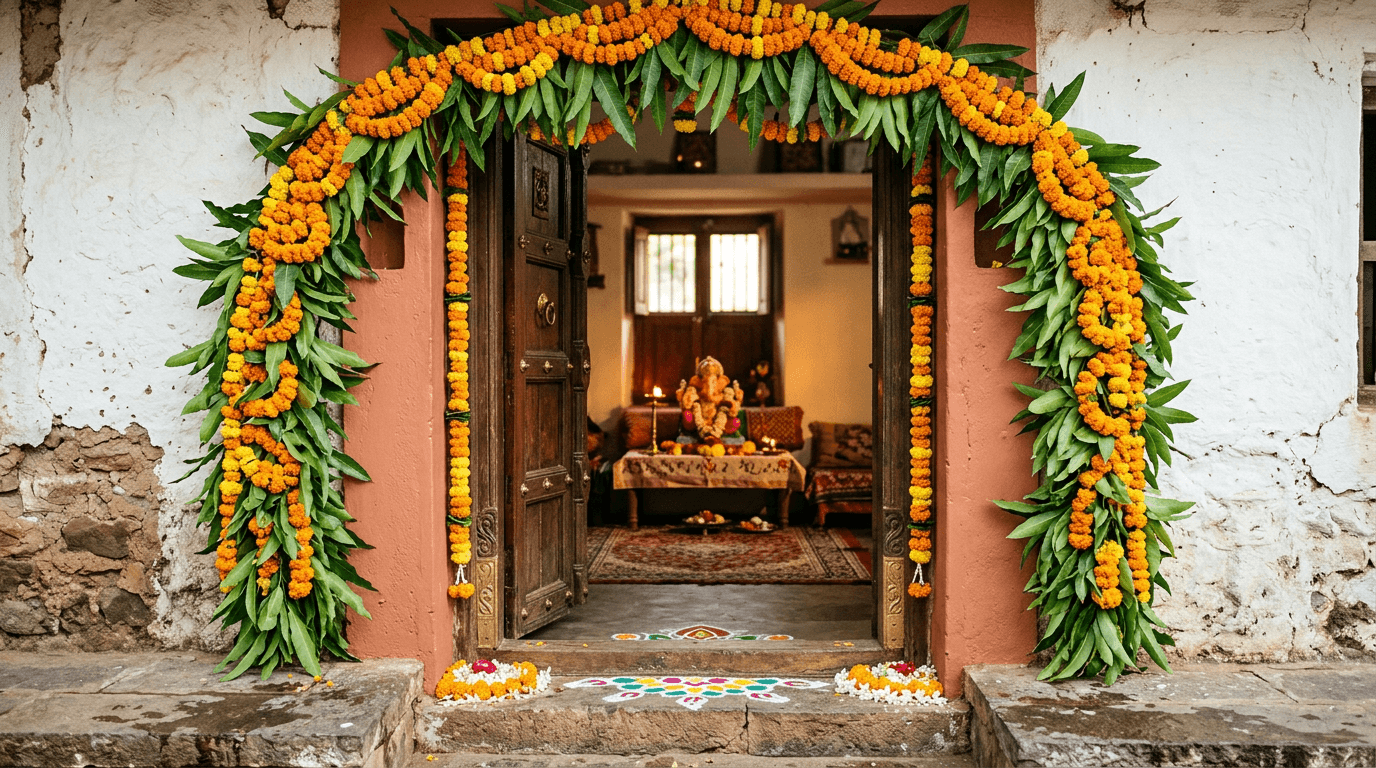
32. Flower Toran Arch
A dense arch of blooms and mango leaves spanning the doorway to the room rather than the wall behind. Announces the setup before you see it.
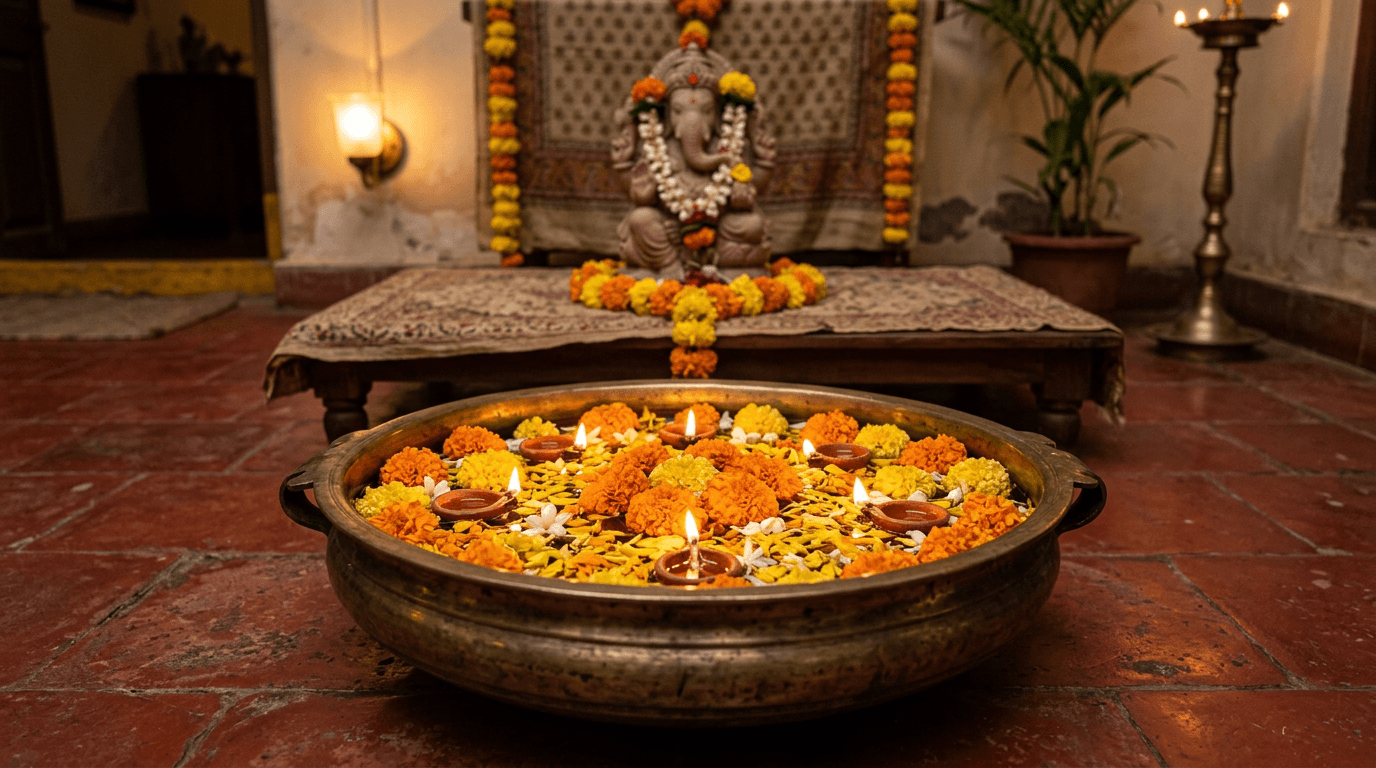
33. Floating Flower Urli
A wide brass urli of water with blooms and small floating lamps, set on the floor at the front of the platform. Two minutes to build, ten days of payoff.
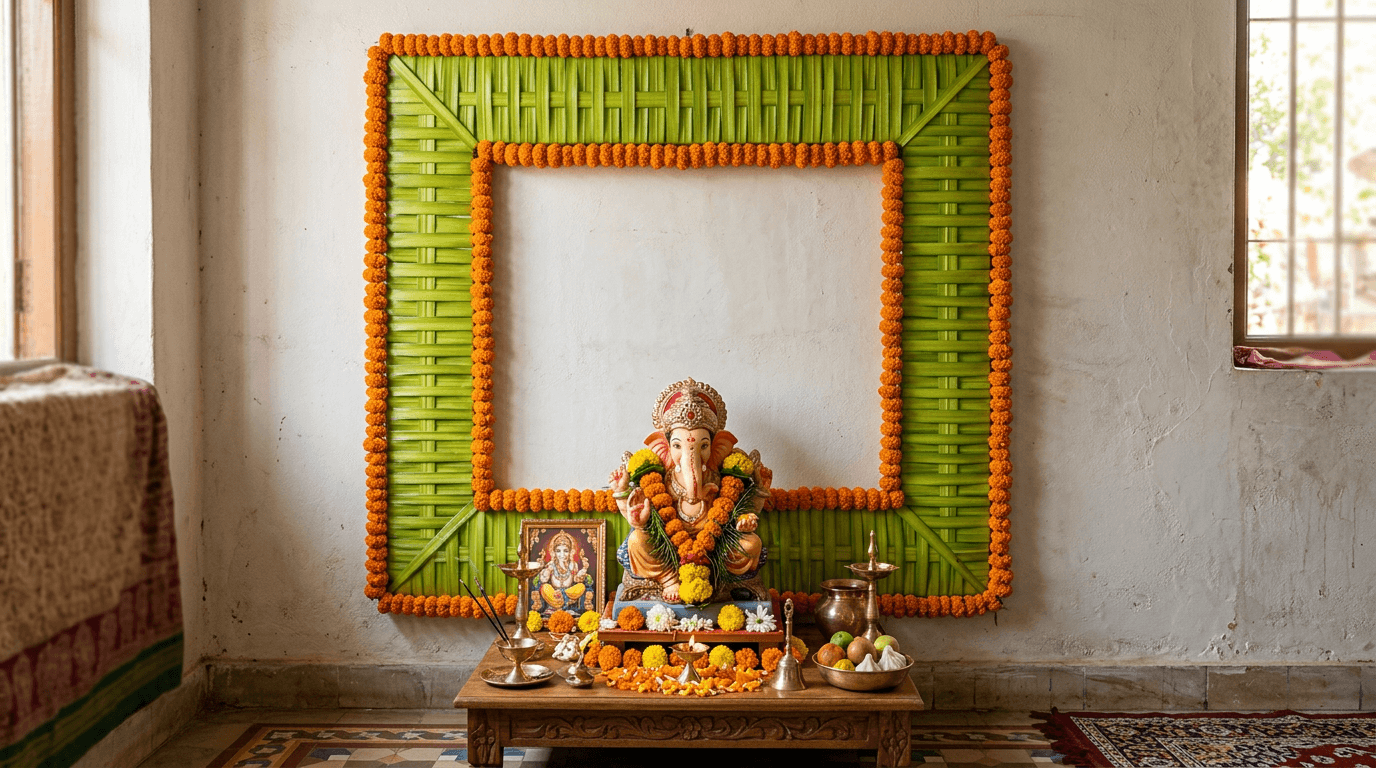
34. Leaf-and-Bloom Frame
A rectangular frame of banana leaf strips edged with flower strings, outlining the wall behind the murti like a picture frame.
Lighting Decoration Ideas: Diyas and Fairy Lights Around the Idol
Lighting is where most home setups go wrong. Cool-white light makes clay look grey and fabric look cheap. Everything below is warm — 2700K or lower — and aimed so the source stays hidden. Warm LED lights and simple fairy lights will do 90% of the job; the decorative work is in where you hide them, not what you buy. Keep the brightest source in front of and slightly above the murti, and keep everything around the Ganpati idol dimmer than the murti itself.
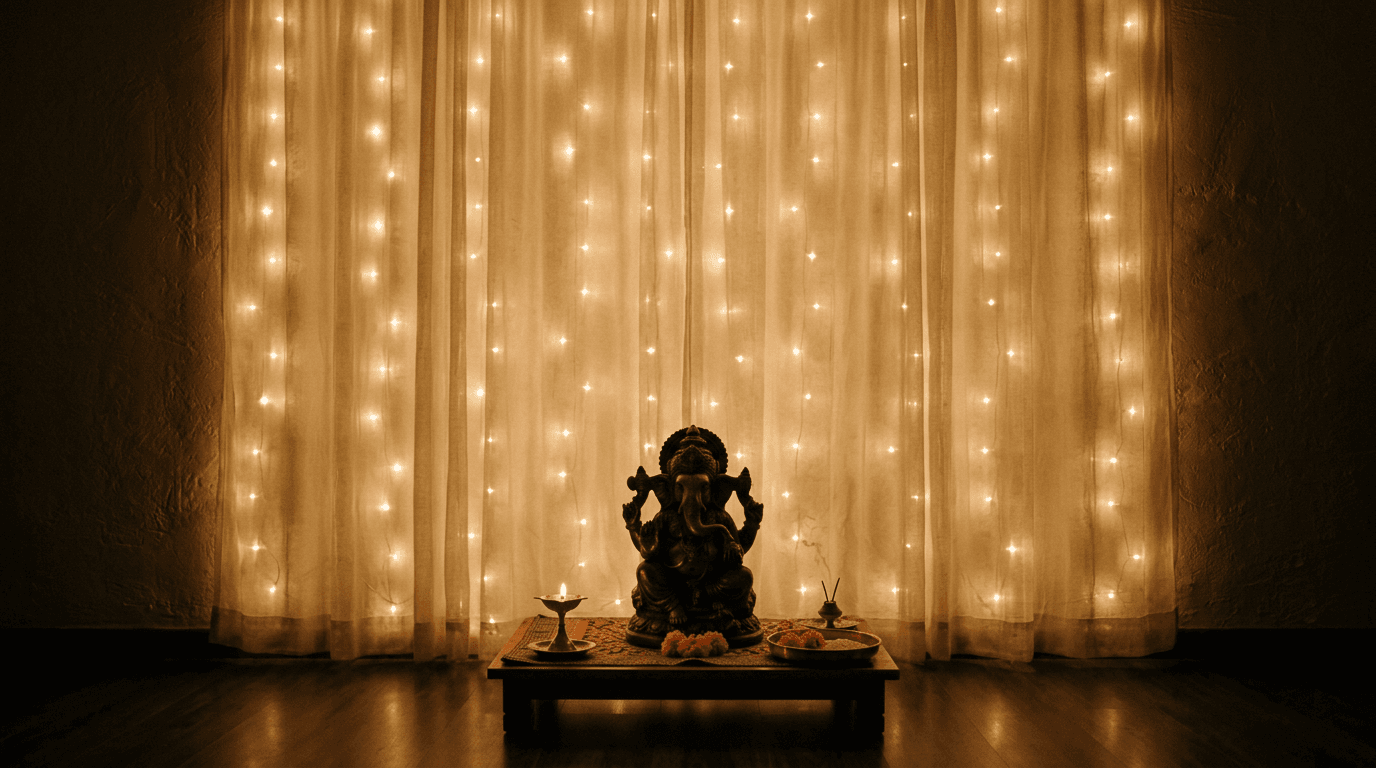
35. Warm String Light Curtain
A curtain of warm string lights hung behind a sheer fabric layer, so you see a glow rather than individual bulbs.
36. Brass Lamp Row
Seven brass oil lamps in a straight line along the front edge of the platform. The oldest lighting idea in the country and still the best-looking.

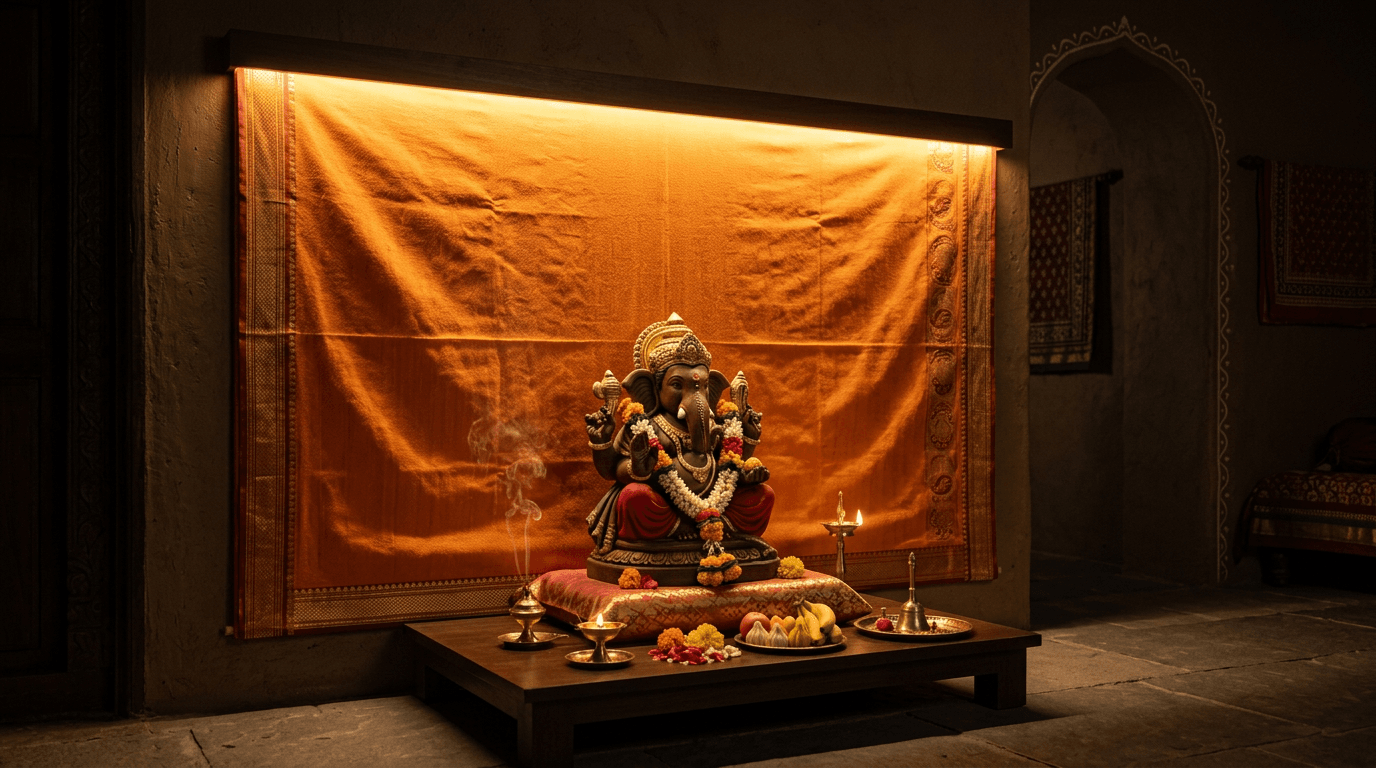
37. Concealed Cove Strip
A warm LED strip taped behind the top edge of the fabric background, washing light downward. Nobody can see where it comes from, which is the trick.
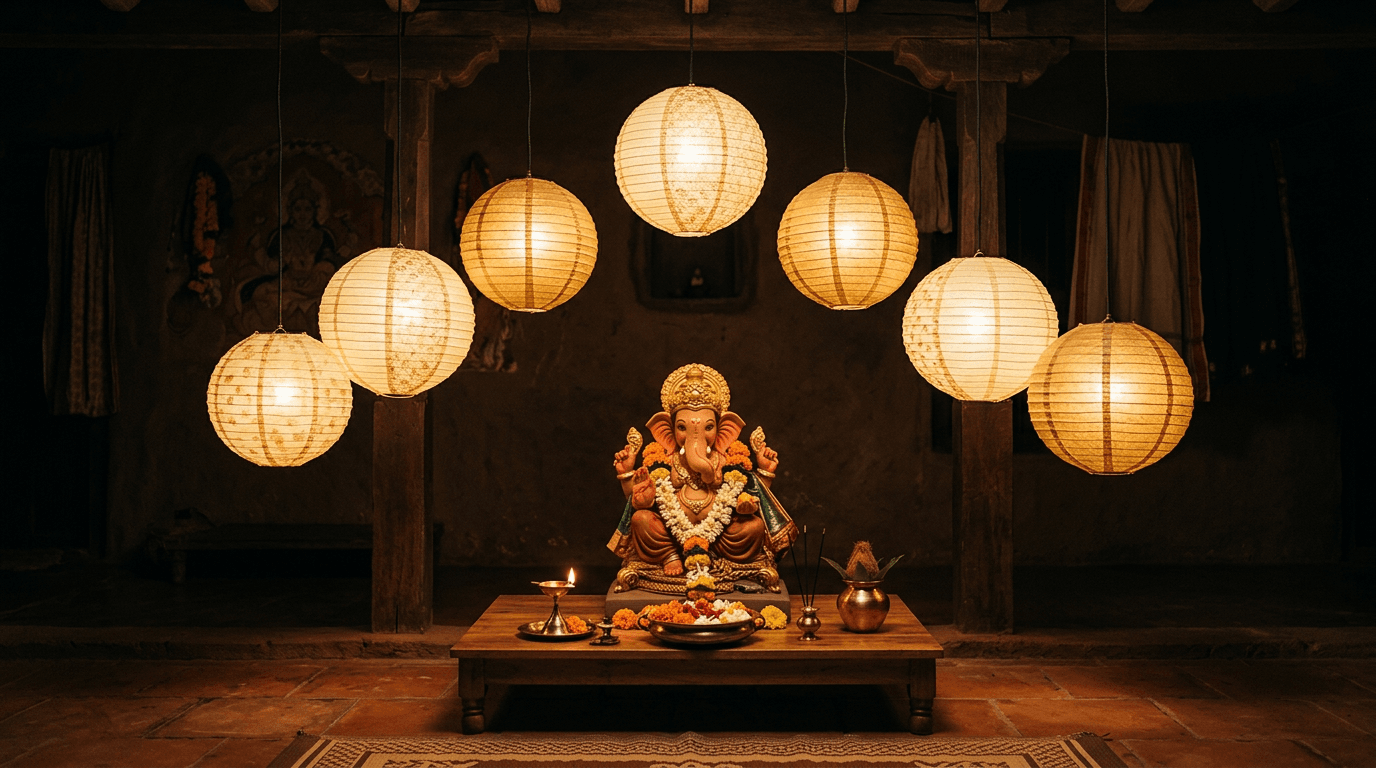
38. Paper Lantern Cluster
Five or six round paper lanterns at staggered heights above the platform. Soft, floaty, and they store flat for years.
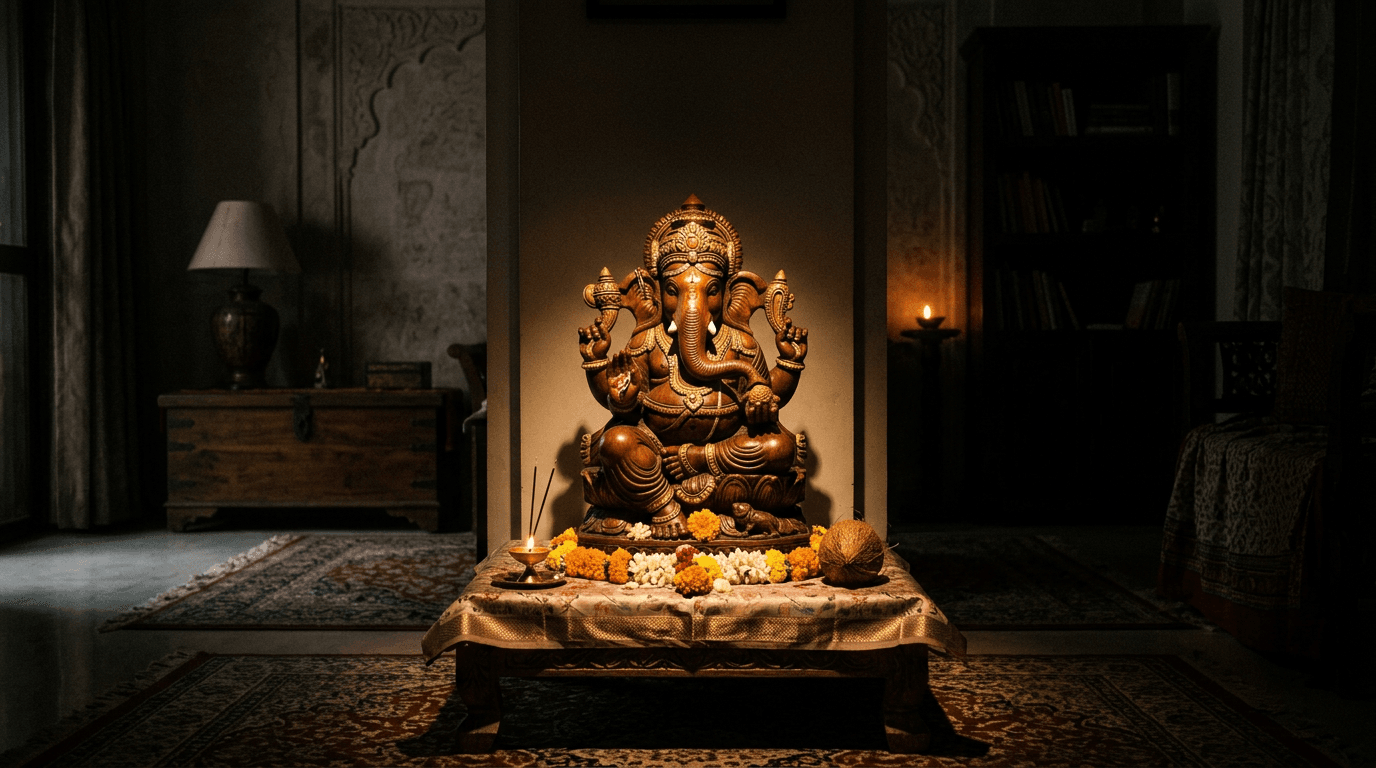
39. Spotlit Ganesha Murti
One small warm spotlight aimed at the Ganesha from the front-left at 45 degrees, everything else dim. Museum lighting, applied to a living room corner.
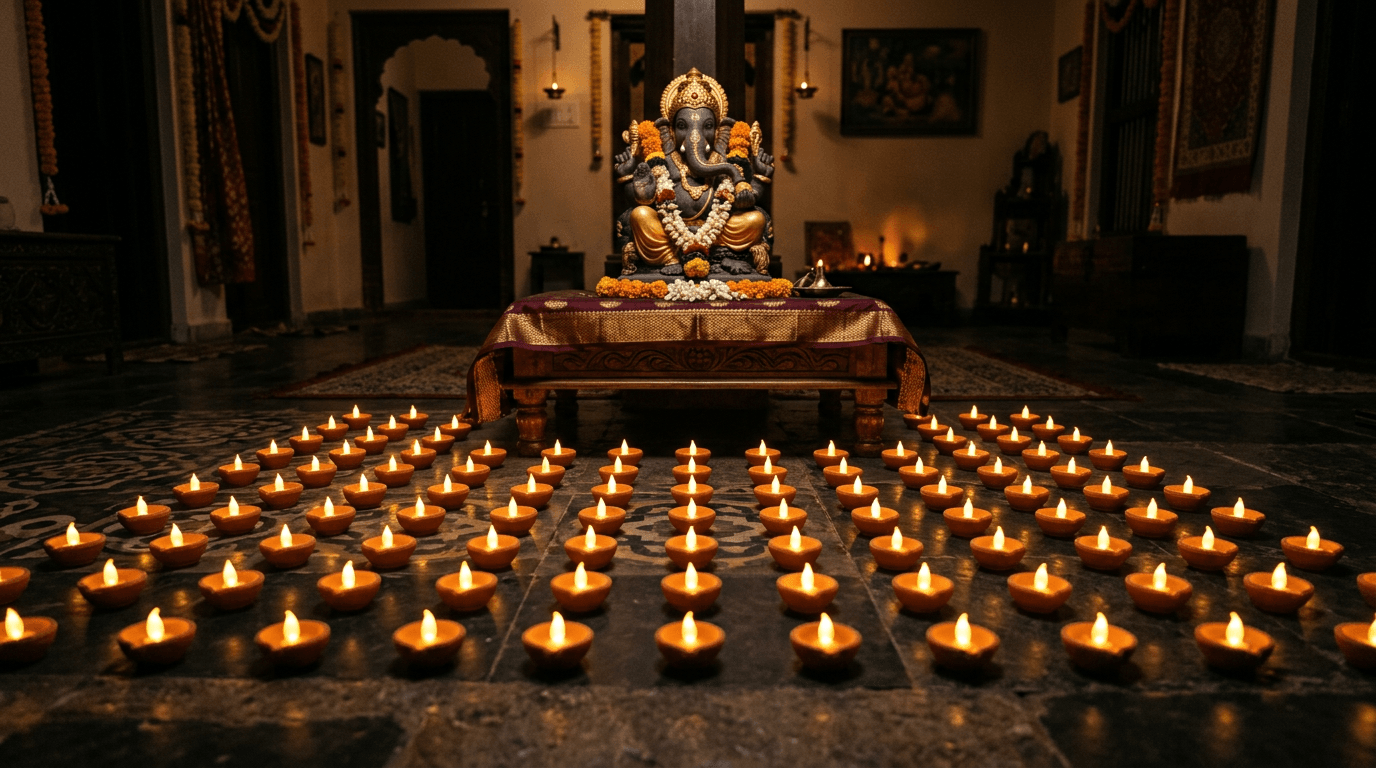
40. Battery Lamp Grid
Flameless battery lamps set in a grid on the floor in front of the platform. The right answer for homes with toddlers, curtains, or both.
Grand Ganpati Mandap Ideas for Big Halls and Societies
These need floor area, two people, and a weekend. We've planned several homes built around large shared family gatherings — one Hyderabad project for the Hamsini family, a five-bedroom home for three generations under one roof, and a pair of homes wrapped around a shared courtyard. In both, the festival crowd was a design input, not an afterthought.
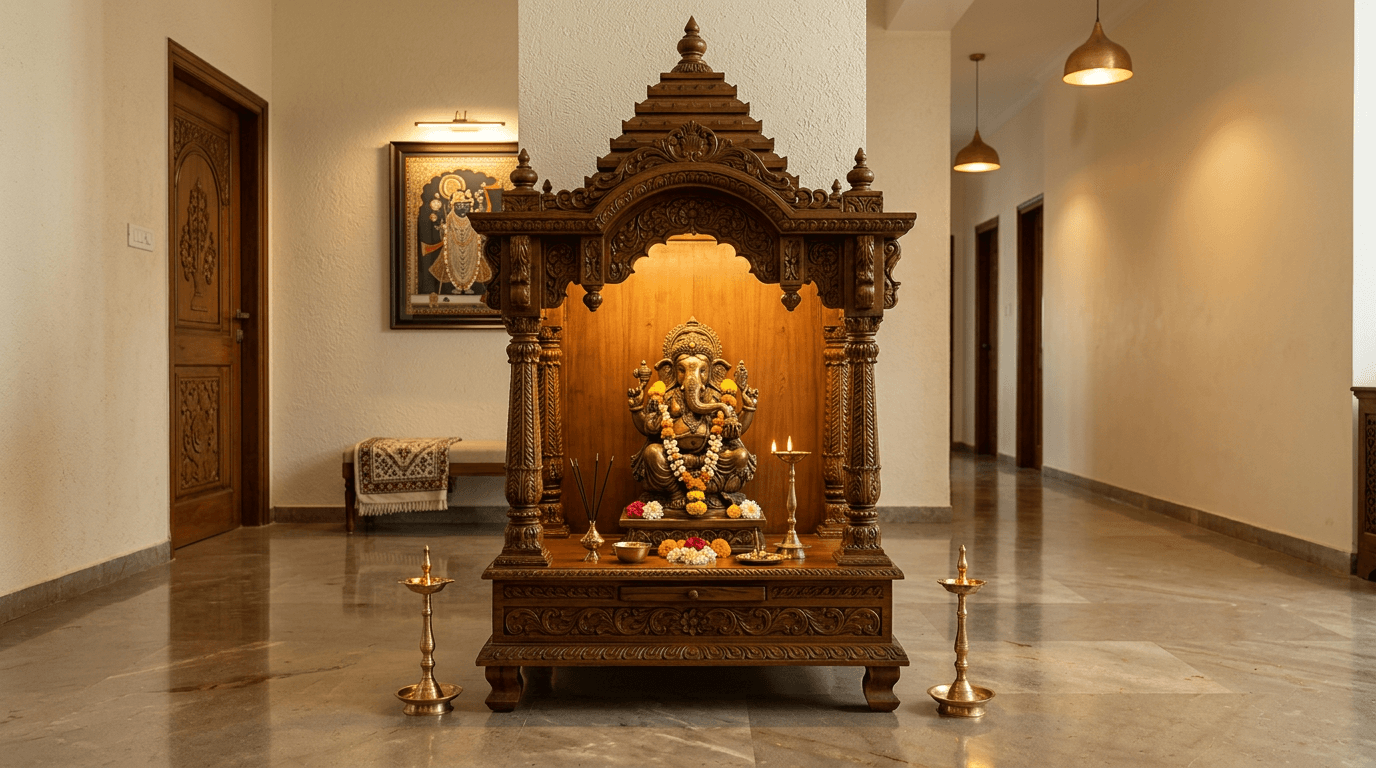
41. Full Wooden Temple Mandap
A carved wooden temple structure, roughly waist to shoulder height, freestanding in the hall. The investment piece — it comes out every year for a decade.
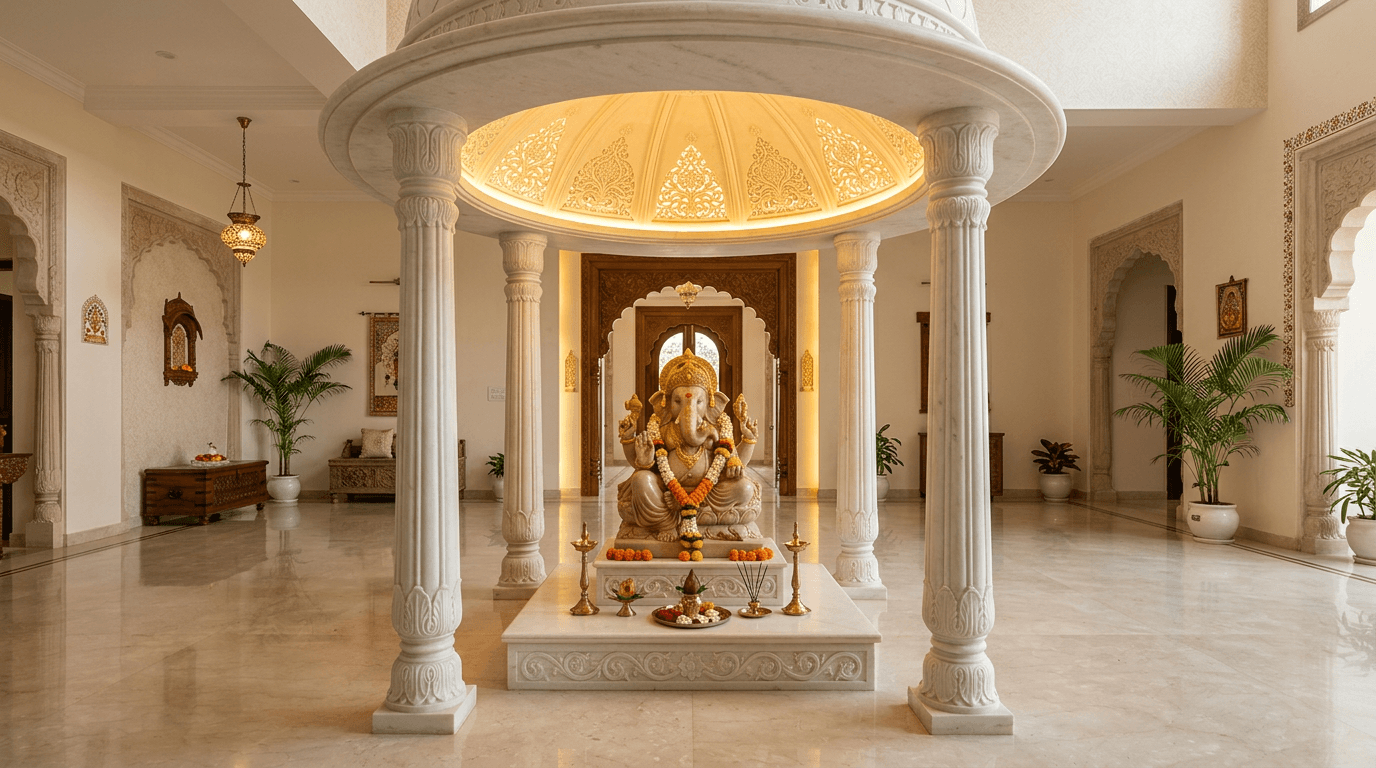
42. Pillared Marble-Look Canopy
Four fluted columns supporting a shallow dome, finished in white marble-look laminate. Reads as permanent architecture and dismantles into six pieces.
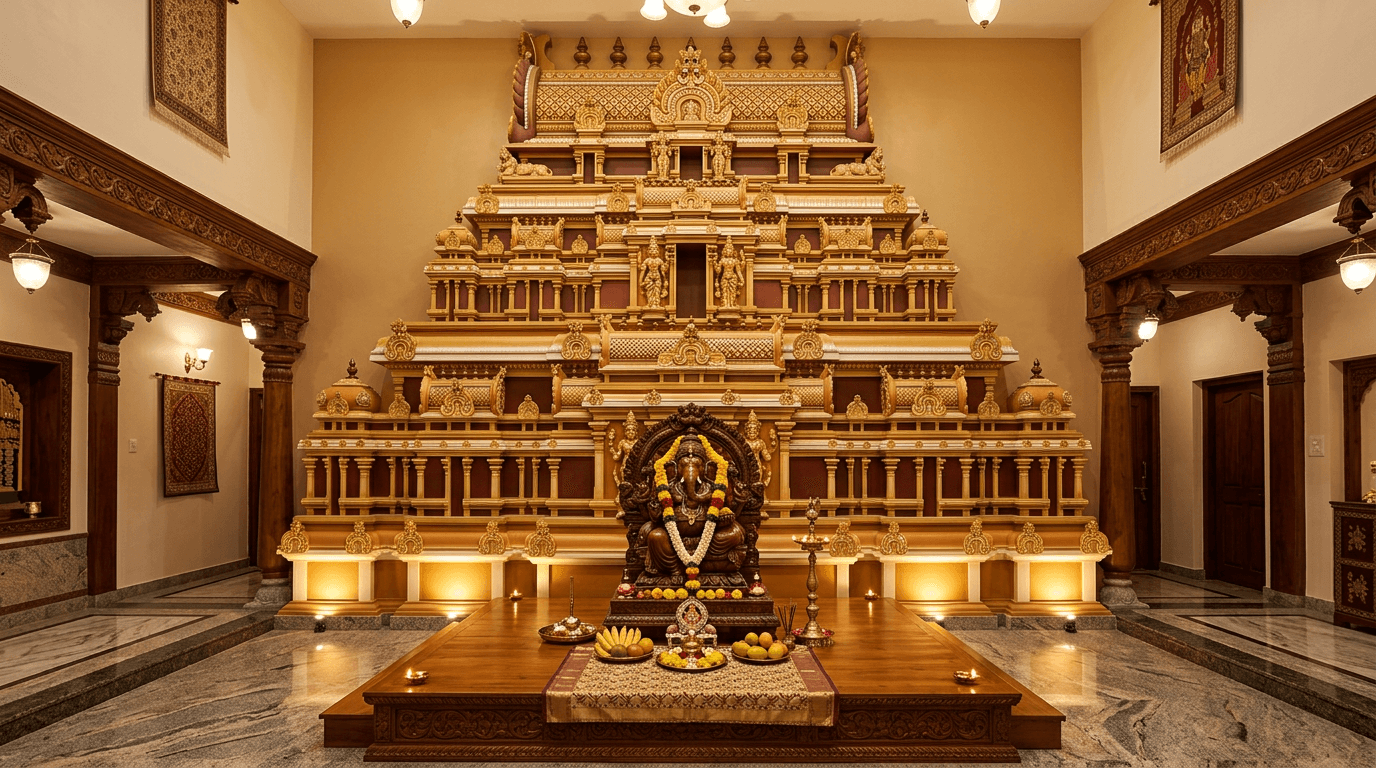
43. Temple Gopuram Background
A tiered South Indian gopuram silhouette built from painted MDF panels, standing the full height of the wall. Big effort, enormous payoff in photographs.
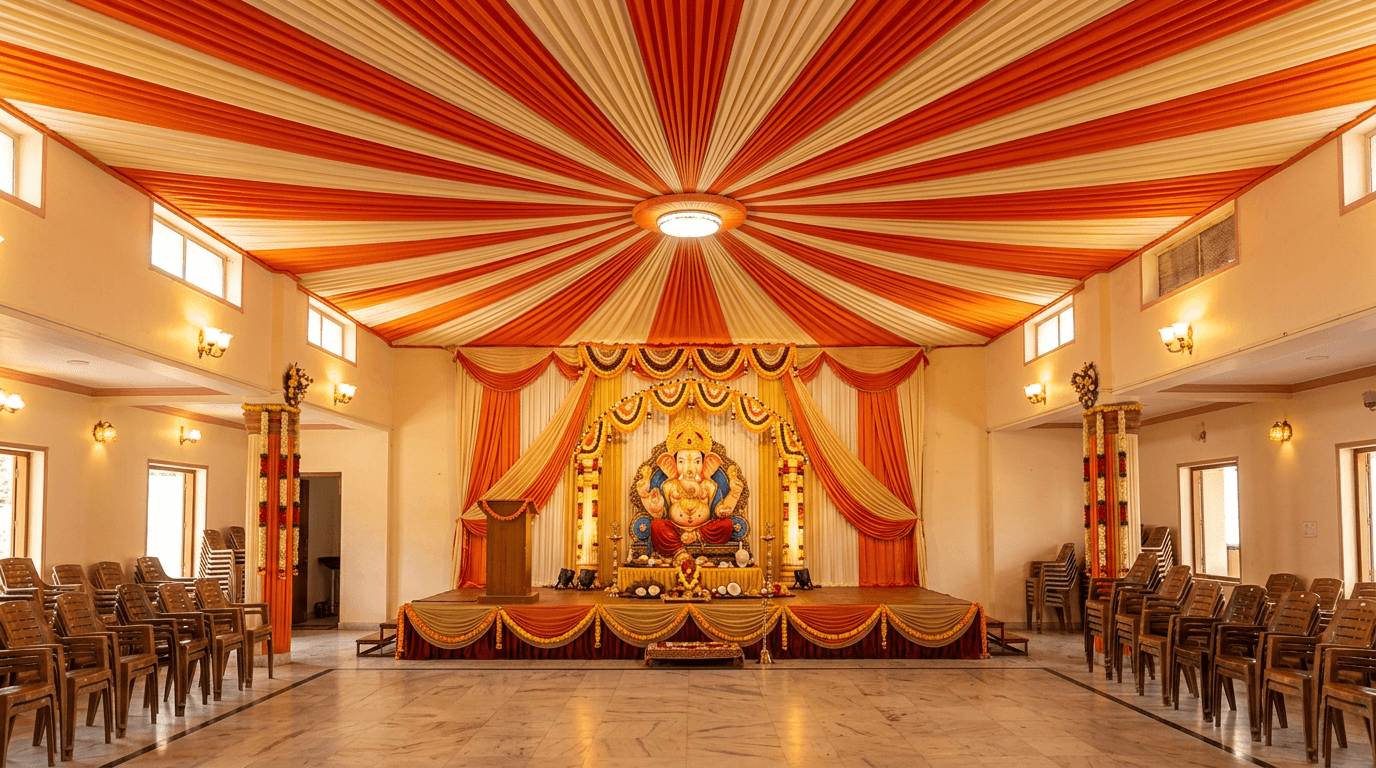
44. Society Fabric Ceiling
For a community pandal: pleated fabric radiating from a central point in the ceiling to the perimeter. It turns a bare hall into a room in one afternoon.
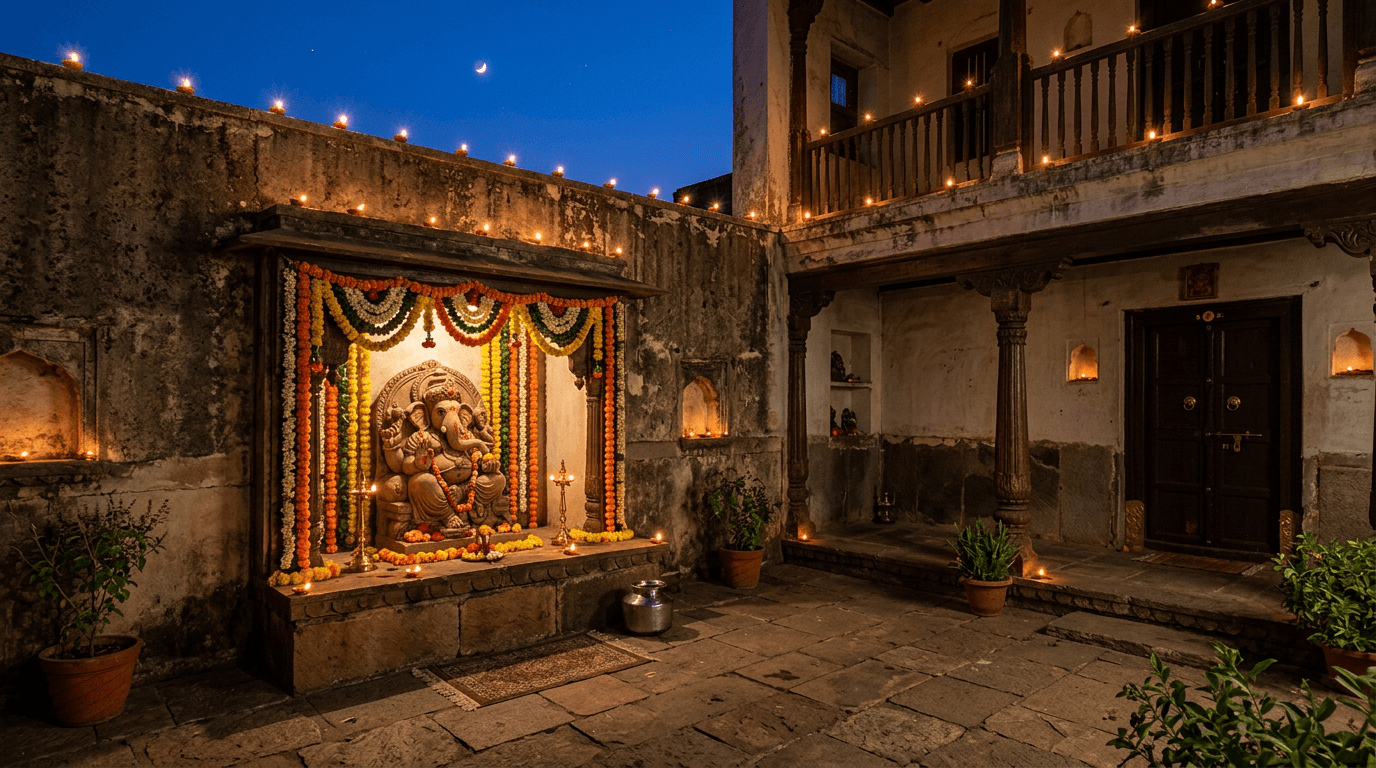
45. Courtyard Open-Air Setup
If the home has a courtyard, use it. Open sky above, lamps along the parapet, and the Ganesha placed against the one solid wall.
Homemade Ganpati Decoration Ideas Kids Can Help With
The rule for these is simple: if a nine-year-old can't finish it, it doesn't belong in this list. These are the Ganpati decoration ideas for Ganesh bhakts in the making, and the ones children actually remember.
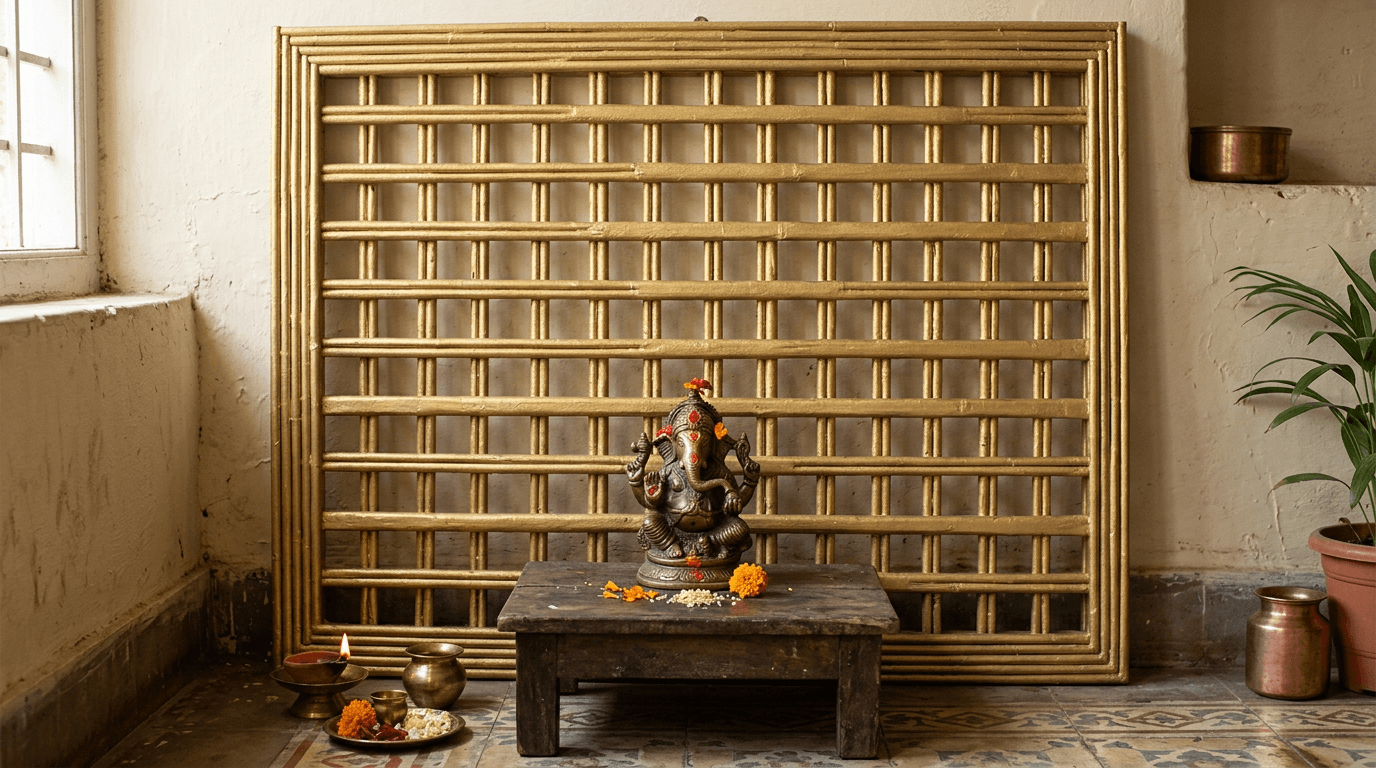
46. Newspaper Roll Frame
Tightly rolled newspaper tubes glued into a lattice frame, then painted one flat tone. Structural, free, and entirely made from the recycling pile.
47. Painted Bottle Lamps
Glass bottles painted and fitted with battery lights inside, grouped at the base of the platform. The best possible use for last month's empties.

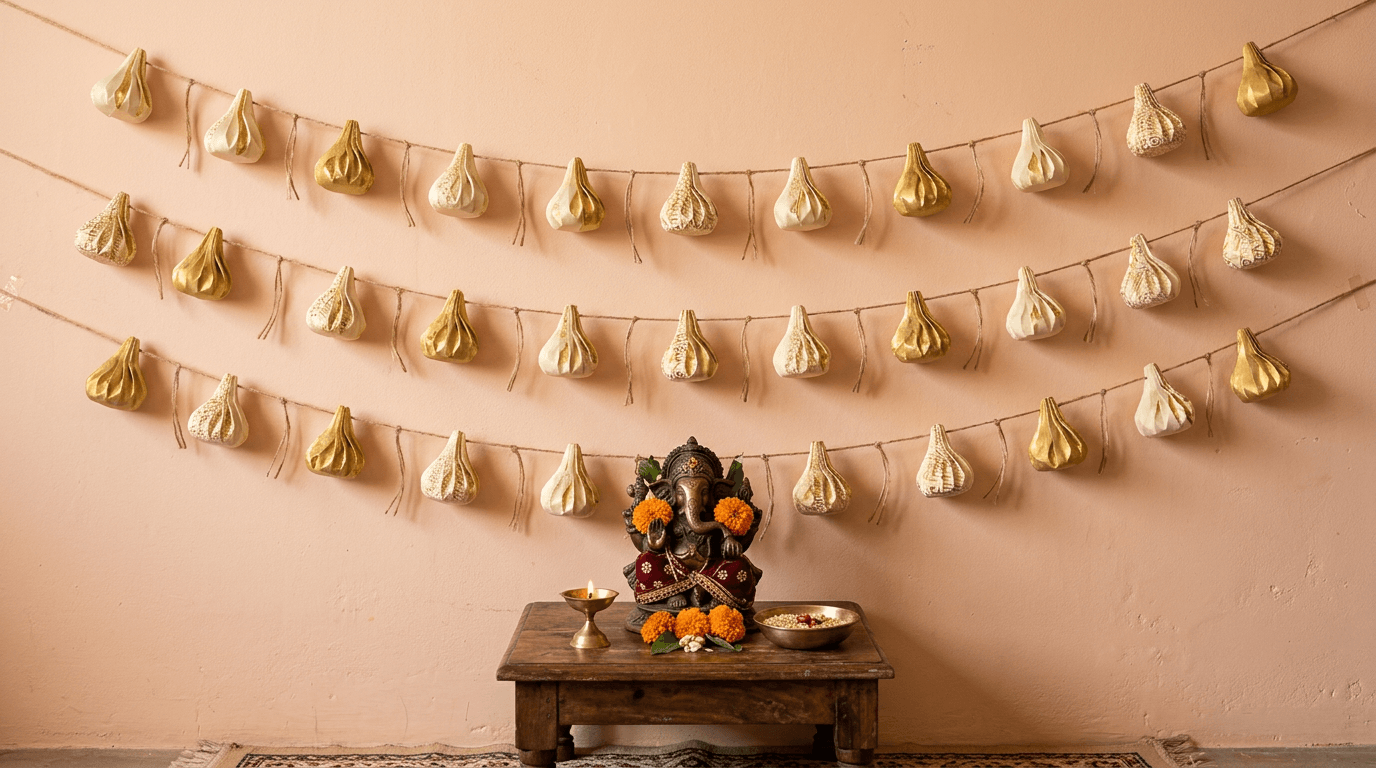
48. Modak Paper Bunting
Paper modak shapes strung into bunting across the wall. Children get the reference immediately, which makes them want to make forty of them.
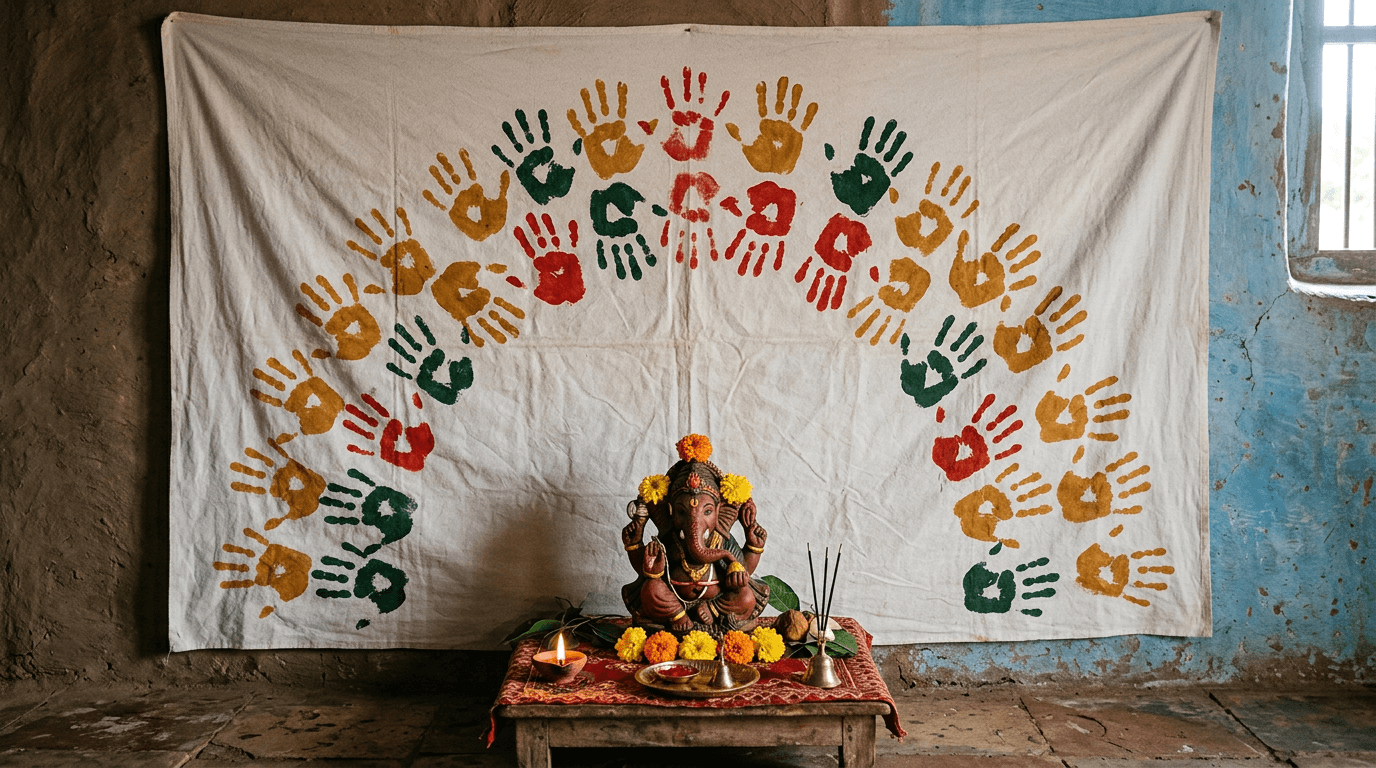
49. Handprint Canvas
A plain cotton sheet covered in the family's painted handprints arranged in an arch. It is not subtle and nobody minds.
50. Recycled Box Step Platform
Cardboard cartons stacked into three tiers, wrapped in cloth, making a stepped plinth for the Ganesha, lamps, and offerings.
Unique Ganpati Decoration Ideas Worth Copying This Year
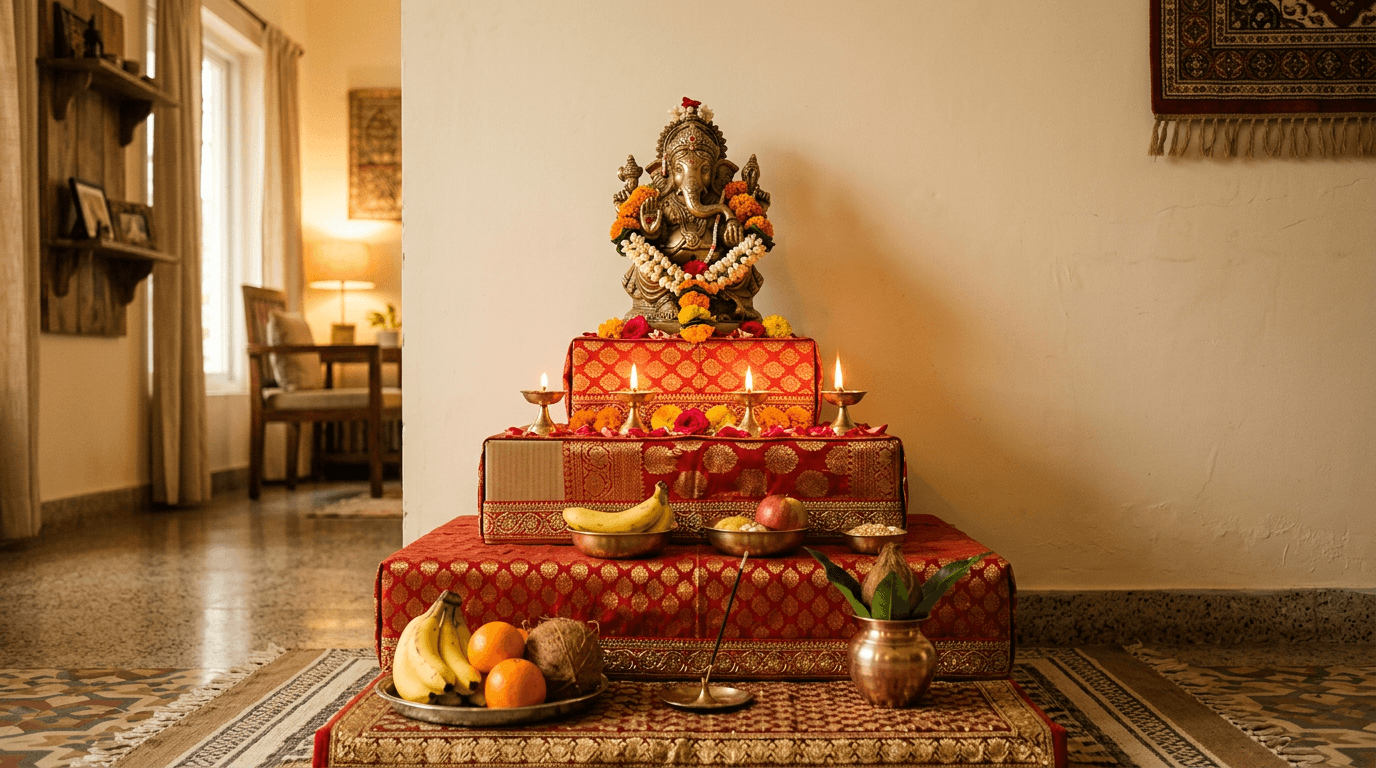
If you want to explore innovative Ganpati decoration ideas rather than repeat last year's, these five are the ones our design team keeps coming back to. They're the most creative Ganpati decoration moves on the list, none of them is expensive, and all of them count as beautiful Ganpati decoration ideas by the only test that matters — how the corner looks at 8pm with the lamps lit.
- The jali shadow wall (idea 24). The pattern on the wall is made of light, not material. It is the most beautiful Ganpati decoration effect here for the least money.
- The seed-paper curtain (idea 8). Decor you plant afterwards. Children remember this one.
- The single hoop (idea 25). One shape, one flower type, nothing else. Restraint reads as design.
- The bloom path (idea 31). It uses the floor, which almost every setup forgets is a surface.
- The reusable frame (idea 42). Build the frame once, re-dress it every year. Of all the best Ganpati decoration ideas here, this is the one that pays you back — and it makes the Ganpati decoration ideas for 2026 and beyond a two-hour job instead of a two-day one.
The common thread: each does one thing completely instead of five things partially. That is genuinely the whole secret to a good Ganesh decoration at home, and it's the Ganesh decoration idea we give every client who asks. It holds whether you're planning a setup for a studio flat or a full Ganesh Chaturthi decoration idea for a bungalow — one strong move, finished properly.
Trending Ganpati Decor Ideas and Decoration Themes in 2026
Four things we're seeing more of this year, across both client homes and the wider Indian decor conversation:
- Single-material setups. All paper, or all fabric, or all clay. The discipline reads as expensive even when it isn't, and it's the decor idea that separates a designed corner from a decorated one.
- Muted palettes. Ochre, ivory, sage, and dull gold instead of the full saturated spectrum. This single decor choice photographs better on a phone camera than any other.
- Reusable armatures. A frame or plinth built once and re-dressed each year with different fabric and flowers. The same chowki can be used for Ganpati one month and everyday puja the next.
- Plantable and compostable materials. Seed paper, clay, and leaf structures — driven by the same civic pressure that pushed clay idols into the mainstream.
Materials Compared: Eco-Friendly Decoration Instead of Thermocol
Thermocol is banned or discouraged in many Indian municipalities and doesn't biodegrade. Here's what actually replaces it, honestly compared.
| Material | Best for | Effort | Reuse | Watch out for |
|---|---|---|---|---|
| Corrugated cardboard | Cut-out arches, tiered plinths | Low | One season | Sags in humidity; keep it away from water |
| MDF / plywood | Carved panels, jali screens, boards | High (needs cutting) | Many years | Heavy; needs proper wall fixing |
| Cotton and khadi fabric | Backdrops, canopies, plinth skirts | Low | Indefinite | Creases show badly — steam it first |
| Cane and jute | Screens, hoops, frames | Medium | Many years | Splinters; sand the edges |
| Flowers and leaves | Frames, strings, floor patterns | Medium | Two to three days | Buy the morning of, not the night before |
| Clay and terracotta | Murtis, pots, lamps | Low | Pots reuse; murti dissolves | Unfired clay stains fabric — use a tray |
| Paper | Blooms, fans, lanterns, bunting | Medium | Store flat, reuse | Fire risk near flames — keep 300 mm clear |
Where to Place the Ganpati Idol: Size, Layout and Vastu
Vastu is straightforward here, and it agrees with common sense more often than people expect.
- Direction: the north-east (Ishanya) corner is the traditional choice, with the idol facing north or east so devotees face the opposite way while praying.
- Avoid: shared walls with a bathroom, the space under a staircase, and any spot directly facing a main door.
- Height: the murti's eyes should sit slightly above the eye level of someone seated on the floor. Roughly 450–600 mm off the ground for a floor-seated aarti.
- Clearance: leave at least 600 mm of clear floor in front for aarti and prostration. This is the measurement people forget, and it's the one that ruins a beautiful setup.
- Scale: the Ganesha should occupy about a third of the visual height of the background behind it. Bigger, and the background stops working; smaller, and it looks lost.
Get this right and a Ganesh murti sits comfortably in a Ganapati home for ten days without anyone having to move furniture twice a day. Placement is where seasonal setups and permanent design meet. On a Hyderabad project — a 1000 sft apartment bought from a previous owner whose family had entirely different ritual needs — reworking the pooja provision was one of the first things the new owners asked for. If you find yourself fighting the same corner every festival, that's a design problem, not a decoration problem. Our guide to pooja room designs covers the permanent version, and pooja room vastu goes deeper on direction rules.
What a Ganpati Decoration Actually Costs
Nobody can quote you a number without knowing the size of your setup, so here are the cost drivers instead, in the order they actually matter:
- Flowers. The largest recurring line, and it scales directly with wall area. A dense flower-string wall costs several times what a fabric background costs.
- The murti. Size and craftsmanship, not material, drive this. A large hand-finished clay idol is the single biggest one-off item in most home setups.
- Structure. Anything that needs cutting, carpentry, or fabrication. This is where reusable armatures pay for themselves in year two.
- Lighting. The cheapest thing on this list to do well, and the most expensive to do badly with proprietary fittings you'll use once.
- Labour. If you're hiring help for a large mandap, it's usually charged by the day, and setup plus takedown is two days minimum.
A useful rule: put the budget into the background and the flowers, and borrow or improvise everything else.
Mistakes to Avoid
- Cool-white lighting. It makes clay look ashen and fabric look synthetic. Warm light only.
- Blocking the aarti path. Beautiful setups that leave no room to stand get rearranged on day two.
- Nailing into the wall. Removable adhesive hooks and tension rods do the same job without the patch-up job in October.
- Buying flowers the night before. They wilt. Buy on the morning of the installation.
- Open flames near paper or sheer fabric. Every year this ends badly for someone. Keep 300 mm of clearance or switch to battery lamps.
- One more idea. When the setup looks nearly right, stop. The last addition is almost always the one that ruins it.
After Visarjan: Store, Recycle and Reuse Your Ganpati Decorations
Immersion day for 2026 is 25 September, and the setup comes down that evening. What survives:
- Fabric: wash, fold, label the box with the size. Sarees used as backdrops go straight back into the cupboard.
- Paper elements: fans, lanterns, and bunting store flat between two sheets of cardboard. Ours have lasted several seasons.
- Frames and plinths: the reason to build in MDF or cane rather than cardboard. Label which piece goes where before you dismantle, or next year is a puzzle.
- Flowers and leaves: compost them. Don't put them in the general waste bin, and never in a water body.
- Lights: coil them around a piece of cardboard rather than into a ball. This single habit saves an hour every year.
Storage is exactly the small-home problem we solve in interiors work all the time — on our 600 sft Tarnaka studio apartment project, the whole brief was maximum storage in minimum footprint. One labelled 60-litre box on a loft shelf holds an entire festival setup.
Ganpati Decoration FAQs
How Do I Do Ganpati Decoration at Home Without Using Thermocol?
Use cardboard for cut shapes, MDF or plywood for anything structural, cotton or khadi fabric for backgrounds, cane and jute for screens, and clay or terracotta for pots and lamps. All of them can be cut, painted, and shaped the same way, and all of them either compost or get reused. Cardboard is the closest direct substitute for cut-out arches.
Which Flower Is Best for Ganesh Chaturthi Decoration?
Marigold is the workhorse — cheap, available everywhere, and it holds its colour for days. Mogra adds scent. Hibiscus is the bloom most closely associated with offerings to Lord Ganesha, and durva grass is the traditional offering placed on the Ganesha itself.
How Can I Make a Simple DIY Ganpati Background at Home?
Hang a saree or dupatta flat against the wall with adhesive hooks, pleat it at the top for depth, and edge it with flower strings. Add warm string lights behind the fabric rather than in front. That's a complete background in under an hour with things most Indian homes already own.
What Are the Vastu Guidelines for Placing the Ganpati Idol?
Place it in the north-east corner of the home, facing north or east. Avoid walls shared with a bathroom, the area under a staircase, and any position directly facing the main entrance. Keep the idol raised off the floor and leave clear space in front for aarti.
How Many Days Before Ganesh Chaturthi Should I Start Decorating?
Build the structure — background, platform, lighting — two to three days ahead. Add flowers on the morning of the installation itself. For 2026 that means the structure by 12 September and flowers on the morning of the 14th.
Can I Reuse Last Year's Ganpati Decorations?
Yes, and the good setups are designed for it. Frames, plinths, fabric, paper elements, and lighting all reuse. Only the flowers, leaves, and the murti are single-season. Re-dressing a reusable frame with different fabric each year is the cheapest way to get a genuinely new look.
Get This Look in Your Home: Free Design Consultation
Bringing Bappa home is a few days a year. Most of these ideas are ten-day setups. But if you're building or renovating, the pooja corner deserves to be planned in properly — the right wall, the right direction, the right storage for everything you put away on visarjan day.
Roomantic designs and builds homes across Hyderabad, Bangalore, and beyond, with 30+ projects across residential, commercial, and institutional work. If you want more ideas for your home beyond the festive weeks, our design team plans these corners for a living. Every project starts with 3D visualisation, so you see the space before anything is built. Book a free design consultation and we'll plan yours.
For year-round decor, see our home decor ideas guide. For the next festival on the calendar, our Diwali decoration ideas. And for everyday styling of the same corner, pooja room decoration.
Written by Karthik M, Chief Designer at Roomantic. IIT Guwahati Design alumnus focused on interiors, 3D visualization, and design-build workflows.
