Key Takeaways
- A good pooja room design comes down to three choices: the format (dedicated room, corner unit, or wall-mounted mandir), the material (wood, marble, Corian, or jaali), and the lighting. Get those three right and the rest is styling.
- 2026 costs: ready-made wooden temples start around ₹8,000, built-in units typically run ₹15,000 to ₹1,00,000, and a full custom mandir room starts near ₹5,00,000 (MakeMyMandir, 2026).
- Our verdict as architects: most flats and many new homes are better served by a generous backlit niche or wall-mounted mandir than a cramped 4x4 ft "room". Reserve the dedicated room for plans that can give it 5x7 ft and real ventilation.
Introduction: Designing a Pooja Room in a Modern Indian Home
A pooja room (also written puja room) is a dedicated sacred space in an Indian home for daily worship, meditation, and festival rituals. Pooja room design in 2026 takes one of three formats: a dedicated room, a corner or cabinet unit, or a wall-mounted mandir. Built-in designs typically cost ₹15,000 to ₹1,00,000, while full custom mandir rooms start around ₹5,00,000 (MakeMyMandir, 2026).
Here's what we've noticed across our residential projects: the pooja space is the one room where the client's parents, spouse, and children all have opinions. Everything else gets delegated. This doesn't.
And honestly? It deserves that attention. It's the only space in the house designed for stillness.
But most families walk into it with two bad inputs: a Pinterest board of palace-sized marble temples, and a floor plan with maybe 16 square feet to spare. Whether you're planning your dream home from scratch or restyling a flat, the right design comes from matching the space available to how your family actually prays, not from copying a photo. This guide closes that gap. We'll cover the three formats and when each one actually works, 15 designs organised by home size, materials with real price bands, lighting (where most budgets should go, and don't), idol and lamp placement, storage solutions, vastu essentials, doors, and honest 2026 costs.
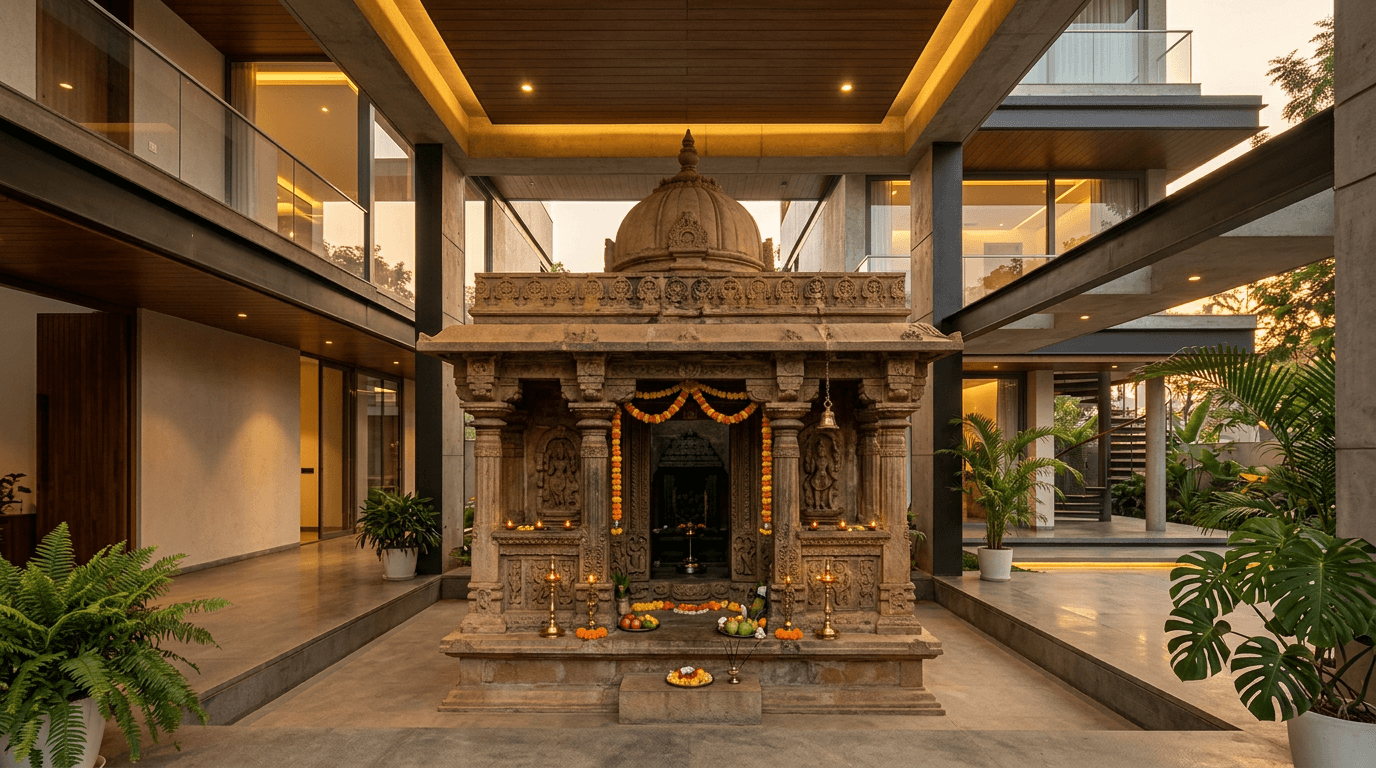
One project shaped how we think about this. When Mr. Prashanth Reddy came to us for his 320 sq yard Hyderabad residence, the brief had an unusual anchor: the family's hereditary temple had to stay intact on the ground floor of an otherwise futuristic home. Not a niche. Not a unit. A functioning family temple, preserved inside a new luxury build with rental flats above. We'll come back to what that taught us about giving a sacred space real architectural weight instead of leftover square footage.
Pooja Room Types: Dedicated Room vs Corner Unit vs Wall-Mounted Mandir
There are three pooja room formats: a dedicated room (best above 5x7 ft with ventilation), a corner or cabinet unit (2 to 4 ft wide, fits living or dining areas), and a wall-mounted mandir (zero floor area, ideal for flats). Match the format to your floor plan first, budget second.
| Format | Space needed | Typical cost (2026) | Best for |
|---|---|---|---|
| Dedicated room | 5x7 ft minimum, ventilated | ₹1,50,000 to ₹5,00,000+ | Independent homes, villas |
| Corner / cabinet unit | 2 to 4 ft wide footprint | ₹30,000 to ₹1,25,000 | 3BHK flats, larger living rooms |
| Wall-mounted mandir | Zero floor area | ₹8,000 to ₹50,000 | 1-2BHK flats, rentals, compact homes |
Now for the part that gets us into arguments with clients' relatives.
Most families should not default to a dedicated pooja room. We know that sounds wrong coming from architects who could bill for the extra room. But we've reviewed too many floor plans where a 4x4 ft "pooja room" was wedged between a passage and a toilet wall because the family insisted on a separate room with a door they could close. That room fails at everything. Two people can't sit in it. Diya smoke has nowhere to go, so the AC ends up recirculating it. And it permanently stole 16 sq ft of floor space from a kitchen or wardrobe you'd use every single day.
A generous niche or wall-mounted mandir, detailed properly, reads more sacred than a cramped room. Give it a full-height marble or wood backdrop, a jaali screen for depth, warm backlighting, and a clean stone ledge. Sanctity comes from focus and light, not from a door. The pooja area becomes a focal point of the home's interior design instead of a closet nobody enters.
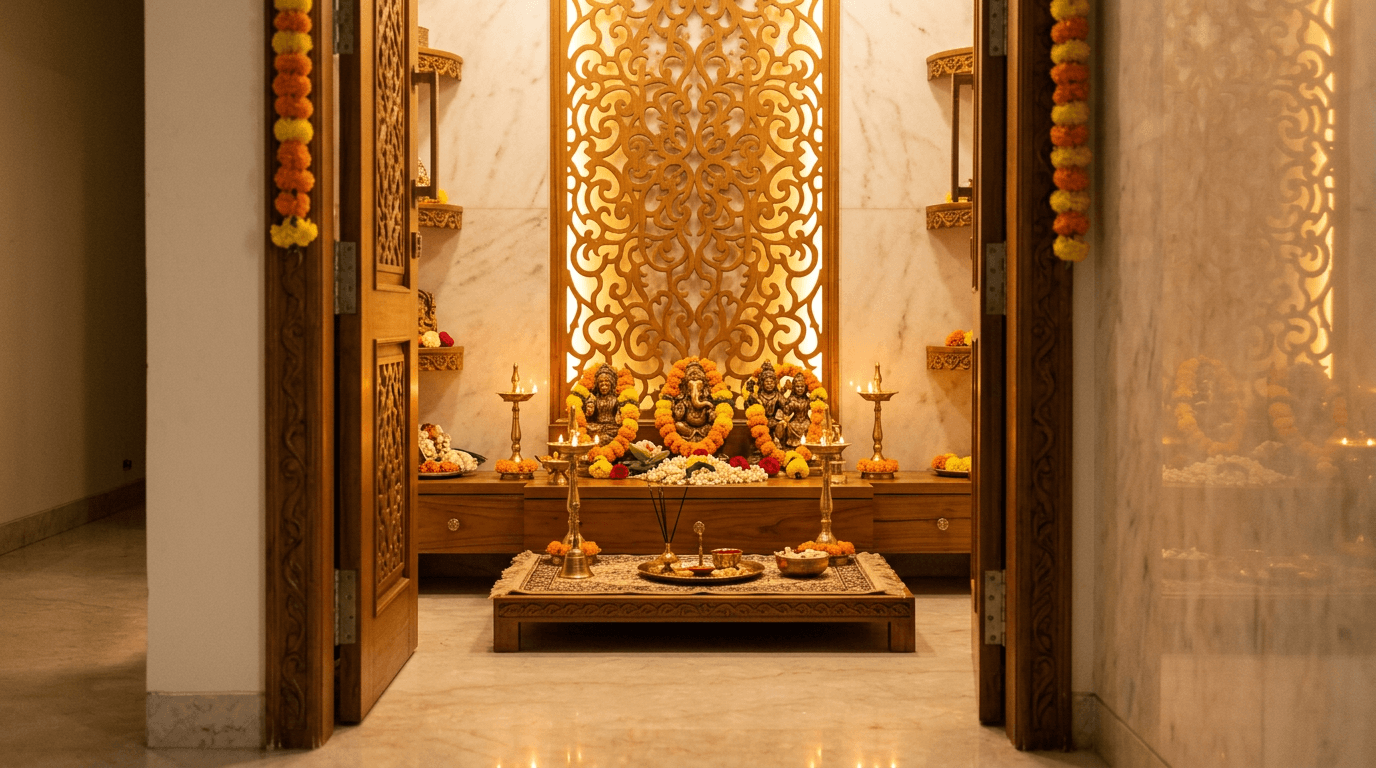
When does the dedicated room earn its place? When the plan can give it at least 5x7 ft, a window or exhaust for ventilation, and a location that isn't a leftover. In the Reddy residence, the ancestral temple got exactly that: a proper ground-floor position that the rest of the futuristic home was organised around, not squeezed behind. That's the standard. If your plan can't meet it, a beautifully detailed mandir design for home as a unit or wall piece is the stronger choice, and flat owners should go straight to our guide on small pooja room designs for apartments.
15 Pooja Room Design Ideas by Home Size (Photos)
Here are the top 15 pooja room design ideas for 2026, grouped by home size:
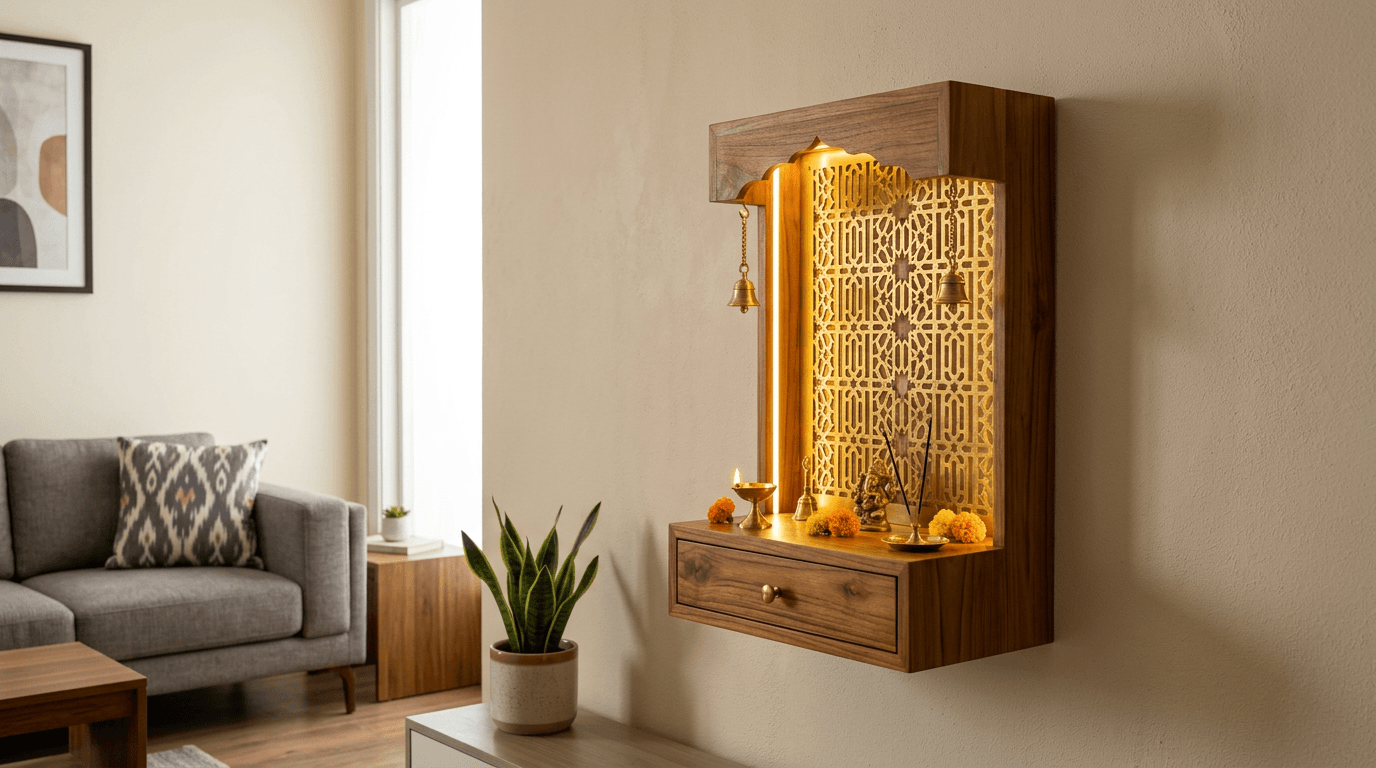
- Wall-mounted jaali-back mandir (1-2BHK)
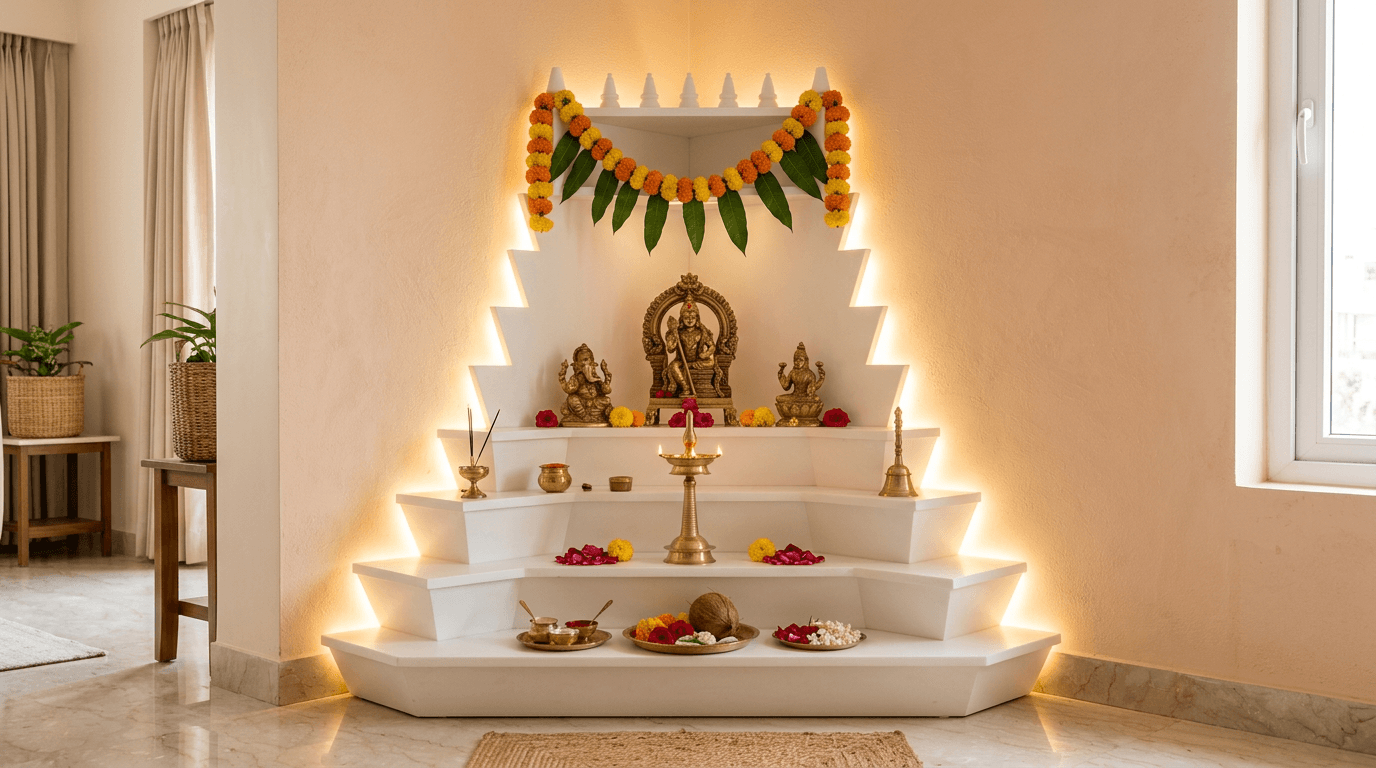
- Backlit corner unit with tapered shelves (1-2BHK)
- Cabinet mandir with folding doors (1-2BHK)
- Kitchen-adjacent niche mandir (1-2BHK)
- Room-divider jaali screen mandir (1-2BHK)
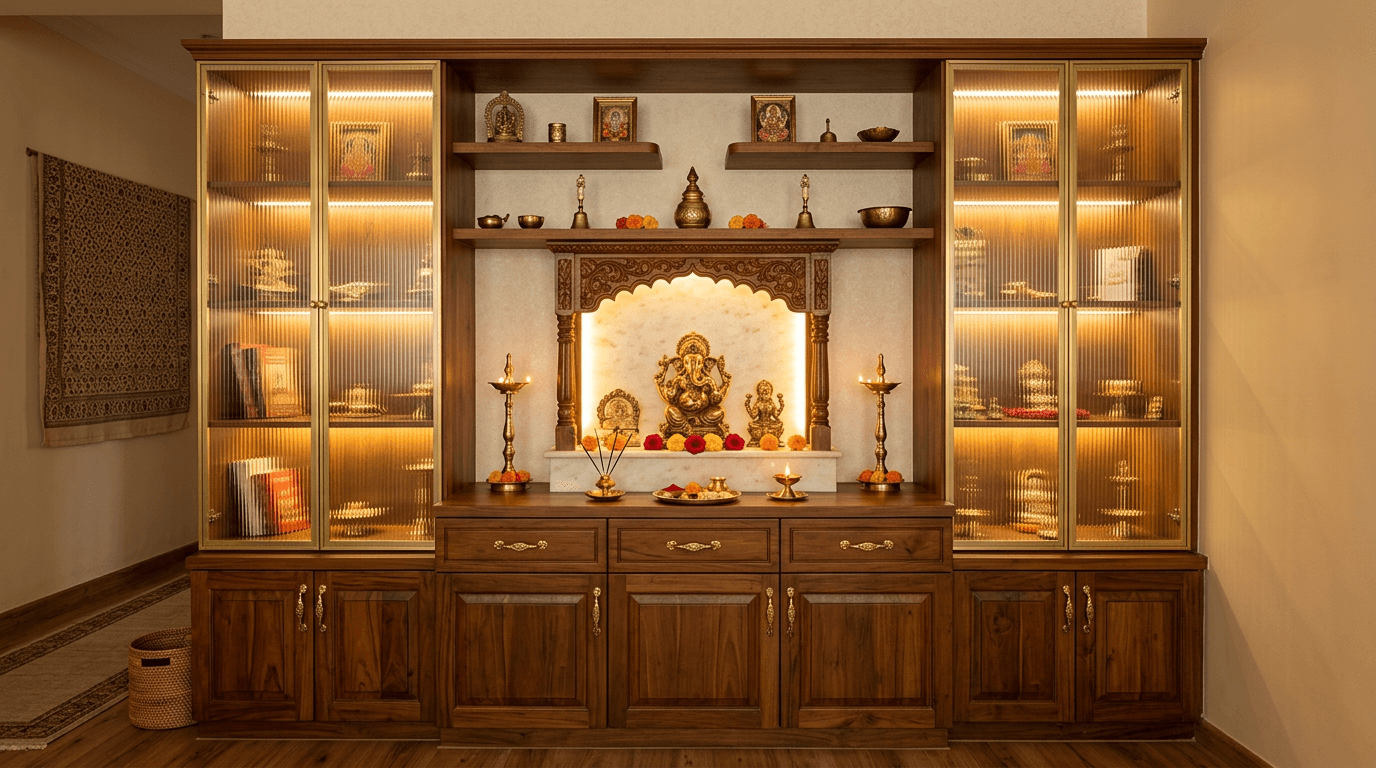
- Full-height marble niche (3BHK)
- Crockery-to-mandir conversion wall (3BHK)
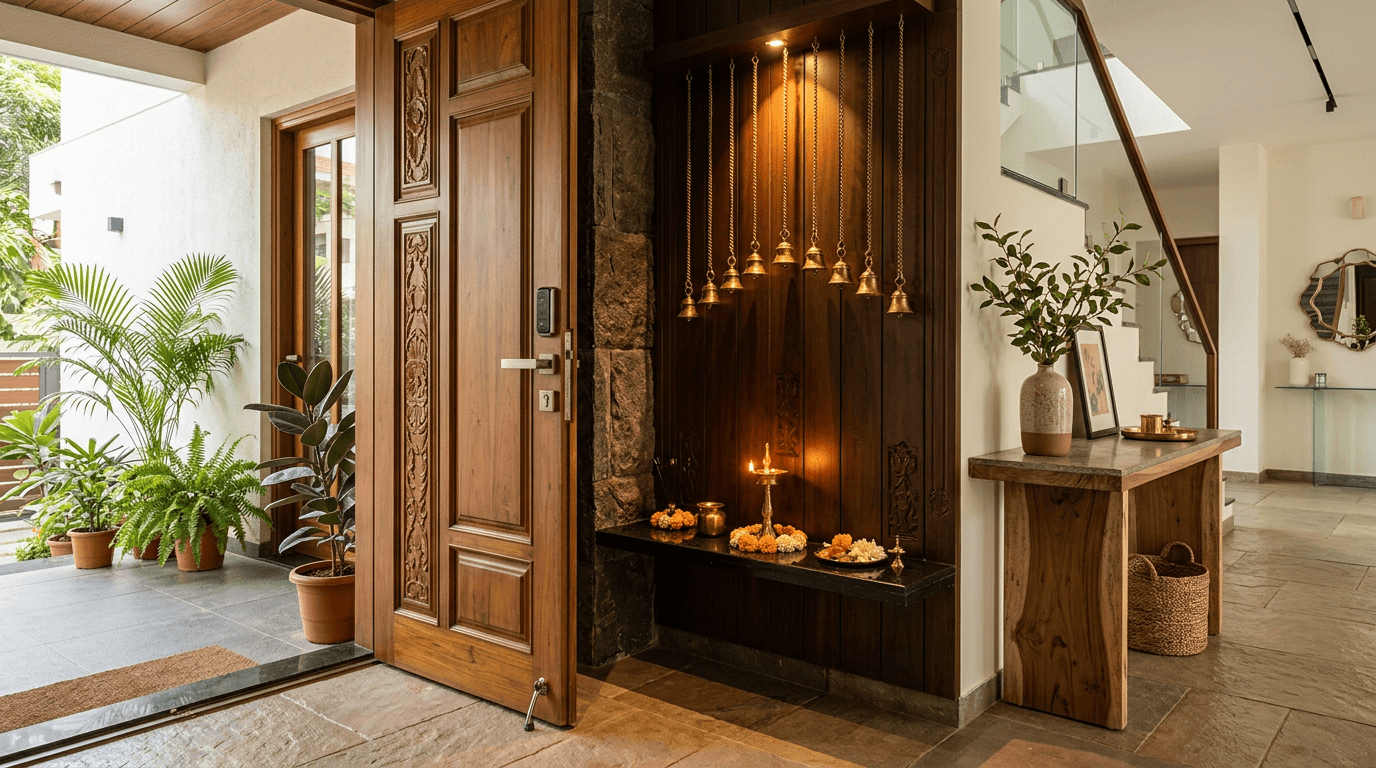
- Foyer entrance mandir with bell detail (3BHK)
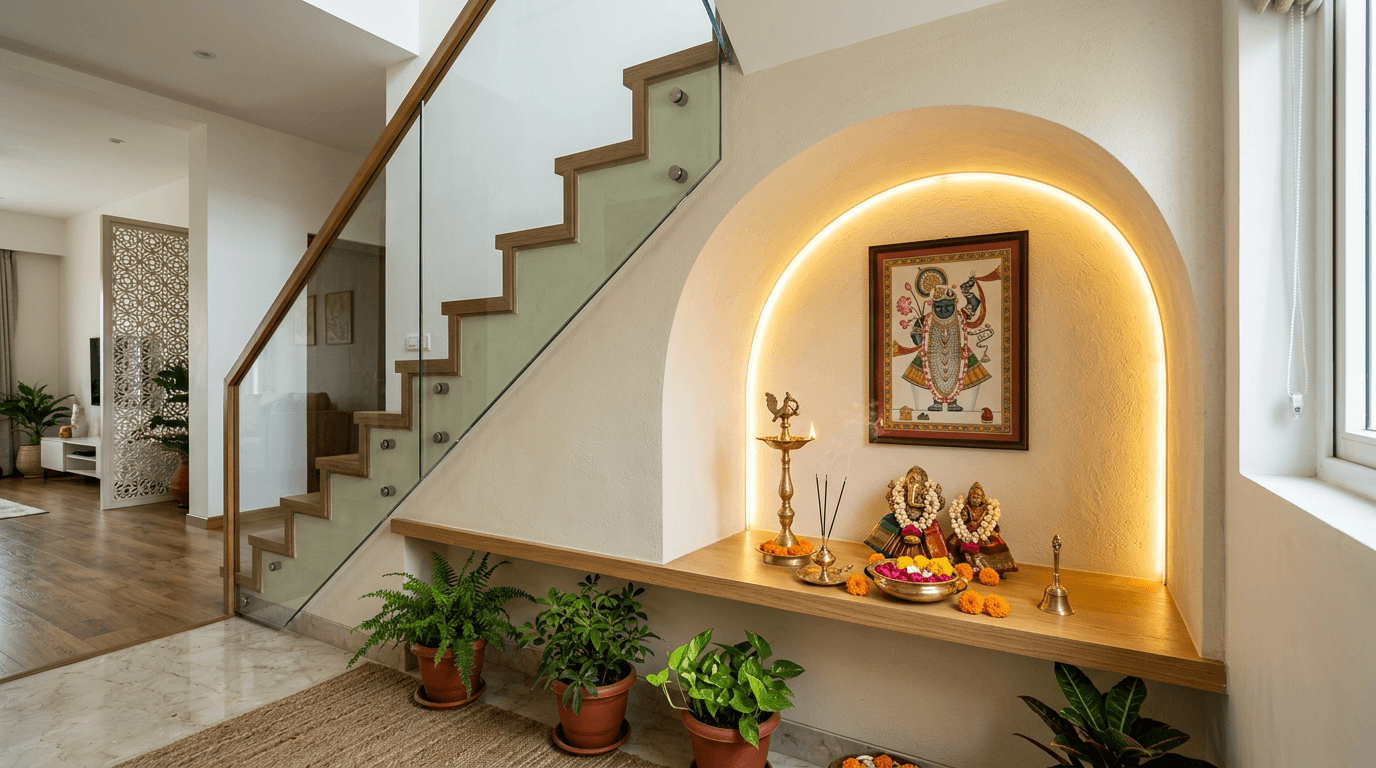
- Under-stair pooja alcove, done right (3BHK/duplex)
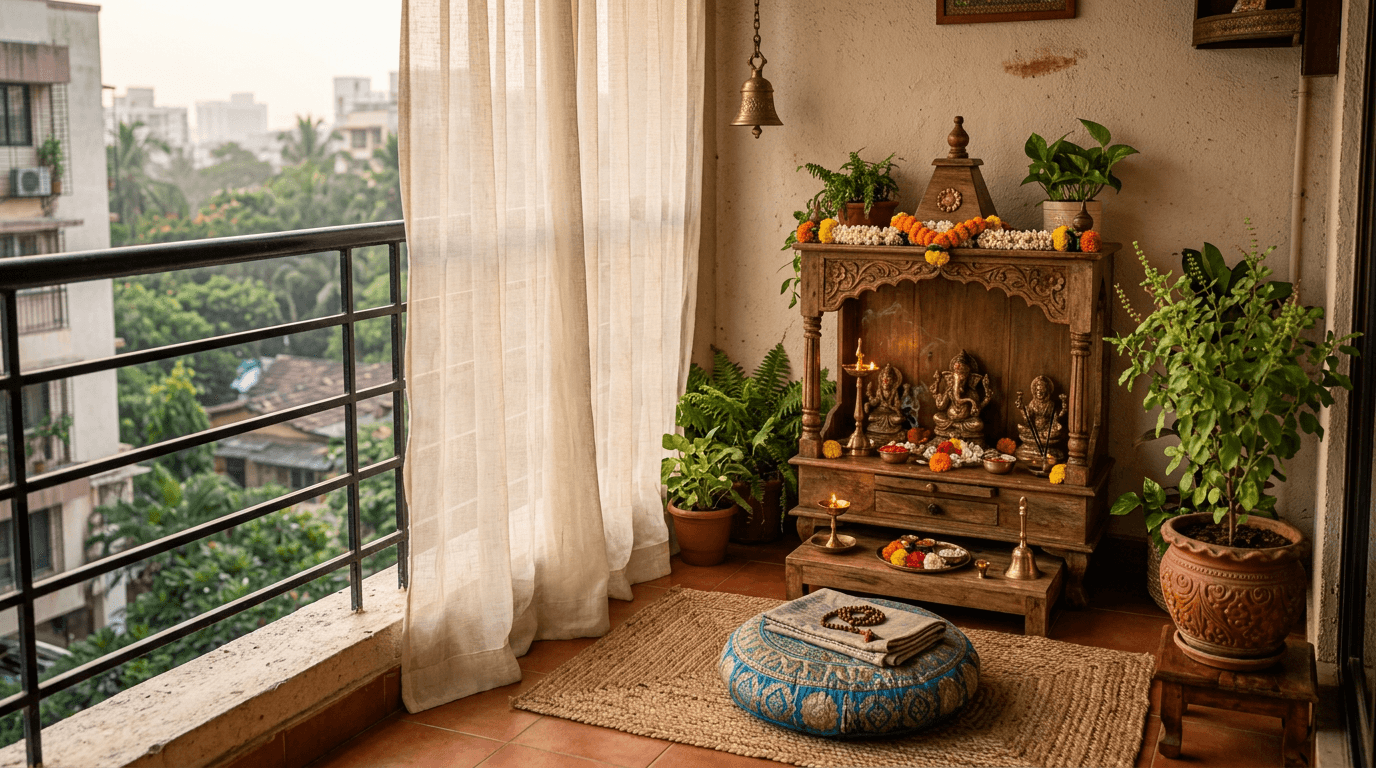
- Balcony-corner meditation mandir (3BHK)
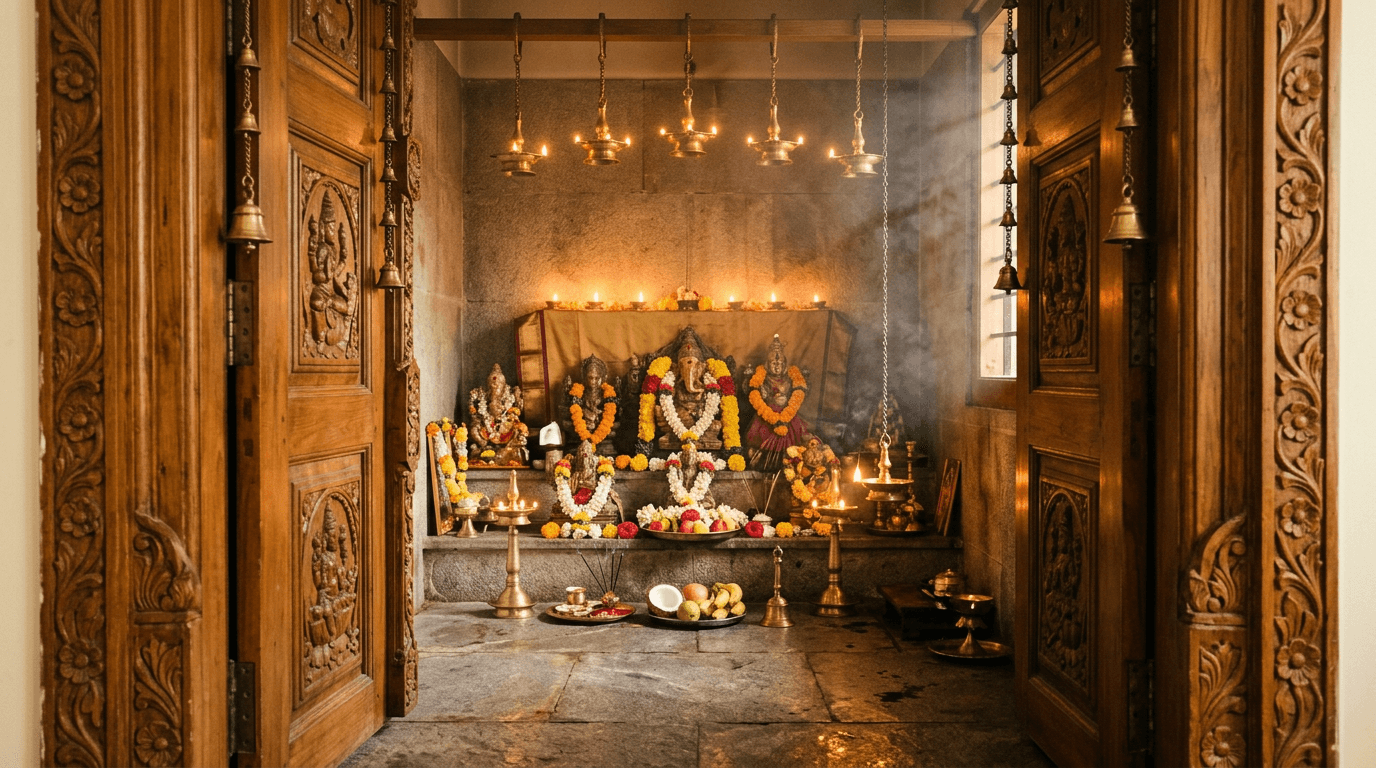
- Dedicated room with carved double doors (independent home)
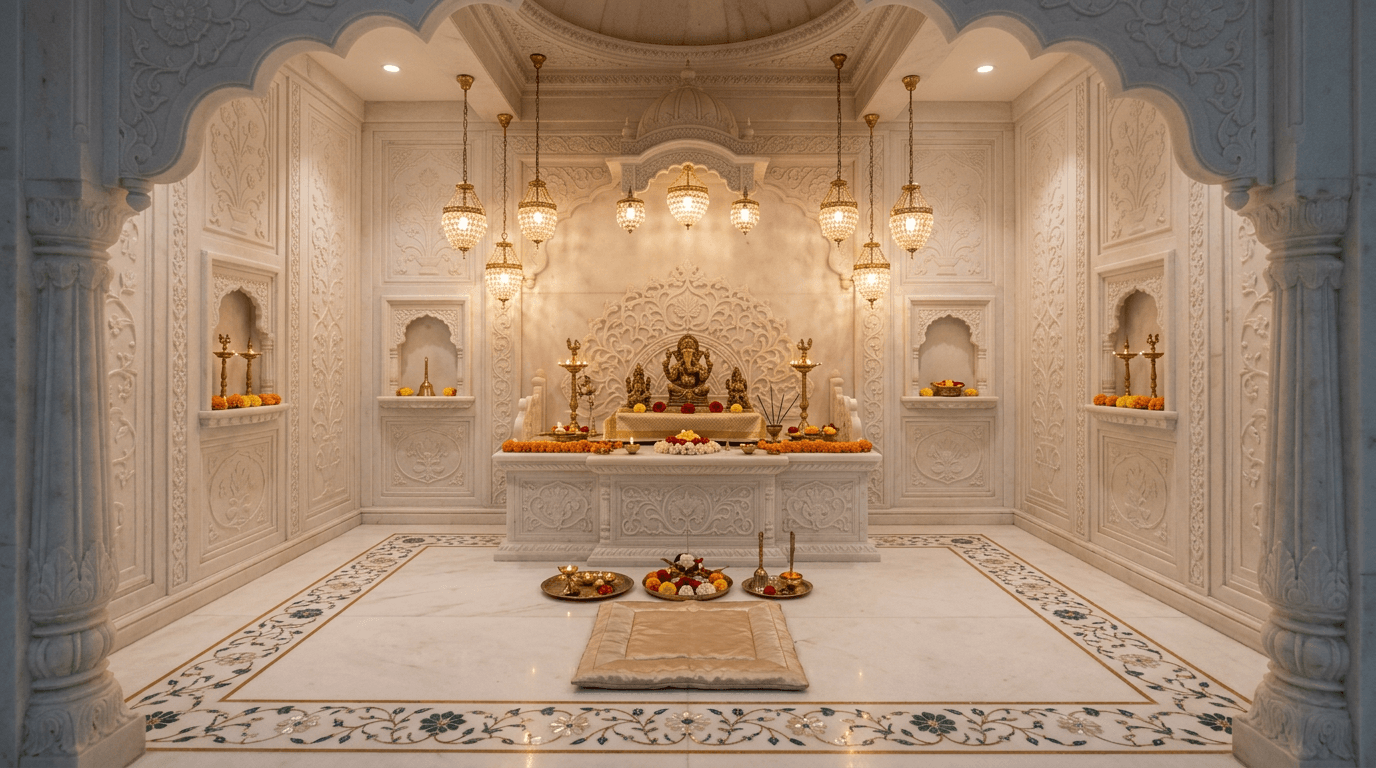
- White marble room with inlay flooring (independent home)
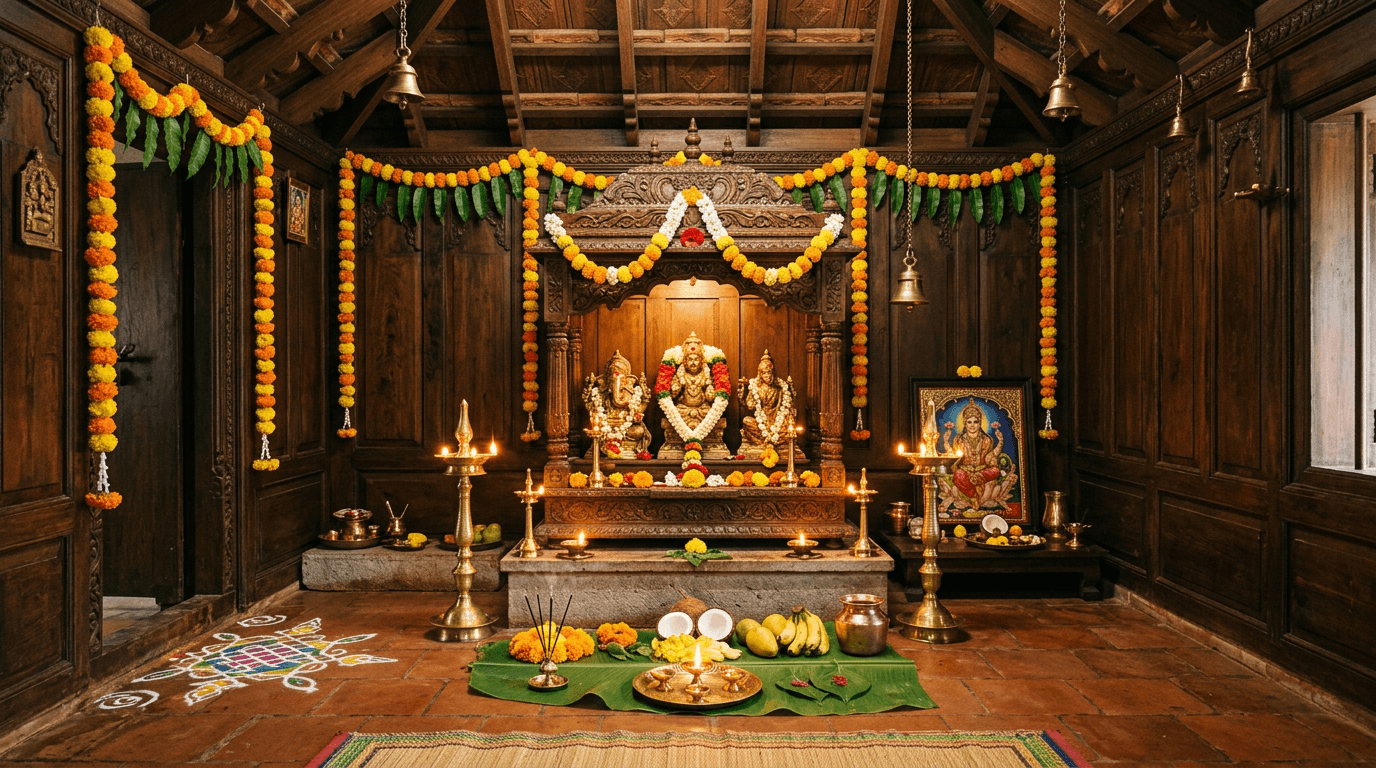
- Traditional South Indian wooden room (independent home)
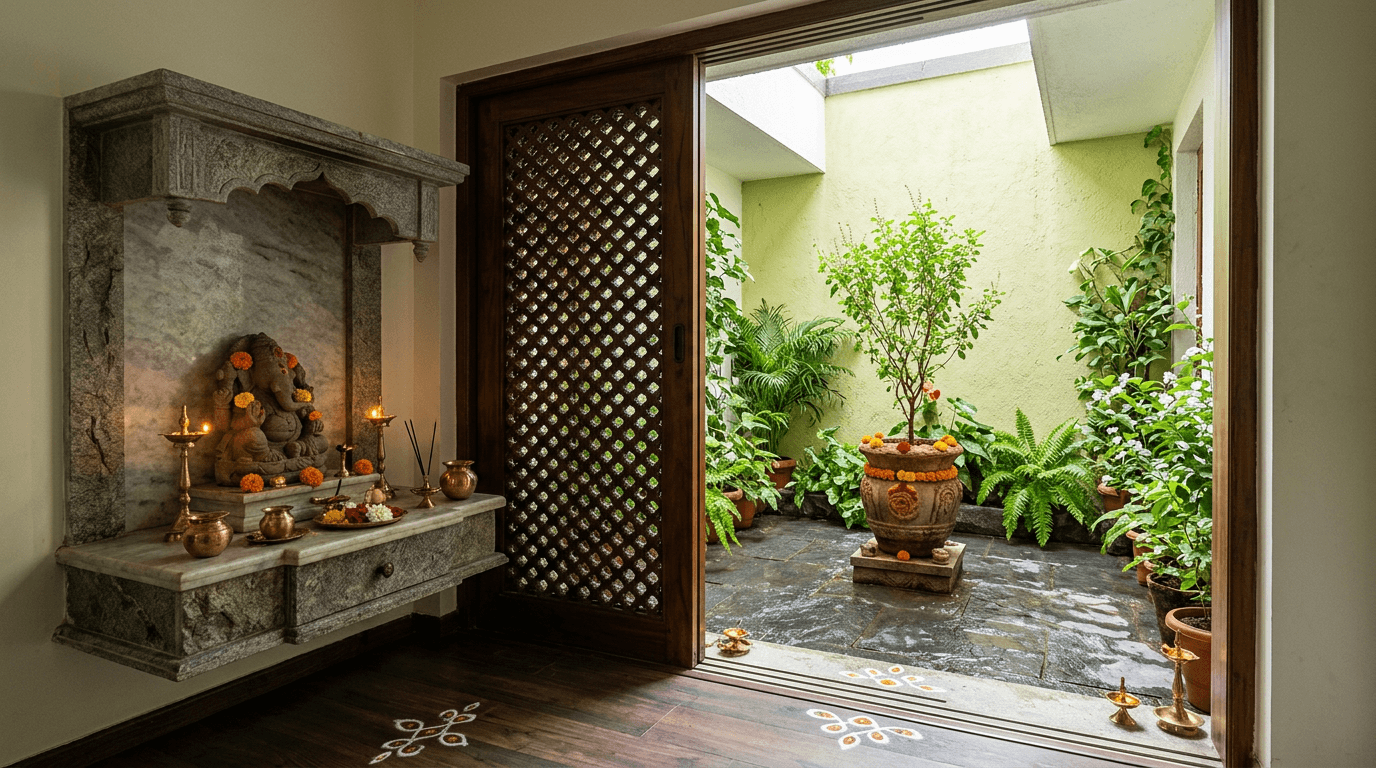
- Courtyard-facing pooja room (independent home)
- Heritage temple integration (independent home)
For 1-2BHK flats and small spaces (designs 1-5)
Zero or near-zero floor area, built for small flats. The wall-mounted jaali-back unit (design 1) is the one we specify most: a 3 ft floating shelf with a laser-cut jaali panel behind it and a 2700K LED strip. Design 2's tapered shelf design stacks like a gopuram silhouette without eating the corner. Design 5, the room-divider mandir, does double duty by separating living from dining with a perforated screen that holds the deities at its centre. Full working details for these live in our small pooja room designs for apartments guide.
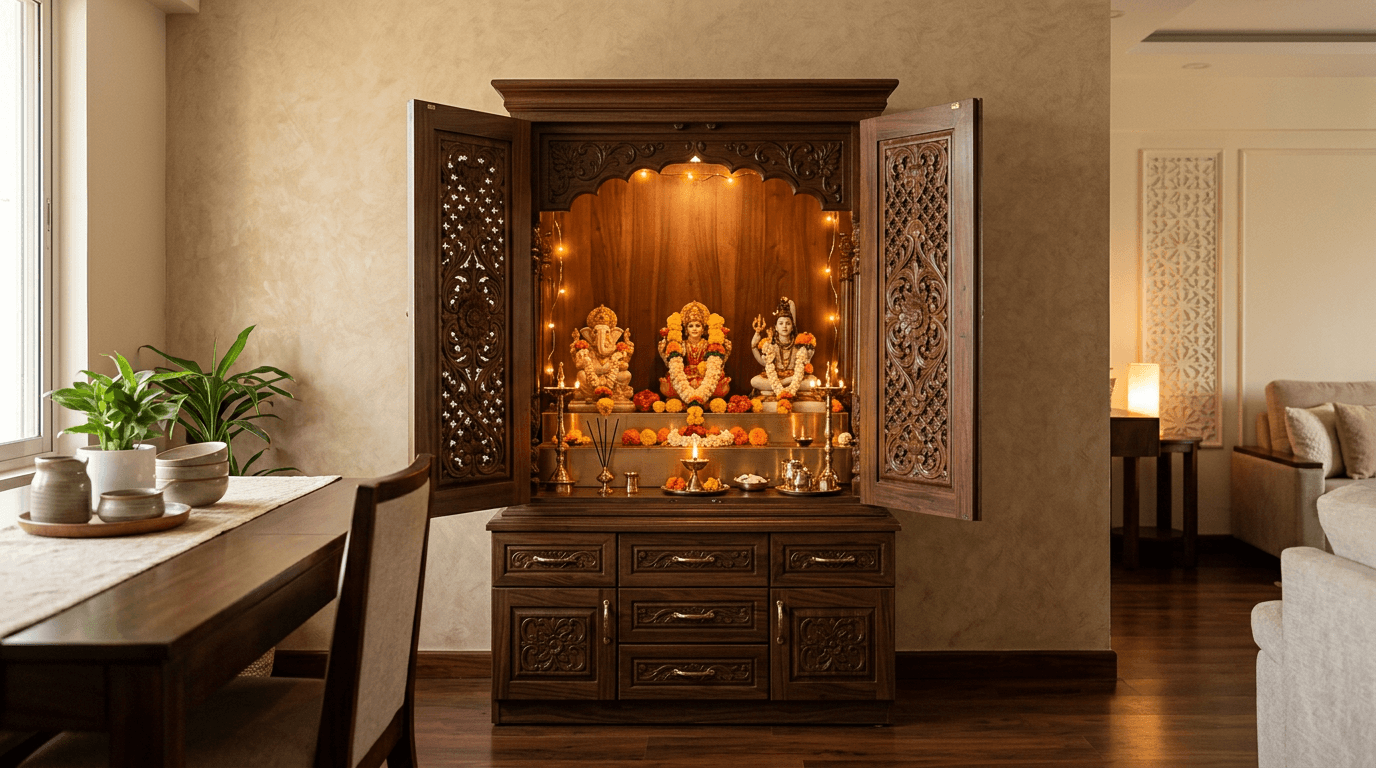
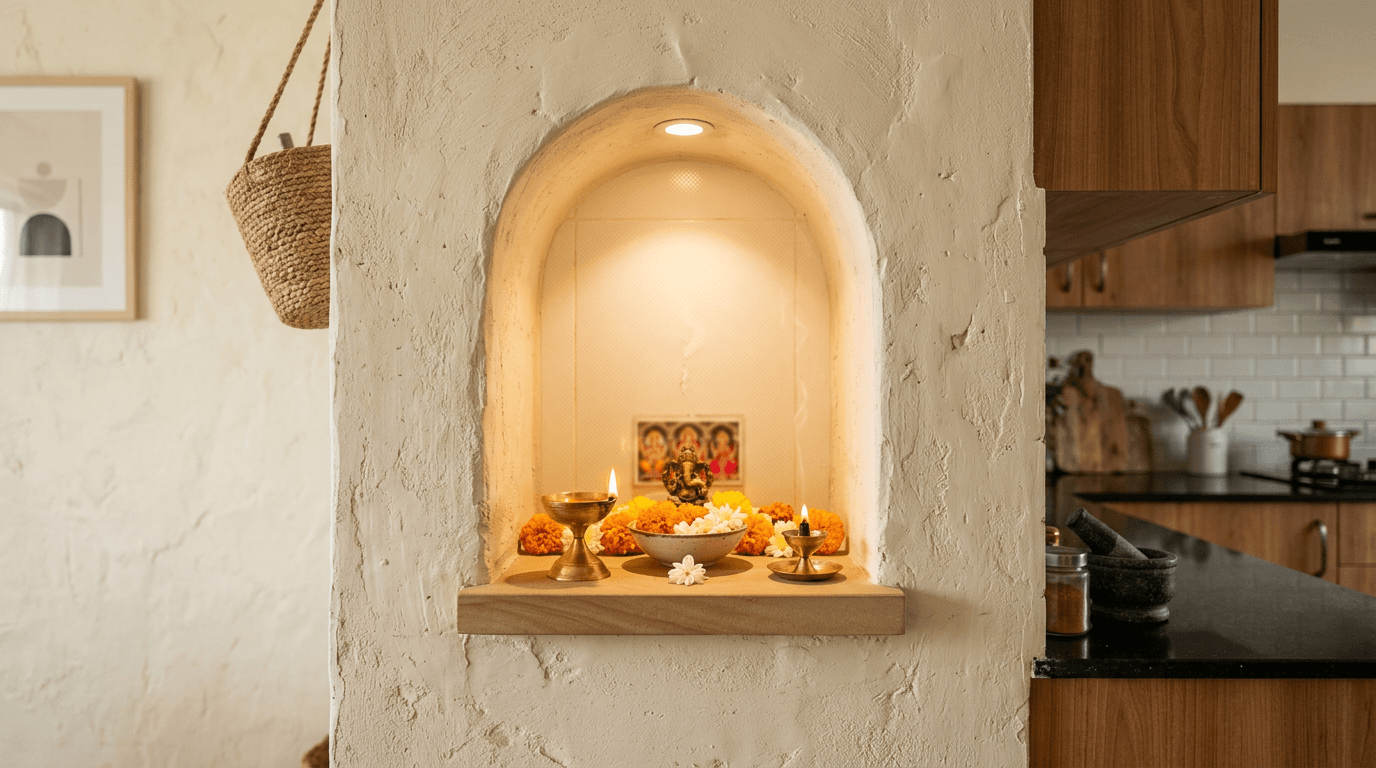
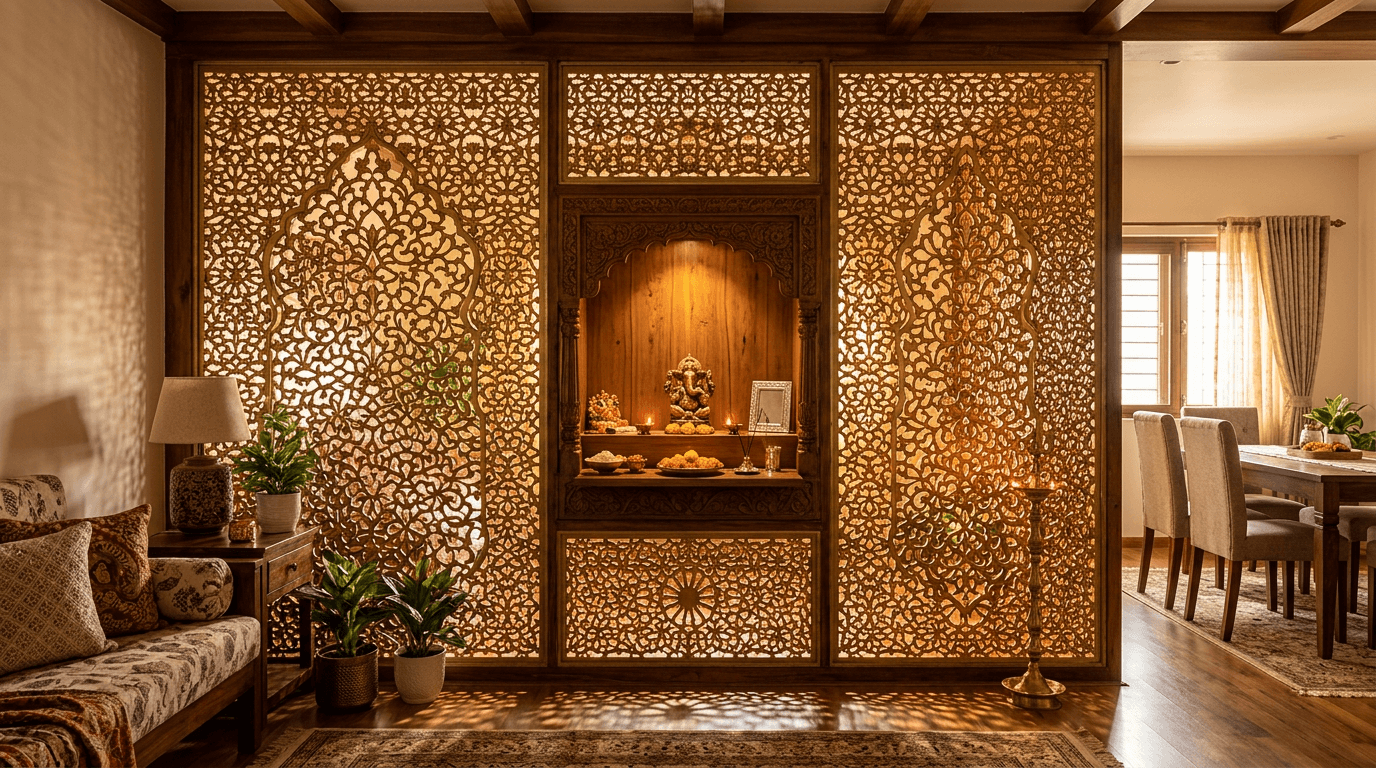
For 3BHK homes and villas (designs 6-10)
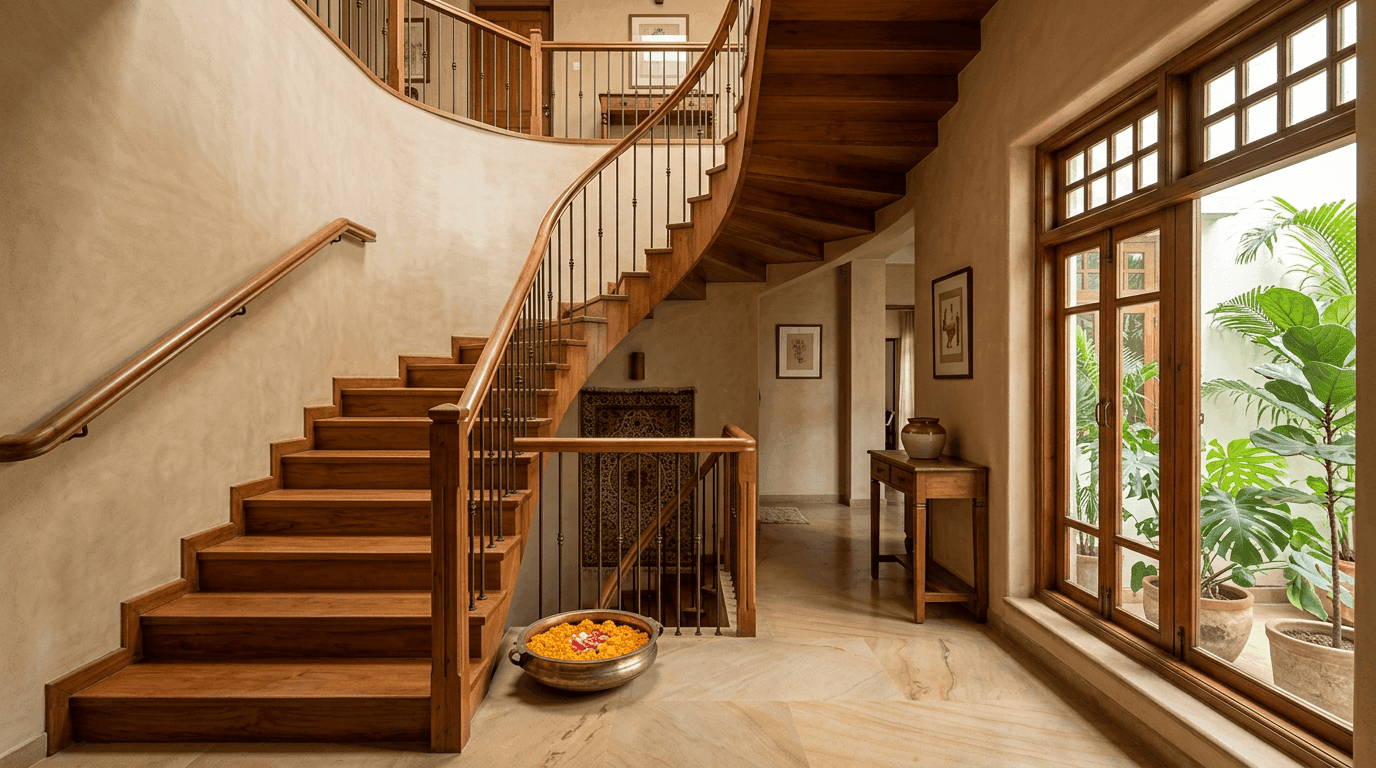
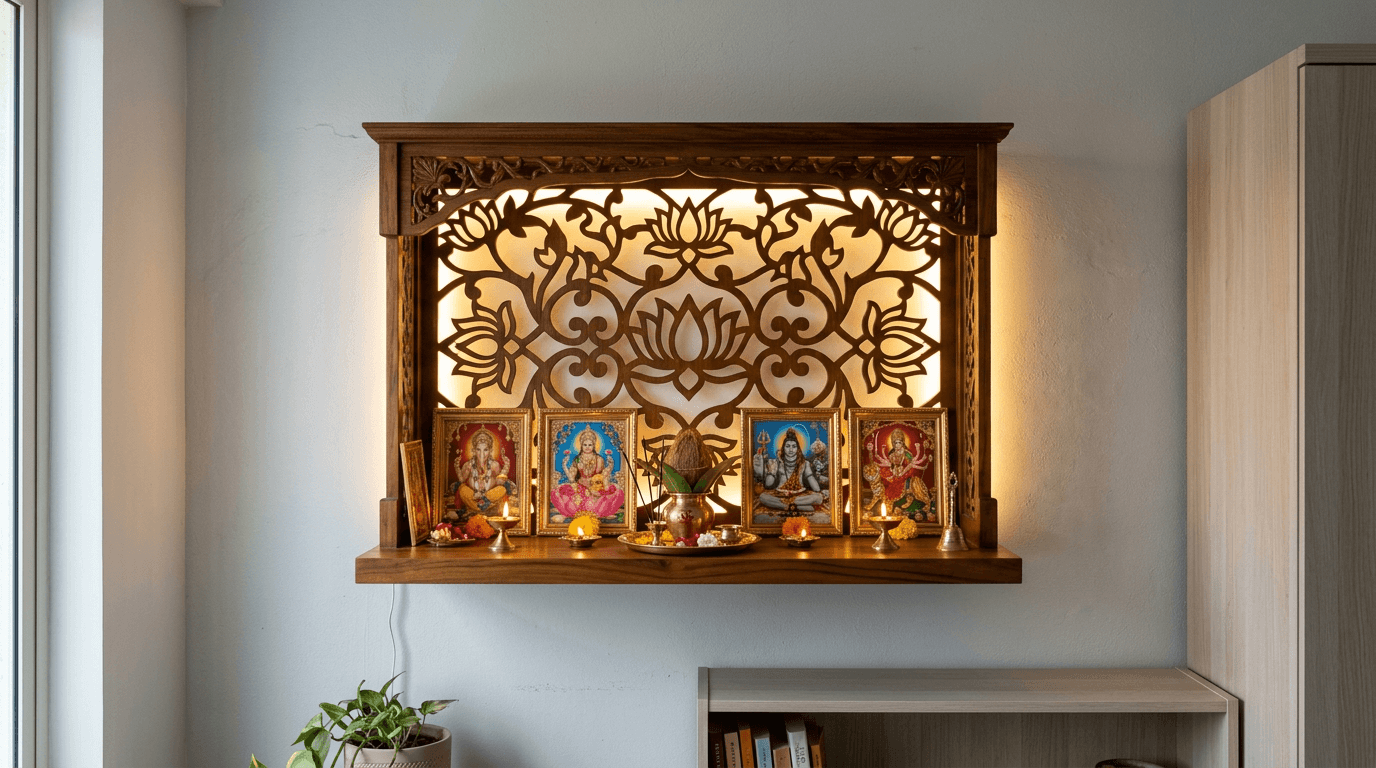
Here you can afford a real footprint. The full-height marble niche (design 6) with a backlit onyx or jaali panel is 2026's most requested look, and our marble temple designs for home guide covers stone selection in depth. About design 9: under-stair mandirs are controversial in vastu terms, and traditional guidance advises against placing deities under a staircase (NoBroker vastu guide). If it's your only option, we detail it as a display alcove rather than the primary worship space. We'd rather tell you that now than after the carpenter's bill.
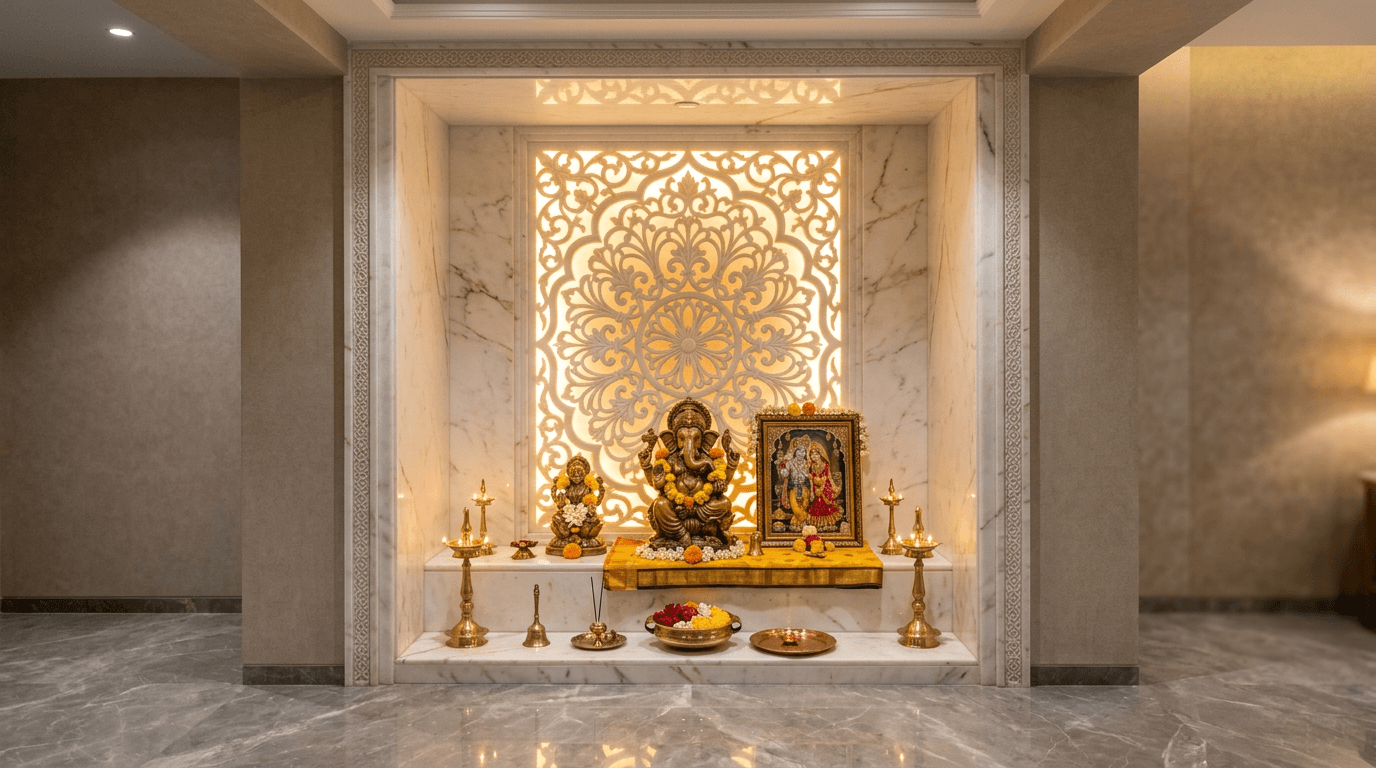
For independent homes with a dedicated pooja room (designs 11-15)
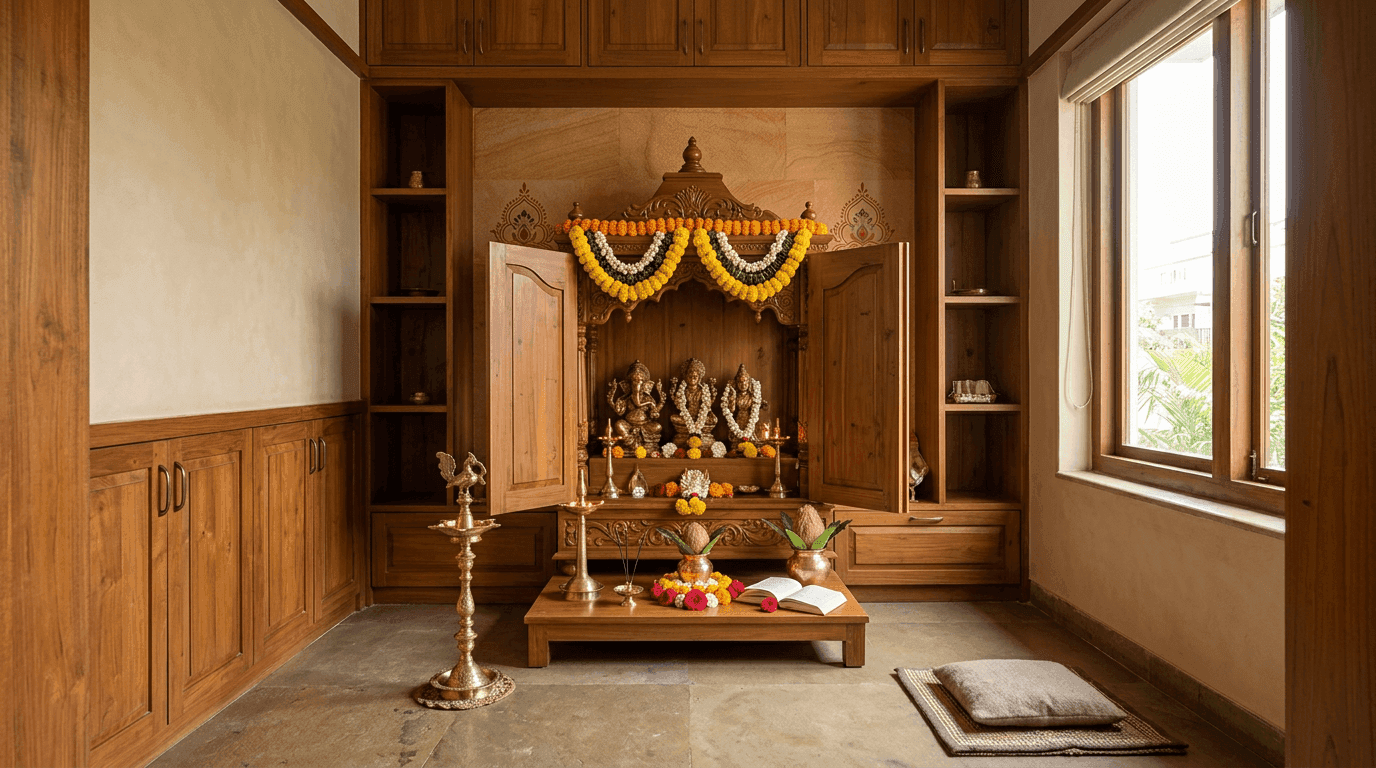
This is where the dedicated room earns its footprint. Design 13, the traditional South Indian room in teak with a gabled wooden ceiling, remains the emotional favourite in our Hyderabad projects. Design 15 is the Reddy residence approach: when a family carries a hereditary temple, the architecture bends around it, preserving the original structure while the new home rises around and above. Carved entries for these rooms deserve their own study, which is exactly what our pooja room door designs guide covers.
Indian Style vs Modern Pooja Room Interiors: Which Should You Choose?
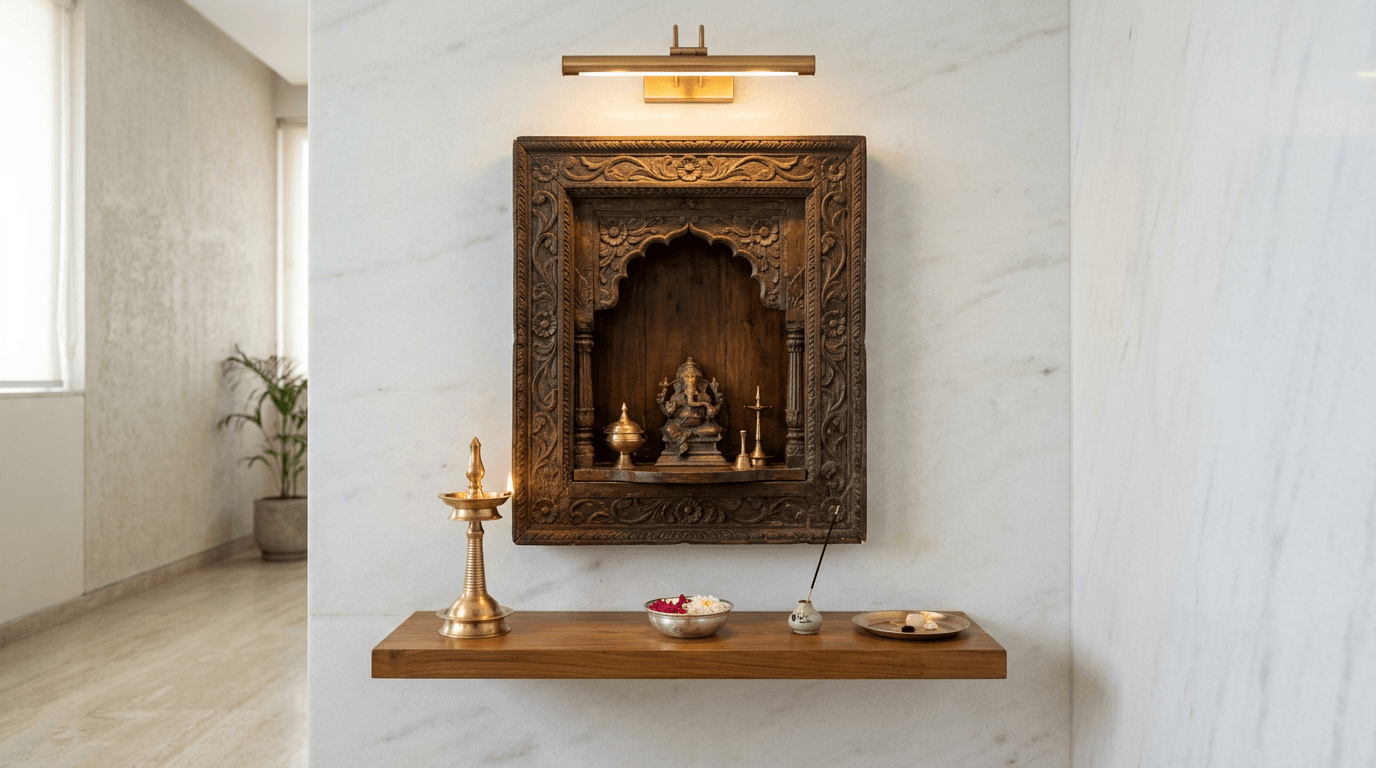
Traditional Indian pooja rooms use carved wood, gabled ceilings, brass, and deep warm tones. Contemporary designs use marble, Corian, clean lines, and concealed lighting. In practice, 2026's best designs are hybrids: a traditional carved element set against a minimal backdrop, so the sacred piece stands out instead of competing.
Pure traditional rooms age beautifully but demand maintenance. Carved teak collects dust in every groove, and oil-lamp soot darkens finishes over a few years. Pure contemporary rooms are easy to clean but can feel like a display shelf if you're not careful. Nothing kills the mood faster than a modern mandir that reads like retail shelving.
So we usually argue for the hybrid. Keep one authentic element with history or craft in it: an inherited carved wooden frame, a temple bell, a brass lamp collection. Then let the envelope stay quiet: plain marble or lime-plaster backdrop, concealed warm light, minimal hardware. The elegance comes from restraint, and the eye goes to the sacred object, which is the whole point. Decor stays supporting cast, never the lead.
Minimalist and pastel palettes are genuinely trending this year (HouseGyan, 2026), but trends are the last input here, not the first. This room outlives your sofa fabric.
Materials Overview: Wooden Mandir, Marble, Corian and Jaali Compared
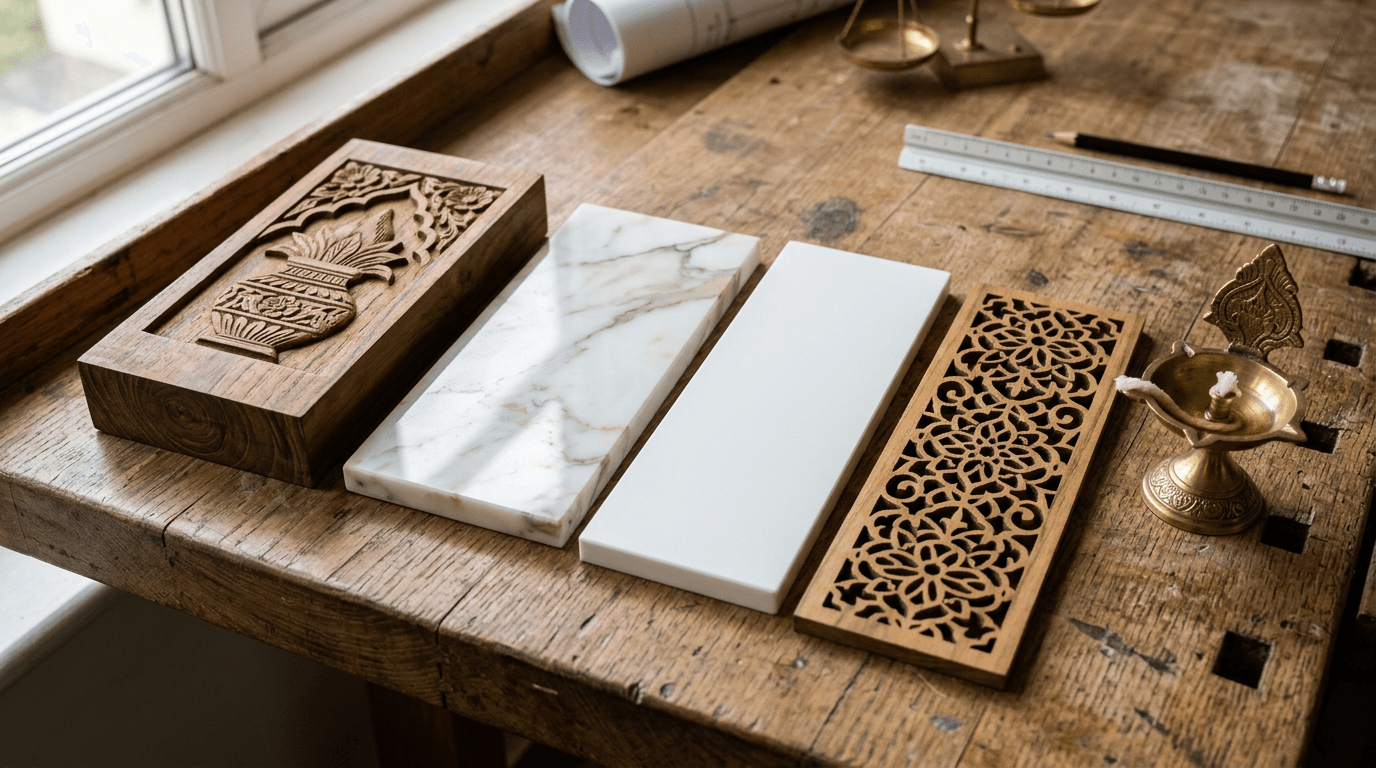
Wood suits warmth and tradition (teak units roughly ₹15,000 to ₹50,000), marble suits permanence and cool luxury, Corian gives joint-free modern whites at mid cost, and jaali panels in wood, metal, or CDF add screening and shadow play. Most 2026 designs combine two: typically a stone or Corian backdrop with a wood or jaali feature.
| Material | Character | Rough 2026 cost band | Watch out for |
|---|---|---|---|
| Teak / rosewood | Warm, traditional, carvable | ₹15,000 to ₹75,000 (units) | Dusting carved surfaces; cost of good timber |
| Engineered wood / MDF | Budget-friendly, modern finishes | ₹8,000 to ₹25,000 | Moisture swelling; won't take deep carving |
| Marble / natural stone | Permanent, cool, premium | Highest band; full rooms ₹5,00,000+ | Weight (slab flooring checks), staining from oil |
| Corian / solid surface | Joint-free white, backlightable | Mid band | Heat marks from diyas placed directly |
| Jaali (wood/metal/CDF) | Screening, patterned light | Add-on to any of the above | Cheap laser-cut MDF jaali warps near heat |
Price bands compiled from WoodenStreet and MakeMyMandir 2026 listings. Treat them as directional only — carving detail and timber grade move these numbers fast, and city-level rates are worth confirming at quotation time rather than assuming from a table.
The one mistake we see repeatedly: choosing material by photo, not by ritual. If your family does daily deepam with oil lamps, an unsealed Corian ledge or a raw MDF jaali right above the flame is a maintenance problem by month three. Stone ledge under the flame, heat-tolerant backdrop behind it, decorative materials everywhere else. Get the full breakdowns in our wooden mandir designs and marble temple for home guides.
Lighting the Home Temple: Backlit Layers for a Serene Atmosphere
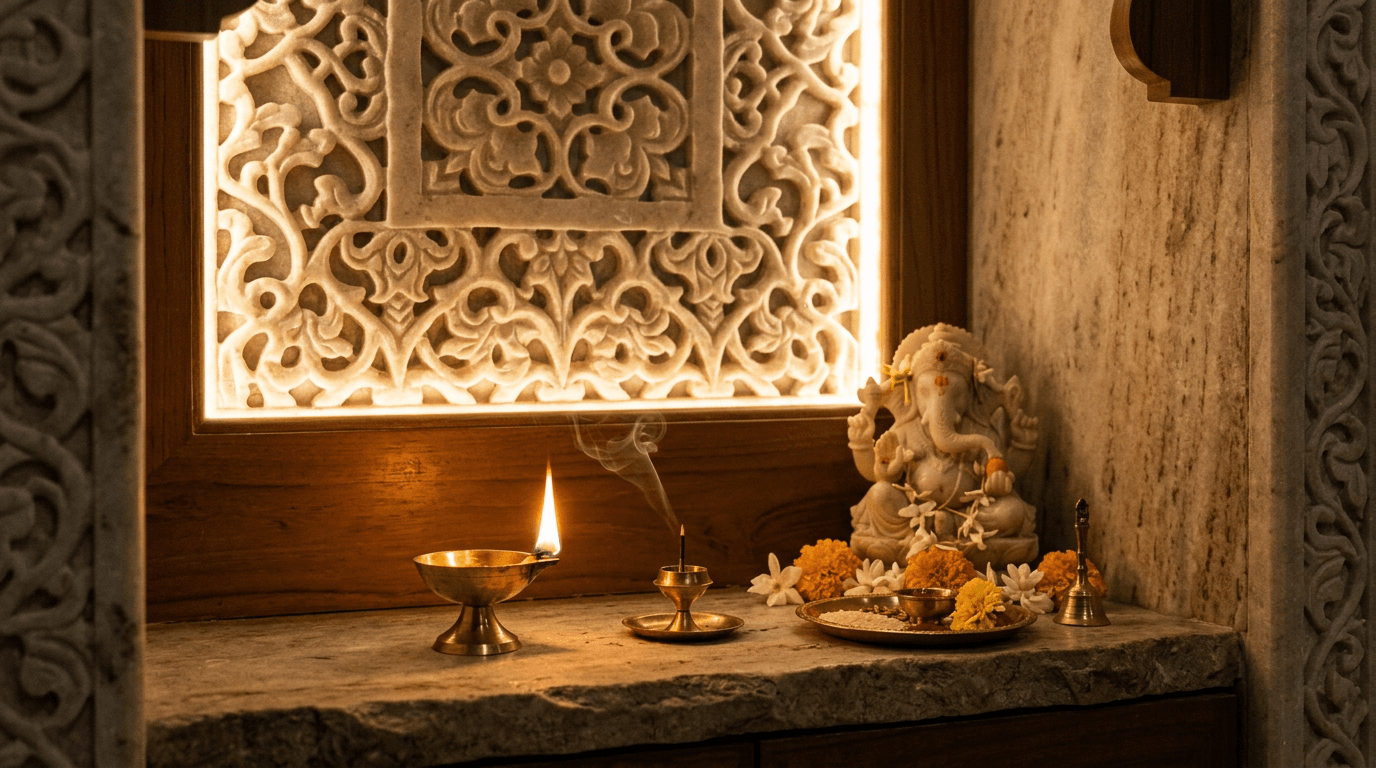
Pooja room lighting works best in three layers: a warm 2700-3000K backlight behind the deity backdrop, a soft general light for cleaning and reading, and the diya flame itself as the focal light. Keep LED strips and drivers at least a hand's width from open flames and always on a separate switch.
Here's the opinion that surprises clients: if your budget forces a choice between a more ornate unit and better lighting, choose the lighting. Every time. A plain marble niche with a well-placed backlight photographs, and more importantly feels, more sacred than an elaborately carved unit under a ceiling tube light. Light does most of the work of creating a serene atmosphere. Backlit backdrops are among 2026's strongest trends for a reason (Relgrow, 2026).
The diya-safe part is where we get specific, because this is genuinely a fire-safety detail most guides skip:
- Flame zone gets stone or metal, nothing else. No fabric skirting, no paper decorations within arm's reach of the lamp.
- Ventilation is not optional. A window, an exhaust, or at minimum a generous opening. Smoke pooling at the ceiling is how you get blackened paint and irritated eyes during longer rituals.
- LED drivers hate heat. Keep the strip channel and driver away from directly above the diya position, or you'll be replacing flickering strips within a year.
- Separate switching. Backlight on one switch, general light on another, so the evening ambiance can be just flame and glow.
Idols, Diyas and Pooja Essentials: Arranging the Sacred Elements
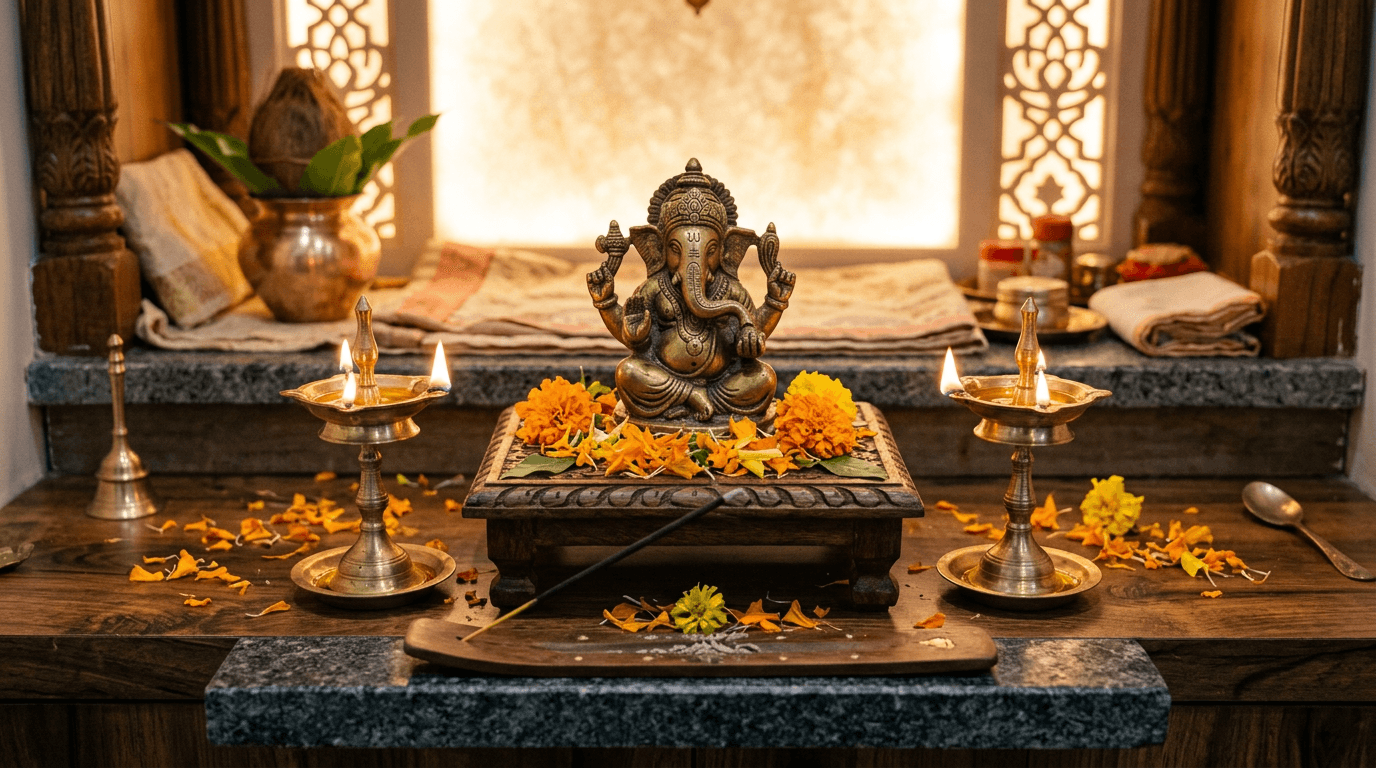
Place idols on a raised platform with a small gap from the wall, keep them modest in size for a home mandir, and give the lamp a stone or metal ledge of its own. Daily pooja essentials (kumkum, incense sticks, cotton wicks, matchbox) live within arm's reach, and everything else goes into closed storage.
The unit is the stage. What sits on it decides whether the space works day to day.
Start with the idols. Traditional guidance keeps home idols small and placed on a raised chowki or plinth rather than directly on the floor, with a slight gap between the idol and the wall behind it (NoBroker vastu guide). Practically, that gap also protects your backdrop: an idol pressed against a painted or veneered surface leaves marks after a year of abhishekam and cleaning. Brass and marble idols handle daily water and oil contact best. Painted clay and resin idols belong on shelves that stay dry.
Then the flame and fragrance layer. The diya gets the most heat-tolerant spot on the unit, ideally a stone inset or a metal tray, never directly on laminate. Incense needs its own holder with an ash channel, positioned so the smoke drifts up and away from wood and fabric. If your family lights incense sticks daily, put the holder at the front edge of the shelf. Ash on the backdrop is the most common stain we see in renovation visits.
A few arrangement habits that keep the composition calm rather than crowded: one focal idol or image at centre, symmetry in the lamps flanking it, and sacred symbols like Om or a small kalash used sparingly as accents. When every gift and souvenir deity ends up on the shelf, the aesthetics collapse into clutter and daily cleaning becomes a chore. Rotate, don't accumulate. Store pooja accessories you use weekly in the plinth drawer and festival items elsewhere, which brings us to storage.
Storage Solutions for Samagri, Books & Festival Items
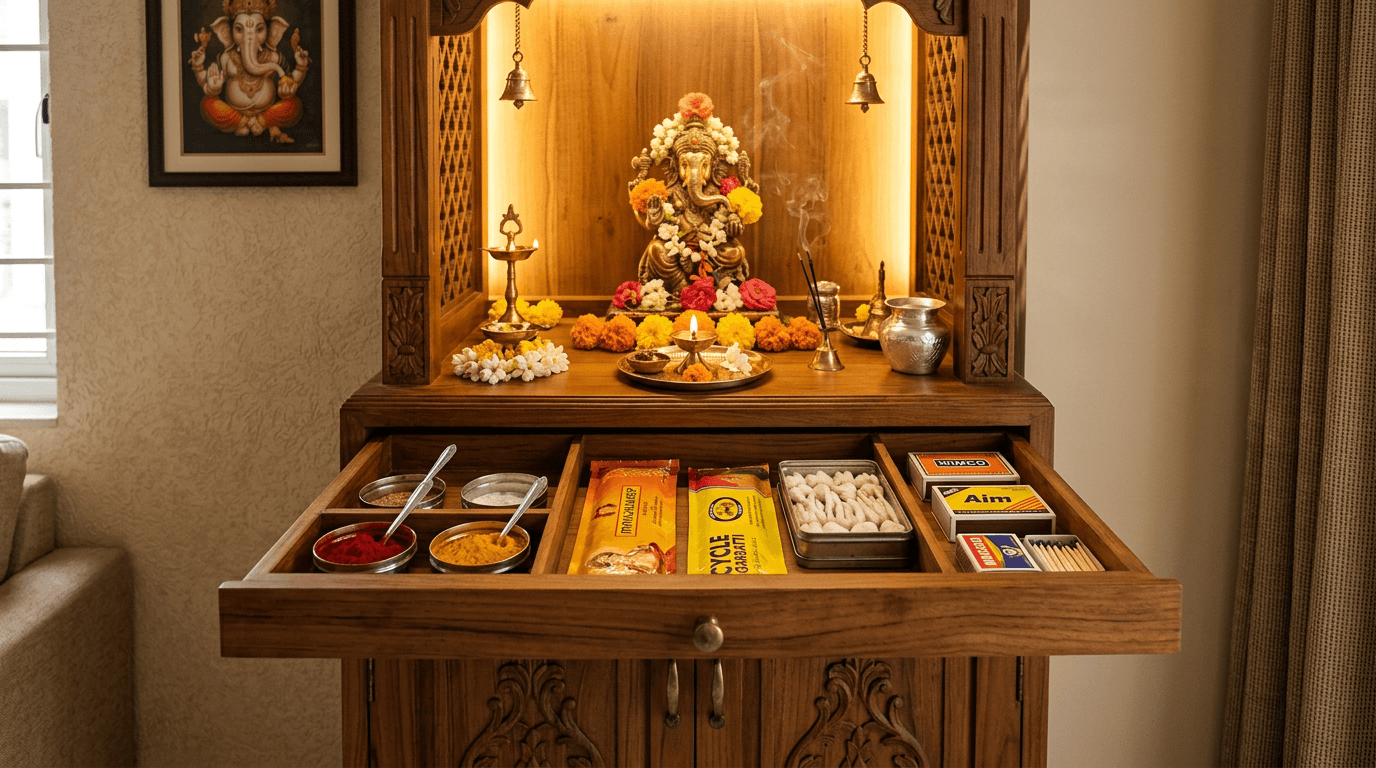
Plan pooja room storage in three tiers: a drawer or shallow shelf at the plinth for daily samagri (kumkum, agarbatti, matchbox, cotton wicks), closed cabinets below or beside for books and puja thalis, and one deep loft or high cabinet for festival items used a few times a year.
Storage is the least glamorous section of this guide and the one that decides whether the room stays beautiful. A mandir with no storage becomes a mandir with plastic boxes stacked beside it by the second Diwali. We've seen it in far too many site visits during renovation consultations.
Practical dimensions we specify: daily-use drawer 4 to 6 inches deep (any deeper becomes a junk drawer), thali cabinet at least 14 inches deep to take the largest plate flat, and the festival loft sized to the actual boxes the family already owns. Ask to see them. Families always underestimate this volume, especially for Ganesh Chaturthi and Golu displays.
One more habit worth building into the design: a small pull-out ledge or fold-down seat if elders will sit for longer paths and readings. For styling the open shelves once storage is sorted, our pooja room decoration ideas guide picks it up from here.
Pooja Room Vastu Tips: Direction and Placement Essentials
As per vastu, the ideal pooja room location is the northeast corner (Ishan Kona), with the east or north direction as alternatives. Face east or north while praying, keep the room above ground level, and avoid placing the pooja room in the south, under a staircase, or against a bathroom wall (NoBroker and WoodenStreet vastu guides).
Vastu shastra, the traditional Indian science of orientation and layout, treats the northeast as the zone that draws positive energy into the home. You don't have to take the energy claims literally to see the practical logic: the northeast catches gentle morning light, exactly when most families pray.
Every Roomantic project is designed vastu-compliant from the first sketch, so we'll say this plainly: vastu principles are much easier to honour at floor-plan stage than retrofitted. Moving a pooja niche two walls over costs nothing on paper and a fortune after the electrician has finished.
The four vastu guidelines that matter most, in the order we apply them:
- Northeast first. If the northeast corner is taken, east or north still work well according to vastu.
- Never below a toilet or against its shared wall, and not under a staircase.
- Idols sit in the east or west so the worshipper faces east or north.
- Keep it at or above ground level, never in a basement.
Two smaller conventions worth knowing: keep the walls of the pooja room in light colours (white, cream, pale yellow) to create a peaceful backdrop, and store nothing above the idols. That's the summary, deliberately short. Direction-by-direction rules, remedies for flats where the northeast is already a bathroom, and what actually matters versus folklore: all of that lives in our full pooja room vastu guide. And if you're planning the whole house, start with the room-by-room vastu shastra for home pillar instead.
Doors, Bells & Threshold Details
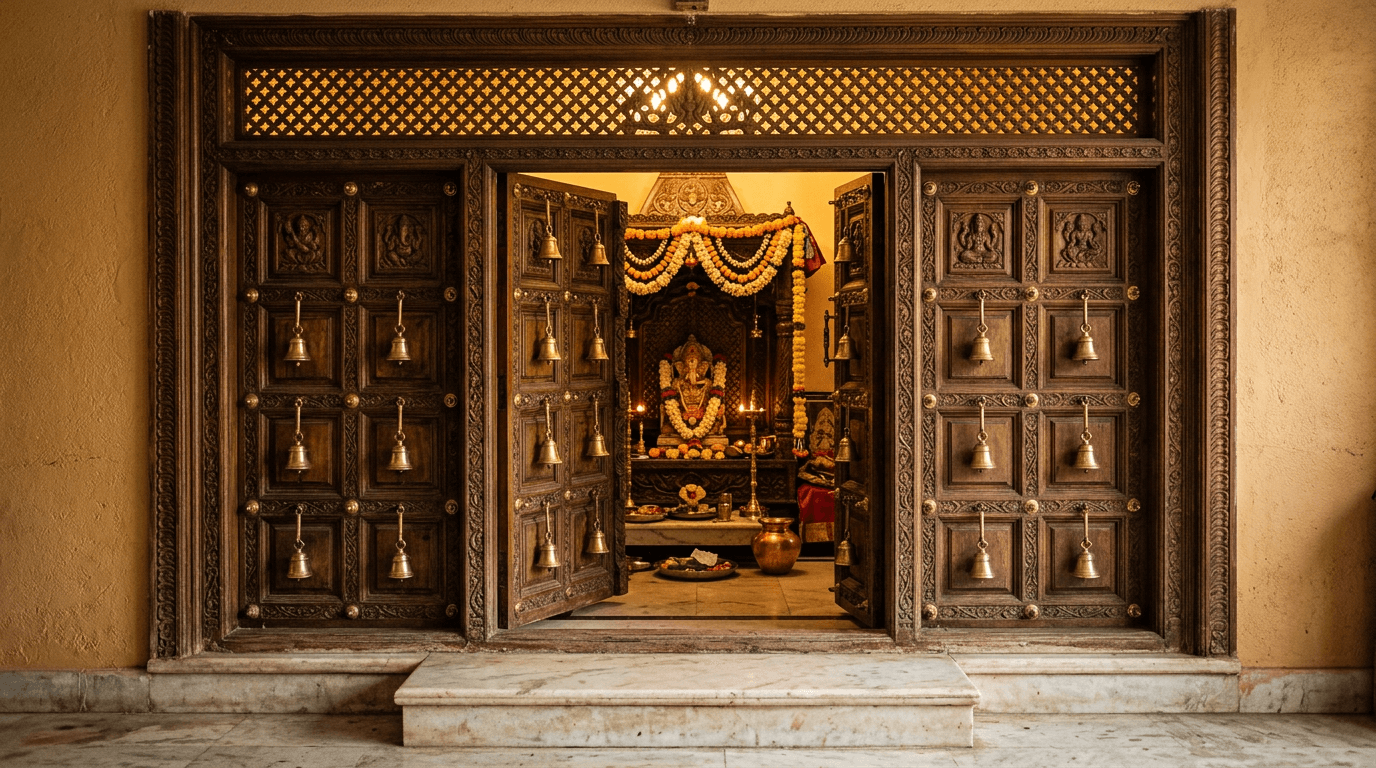
Pooja room doors in 2026 favour carved wood with brass bells, laser-cut jaali shutters that keep the space visible while screened, and fluted or frosted glass for compact homes. The threshold matters as much as the door: a marble or stone step marks the transition into sacred space.
The door is doing symbolic work, not just acoustic work. A row of small brass bells on the shutter (they chime as you enter), a slightly raised stone threshold, a carved or perforated panel that lets lamplight glow through after dark. These small details are what make even a compact mandir feel like a destination within the home.
Keep glass for homes where smoke is minimal. Daily oil-lamp households will be cleaning soot film off glass shutters weekly. We compare jali, glass, and double-door options, with sizes and hardware, in the dedicated pooja room door designs guide.
Why a Home Mandir Still Matters in Modern Homes
A home mandir gives a family one dedicated space for worship, reflection, and festival ritual. In Indian homes in 2026, where flats shrink and screens multiply, a well-designed spiritual space works as both a daily anchor and the emotional focal point of the interior.
We'll admit our bias upfront: we're architects, and designing pooja spaces is some of the most satisfying work we do. But the case for one doesn't rest on sentiment.
There's the daily-rhythm argument. A dedicated space for worship, even a two-foot shelf, gives the day a fixed point. Ask the grandparents in any household we've designed for: the morning lamp is non-negotiable, and the room quietly organises everyone else's morning around that moment of stillness and positivity.
There's the festival argument. Diwali, Ganesh Chaturthi, Navratri: each one needs a stage, and a home without one improvises on a console table every year. A proper mandir absorbs these peaks gracefully, and a warm lamp glowing through a jaali screen enhances the spiritual ambiance of the whole living area, not just the shrine itself.
And there's the design argument, the one interior designers rarely say aloud. Creating a sacred focal point disciplines the rest of the home. When one wall is reserved for meaning, the surrounding interior tends to stay calmer, because every other element now has something to defer to. Mandirs, in that sense, are the rare feature that improves the rooms around them. Some clients tell us the spiritual energy of the house changed after the remodel. We'd modestly claim the light, proportion, and quiet did their job.
How Much Does a Pooja Room Cost in 2026?
In 2026, ready-made wooden home temples start around ₹8,000 (WoodenStreet), built-in pooja units typically cost ₹15,000 to ₹50,000 at the budget end (Livspace), modular cabinet mandirs around 3x2x6 ft start near ₹1,00,000, and full dedicated mandir rooms start around ₹5,00,000, with custom projects ranging up to ₹25,00,000+ (MakeMyMandir, 2026).
| Tier | What you get | 2026 range |
|---|---|---|
| Ready-made unit | Off-the-shelf wooden/MDF temple | ₹8,000 to ₹30,000 |
| Budget built-in | Niche or wall unit, laminate/MDF, LED strip | ₹15,000 to ₹50,000 |
| Mid custom | Corner or cabinet mandir, teak/Corian, jaali, backlight | ₹50,000 to ₹1,25,000 |
| Premium room | Dedicated room, marble/teak, carved doors, layered light | ₹5,00,000 upward |
Sources: WoodenStreet home-temple listings, Livspace's under-₹50K design roundup, and MakeMyMandir's 2026 custom mandir price guide. City, timber grade, and carving detail move these numbers significantly.
Where does the money actually go? In our experience of pricing these as part of full-home projects, the backdrop and lighting are a minority of cost but a majority of effect, while carving and exotic stone are the opposite. Good pooja room interior design is mostly light and proportion. If you need to trim a quote, protect the backlight and the stone ledge; simplify the carving.
A note on our own pricing: Roomantic doesn't publish flat rates, because a pooja space priced inside a full design-build project behaves differently from a standalone carpentry job. Costs depend on your city, plot, and spec. If you want a number for your actual floor plan, talk to our team and we'll estimate it against your drawings, or browse our portfolio to see how sacred spaces sit inside our full projects.