Key Takeaways
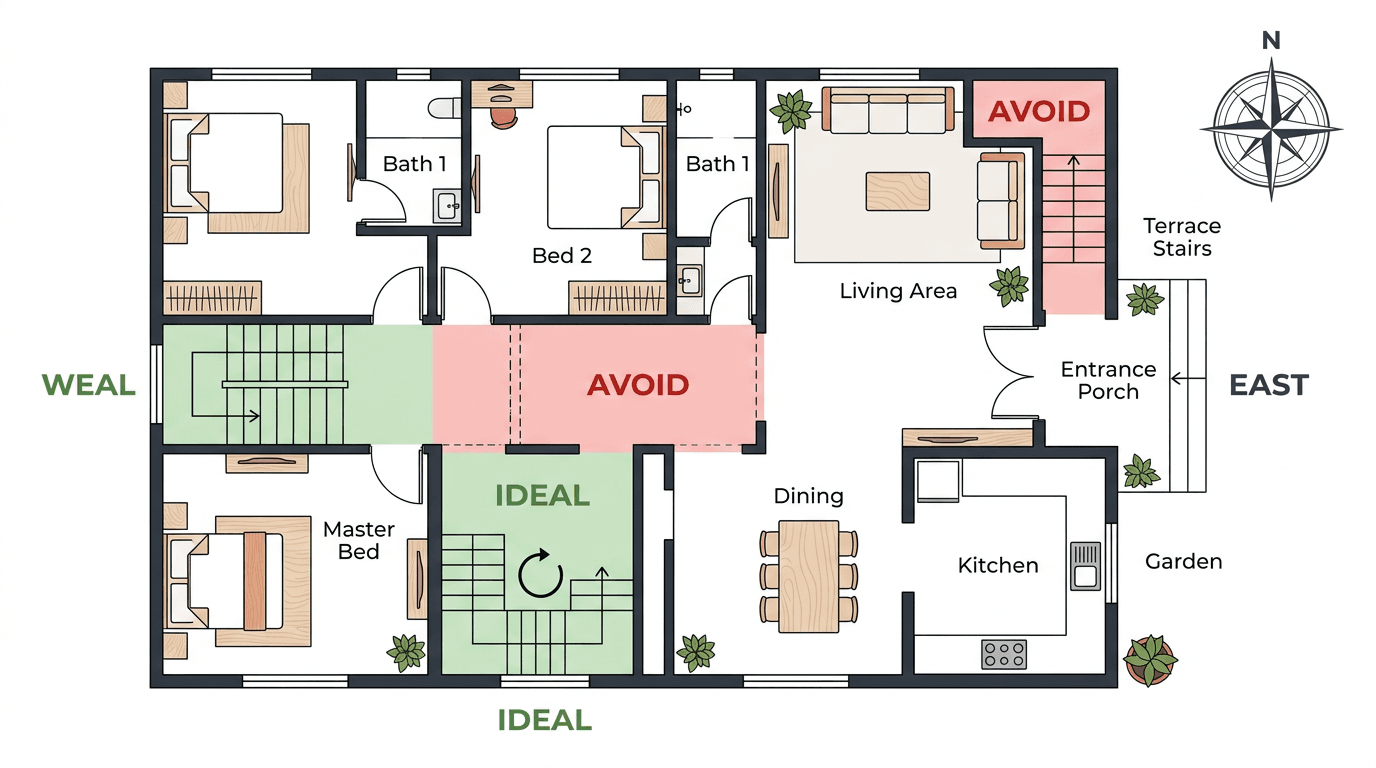
- Direct answer: The best place for a staircase as per vastu is the southwest, south, or west part of the house. It should climb clockwise and have an odd number of steps, such as 11, 15, 17, 19 or 21.
- Avoid: A staircase in the northeast corner (Ishan) or the centre of the house (Brahmasthan). Never end the step count in zero.
- Under the stairs: Dry storage under the staircase is fine. A pooja room, kitchen, or toilet beneath a staircase is not.
- Our verdict: After 30+ vastu-compliant projects across India, we treat staircase vastu rules as a structural planning framework. Most double as plain good engineering.
Why Staircase Vastu Shastra Matters in Your Home
Vastu Shastra is the traditional Indian science of architecture that assigns every part of the house a direction and a purpose. Staircase vastu covers the direction and placement of your stairs, which way they turn, and how many steps they carry. In traditional vastu, the staircase in your house matters more than most rooms. It's the heaviest traffic-bearing structure in the home, and because a staircase physically connects floors, the texts treat it as a channel for energy flow between them, carrying positive energies upward or draining the energy in your home when it's wrongly placed.
Here's the practical reason vastu is important to us as architects: a staircase is nearly impossible to move later. Get a wardrobe wrong and you shift it on a Sunday. Get a staircase built wrong and you're looking at structural demolition. So this is the one vastu conversation we insist on having at the floor-plan stage, on every project, whether or not the client plans to follow vastu strictly.
Before the details, learn staircase basics from the quick-reference table we sketch for clients:
| Staircase Parameter | Auspicious Vastu Rules | What to Strictly Avoid |
|---|---|---|
| Best Directions | Southwest, South, West | Northeast, Centre (Brahmasthan) |
| Climbing Orientation | Clockwise (North to South / East to West) | Anticlockwise / spiral designs |
| Step Count | Odd numbers (11, 15, 17, 19, 21) | Even numbers or ending in zero (10, 20) |
| Under-stairs Area | Dry utility storage | Pooja room, kitchen, bathroom |
Two terms you'll meet repeatedly. The Brahmasthan is the centre of the house, which vastu keeps open, light, and free of heavy structures. The Ishan corner is the northeast, the zone reserved for the lightest, most sacred functions like the pooja room. A staircase is heavy. It belongs in neither.
Which Is the Best Direction for a Staircase as Per Vastu?
The ideal direction for a staircase according to vastu is the southwest corner of the house, followed by the south and west. These are the heavy zones of the vastu grid, meant to be loaded and anchored. Avoid the northeast and the centre, which must stay light and open for the house to breathe.
The logic behind the right staircase direction as per vastu runs on weight. The vastu grid divides the plan into zones and asks you to load the southwest, the zone of stability, with mass: master bedroom, storerooms, staircase. The northeast stays open for light and water elements. Whether you read that as energy flow or as a sensible convention that keeps your brightest corner unblocked, the result on a drawing is the same. Choosing the right staircase direction early costs nothing. Correcting it later costs a demolition crew.
Internal Staircase Direction and Placement
For an internal staircase, a staircase in the southwest is the first choice, then the south or west direction. Place the staircase against an outer wall rather than cutting through the middle of the plan. A well-designed staircase hugs the perimeter and leaves the core open. A staircase should also not be the first thing a visitor meets, so never start the flight directly facing the main entrance. In practice we tuck the staircase area behind the living zone, which quietly also solves privacy for the bedroom floor. That, in one line, is the ideal staircase location as per vastu: southwest, on the edge, out of the entry's sightline.
External Staircase Direction as Per Vastu
An external staircase follows the same compass with one extra care: it should not shadow or crowd the northeast of the plot. South-facing and west-facing walls take an external flight comfortably, so the external staircase direction as per vastu shastra stays south or west. We use external stairs a lot in rental-unit projects, where the tenant's access must stay separate from the family's, and the southwest or south staircase position as per vastu handles both tradition and privacy in one move.
Staircase Vastu for East Facing Homes
Owners ask us about staircase vastu for east facing house plans weekly. The house facing changes the entrance rules, not the stair rules. Even in an east-facing house, the staircase still goes southwest, south, or west, and it still must not sit in the northeast, which is doubly precious on an east plot because that's where the morning light enters. Vastu for east facing house entrances is its own topic, so see our house facing vastu guide for that side of the equation.
Clockwise Direction: How Stairs Should Turn According to Vastu Shastra
Vastu asks for a clockwise staircase: you rise moving from north to south or east to west. The traditional reading ties the clockwise direction to the sun's path and to smooth energy flow throughout the house. The practical reading: a consistently turning stair is easier to plan around a central landing and far simpler to light.
Anticlockwise staircases are considered a defect per vastu shastra, and fully spiral staircases fare worst in the tradition, whatever they do for a photograph. If you already live with an anticlockwise flight, don't panic and don't demolish. The vastu remedies section below covers the non-demolition fixes.
Number of Steps in a Staircase as Per Vastu: The Odd Number Rule
According to staircase vastu, the number of steps should be an odd number: 11, 15, 17, 19, or 21 are the counts vastu experts prescribe most often. The count must never end in zero.
The reasoning behind the odd number of steps is charming and surprisingly biomechanical. Most people start climbing with their right foot. Keep the steps in a staircase odd and the same right foot lands on the final step, which the tradition reads as an auspicious beginning and end to every climb. Some schools count differently, treating the landing as a step, others not. If your family follows a particular consultant, fix the counting convention before the contractor pours concrete.
One honest note from site experience: riser height and tread depth decide daily comfort far more than the total. We size risers around 150 to 175 mm and treads around 250 to 300 mm, in line with common Indian residential practice, then tune the count to an odd number. You rarely have to fight for it. A typical Indian floor height gives 15 to 19 steps anyway, so a proper staircase lands on an odd count with one small riser adjustment.
Staircase Placement Rules: What to Avoid According to Vastu Principles
Some placements are flat no-gos under staircase vastu shastra, and most are no-gos in our studio too. The common staircase defects we're asked to fix:
- The Brahmasthan. Placing a staircase in the centre of the house is the biggest defect in the vastu guidelines. It blocks the heart of the plan, and structurally it chops your best space into corridors.
- Above the kitchen or pooja room. Sacred and fire zones shouldn't carry stairs overhead. Our kitchen vastu guide covers the kitchen's own placement rules.
- A staircase directly facing the main entrance. When the staircase faces the main door, the texts say the home's energy rushes straight out. It also makes a home feel like a stairwell. Recess it or screen it.
- A staircase in the northeast. The Ishan corner stays light, open, and low. A heavy concrete flight there is the classic mistake we're asked to remedy in renovations.
- Touching the pooja room or toilet walls thoughtlessly. Stack wet areas and utility zones together instead; our toilet direction as per vastu guide explains that part of the house.
Follow vastu on these five and the direction of the staircase itself becomes much easier to settle.
Storage Under the Staircase: What Vastu Allows
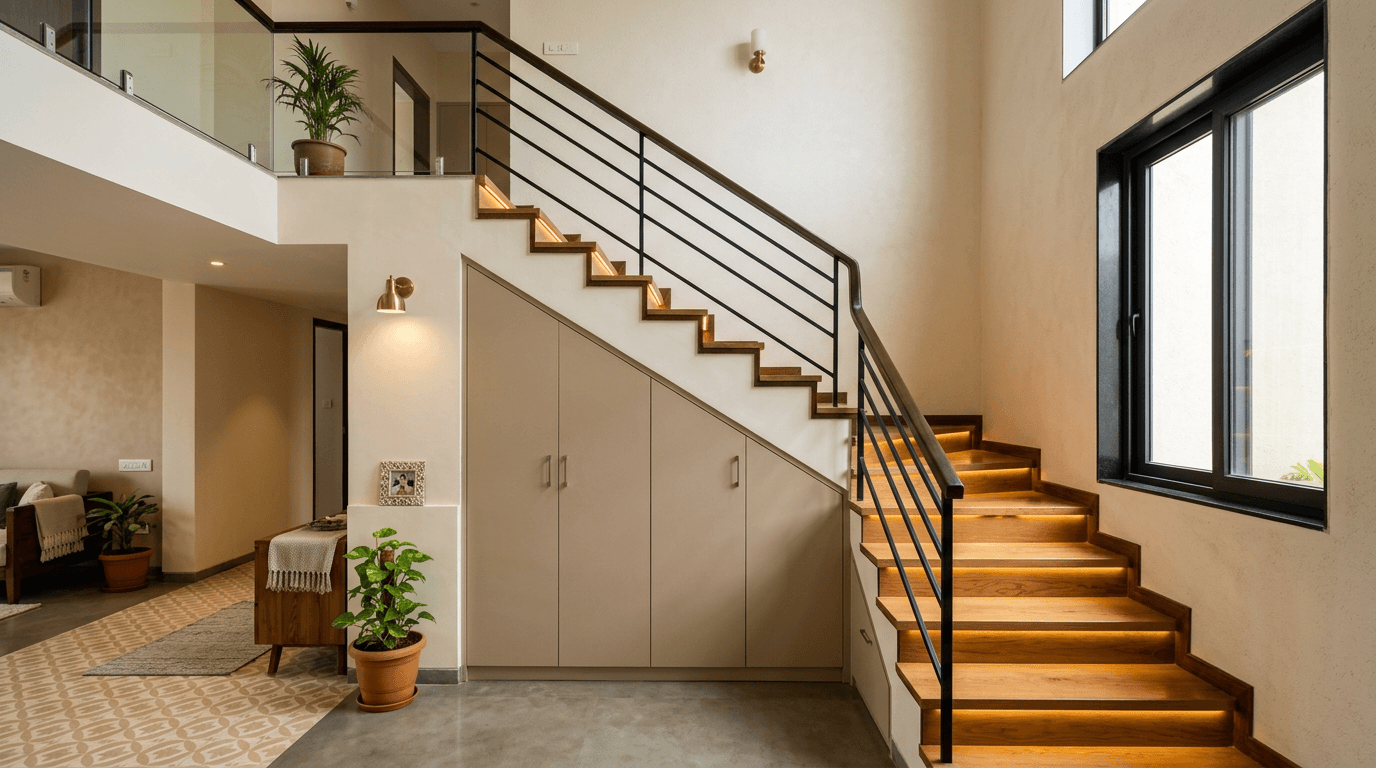
Use the space under the staircase for dry utility storage. Shoe cabinets, cleaning supplies, a store cupboard, all fine. What the vastu rules prohibit beneath a staircase: a pooja room, a kitchen, or a toilet. The under-stair volume is a pressed, traffic-loaded space, the opposite of what a sacred or cooking zone needs.
In Hamsini's three-storey joint-family home in Hyderabad, the brief packed special storage requirements for every family member, and the under-stair zone earned its keep: we designed the crockery storage under the staircase, with dedicated space and ventilation for the inverter. Utility, exactly where vastu says utility belongs. In Vikas Goud's duplex residence, the landing between the two flights holds a small library. Landings are fair game. It's the volume under the flight that carries restrictions. That's the pattern to copy when you want a staircase placed to earn double duty without breaking a rule.
Staircase Vastu Tips for Duplex Homes and Villas
Multi-floor homes live and die by staircase placement, because every floor inherits it. When we planned Nitesh's eight standardized villas in Machilipatnam, the developer's brief was living, dining, kitchen, pooja and one bedroom on the ground floor, remaining bedrooms upstairs, everything placed as per vastu principles, on a trapezoidal plot. As per staircase vastu shastra, the stairs were the first line we fixed in each villa plan. Designing a staircase as per vastu principles from day one meant the eight plans never needed a retrofit. Every other room negotiated around that positioned staircase.
Same story in compact builds. Sneha and Venkat's triplex in Hyderabad sits on a 150 sqm plot with a penthouse and party terrace on top. Three flights, stacked, one decision made once. On tight plots you don't get a second staircase, so choosing the right direction, turn, and landing sizes deserves the longest meeting of the design phase. If you're starting from scratch, our house design in India guide walks the full sequence, and the staircase location conversation belongs in week one, not month three.
A note on aesthetics, since placement and design get tangled: this page is about vastu for staircase planning. For materials, railings, and looks of a modern staircase design, see our staircase and railing designs guide. The two decisions are separate, and the vastu one has to come first.
Vastu Remedies for an Existing Staircase
Can't demolish? Neither can most of our renovation clients. The traditional, non-demolition remedies for an existing staircase:
- Paint it light. Whites, creams, and light pastels traditionally soften a wrongly placed staircase. Avoid black and red on a home staircase.
- Crystals and copper. Consultants prescribe a crystal or a copper wire strip under the first and last steps of an anticlockwise or northeast flight to restore positive energies. It's traditional practice, not physics, and we say so to clients plainly. It's also harmless and inexpensive.
- Light the flight. A dark staircase reads badly in vastu and is a genuine safety hazard. Warm, continuous lighting fixes both readings at once.
- Keep it closed off. Doors at the top or bottom of the flight are said to contain the rushing energy of a badly located staircase, and they help with acoustics and air-conditioning anyway.
- Plants at the base. A healthy plant near the foot of the stairs is a common prescription for softening the staircase area.
What we won't promise: that a crystal reverses a structural defect. If the staircase sits in the Brahmasthan, remedies soften it; only a redesign removes it. We've rebuilt exactly such staircases during full renovations. That's a decision to make with a structural engineer, not a pendant.
Common Staircase Vastu Mistakes to Avoid
- Building a pooja room under the stairs to save space. It's the most common request we refuse.
- Letting the contractor decide the count. You end up at 12 or 20 steps because the floor height divided neatly, and the odd-number rule quietly breaks.
- Spiral staircases as the main staircase. Vastu dislikes them, and daily life with furniture agrees.
- Broken or creaking steps left unrepaired. Traditional vastu reads damaged stairs as stalled progress; we read them as a lawsuit.
- Treating vastu tips for staircase planning as an afterthought. Planning the stairs as per vastu happens on the drawing, before a single wall exists, and that's when the right staircase costs nothing extra.
Staircase Vastu Checklist for New Builds
These placement tips condense everything above. Run the checklist before your working drawings are finalized to ensure your staircase clears every rule:
- Mark the Brahmasthan and the northeast on the plan. Confirm the staircase touches neither.
- Place your staircase in the southwest, south, or west zone, against an outer wall. That's the ideal placement in nearly every plan we've drawn.
- Set a clockwise climb, rising north to south or east to west.
- Fix the counting convention with your consultant, then land on an odd count that doesn't end in zero. A staircase must clear this before the slab is cast.
- Check the flight doesn't face the main entrance or sit above the kitchen or pooja room.
- Reserve the under-stair volume for dry storage only.
- Confirm risers, treads, and railing comply with safety norms. Comfort is also what vastu principles intend.