Written by Sindhu G, Principal Architect at Roomantic (SPA Delhi). She has designed residential, commercial, and institutional spaces across India, with 30+ projects delivered in Hyderabad, Bangalore, and beyond.
Key Takeaways
- Direct answer: the best toilet direction as per vastu is the northwest direction (Vayu zone) or the west direction of the home. The second-best option is the south-of-southwest (SSW) segment. Never place a toilet in the northeast or the center (Brahmasthan).
- Seat rule: the person using the toilet seat should face north or south. Facing east or west is prohibited in the classical texts.
- Our verdict as architects: almost every toilet rule in vastu shastra is pre-plumbing sanitation logic. Fix an incorrect placement by changing ventilation, function, and door discipline, not by demolishing a bathroom.
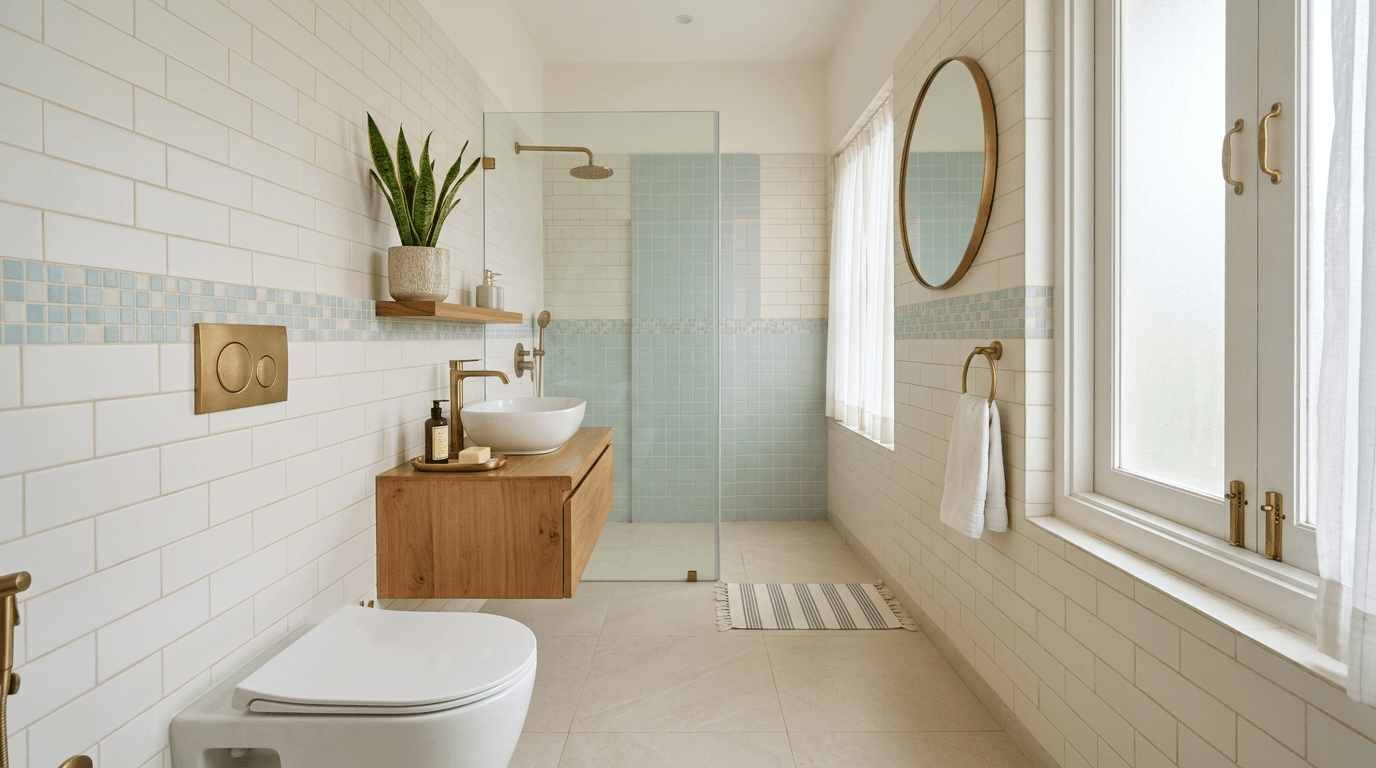
Why Toilets and Bathrooms Get the Strictest Vastu Rules
According to vastu shastra, the toilet is the most restricted room in the house: it must sit in the northwest, west, or south-of-southwest, stay out of the northeast and the center, and never share a wall with the kitchen or pooja room. The toilet seat should let the user face north or south.
Here's the context most pages on vastu for toilet rules skip. When the classical texts were written, there was no sewage line under the street. Waste was pits and open drains, water was stored in the northeast of the plot, and the prevailing breeze decided what your whole house smelled like. So the texts treated bathrooms and toilets as per one principle: push them, along with septic zones, downwind, downhill, and as far from stored water and food as the plot allowed. That's not superstition. That's epidemiology before the word existed.
We're a design-build architecture studio, and every one of our 30+ projects is planned according to vastu, toilets included. This guide gives you the guidelines for toilet and bathroom placement the way we apply them on real drawings: the best direction for toilet construction and the ideal location, the seat orientation, what to do about a shared kitchen wall, and every practical remedy for flats where the plumbing was decided years before you bought.
Toilet Position as Per Vastu: The Ideal Location on the Vastu Grid
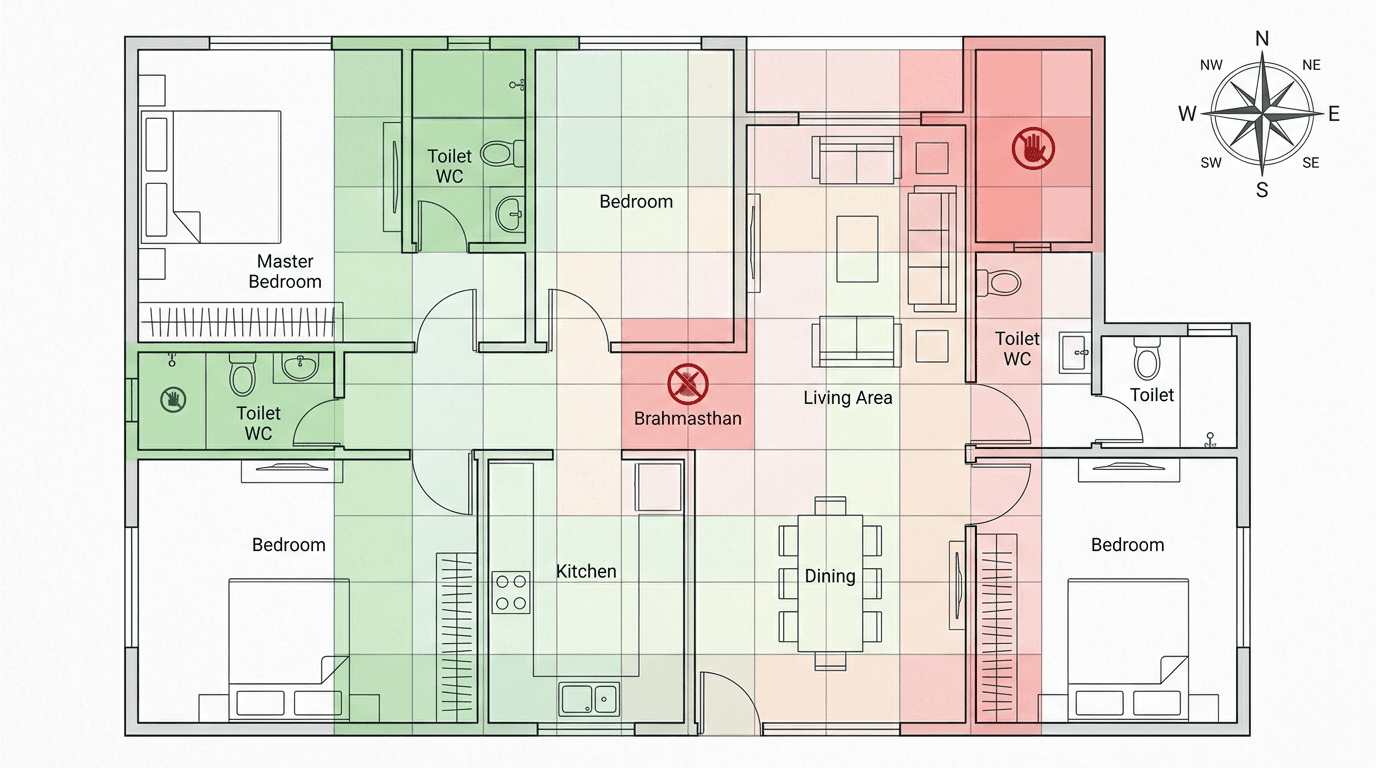
The ideal toilet location as per vastu is the northwest of the home, with the west a close second and the south-of-southwest segment as an accepted alternative. The zones to avoid placing the toilet in are the northeast (the water corner), the center (Brahmasthan), and the exact southwest corner.
Lay the Vastu Purusha Mandala over your floor plan (our vastu shastra for home guide explains the grid itself) and the logic of toilet placement as per vastu reads straight off it. The northwest belongs to Vayu, the air element. It's the windward, airflow zone, which is exactly where a wet, odor-prone room wants to be. That's why the northwest direction is considered the ideal direction for toilets as per nearly every school, with the west a solid second. Getting the toilet direction as per vastu helps the room do what the texts intended: stay dry, aired, and unnoticed.
| Direction | Vastu status for a toilet | Why / remedy if already built |
|---|---|---|
| Northwest (Vayu) | Best | Air zone; maximize ventilation and it performs as intended |
| West | Good | Acceptable in nearly all vastu guidelines; keep it dry and bright |
| South-of-southwest (SSW) | Acceptable second choice | Keep the seat orientation correct; ventilate well |
| South | Workable | Avoid the exact SW corner; add an exhaust and window |
| Northeast (Ishanya) | Strictly avoid | Water/pooja corner; if built, see the remedies section |
| Center (Brahmasthan) | Strictly avoid | The core must stay open and clean; convert if at all possible |
| Southwest corner | Avoid | Earth/master-bedroom zone; remedy with salt, brass strip, closed door |
| East / North | Poor | Daily-light zones; keep for living functions where you can |
Two placements deserve their own sentence. Constructing a toilet in the northeast corner of the house is the single most flagged dosha we meet in audits, because the northeast is reserved for water storage and the pooja room. And placing a toilet in the center of the house breaks the one rule every school of vastu agrees on: the Brahmasthan stays open, light, and clean. If your existing toilet or bathroom falls in either zone, don't panic; skip ahead to the remedy section before you price a demolition.
WC Facing Direction Rules: Toilet Seat Direction as Per Vastu
The toilet seat direction as per vastu should let the user face north or south while seated. The toilet seat should not face east or west, because those are the sun's rising and setting axes, which the tradition treats as sacred. In practice: mount the WC so its axis runs north-south.
This is the question that decides bathroom layouts, so let's be precise. The rule is about the person, not the porcelain. Classical practice says you should be facing north or south when using the toilet, and you should avoid facing east and avoid the west-facing position too; a toilet seat facing either solar axis is treated as disrespect to Surya. Some modern practitioners add a bio-magnetic, north-south alignment argument on top. So the direction of the toilet seat, per vastu shastra, comes down to one line: user faces north or south, never toward sunrise or sunset. Every bathroom toilet seat direction query we get is answered by that sentence.
Our honest architect's read: the seat direction as per vastu is tradition, not building science, and we'll say that plainly. But complying costs nothing. On a fresh drawing, toilet seat placement is a pencil stroke: rotating a WC ninety degrees costs exactly nothing, so in our projects the commode axis runs north-south by default and the argument never needs to happen. In an existing bathroom, check which way you face; a toilet facing east or west is the most common miss we find in audits. If the room allows it, placing the toilet seat along the adjacent wall is usually a one-day plumbing job, and you'll have the toilet seat as per vastu without touching a single tile beyond the pedestal.
Toilets Sharing Walls With Kitchen or Pooja: The Fixes
A toilet should not share a wall with the kitchen or the pooja room according to vastu. The traditional reason is energy contamination; the practical ones are damp, odor, and hygiene migrating through a shared wet wall. Fix it with a buffer cabinet wall, dedicated waterproofing, and strict exhaust ventilation.
The tradition is blunt about this pairing: bathroom energy next to food or worship is inauspicious, full stop. Sit with the practical layer, though, and the rule earns its keep. A toilet wall is a wet wall. Put it against the kitchen and you've got moisture, smells, and plumbing vibration on the other side of the surface where food lives; put it against the pooja room and every leak becomes a small crisis of conscience.
When we can't separate the rooms on plan, we build the separation into the wall itself. A full-height storage unit or utility shaft between toilet and kitchen acts as a buffer. Waterproofing goes up the shared wall, not just the floor. The toilet gets an exhaust fan that actually runs, and the door stays closed as a house habit. If you're planning a kitchen right now, its own directional rules live in our kitchen vastu rules guide.
Apartment Reality: Vastu Remedies When You Can't Move Plumbing
For a toilet placed in the wrong direction in an apartment, vastu remedies are non-structural: keep a bowl of raw sea salt in the bathroom and change it weekly, keep the lid down and the door closed, add a brass strip at the threshold, ventilate aggressively, and use light colors like white, cream, or blue.
Flats are where toilet vastu gets emotional, because the plumbing stacks were fixed years before you saw the brochure. You can't move a soil pipe that runs through twelve floors, so a west-shaft WC stays a west-shaft WC, and an unlucky one stays put too. We renovated Om Sri Padma Nilayam, a 30-plus-year-old apartment building in Hyderabad, right down to its plumbing and waterproofing, and even there the toilet positions stayed where the original stacks dictated.
So here's our two-tier honesty about remedies, the same stance we take in the pillar guide. The traditional kit has no physical mechanism, but it's cheap and it comforts families, and we don't argue with cheap comfort: place a vastu pyramid or crystal on a shelf, keep the sea-salt bowl, fit the brass strip. Fine. The vastu tips that measurably change the room are these:
- Ventilation first. An exhaust fan on a timer plus a window opened daily turns a "negative energy" bathroom into a dry, odorless one.
- Door and lid discipline. Keep the toilet door closed and the WC lid shut. Half of bathroom vastu practice is simply containment.
- Light colors. For a northwest bathroom, the tradition and our finishes palette agree: white, cream, light blue, or soft yellow. Skip black and deep red.
- Function swaps at renovation. In Giridih, Jharkhand, we merged two bedrooms and a cramped common bathroom in the Sumit Agarwal residence into one master suite with a walk-in closet and study. The "problem bathroom" stopped being a problem because it stopped being that bathroom.
- Keep it dry. Fix leaks fast, squeegee the floor, and the room stops broadcasting damp into the house.
If the toilet is already in a prohibited zone and a renovation is genuinely on the table, a vastu expert and your architect should look at the plan together, in the same meeting. Sequential consulting is how demolition-grade "fixes" get invented for problems a function swap would have solved.
Bathroom Direction as Per Vastu: Guidelines Inside the Bathroom Itself
Bathroom vastu doesn't stop at the door. Within the bathroom, classical guidelines place the washbasin and shower on the north or east wall, mirrors on the north or east, the geyser and switchboards in the southeast, and the drainage slope towards the north or east direction. The WC itself stays in the west or northwest of the room.
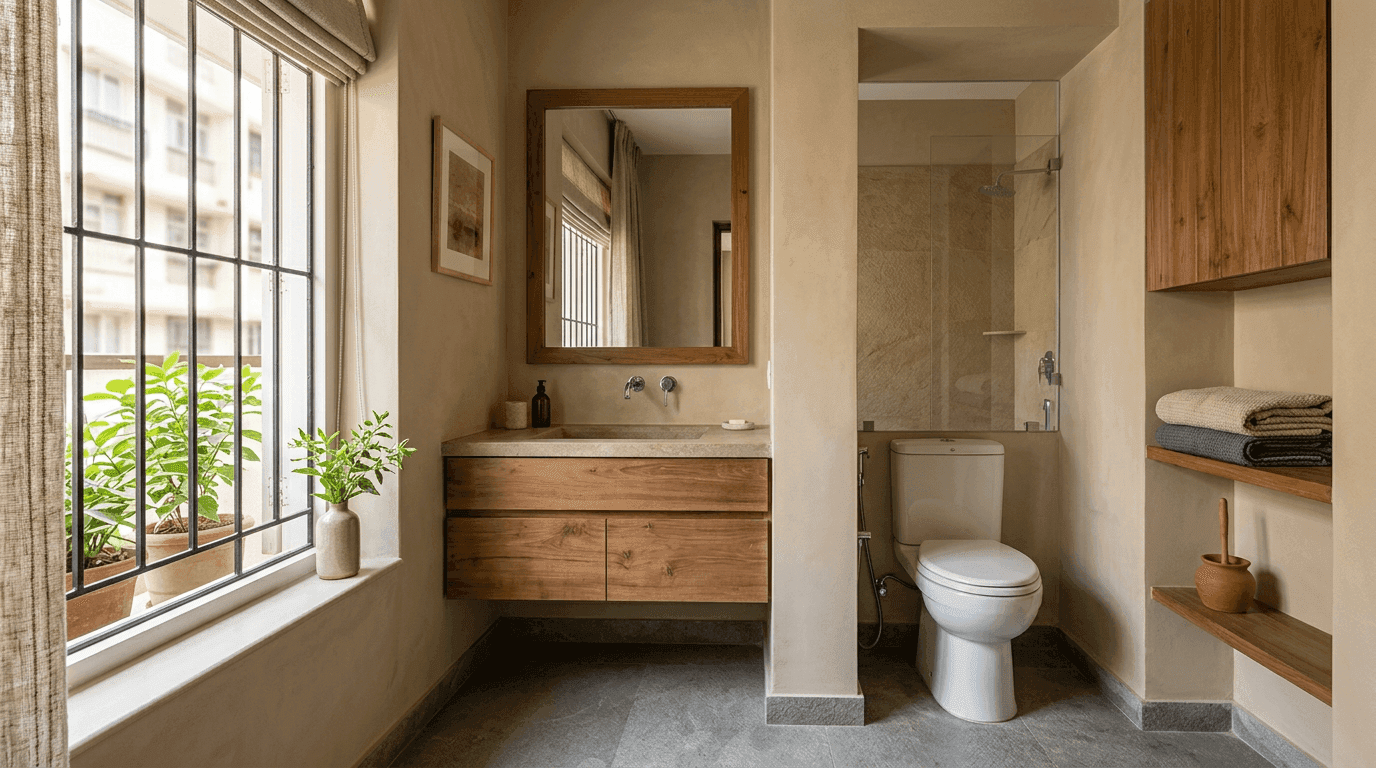
Once the room's position is settled, the same directional grid repeats inside it, and following it happens to produce a bathroom that simply works better. The wet, daily-use fittings, the basin and shower, sit on the north or east wall where the texts put water functions; water leans to the north direction throughout vastu. The geyser, the fire element, takes the southeast of the bathroom, which conveniently is also where an electrician wants it: away from the shower spray. The right toilet position within the room: place the toilet in the west or northwest, keeping the WC off the wall you see first from the door. Mirrors go on the north or east wall; the tradition reads them as amplifiers of those zones, and a designer reads them as reflectors of the best available light.
None of this requires a bigger bathroom or a costlier one. It's a seating chart, not a shopping list, and on a new drawing every toilet and bathroom item lands in its correct zone for free. For fittings, finishes, and layout ideas beyond the directional rules, our bathroom design guide picks up where the vastu rules stop.
Attached vs Common Toilet Placement as Per Vastu in New Plans
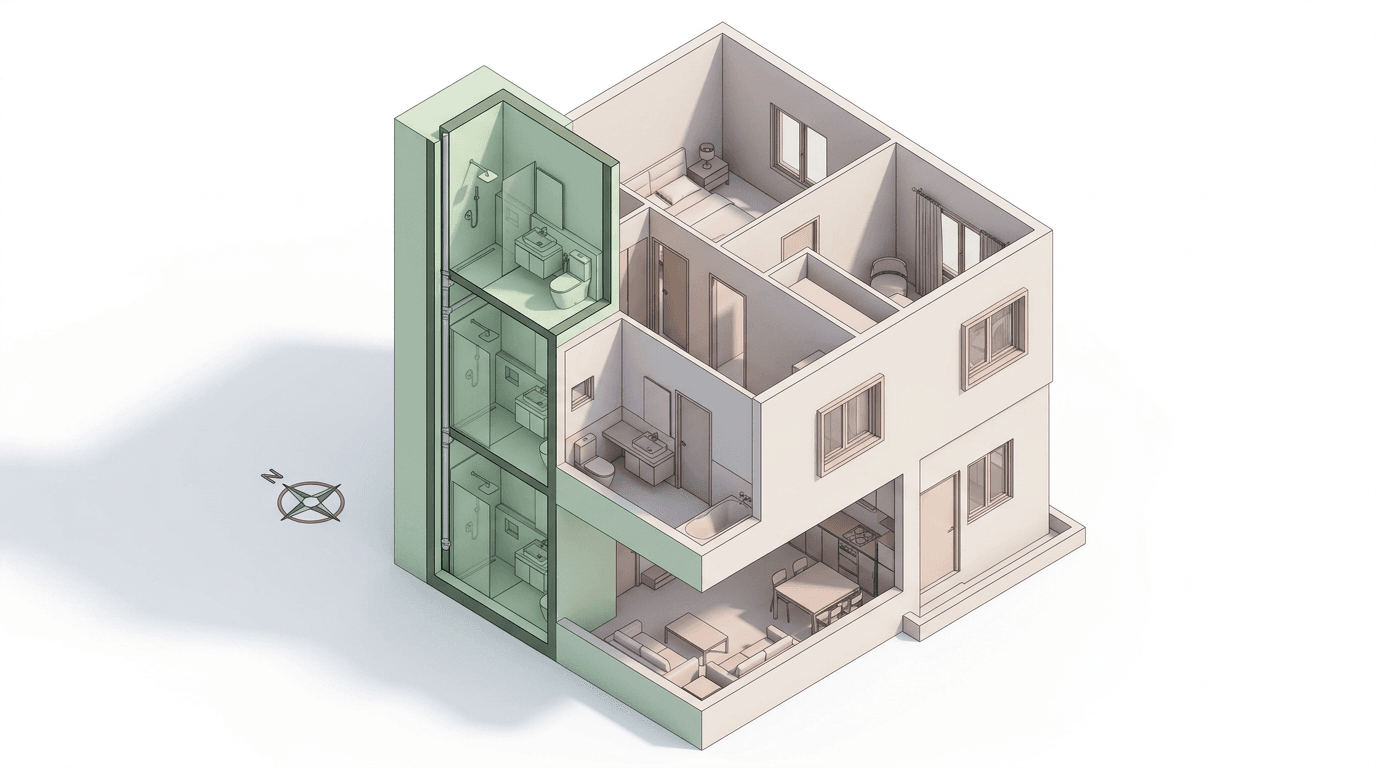
In a new plan, place attached toilets on the west or northwest side of their bedrooms, stack bathrooms and toilets vertically on one or two plumbing shafts, and put the common toilet in the home's northwest zone. Decide toilet positions in the first zoning sketch, never after the slab.
New construction is where this whole guide becomes free to implement. On a fresh plan, the toilets, the septic position, and the plumbing shafts get placed in the same sketch as the mandala overlay, so paying attention to the direction and location of every wet room costs nothing, and following vastu never has to fight the hydraulics.
We got a compressed lesson in this with the Nitesh villas project in Machilipatnam: eight standardized villas on a trapezoidal plot, each with living, dining, kitchen, pooja, and bedrooms all placed per vastu principles, repeated across plots of 150 to 200 square meters. Standardizing toilet and shaft positions across all eight, while keeping every unit's grid compliant on an irregular site, is exactly the kind of puzzle that gets solved on paper in a week or on site in a very expensive month.
The working rules we draw by: attached toilets sit west or northwest within each bedroom block, never in a bedroom's northeast corner. The common toilet takes the home's own northwest, whatever the facing direction of the house. Wet areas stack floor over floor, bathroom and toilet alike. Whatever you do, avoid placing the toilet over or under the pooja room in a multi-storey plan; it's the vertical version of the shared-wall problem. And bedroom-side decisions, like which room becomes the master, follow the logic in our guide to bedroom vastu and sleeping direction.
Conclusion: The Toilet Vastu Checklist for Buyers & Builders
Whether you're approving a new floor plan or flat-hunting with a compass app open, this is the ten-second vastu toilet audit we'd run to confirm a correct toilet position in every bathroom:
- Toilets in the northwest, west, or SSW zones?
- Nothing built, and no plans to build a toilet, in the northeast corner or the center of the house?
- WC axis north-south, so you ensure the toilet seat has the user facing north or south?
- No shared wall with kitchen or pooja room (or a buffered, waterproofed wall if unavoidable)?
- Every bathroom with a window or working exhaust?
- Wet areas stacked on common shafts (new plans)?
- Septic/sewage connection placed where hydraulics and the grid both allow?
- Basin and shower north or east, geyser southeast, mirror north or east wall?
- Doors that close, lids that shut, leaks that get fixed?
Score well and your bathrooms are more compliant than most, whatever a remedy-seller says. Score badly on a flat you haven't bought yet, and you've just saved yourself years of low-grade guilt for the price of a compass reading. And if a wrong direction toilet is already yours, remember the order of operations: ventilation, containment, light colors, function swap. Demolition last, if ever.
If the walls aren't drawn yet, that's the moment to get every toilet in the correct zone for free. We design vastu-compliant homes across India, toilets to temples; pricing depends on your city, plot, and spec, so talk to our architects for a project-specific estimate or browse the portfolio first.