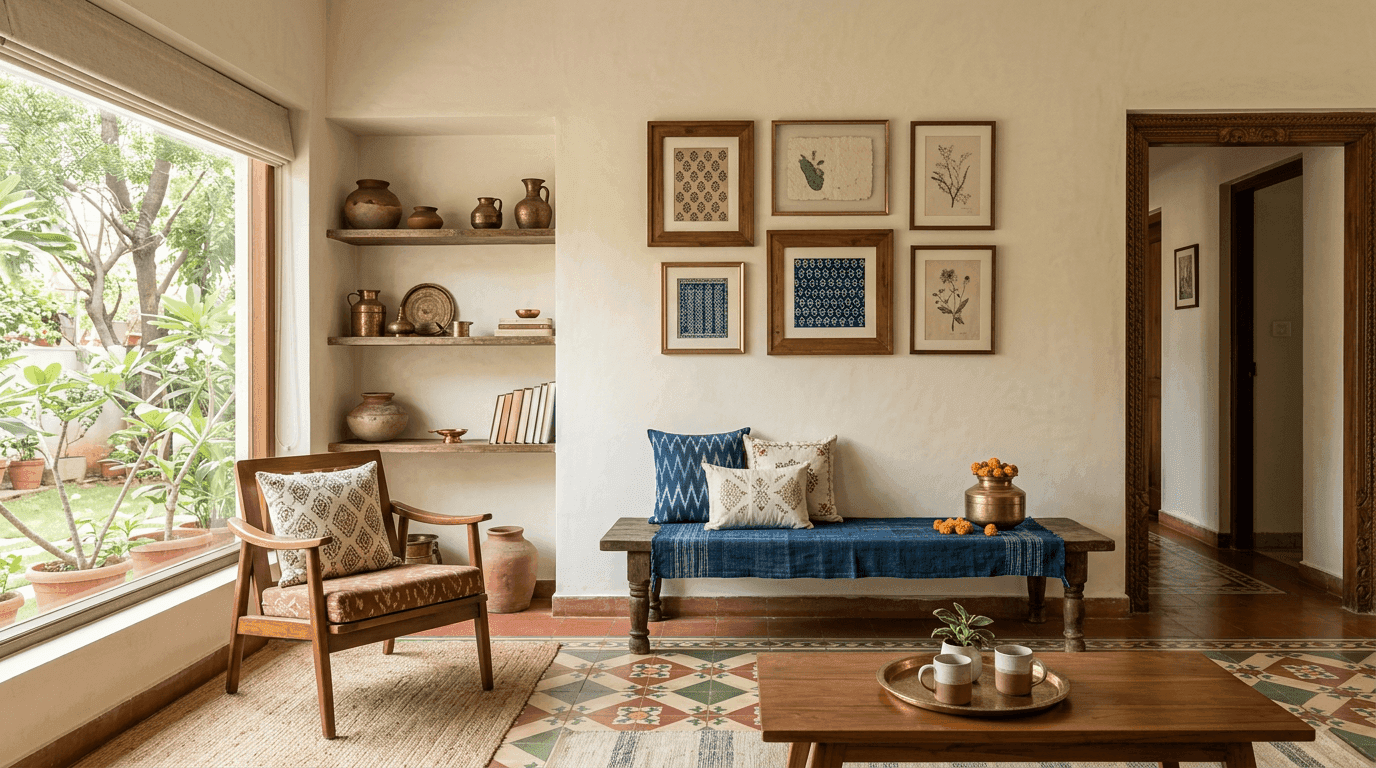
Key Takeaways
- A room reads as decorated — in any style — when five layers are present: soft surfaces, anchor furniture, walls, light, and a small number of objects on display. Most homes are missing two of the five.
- Scale fixes more rooms than shopping does. Undersized wall art, undersized rugs and short curtains are the three problems we see most often.
- One repeated colour and one dominant material tie a space together. Everything else is variation.
- Spend on what you touch daily and on what is hard to change later. Save on everything purely decorative.
- Trends date at the surface, not in the structure. Keep trend risk in the things you can swap in an afternoon.
- This page is the map. Whatever your style, every room and every surface has its own detailed guide, linked in place.
What Makes a Home Decor Idea Actually Work?
A decor idea works when it changes one of five layers — fabric and floor coverings, anchor furniture, the walls, the lighting, or the small objects on display — at the right scale for the room. Rooms rarely fail because they lack decoration. They fail because one layer is missing and another is oversupplied.
That is the whole method. The rest of this page is how to apply it.
We are an architecture and interiors firm. We design and build homes across Hyderabad and six other regions of India, and by now we have walked into a few hundred rooms whose owners described them as "somehow not looking finished". Almost none of them needed more things. They needed the right five things, at the right sizes.
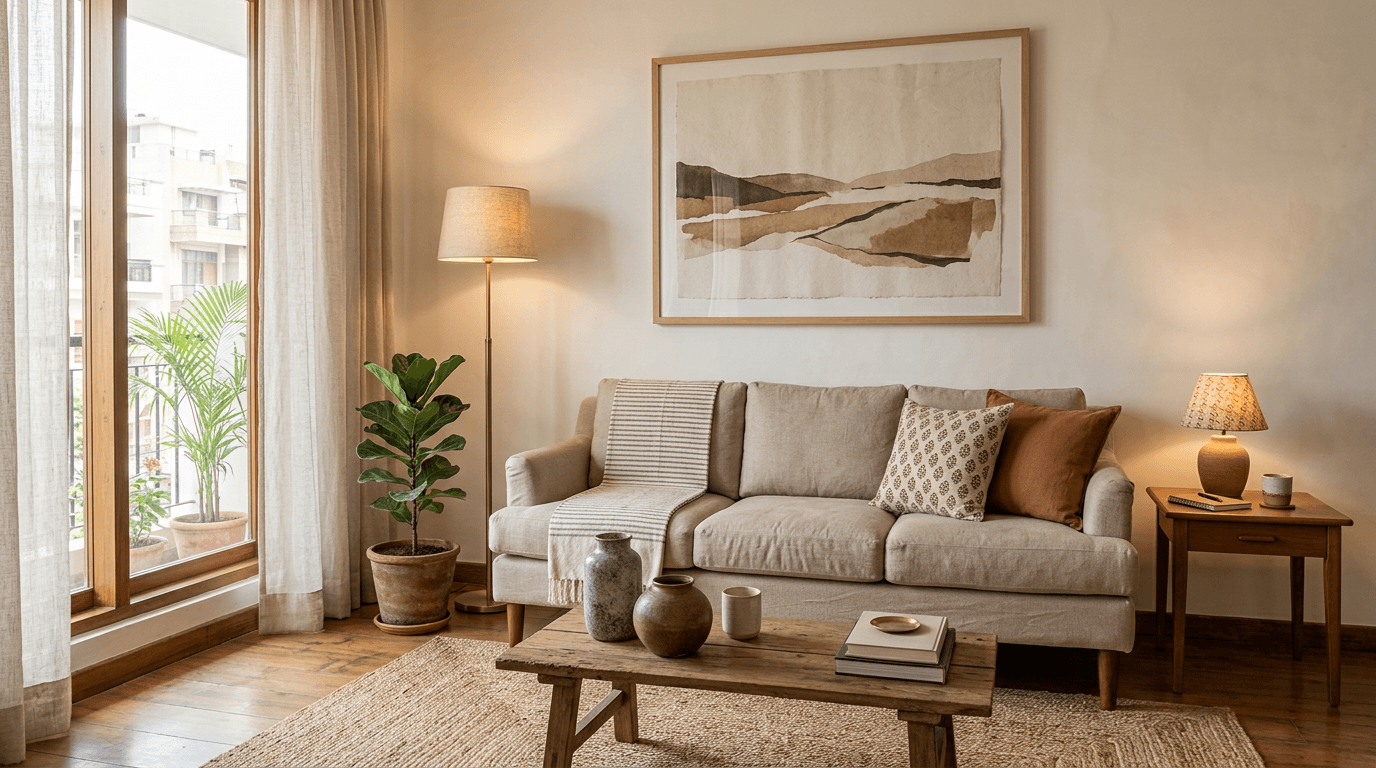
The Five Layers of a Decorated Room
Think of a room the way you think about getting dressed. There is an order, and skipping a step shows.
Layer 1: Soft Surfaces Set the Mood of a Room
Rugs, curtains, cushions, throws, upholstery. After the walls, these are the largest colour and texture surfaces you own, and they are the cheapest to change.
If a space feels cold or echoey, this is the missing layer nine times out of ten. Indian homes are hard-surfaced by default: vitrified tile or stone floors, plastered walls, very little fabric. Sound bounces off all of it. Add a rug and lined curtains and the identical room feels warmer without one new piece of furniture, and it happens before you decorate a single wall.
Layer 2: Anchor Furniture — Sofa, Coffee Table, Console Table
The sofa, the bed, the dining table, the coffee table, the console. These set the geometry of the space. They are also the pieces most people buy first and regret longest.
Our working rule: anchor furniture should be quiet. Its job is to hold the shape of the room, not to be the interesting thing in it. Interesting is cheap to change. Good seating is not. Clean lines on the big pieces buy you freedom on the small ones.
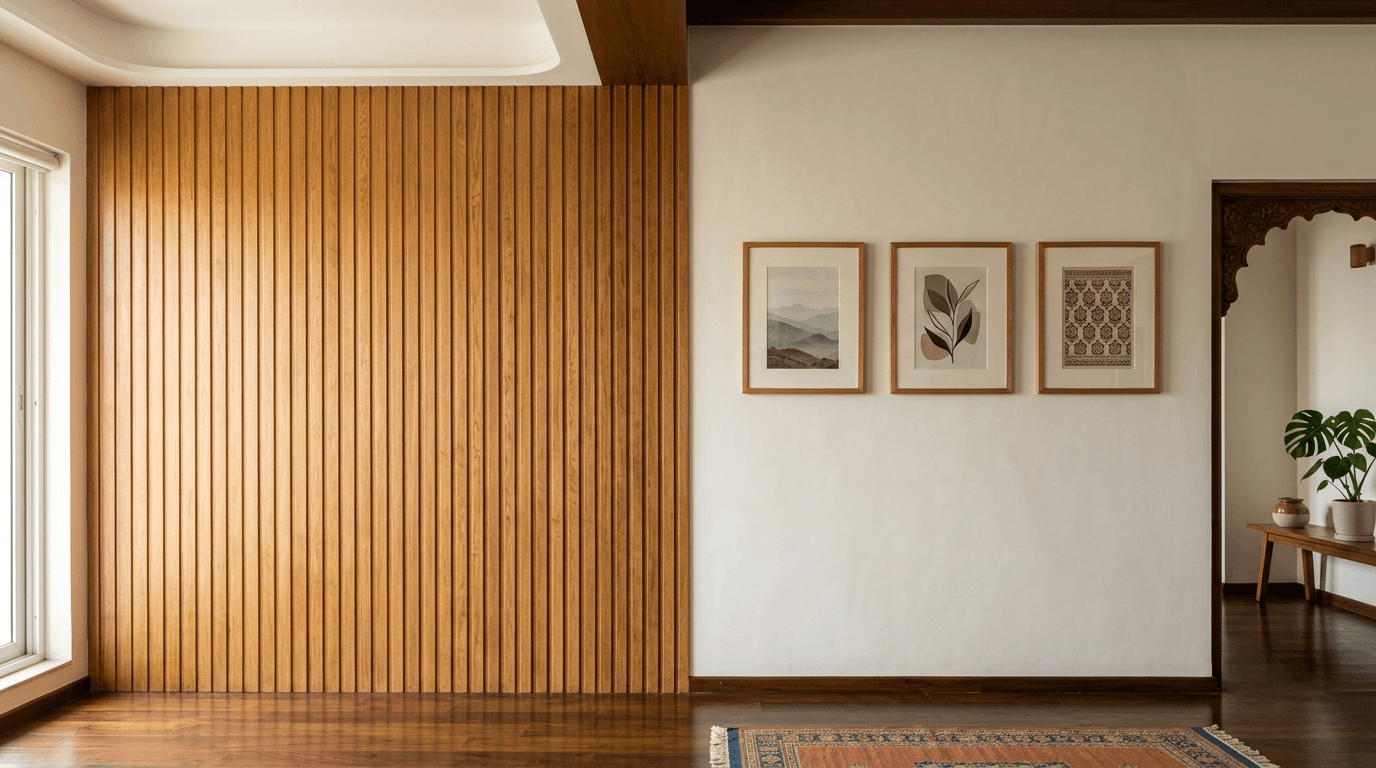
Layer 3: Wall Decoration Ideas Are Not the Same as Panelling and Paint
This is where most people freeze. A large empty wall is intimidating, so it stays empty for years.
Wall treatment splits into two categories that behave completely differently:
- Surface work changes the wall itself — paint, panelling, wallpaper, tile, an accent wall. This is a renovation decision with a fixed cost and a long life.
- Wall decor items hang on it — framed wall art, mirrors, floating shelves, textiles, metal pieces. This is a styling decision you can reverse in ten minutes.
Start with the second. A hanging you can take down teaches you what the wall wants before you commit to a permanent finish. Half the ideas people abandon were abandoned because they started with a drill.
Layer 4: Lighting, Lamps and Wall Sconces
One ceiling fixture in the middle of the room is not lighting. It is illumination.
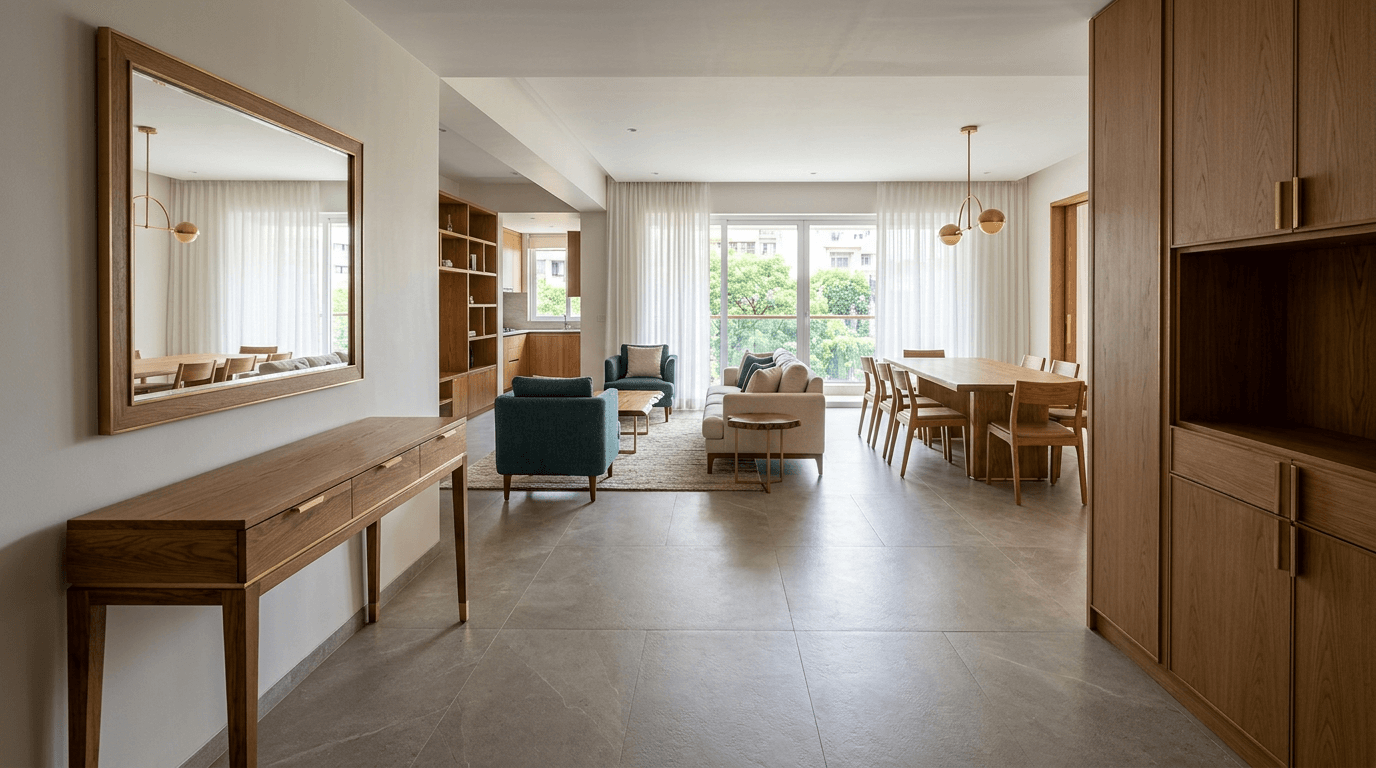
A decorated space has at least three sources at different heights: something overhead, something at eye level such as a sconce or a table lamp, and something low. That is the trick that makes photographs of designer rooms look different from photographs of yours. Warm light where you relax, neutral light where you work.
Layer 5: The Objects You Actually Display
Books, ceramics, plants, a bowl, a lamp, whatever sits on the console. This layer holds the personality, and it is the one people overdo.
A useful test: could you remove a third of the objects and have anyone notice? If yes, remove them. Clutter is not a storage problem. It is an editing problem, and editing is free. Restraint reads as stylish in a way that quantity never does.
Scale and Proportion: The Rules That Fix Most Rooms
Numbers now, because this is exactly where guessing fails.
How Big Should Wall Art Be on a Blank Wall?
Artwork above furniture should span roughly two-thirds to three-quarters of the furniture's width. A 7-foot sofa wants a piece or an arrangement about 5 feet wide. A single 2-foot frame floating above a 7-foot settee is the most common styling mistake in Indian homes, and it is the reason a room can look both empty and busy at the same time.
Hang the centre of the arrangement at eye level, about 145–150 cm off the floor for someone standing. Above seating, drop it so there is a 20–25 cm gap between the top of the backrest and the bottom of the frame.
For a genuinely large wall, one oversized piece is the lowest-risk answer. A grid of identical frames is second. A scattered gallery wall photographs beautifully and is the hardest of the three to get right in a real home — it needs a paper template on the floor before a single nail goes in.
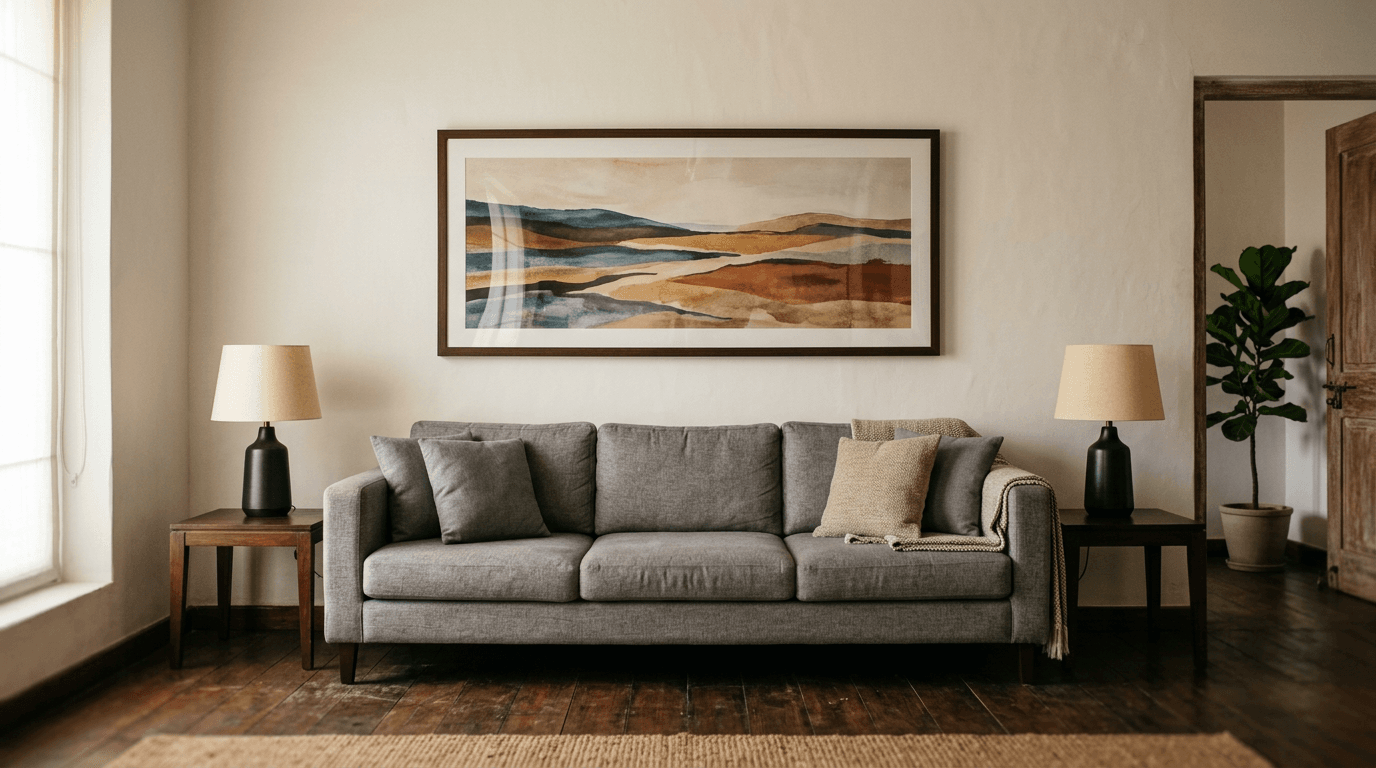
Rug Sizes for Living Rooms
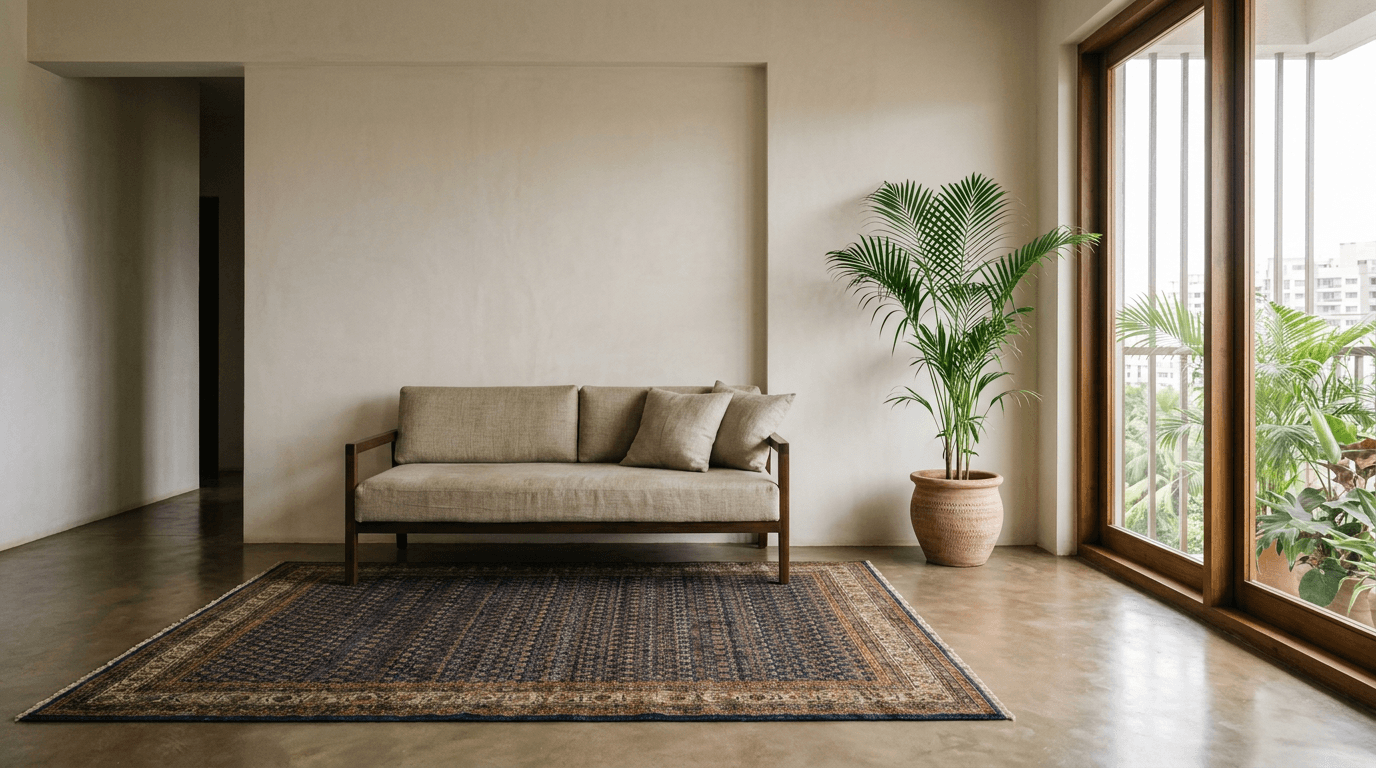
The front legs of every seat should sit on the rug. If the budget allows the bigger size, put all legs on. A rug floating in the middle with only a centre table on it makes a space look smaller, not larger.
Leave a border of bare floor between rug and wall. Around 45 cm is generous; 20–25 cm still reads deliberate in a tight room. Most Indian living rooms need something around 8 × 10 feet, which is one size up from what people usually buy.
Curtains, Tables and Walkways
Mount the curtain rod close to the ceiling rather than just above the window frame, and let the fabric touch the floor. That extra height is free, and it is the cheapest way to make a standard 10-foot ceiling feel taller. Allow about twice the window width in fabric so the curtain gathers properly instead of hanging flat.
A coffee table should run roughly two-thirds the length of the sofa, with 40–45 cm of walking space between the table edge and the seat. Keep 75–90 cm clear for any route people use to cross the room.
Colour Carry-Through: Making a Space Read as One
Here is the method, without getting into which shades to pick — that is a separate conversation.
Choose one colour that is not a neutral. Make it appear in at least three places, at three different sizes:
- Large — the rug, or the curtains.
- Medium — a pair of cushions, or a framed piece.
- Small — a ceramic, a plant pot, a book spine.
Three appearances is the minimum for the eye to read it as intentional. One looks like an accident. Five identical ones look like a showroom.
That is the entire technique. Which shades belong together, and what wall color suits which room, is a different question — we have answered it properly in our guide to room colour combinations.
Texture Beats More Colour: Why a Room Feels Cozy or Cold
When a space feels flat, most people reach for another colour. Reach for texture instead.
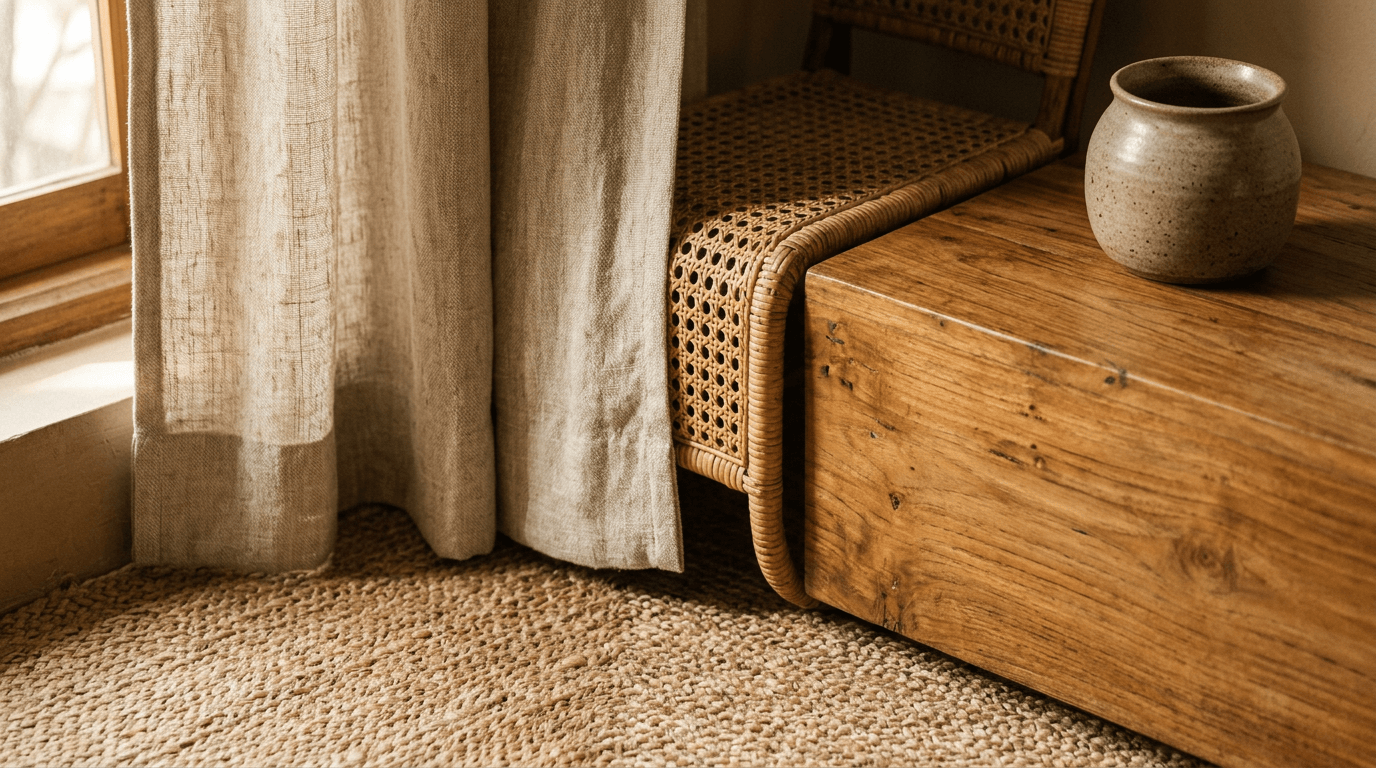
A room with cream walls, a jute rug, linen curtains, a wooden table, a cane chair and a wool throw is not a beige room. It has six materials in it. It photographs modestly and lives beautifully, which is the exact opposite trade-off from a room carrying six colours.
The pairing rule is simple. Rough against smooth. Matte against a little gloss. Hard against soft. Get that right and a cozy room happens by itself, with no extra spend.
Decorating on a Budget: Where to Spend and Where to Save
To make a home feel expensive without breaking the bank: hang curtains at ceiling height and let them reach the floor, swap plastic storage for natural materials such as cane or cotton, add a second and third light source at low and mid heights, and take away a third of the small objects on display. All four cost very little, and all four are what designers do first.
Budget decorating works best in tiers. Finish one tier before starting the next, because the cheapest ideas on a budget usually make the expensive ones unnecessary.
Tier 1: Room Ideas That Cost Nothing
Move the furniture. Pull the seating 10 cm off the wall. Group small objects into clusters of three instead of spreading them evenly along a shelf. Take down whatever you stopped noticing years ago.
We run a version of this on every project before designing anything: walk the space, list what should leave. On one resale apartment in Hyderabad — a 1,000 sft flat a family had just bought from the previous owners — a large part of the work was subtraction. A permanent painting left behind on the wall became a storage unit. A bulky showcase came out, and the opening it left became a window between the kitchen and the living area. Removing things bought that family more than adding things would have.
Tier 2: Easy DIY Home Decor for One Weekend
Cushion covers, a rug, one large framed piece, a floor lamp, a set of pots. This is the tier where making things yourself pays off — a frame wall you paint, floating shelves, a fabric hanging, a repainted old cabinet.
The honest limit of any diy project: it should be something you would still be happy with if it came out only 80% as good as the photo that inspired it. Easy diy is genuinely easy. Ambitious diy on a visible wall usually is not.
This tier is also the right home decor on a budget answer for anything trend-led, and the safest place to experiment when you decorate a rented flat, because you have not committed real money to something you may dislike in two years.
Tier 3: Luxury Home Decor Is One Statement Piece
One piece. A good sofa, a real dining table, a hand-knotted rug, or a single large artwork. A room with one genuinely good object and a lot of restraint beats a room with fifteen medium ones. This is the only place where high-end spending pays for itself visually, and it is what separates a considered room from expensive-looking clutter. Styling a home on a budget is not about buying nothing — it is about buying one thing properly.
Home Decor Trends 2026: What Lasts and What Dates Fast
Pick a style you can live with for a decade, then let the trends happen at the edges. Trend risk belongs in the layers you can change in an afternoon. Cushions, art, pots, lampshades, throws — go as far as you like. Flooring, wardrobe shutters, kitchen finishes, tile — stay boring on purpose. That single rule is worth more than any list of decor trends.
Dr. Kirti Goud briefed us on a 4,000 sft apartment she intended to let out. The instruction was explicit: universally acceptable colours and finishes, timeless, minimum maintenance. Another client, Gautami, a fresh graduate designing for her family of four, asked for the same thing in different words — durable, timeless, executed well enough to last at least a decade. Two very different budgets, one identical instinct, and it is the right one.
What actually dates: high-gloss everything, very dark feature walls in small rooms, matching furniture sets, and any finish that imitates another material badly.
What does not date: natural materials, restrained palettes, correct proportions and warm light. Those are the 2026 trends worth having, and they were also the 2016 ones.
Two genuine shifts are worth noting in decor ideas in 2026. First, smart home lighting has become cheap enough that warm-dimming bulbs are a realistic default rather than a luxury, and dimmable warm light flatters a room more than any accessory can. Second, plants have moved from decoration to structure — a green wall, or even one tall specimen, now does the job a large piece of furniture used to. Modern home decor in India has quietly become less about objects and more about light and greenery, and the 2026 home decor conversation is better for it.
Room-by-Room Home Decorating Ideas: Where to Go Next
This page is the map. Below is where the detail lives, room by room and surface by surface.
Modern Living Room Ideas
The largest and hardest room, because it carries the most jobs at once. Sequence matters here: seating layout first, then the rug, then the wall behind the main seat. Get those three right and the hall you were picturing mostly assembles itself. Our full guide to living room interior design covers layouts and circulation, and for the formal front room, we have written separately on how to decorate a drawing room for guests.
Living Room Wall Decor Ideas
What goes above the seating, and at what size, sits inside those two guides rather than here. The rest of the living room decor decisions, from rug placement to how many lamps a hall needs, sit there too.
Bedroom Styling: Make the Bed Wall the Focal Point
The bed wall leads and everything else supports it. Symmetry works better in a bedroom than anywhere else in the house: matching side tables, matching lamps, a headboard that spans the bed. Full layout guide: bedroom design for Indian homes. For styling a bedroom you already live in, see decorating your bedroom.
Wall Design: Accent Walls and Panelling
Changing the wall itself rather than what hangs on it is a different decision with a different budget. Our feature wall guide covers accent walls and panelled walls, and PVC panelling covers the budget-friendly route for anyone who wants the panelled look without carpentry.
Wall Colour
Room colour combinations goes room by room, including which shades survive Indian daylight and which turn muddy under it.
Lighting
The highest impact per rupee of any layer. Home lighting design covers profile lights, cove lighting, pendants, and how to plan circuits before the false ceiling closes.
Floors, Furniture and Plants
Floor tiles for flooring. Table designs for dining, centre and side tables. Indoor plants for home for the greenery layer, which is the cheapest texture money can buy and the fastest way to soften a hard-edged interior.
Festival Decoration Ideas
Festival setups are temporary by design and follow their own rules — they get built, photographed and taken down. Ganpati decoration covers Ganesh Chaturthi setups end to end, Diwali decoration covers lights, torans and entrance styling, and rangoli designs covers floor patterns across festivals.
Decorating Mistakes That Make a Home Look Cheap
- Everything pushed hard against the walls. Furniture floating slightly inward reads as designed; furniture lining the perimeter reads as waiting-room seating.
- Undersized rugs and undersized art. Covered above. It is the single biggest one.
- Cool white light everywhere. Warm light in living spaces and bedrooms. Save neutral white for kitchens and bathrooms.
- Too many small objects. Three good things beat twelve mediocre ones, every time.
- No focal point. Every room needs one thing the eye lands on first. If the room does not have one, build one.
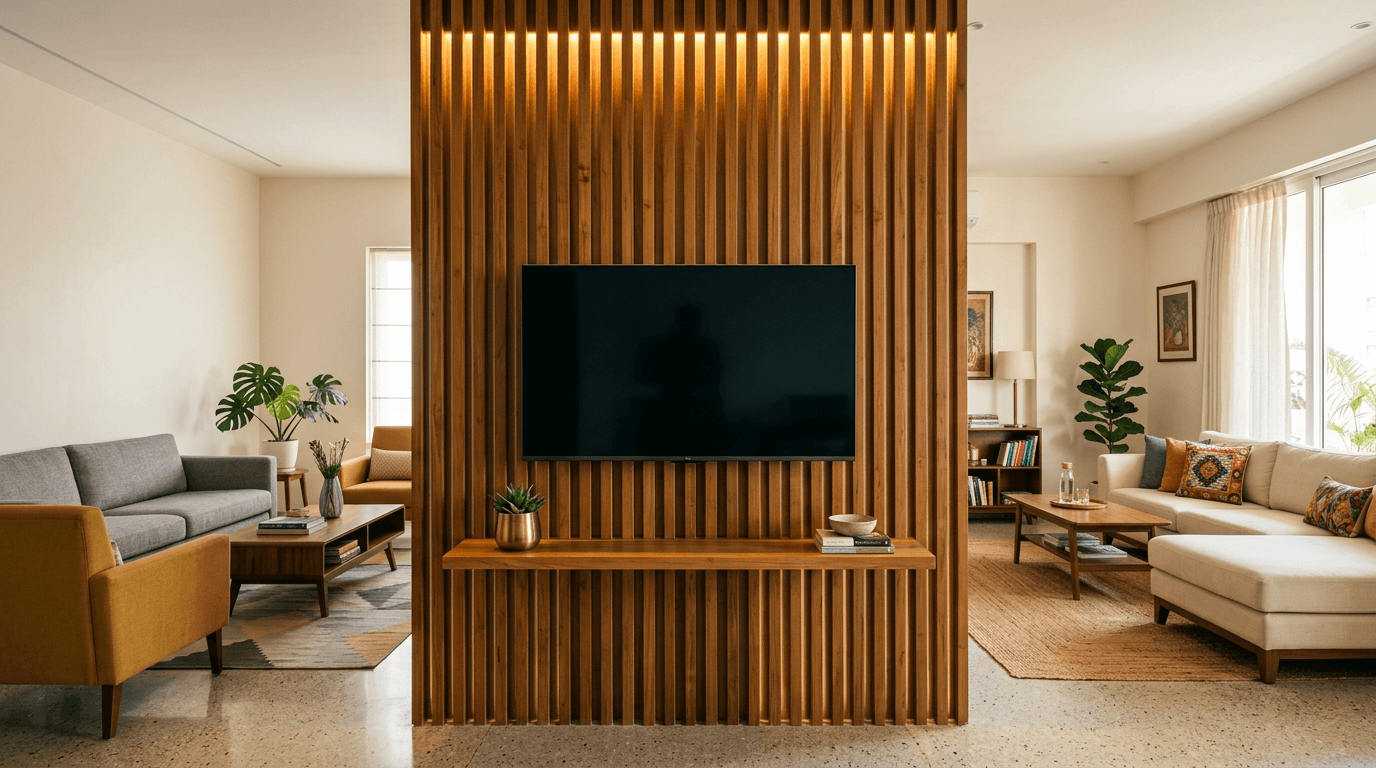
On a Hyderabad apartment we took on, there was simply nowhere sensible for the television unit. We extended an existing wall with a wooden partition, which separated the drawing room from the living area and, in doing so, created the focal point the space never had. Sometimes it has to be built rather than bought. Decorate around how you actually live, not around where the furniture happened to land on handover day.
How We Make Decor Choices on Real Projects
Method is easier to trust with evidence, so here are three projects at different ends of the range.
Mr. Manikantha and his wife asked us for a clean, low-maintenance three-bedroom apartment: zero open shelves, maximum concealed storage, minimal design. It is the only home we have designed that has no television in it. Years later it still looks the way it did on handover, and the reason is simple — there is almost nothing on display that can go out of date.
At the other end, a 560 sft studio apartment in Tarnaka came to us as a rental proposition. Mr. Ramana Murthy wanted it fully functional, minimal and easy to maintain so he could let it out furnished. Before the renovation the unit could command roughly ₹10,000–12,000 a month. After the redesign, and after refurbishing the furniture that was already there, it lets for ₹35,000. Decor as an investment is real, but it works through function and finish quality rather than through ornament.
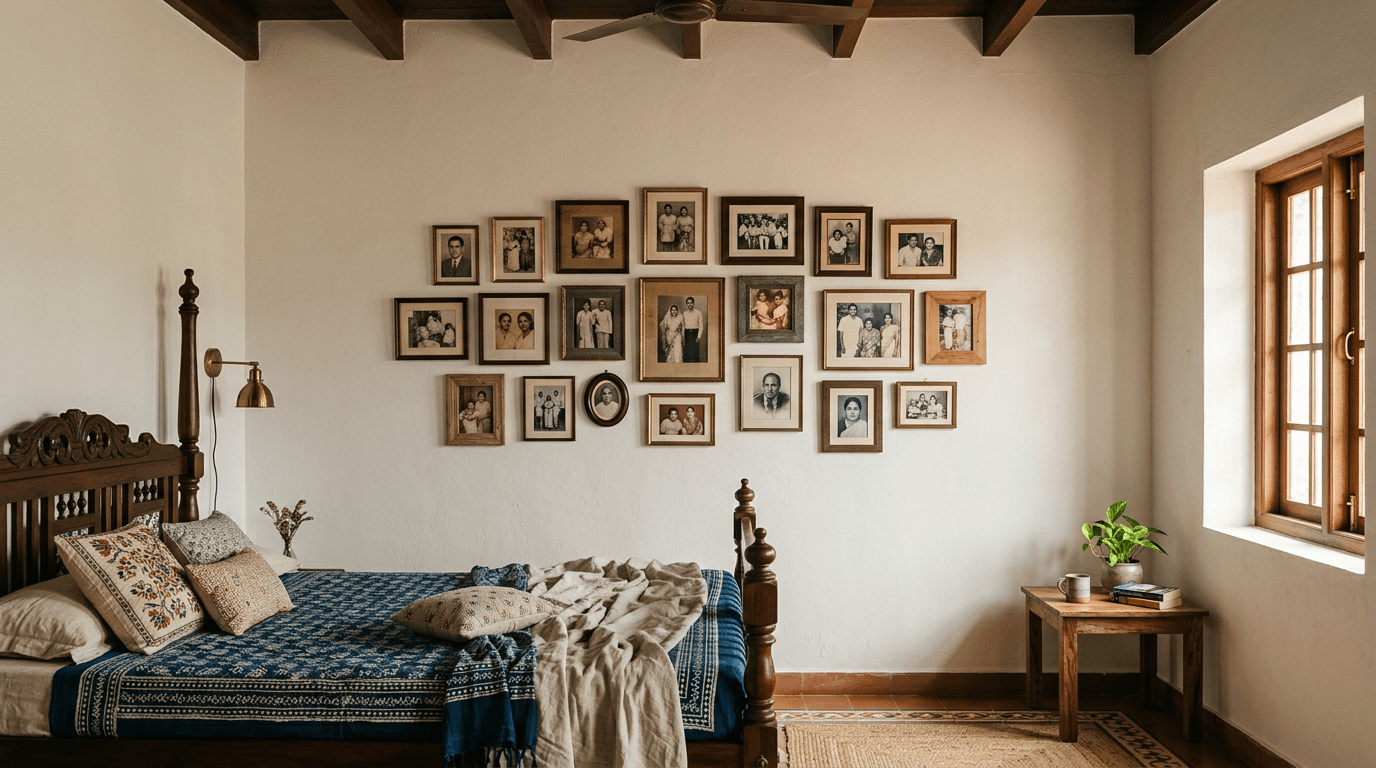
The third is the one we think about most when clients ask what decoration is actually for. Navya Reddy asked us to design her parents' resale apartment for three generations — her retired army parents, her working sister, and her grandmother. The grandmother wanted two things: a memory wall, and her old bed refurbished rather than replaced. Neither request came off a mood board. Both are the reason that house feels like theirs. What you choose to curate on a wall matters more than what you bought for it.
Across 30-plus projects in seven regions, the pattern holds. The homes that feel finished are not the ones with the most in them.
Home Decor: Frequently Asked Questions
How do I make a small apartment look larger?
Light, low-contrast walls; a mirror positioned to reflect a window rather than a bare wall; furniture with visible legs so floor shows underneath; and fewer, larger objects instead of many small ones. Running the same flooring through adjoining rooms helps small spaces more than most people expect, because the eye stops registering thresholds and the room looks continuous.
Is wallpaper better than textured paint for an accent wall?
Peel-and-stick wallpaper is cheaper, faster and reversible, which makes it the right call for rented homes and for anything trend-led. Textured paint gives real tactile depth and takes cleaning better over the years. For a wall you will keep for a decade, choose paint or panelling. For a wall you want to enjoy for two years, wallpaper wins.
What should I hang on a large empty living room wall?
Something big, or several pieces arranged to read as one big thing. A single oversized artwork is the lowest-risk option. A grid of identical frames is the second lowest. A scattered gallery wall looks best in photographs and is the hardest to execute in a real home — lay it out on the floor first, then trace each frame onto paper and tape the paper up before you drill.
How do I choose a rug size?
Front legs of all seating on the rug, at minimum. Measure the seating group, add 60 cm on each side, then buy the nearest standard size up rather than down. Almost nobody regrets a rug that is slightly too big.
How many decorative objects are too many?
If you cannot dust a surface in one pass, there is too much on it. Group in odd numbers, vary the heights, and leave real empty space between clusters. Empty space is not a gap to be filled; it is what makes the filled parts read.
What is the fastest way to transform your home in one day?
Rehang the curtains at ceiling height, add one large mirror or artwork on the main wall, bring in two lamps at different heights, and remove a third of what is on display. Four moves, one afternoon, no construction — and it is genuinely enough to transform a room you had given up on.
Get the Look: Talk to Our Design Team
We design and build — architecture, interiors and execution under one team, with 3D visualisation before anything is ordered, so you see the room before it exists. If you would like a single room or a whole house looked at properly, talk to our design team. Pricing depends on your city, your home and the specification, so we will give you a real estimate on a call rather than a package price.
Written by Karthik M, Chief Designer at Roomantic. IIT Guwahati Design alumnus focused on interiors, 3D visualization, and design-build workflows.
