Key Takeaways
- Wall design is the deliberate choice of treatment for each wall in a room: paint, wallpaper, panelling, or texture. Most rooms need exactly one true accent wall, not four.
- Trending in 2026: vertical wood slats, fluted panels with LED strips, limewash texture, and warm earthy colours (terracotta, olive, cocoa, charcoal) replacing cool grays.
- Typical India costs: designer paint finishes roughly ₹35 to 80 per sq ft, wallpaper ₹30 to 150, wall panelling ₹100 to 2,500 depending on material.
- Our verdict: pick the wall first, the material second, the colour last. Almost everyone does it backwards.
Every wall in your home is a decision. That sounds dramatic, but after 30+ projects across Hyderabad, Bangalore, and five other regions, we've watched the same thing happen again and again: a family spends weeks agonising over sofa fabric, then picks a wall treatment in one showroom visit. And the walls are 60 to 70 percent of what you actually see in a room.
Wall design is the practice of choosing a treatment (paint, wallpaper, panelling, or applied texture) for each wall surface, based on the room's function, light, and focal point. Done well, a single wall can carry an entire room. Done badly, it's the most expensive thing you'll repaint in two years.
An accent wall (also called a feature wall or statement wall) is one wall treated differently from the others in colour, material, or texture, so it becomes the room's focal point. The other three walls stay quiet so that one wall can speak.
Here are the ten wall ideas to transform your rooms that we're specifying most in 2026:
- Vertical wood-slat panelling (living rooms, TV walls)
- Fluted panels with integrated LED strip lighting
- Limewash paint for soft, shifting texture
- Colour drenching (one colour on walls, trim, and ceiling)
- Warm earthy paint palettes: terracotta, olive, cocoa
- Large-scale wallpaper murals behind beds
- Textured emulsion or stucco finishes in halls
- Charcoal or deep navy painted accent walls
- Grasscloth and fabric-texture wallpapers
- Shallow geometric trim panelling in small rooms
The rest of this guide explains how to choose between these design ideas, what each wall treatment costs in India, and which wall deserves the budget. This is the hub page for our whole wall design cluster, so wherever a topic needs 2,000 words of its own, we link you to the deeper guide.
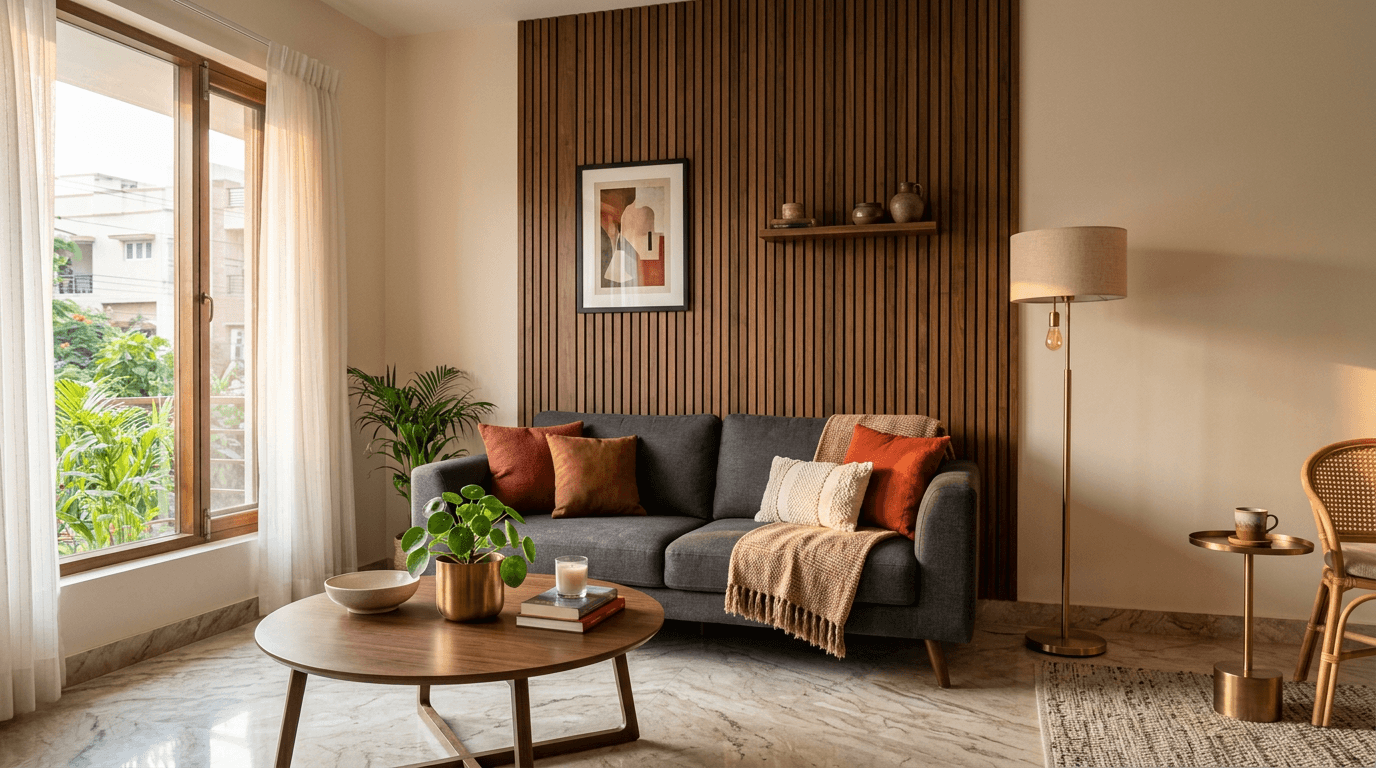
Every Interior Wall Is a Decision: Paint, Wallpaper, Panel or Texture
Every interior wall takes one of four treatments: paint (cheapest, most flexible), wallpaper (fastest pattern), panelling (most dimensional, most durable), or applied texture (limewash, stucco). The right choice depends on humidity, budget, and how long you'll live with it, not on what looked good on Instagram.
Here's the comparison we sketch for clients in the first meeting:
| Wall treatment | Typical cost (₹/sq ft, India 2026) | Lifespan | Humidity tolerance | Install time (one wall) |
|---|---|---|---|---|
| Premium paint / designer finish | 35–80 | 5–7 yrs | Good | 1–2 days |
| Wallpaper | 30–150 (3D up to 600) | 10–15 yrs (vinyl) | Poor to fair | Half a day |
| Panelling (PVC to wood) | 100–2,500 | 10–20 yrs | PVC: excellent; raw wood: poor | 1–3 days |
| Texture / limewash / stucco | 50–150 | 7–10 yrs | Good | 1–2 days |
(Cost bands compiled from published 2026 rate guides: Livspace and DesignCafe for panelling, NoBroker for wallpaper, AapkaPainter for designer painting. Installation labour adds roughly ₹8–30/sq ft for wallpaper and ₹20–150 for panelling. Rates vary by city; treat these as planning numbers, not quotes.)
Each of these gets a full spoke guide in this cluster. Paint and colour route to our room colour combination hub, panelling to the wall panelling guide, wallpaper to wallpaper for home, and murals to the wall painting design gallery.
One honest note before we go on. We're a design-build firm, so clients pay us to make these calls. But the decision framework below is the same one we use internally, and you can run it yourself in an afternoon.
The Feature Wall Method: Choosing the Right Accent Wall
The right accent wall is the first wall your eye lands on when you enter the room. In bedrooms that's the wall behind the bed, in living rooms the sofa or TV wall, in dining rooms the wall behind the table. If no wall is a natural focal point, don't force one.
Choosing the right wall, in order:
- Stand in the doorway. The first wall you see is the default candidate.
- Check for anchors. A bed, a TV unit, a fireplace wall or console: the feature wall usually sits behind the room's anchor, not opposite it. (True fireplace walls are rare in Indian homes, but a media console plays the same anchoring role.)
- Check the light. A wall that gets raking daylight will show every texture beautifully, and every installation flaw brutally.
- Check interruptions. Windows, AC units, and switchboards chop a feature wall into scraps. Pick the cleanest surface.
- Then, and only then, choose the right material.
The goal is to create a focal point that works with the room's architecture, and to choose finishes that complement the rest of the room instead of competing with it. An accent wall creates hierarchy: one wall speaks, three support.
Now the part most accent wall guides won't tell you: sometimes the right number of feature walls is zero. This is our genuinely contrarian position, and we'll defend it. In compact Indian flats, say a 10x11 ft bedroom, a dark accent wall can make a room feel smaller, because it chops the volume into "the wall" and "everything else." The 2026 alternative is colour drenching: painting every wall, trim, ceiling, and even doors in one continuous colour. It sounds louder. It actually reads calmer, because the eye never hits a boundary. Interior designers have been using it on moody studies and dining rooms all year, and in small rooms a mid-depth drench frequently beats a lone painted rectangle.
So the honest hierarchy is: a strong focal-point wall if you have one, colour drench if the room is small or choppy, and a quiet four-wall scheme if the room's interest comes from furniture and art. An accent wall is one tool of interior design. It is not a requirement.
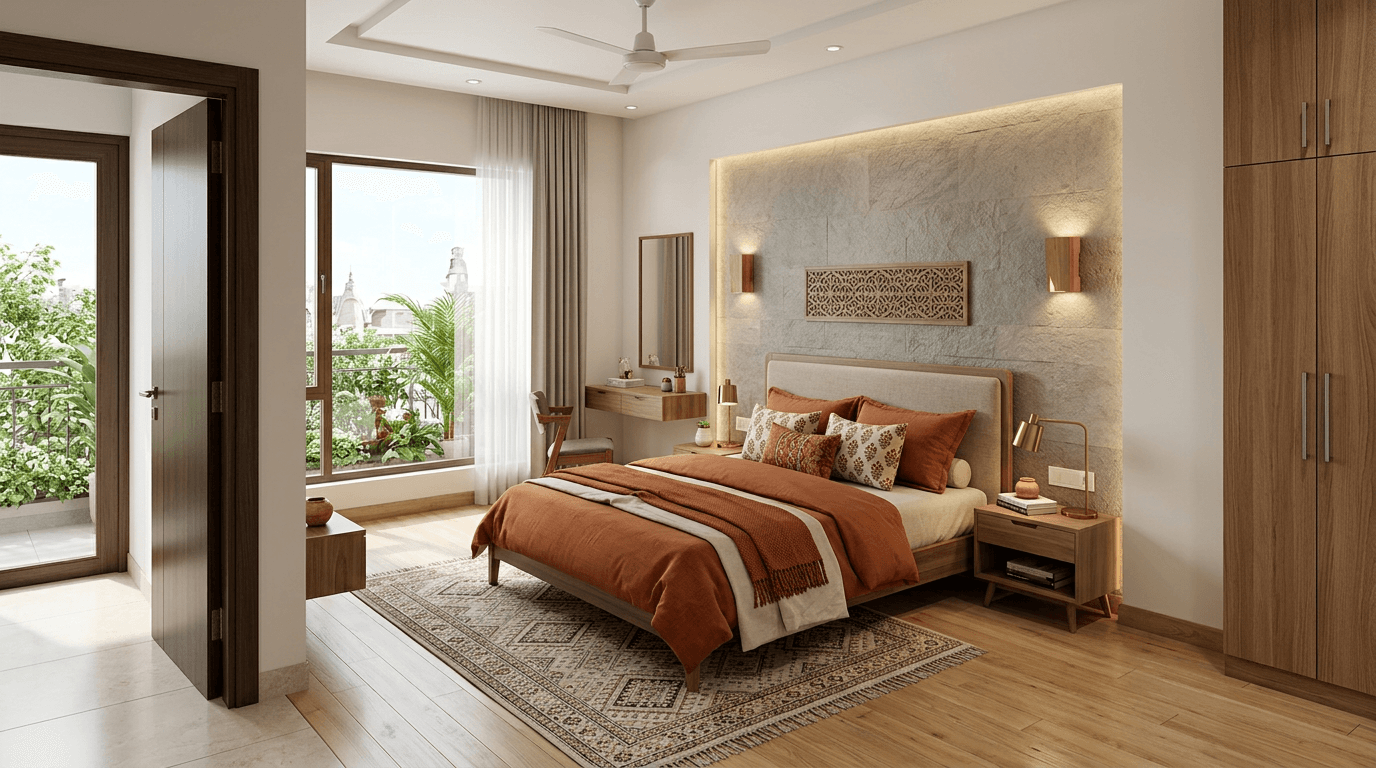
Wall Paint Finishes Explained: Emulsion Grades to Texture Paint
Emulsion is the standard water-based wall paint in India, sold in matt, satin, and sheen finishes. Matt hides wall imperfections and suits bedrooms; satin is washable and suits living areas and kids' rooms; textured and limewash finishes add depth but cost more per square foot.
A quick decoder, because paint brochures are written to confuse:
- Matt / flat matt. Velvety, non-reflective, forgiving on slightly uneven plaster. The default paint finish for bedrooms and ceilings. Harder to wipe clean.
- Satin / silk. A low lustre that takes scrubbing. Corridors, living rooms, anywhere with kids' handprints. Shows plaster waviness more than matt does.
- Sheen / gloss. Reflective, dramatic, unforgiving. Best kept to trim and doors in most modern homes.
- Textured finishes. Texture paint goes on thick, so it hides bad walls well. Cost sits in the designer band (roughly ₹35–80/sq ft applied, per 2026 published rates).
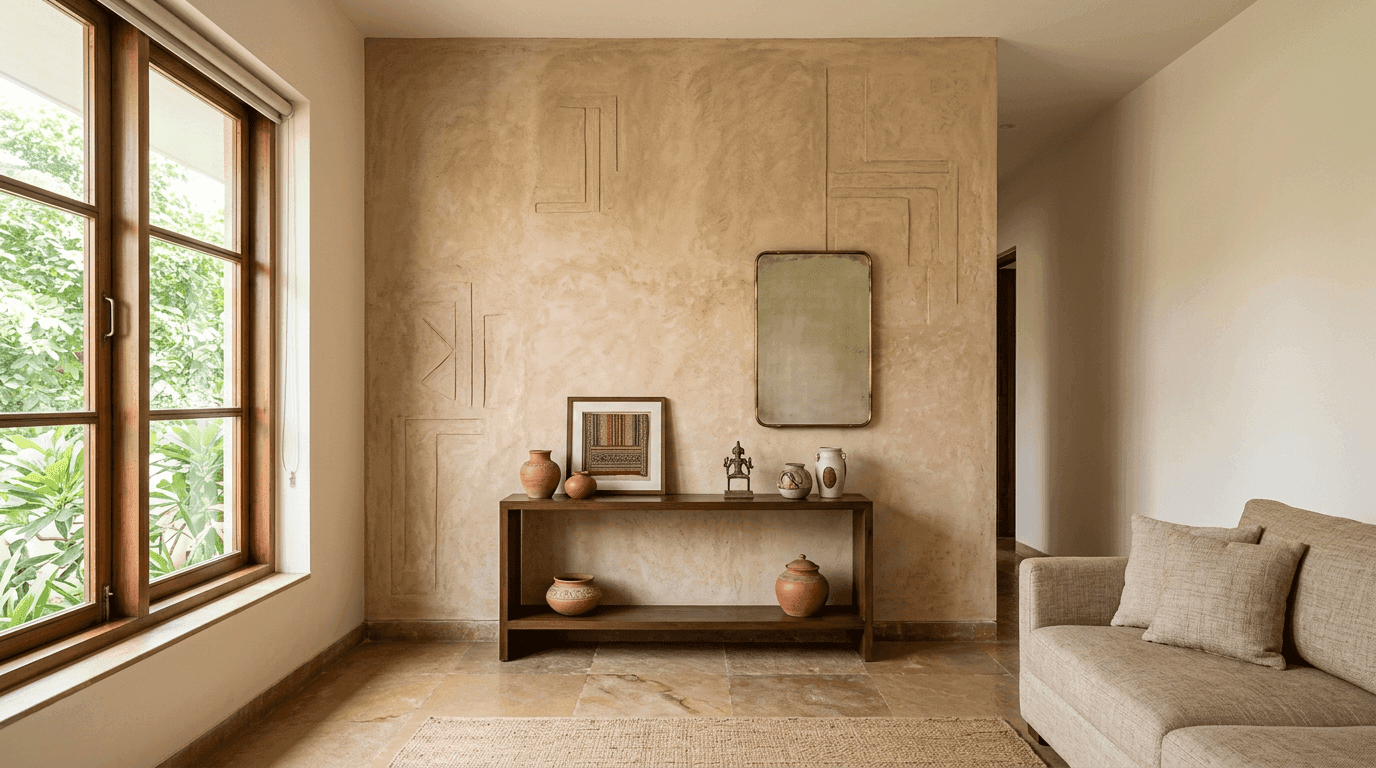
- Limewash. The 2026 favourite. A chalky mineral finish that shifts tone as daylight moves across it. It gives you texture without a single trowel pattern, and it's the quiet way into the warm, earthy palette trend.
Painted accent walls remain the cheapest accent wall idea by a wide margin: one dark or warm wall against three neutrals, done in a weekend. If you're going dark, a darker accent shade behind the room's anchor adds depth without shrinking the whole space.
On colour: the grey decade is ending. The palettes we're specifying, and the ones dominating 2026 trend reports, are warm and mineral: terracotta, olive, cocoa, mushroom, charcoal, deep navy. Brands like Asian Paints and Dulux publish their finish ranges in exactly these grades, so you can shortlist off a shade card before calling a painter. If you're choosing whole-house colours, our house colour combination guide covers scheme-building room by room.
One practical warning: finish choice is a lighting decision. A satin swatch approved under cool showroom LEDs will often read completely differently under warm 2700K home lighting. Always test a one-metre patch on YOUR wall, and look at it morning and night for two days before committing.
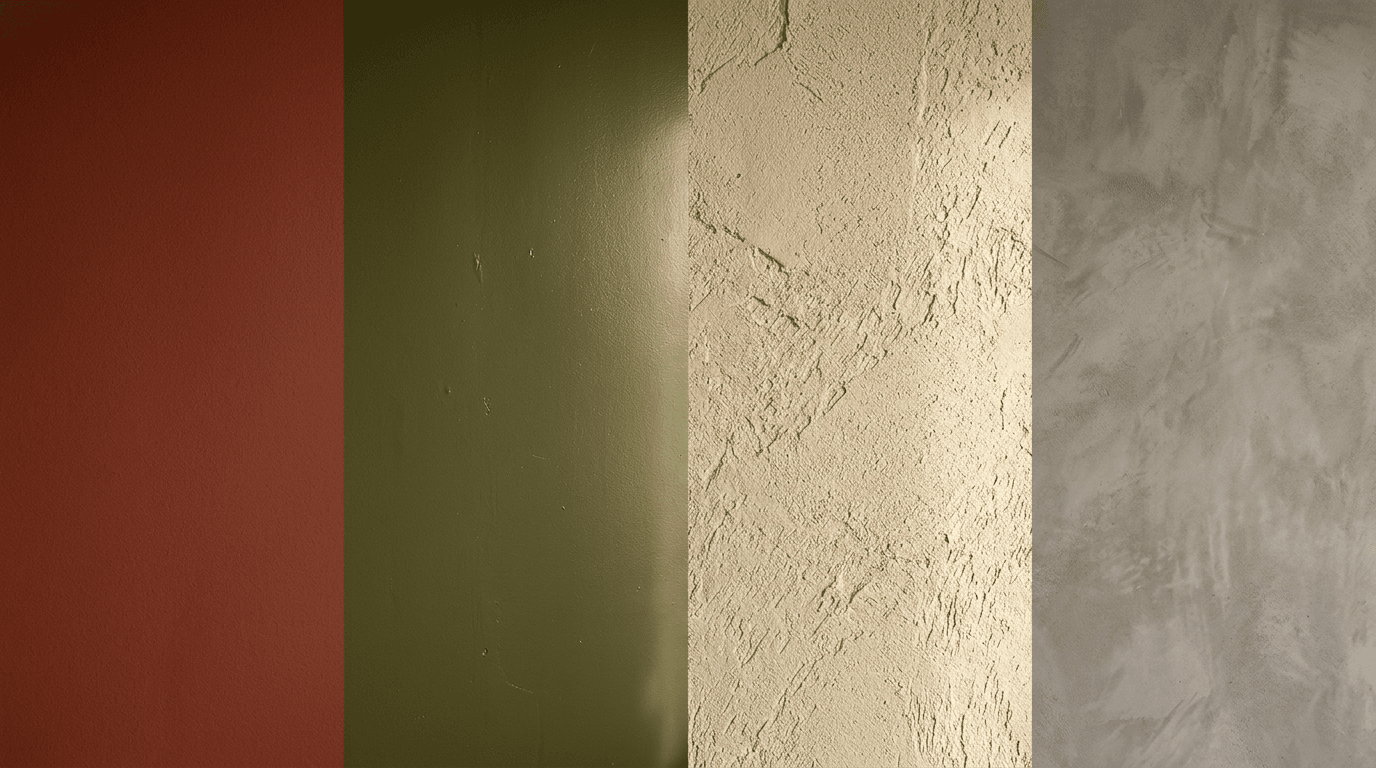
Wall Panelling Overview: Fluted, Slat & Geometric 3D Wall Design
Wall panelling fixes dimensional material (PVC, MDF, WPC, or wood) onto a wall for texture you can touch. In India, PVC panels start around ₹100/sq ft, MDF runs ₹150–400, WPC fluted panels ₹250–500, and solid wood ₹500–2,500, plus ₹20–150/sq ft installation.
Panelling is the trend engine of 2026 wall design. Three formats dominate:
- Vertical slat panels (louvres). Timber or WPC battens with shadow gaps. The definitive TV-wall and bedhead treatment right now, and the fastest way to bring wood-tone warmth into a modern interior.
- Fluted panels. Fine, continuous vertical grooves, usually WPC or MDF. Pairs beautifully with a concealed LED strip washing down the grooves, which is exactly how you'll see it in 2026 showrooms.
- Geometric and 3D panels. Pressed or CNC-cut relief patterns. Strong in large rooms, risky in small ones.
Where Panelling Beats Paint
Paint gives you colour. Panelling gives you shadow. That's the real difference: a panelled wall changes appearance through the day as light moves across its relief, which no flat colour can do. Decorative wood panels also hide bad plaster completely, survive scuffs that would mark paint, and integrate lighting cleanly.
Where panelling loses: cost (a slat wall can run 10x a painted one), and humidity if you choose wrong. Raw wood veneer swells in coastal and monsoon-heavy climates. PVC and WPC shrug it off, which is why they've become the default in kitchens and rental units. Our full wall panelling guide compares every material, and if you're specifically weighing budget-friendly moisture-proof wall panels, the PVC panel design guide goes deeper.
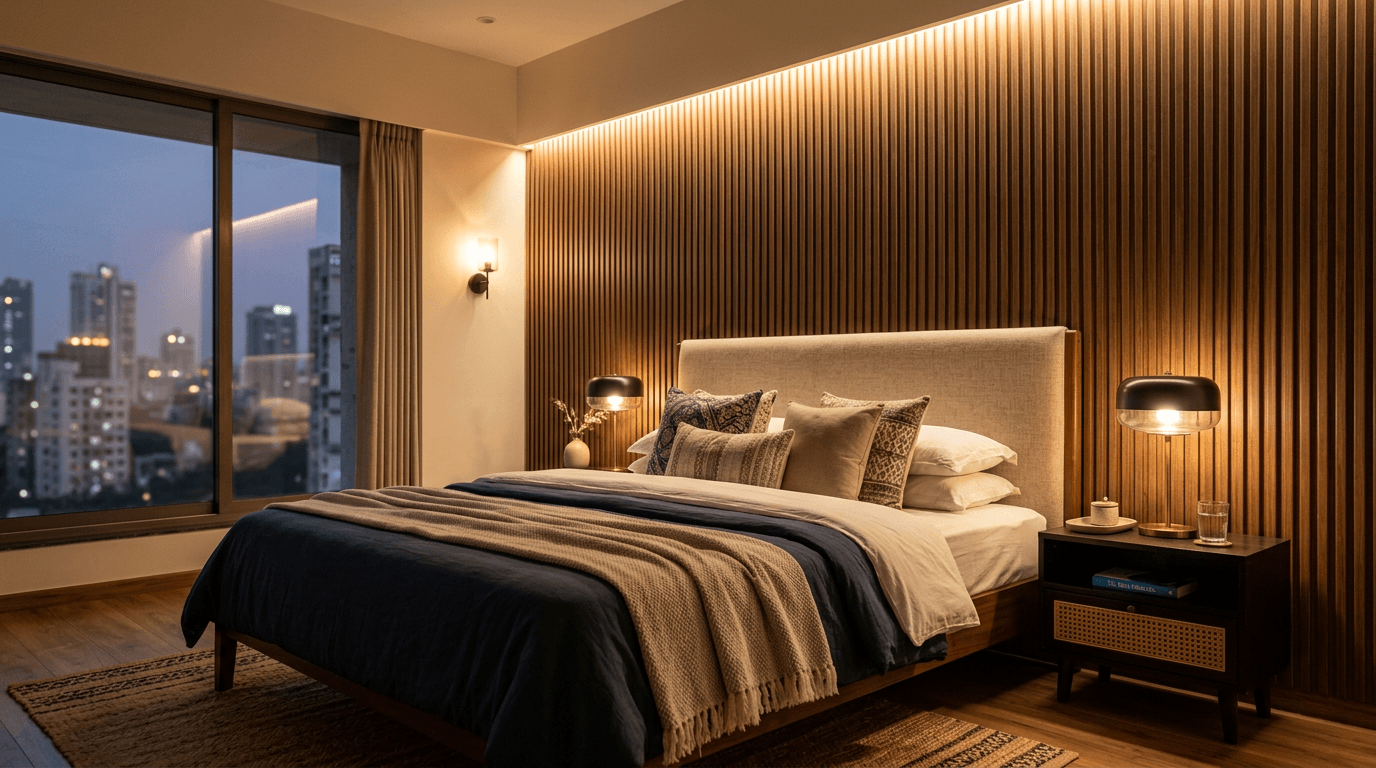
Wallpaper Overview: Patterns, Murals & Wall Decoration Design
Wallpaper delivers pattern and mural-scale art faster than any other wall decoration design, at roughly ₹30–150 per sq ft in India (3D wallpaper up to ₹600), plus ₹8–30 installation. Vinyl and non-woven types last 10–15 years; humidity and poor wall prep are what kill the rest.
What's changed for 2026 is scale. Small repeating prints are fading; large-scale murals, grasscloth textures, and fabric-look papers are taking over, because they make one wall feel like a commissioned artwork rather than a pattern swatch.
The quick type guide:
- Vinyl wallpaper: the workhorse. Wipeable, humidity-tolerant, durable for 15+ years when installed on properly primed walls.
- Non-woven: breathable, easy to remove, mid-price.
- 3D / embossed: relief without carpentry. Priced like premium panelling in some designs.
- Peel-and-stick: 2 to 5 year lifespan. Fine for rentals, not for your forever wall.
Wallpaper's honest weakness in India is moisture, at the wall level rather than the room level. A bathroom-adjacent wall with minor seepage will bubble any paper within a year. Have your installer check the wall with a moisture meter before committing to paper; if you can't test, keep wallpaper off external walls in monsoon-heavy cities and use paint or PVC panelling there instead. Full pattern-by-pattern picks live in our wallpaper for home guide.
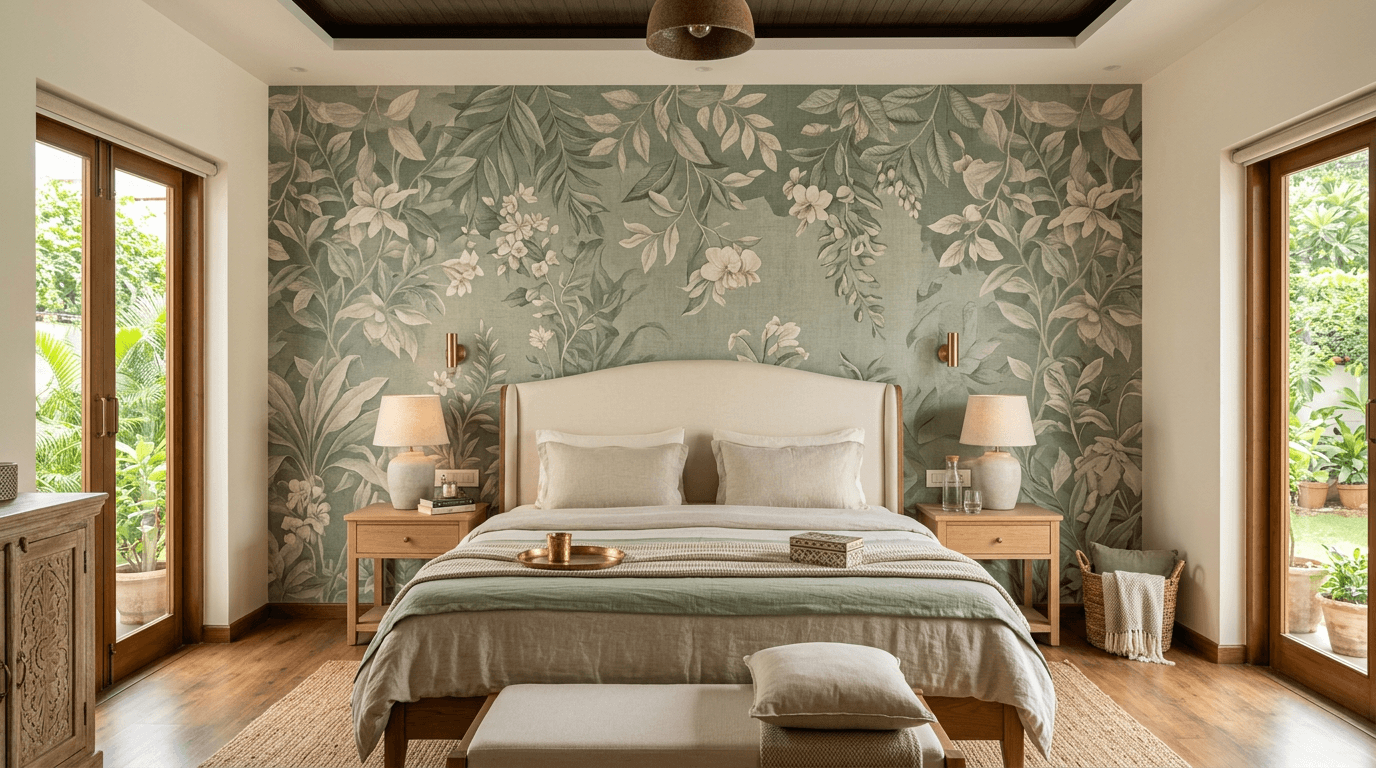
Wall Painting & Mural Art: Beyond a Flat Colour
Hand-painted and stencilled wall art turns a wall into one-off decor, typically ₹35–80 per sq ft for designer wall painting work in India. It suits homes that want personality no catalogue product can give: murals, ombre fades, geometric colour blocking, or traditional Indian motifs.
This is the most personal wall design route and the least standardised. A few directions that consistently work:
- Geometric colour blocking: arcs and angled fields in two or three colours. Cheap, fast, striking in kids' rooms and studies.
- Ombre / gradient walls: one colour fading vertically. Gorgeous behind open shelving.
- Hand-painted murals: from Madhubani-inspired panels to loose botanical line art. Price scales with artist skill and detail, and a mural doesn't need the entire wall; a two-thirds drop behind a console often reads better.
- Stencil work: repeatable pattern at a fraction of wallpaper cost, though labour-slow.
The trap here is Pinterest-scale ambition on a bedroom-scale budget. A detailed two-wall mural is artisan work; get the artist to sample one square metre first. For a full visual library of modern wall design directions with photos, see the wall painting design gallery.
Accent Wall Ideas for Every Room
The best accent wall for each room follows its anchor: the TV or sofa wall in living rooms, the wall behind the bed in bedrooms, the desk wall in a home office, and the open dining-side wall in kitchens. Material shifts by room too, from slats and stone in living spaces to washable tile near heat and steam.
Here are the accent wall ideas we reach for most, room by room. Function changes, so the wall changes with it.
Living Room Accent Wall
The living room accent wall (usually the TV or sofa wall) is where most Indian homes spend their feature-wall budget, and rightly, since it's the wall guests actually see. Slat panelling, fluted panels with LED, and texture paint all work here at different budgets. A stone accent wall in ledger cladding or a stone-look tile is the premium move for double-height living spaces; a full stone wall earns its cost in large rooms and overwhelms small ones. Whatever you pick, keep the opposite wall near-neutral so the room doesn't argue with itself. In modern living rooms we also see gallery wall arrangements paired with a painted accent: art carries the interest, paint carries the depth. Colour schemes for halls are covered in our hall colour combinations guide (pending publication in cluster C3).
Bedroom Accent Wall
The accent wall behind the bed, almost always. A bedroom accent wall works because the headboard anchors it and you never face it from the pillow, so it adds drama without overwhelming the room. In compact bedrooms, prefer shallow relief (fluted MDF, trim panelling, limewash) over deep 3D texture, and mid-tone warm colours over very dark ones. Mirrored or light-toned panels visually push a small bedroom's walls outward. Full palettes live in the bedroom colour ideas guide (pending, cluster C1).
Home Office & Study Walls
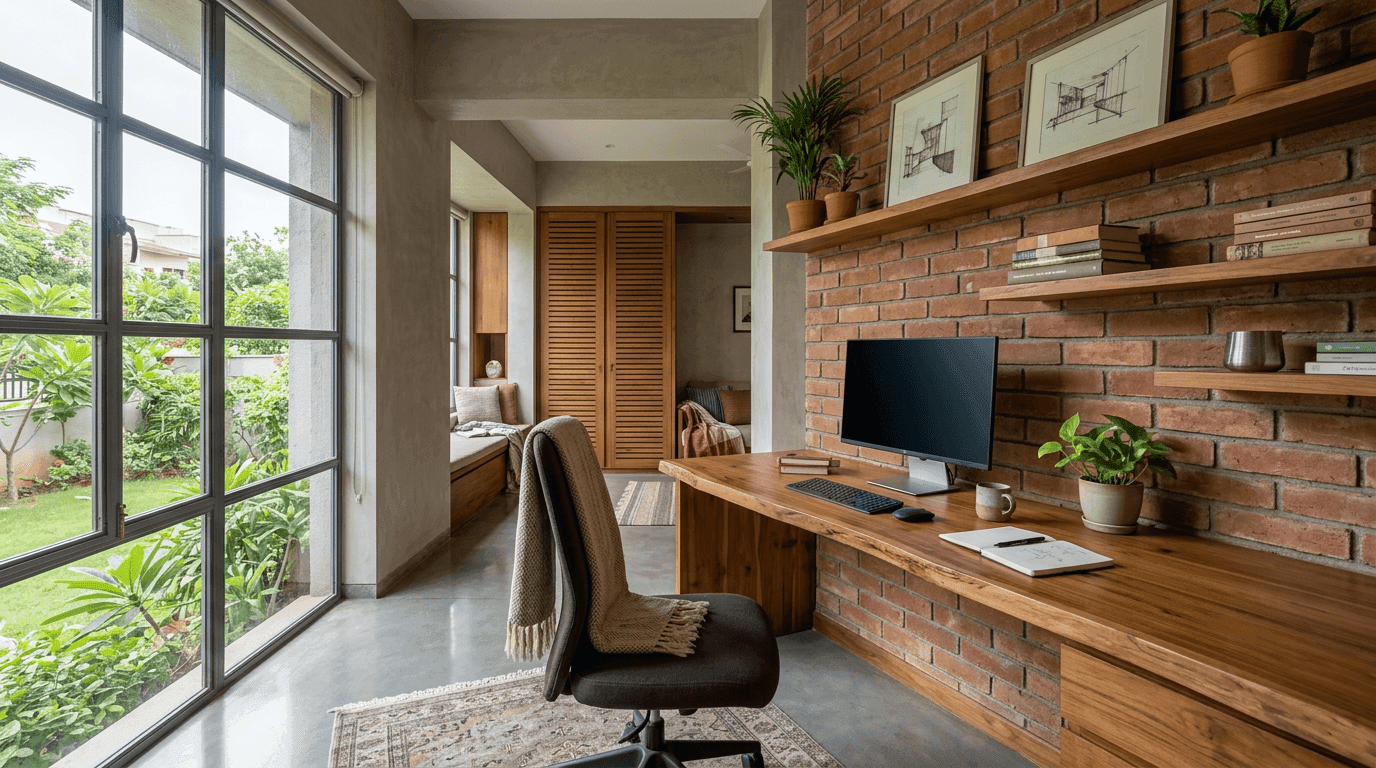
The home office accent wall belongs behind the desk, for two practical reasons: it frames you on video calls, and you don't stare at it while working. Deep olive, charcoal, or a slat-panel section reads professional on camera and gives visual interest to an otherwise functional room. Keep the wall you face while working calm and pale; a busy wall in your sightline is a distraction you'll notice by week two.
Kitchen & Dining Walls
Above-counter walls belong to tile and washable satin paint; wallpaper struggles near heat and steam. Glazed terracotta or handmade-look tile gives the kitchen its texture hit while staying scrubbable. If you want drama, put it on the open dining-side wall, not behind the hob. Kitchen palettes are covered in the kitchen colour ideas guide (pending, cluster C2).
Simple Wall Design for a Small House or Flat
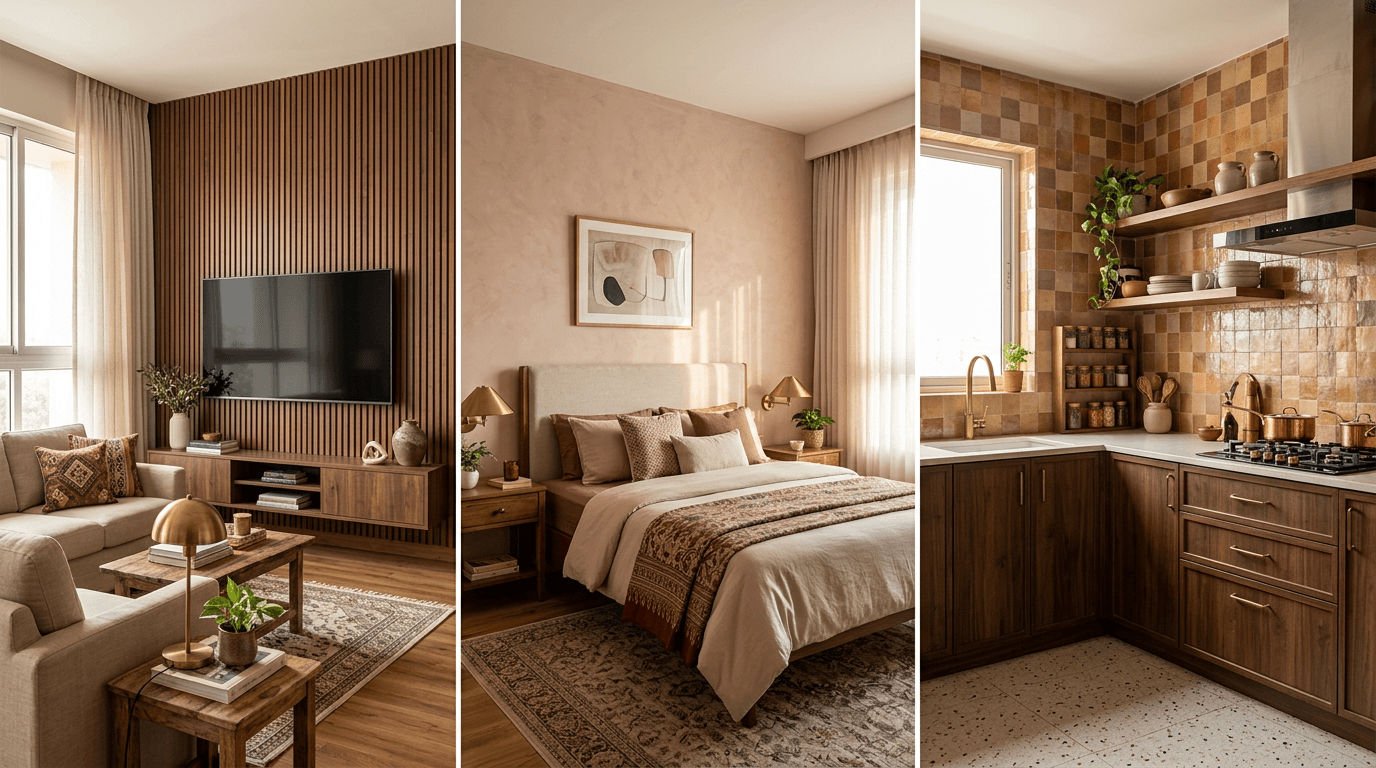
In a small house, the best wall design is light, shallow, and singular: one wall in a warm mid-tone or shallow panelling, the rest in light neutrals. Deep 3D texture, very dark colour, and busy pattern all shrink a compact room further.
Small homes are where wall design mistakes cost the most, because there's no spare volume to absorb them. What we specify in compact flats and 600 to 1,000 sft homes:
- Light, low-contrast palettes. Whites, warm creams, mushroom, pale olive. Contrast eats perceived space.
- Shallow relief only. Trim panelling or fine fluted MDF reads as detail; deep 3D panels read as bulk.
- Mirrored panel sections. A mirror-finish strip beside a feature wall can make a small space feel nearly double its depth. Old trick, still the best one.
- Vertical lines. Slats and vertical grooves pull the eye up and make standard 9 to 10 ft ceilings feel taller.
- One feature, maximum. In a small room, a second accent wall isn't bold. It's clutter.
And remember the colour drenching option from earlier: in genuinely tiny rooms, drenching in one soft mid-tone often beats any accent wall, because boundaries are what make small rooms feel small.
Wall Decor: Finishing a Wall After the Treatment
Wall decor is what goes ON the finished wall: wall art, mirrors, shelves, and lighting. The rule that keeps home decor cohesive is one hero per wall; a treated feature wall needs minimal decoration, while a plain painted wall can carry a gallery wall.
A quick framework we use during styling handover:
- Treated walls stay bare-ish. A slat or mural wall is already the hero. One artwork or nothing.
- Quiet walls do the display work. Gallery grids, floating shelves, and mirror arrangements belong on the plain emulsion walls.
- Light the texture, not just the room. A wall washer or picture light doubles the impact of any textured treatment for a fraction of its cost. Good lighting is what separates the wall treatments that genuinely elevate a room from the ones that just cost money.
- Leave breathing room. Indian homes accumulate objects fast; walls planned at 70 percent capacity still look designed two years in.
This is deliberately a summary. Decor styling changes with every brief, and the room colour guides above carry the specifics.
Accent Wall Styles in 2026: What's Trending
The accent wall styles trending in 2026 are tactile and warm: wood slats, fluted panels with LED, limewash and mineral texture, mural-scale wallpaper, and deep earthy paint. The common thread is material honesty; flat grey feature walls and heavy 3D foam panels are on the way out.
If you want your walls in 2026 to still look right in 2030, here's how we read the design trends for the walls in your home. Our shortlist of wall ideas for 2026, sorted honestly:
- Committing: slat and fluted panelling, limewash, terracotta-to-cocoa palettes, colour drenching, large murals. These have crossed from passing trend to settled modern style; they define the current design style rather than chase it.
- Watching: grasscloth and fabric-texture wallpaper, stone-look porcelain cladding, micro-cement. Strong in premium projects, still settling in mainstream homes.
- Retiring: cool grey accent walls, glossy 3D foam panels, tiny-repeat wallpaper prints, and the four-feature-wall habit that made 2018 living rooms so busy.
A note on how the 2026 accent wall differs from the 2020 one: it's less about colour contrast and more about texture under light. The trend is a wall you want to touch, not just photograph. That's why every 2026 accent wall idea in this guide pairs a material with a lighting plan; modern interior design treats the two as one decision.
Wall Treatment Costs Compared (2026)
In 2026 India rates, expect roughly ₹35–80/sq ft for designer paint finishes, ₹30–150 for standard wallpaper, ₹100–500 for PVC/MDF/WPC wall panelling, and ₹500–2,500 for solid wood, before installation labour. A single 10x10 ft feature wall therefore runs from about ₹4,000 to over ₹1 lakh.
The master cost table, per square foot, materials plus typical labour:
| Wall treatment | Material (₹/sq ft) | Labour (₹/sq ft) | Lifespan | Humidity rating |
|---|---|---|---|---|
| Standard emulsion repaint | 15–35 | included in rate | 4–6 yrs | Good |
| Designer / texture paint | 35–80 | included in rate | 5–7 yrs | Good |
| Limewash / mineral finish | 40–90 | included | 7–10 yrs | Good |
| Wallpaper (vinyl/non-woven) | 30–150 | 8–30 | 10–15 yrs | Fair |
| 3D / premium wallpaper | 95–600 | 8–30 | 10–15 yrs | Fair |
| PVC panels | 100–200 | 20–50 | 10–15 yrs | Excellent |
| MDF panels | 150–400 | 20–100 | 8–12 yrs | Fair |
| WPC fluted panels | 250–500 | 30–100 | 10–15 yrs | Very good |
| Solid wood panelling | 500–2,500 | 50–150 | 15–20 yrs | Poor unless treated |
(Sources: Livspace, DesignCafe, HouseYog panelling rate guides; NoBroker and Building & Interiors wallpaper guides; AapkaPainter painting rates, all 2026 editions. City, brand, and wall condition move these numbers significantly.)
Two cost truths people miss. First, wall prep is the hidden line item: putty, primer, and crack repair can add 30 to 40 percent on an old wall, whatever treatment goes on top. Second, cheap installation ruins expensive material; a ₹500/sq ft fluted panel with visible joint lines looks worse than an honest ₹50 paint job. We don't quote fixed Roomantic prices in articles because rates genuinely differ by city and spec; if you want a project-specific number, book a consultation and we'll estimate against your actual walls.
Wall Design Mistakes to Avoid
The five mistakes we correct most often: accenting the wrong wall, deep texture in small rooms, wood veneer in humid zones, choosing finishes under showroom lighting, and treating walls before electrical work is final. Each one is cheap to avoid and expensive to reverse.
- Accenting the wall you face, not the wall you see. The feature wall belongs behind the room's anchor. An accent wall behind YOU as you watch TV is money spent on a wall nobody looks at.
- Deep 3D texture in a compact room. Relief needs viewing distance. Under 3 metres, it looms.
- Raw wood veneer on humid or external walls. It cups and delaminates. Use WPC, PVC, or treated finishes there.
- Approving colour in the showroom. Light temperature changes everything. One-metre test patch, two days, morning and night.
- Sequencing walls too early in renovation. Every conduit chased after panelling means rework. Walls come after electrical and AC planning, always.
- Accenting every wall. If the entire room shouts, it has no focal point at all. One wall speaks; three support.