Written by Karthik M, Chief Designer at Roomantic. IIT Guwahati Design alumnus focused on interiors, 3D visualization and design-build workflows.
The Kitchen Chimney Decision Designers Get Asked Most
For most Indian homes in 2026, the right kitchen chimney is a ducted, 90 cm wide model with 1200–1500 m³/hr suction power and either baffle filters or a filterless auto-clean design. Size the chimney to your hob, duct it outside, and mount it 65–75 cm above the burners.
We don't sell chimneys. We're a design-build studio, so what we actually do is size, place, duct and cabinet a chimney inside a modular kitchen, then live with the consequences when the client calls six months later. That's a different job from writing a top 10 chimney list or a 10 best kitchen chimneys round-up, and it's the reason this buying guide exists.
Search "best kitchen chimney in india" or "best chimney for indian kitchen" and you get shopping pages and affiliate round-ups. Useful for prices. Almost useless for the question people actually have, which is what does this spec mean in my kitchen. A 1500 m³/hr chimney behind four duct bends performs worse than a 1200 m³/hr one venting straight out. Nobody on that first page tells you so.
Essential Kitchen Chimney Specifications
- Suction power: 1200 m³/hr minimum for a normal Indian kitchen. 1500 m³/hr and up for daily deep frying, a joint family, or an open kitchen.
- Chimney size: 60 cm chimney for a 2–3 burner hob, 90 cm chimney for 3–4 burners, 120 cm for a 5-burner or island kitchen hob. Never narrower than the hob.
- Filter type: baffle filter for heavy indian cooking. Filterless auto-clean if you want the least maintenance.
- Ducting: always a ducted chimney if there's any route to an outside wall.
- Height: 65–75 cm above a gas hob, 60–65 cm over induction.
- Noise: check the dB figure, especially in an open kitchen.
That list is the whole article compressed — the chimney features that actually matter, in the order they matter. The rest explains why each number is what it is, and where people get it wrong.
Suction Power Math: What CMH Your Indian Kitchen Actually Needs
The air-change formula, and why Indian cooking breaks it
Every brochure quotes the same maths. Take your kitchen volume in cubic metres, multiply by 10 to 15 air changes per hour, and that's your suction requirement in m³/hr. A 10 × 10 ft kitchen with a 10 ft ceiling works out to roughly 28 m³ of kitchen volume, which gives you 300–420 m³/hr.
Then you look at what's actually sold in India and the entry point is 1000 m³/hr. So either the whole market is overselling, or the formula is measuring the wrong thing.
It's the second one. The formula was designed to clear heat and steam. Indian cooking doesn't produce heat and steam so much as it produces aerosolised oil. When you fry, when you temper mustard seeds in hot oil, when you sear masala at the bottom of a kadai, you throw fine grease droplets into the air. A chimney removes grease by moving enough air fast enough to catch those droplets before they drift sideways and settle on your shutters. Catching grease needs velocity, and velocity needs headroom over the theoretical number.
That's the real reason the practical floor sits at 1200 m³/hr, three to four times what the air-change formula suggests.
Suction capacities by kitchen size and cooking style
Modern Indian kitchens vary too much for one number to cover them all. Here's how the bands break down across kitchen sizes and cooking styles.
| Kitchen size and cooking style | Recommended suction power |
|---|---|
| Under 80 sq ft, mostly boiling and sautéing | 1000–1200 m³/hr |
| 80–120 sq ft, daily Indian cooking with regular frying | 1200–1500 m³/hr |
| Over 120 sq ft, or a joint family kitchen, or heavy indian cooking every day | 1500–1800 m³/hr |
| Open kitchen connected to the hall, any size | 1500 m³/hr and above |
One adjustment nobody mentions on the shopping page: every extra metre of duct and every 90° bend eats into effective suction. Buy above your calculated number, not exactly at it. If your hob sits on an internal wall and the duct has to travel three metres and turn twice, treat that as one band up.
We hit this on a 3 BHK at Accurate Wind Chimes in Hyderabad. The client, Mr Umesh, was coordinating with us through his son Piyush from Canada, and the brief asked for an open kitchen inside a genuinely small transitional space, plus a concealed bar unit. An open kitchen is the single clearest case for buying up a suction band, because there's no doorway to contain what the chimney misses.
12 Kitchen Chimney Designs and Types for Indian Kitchens (2026)
Types of kitchen chimneys sound like a style question. They're mostly a plumbing question wearing a nice glass front. Here are the twelve chimney designs we specify most often, what each one suits, and what it costs you in cabinet space.
1. Straight-line wall-mounted chimney
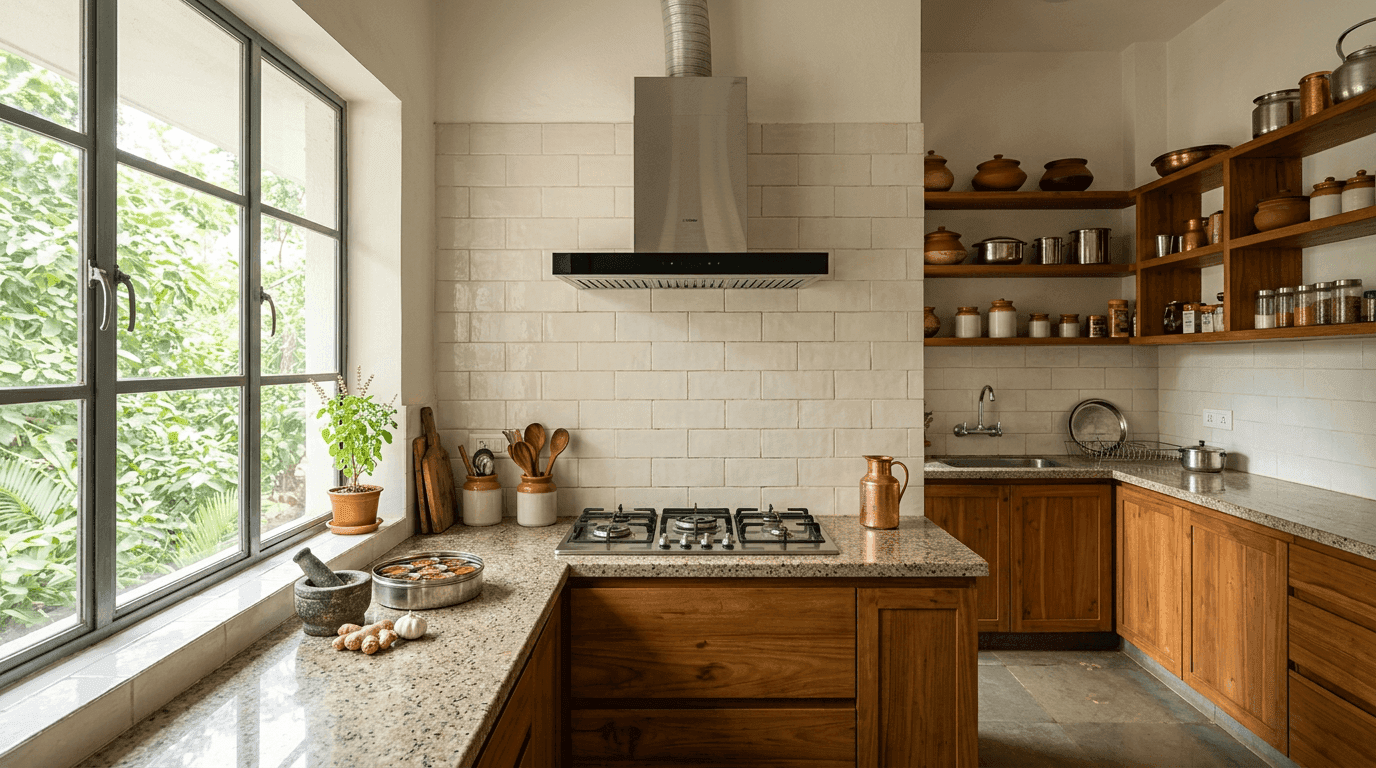
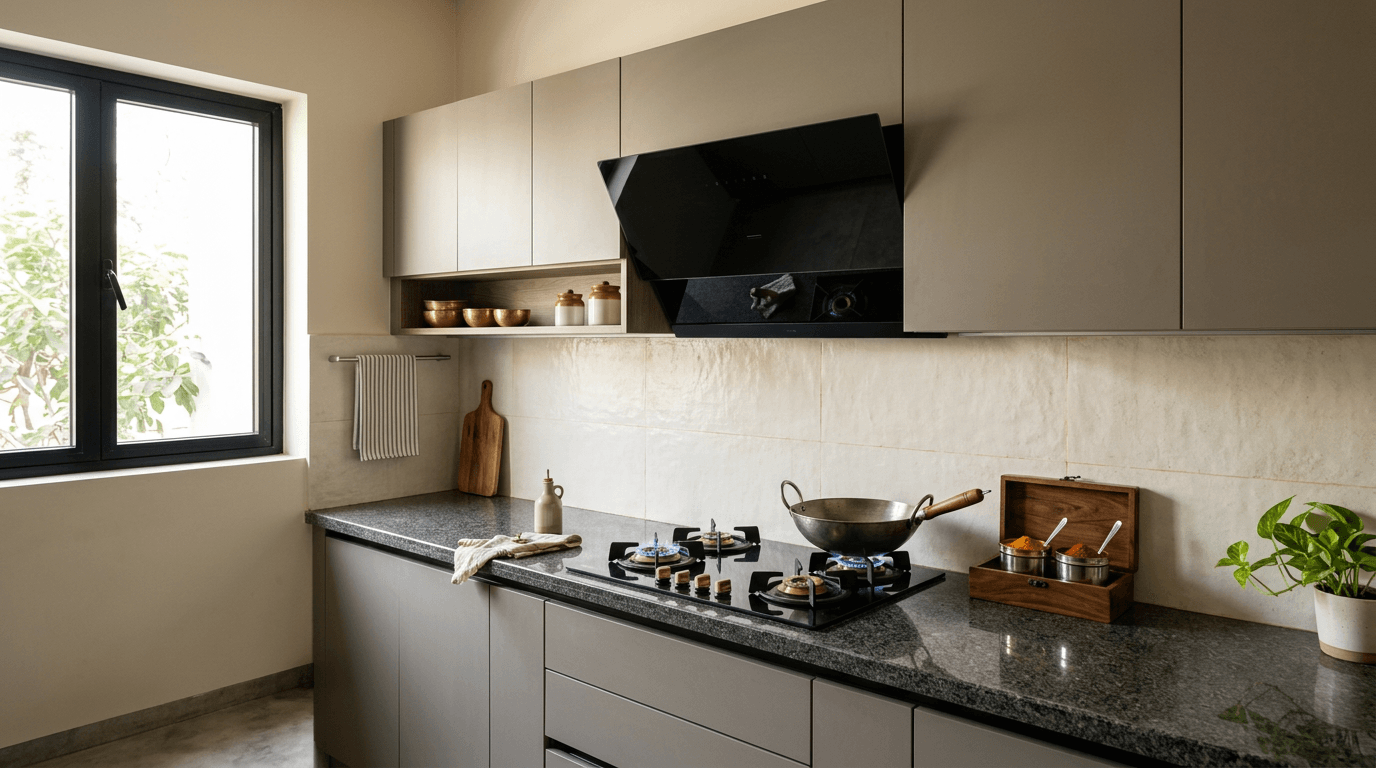
The default in Indian flats, and for good reason. A flat glass or steel face, minimal projection, and a short duct run straight through the outside wall behind it. Straight-line chimney designs sit flush with your wall units, so the kitchen reads as one clean band instead of a cabinet run with a lump in it. Best when the hob is already on an external wall. The catch: the shallow hood captures a smaller cone of air than a deep pyramid, so don't skimp on suction power to compensate for the slim look.
2. Curved glass wall-mounted chimney
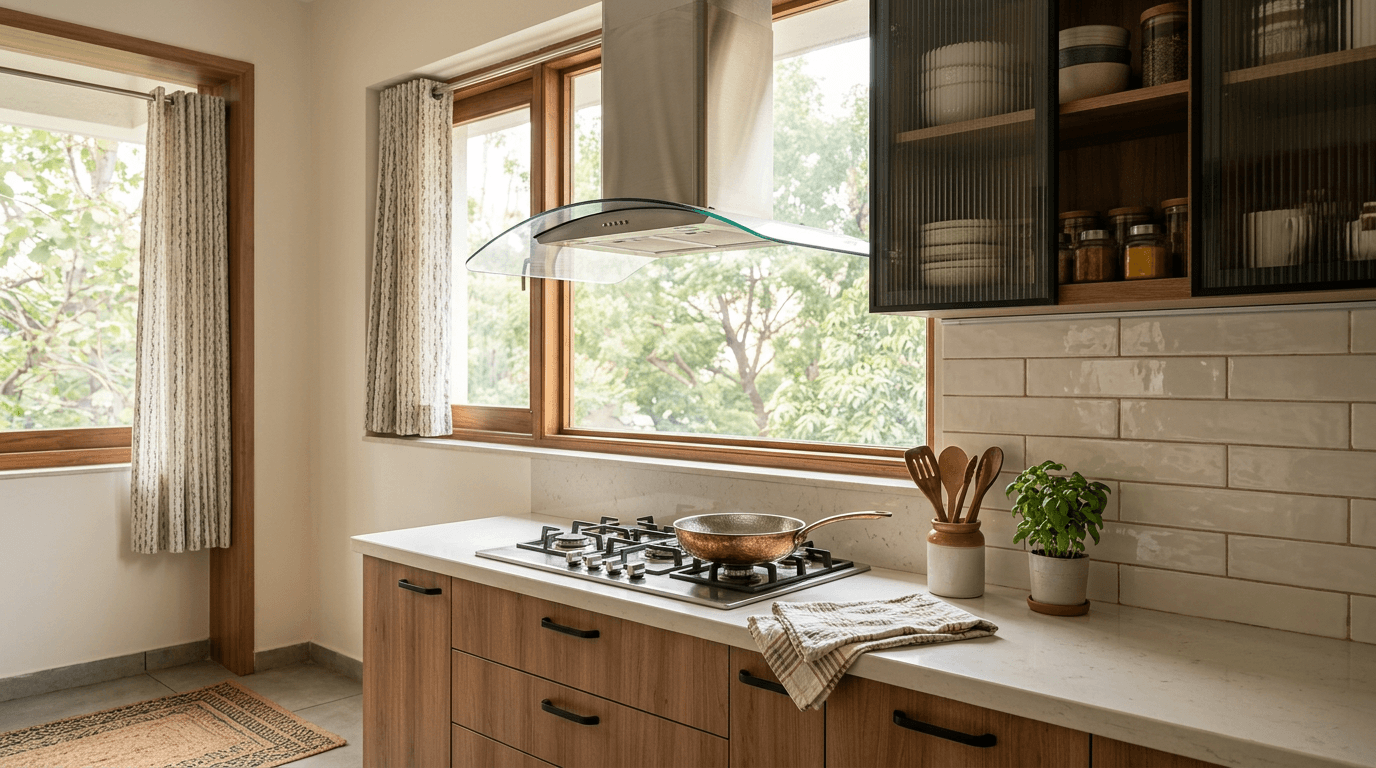
The curved-glass hood is what most people picture when they picture a chimney. The curve gives you a deeper capture area than a straight-line face while keeping sightlines open, which matters if your kitchen window is behind the hob. It's forgiving of slightly imperfect hob centring too. Downside: the curve collects a visible film of grease on the underside of the glass, so it wants a wipe every few days. In a kitchen where nobody wipes daily, choose steel.
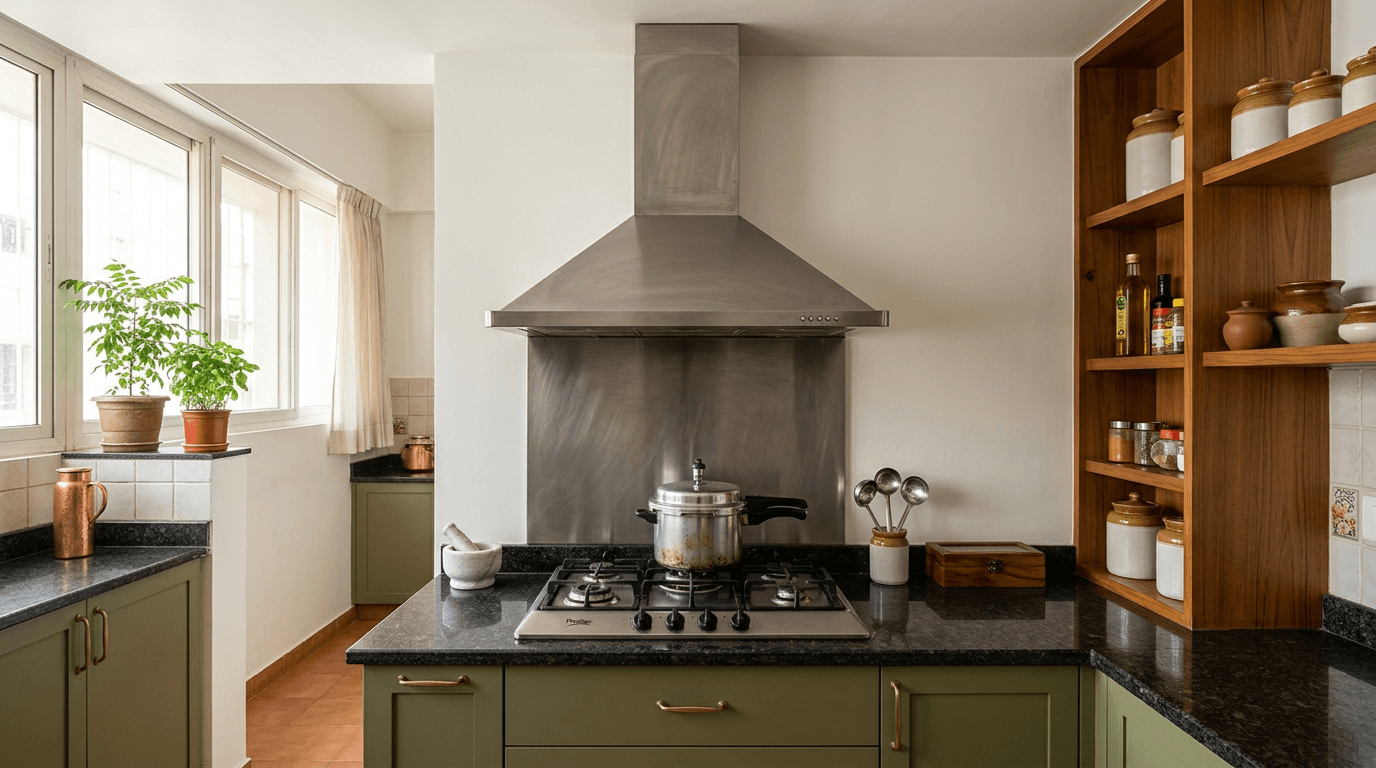
3. Pyramid hood chimney
The tapered box hood, wider at the bottom than the top. It's the best pure capture geometry of the wall-mounted family, because the wide mouth sits closest to the hob and funnels rising smoke upward instead of letting it spill. We specify pyramid hoods for clients who fry seriously and don't care about a minimal look. It projects further into the room, so check headroom if the cook is tall or the kitchen is narrow.
4. Island chimney
If the hob is on a peninsula or an island kitchen counter, you need an island chimney, and the decision is made for you. Island chimney designs hang from the ceiling on a suspended flue, so they're visible from every angle and get treated as a light fixture as much as an appliance. Two real costs: the duct has to run through the false ceiling to an outside wall, which is a coordination job to plan before ceiling work starts, and island chimneys need more suction than a wall model of the same size because air can escape on all four sides.

5. Built-in chimney concealed in a wall unit
The motor and hood live inside a purpose-built cabinet, and all you see is a slot. This is the right answer when the client wants the kitchen to read as pure joinery, or when the chimney sits in a sightline from the dining table. The trade-off is real: you sacrifice a wall unit, the hood volume is constrained by the cabinet, and servicing means opening up joinery instead of unclipping a filter. Build the access panel in from day one.
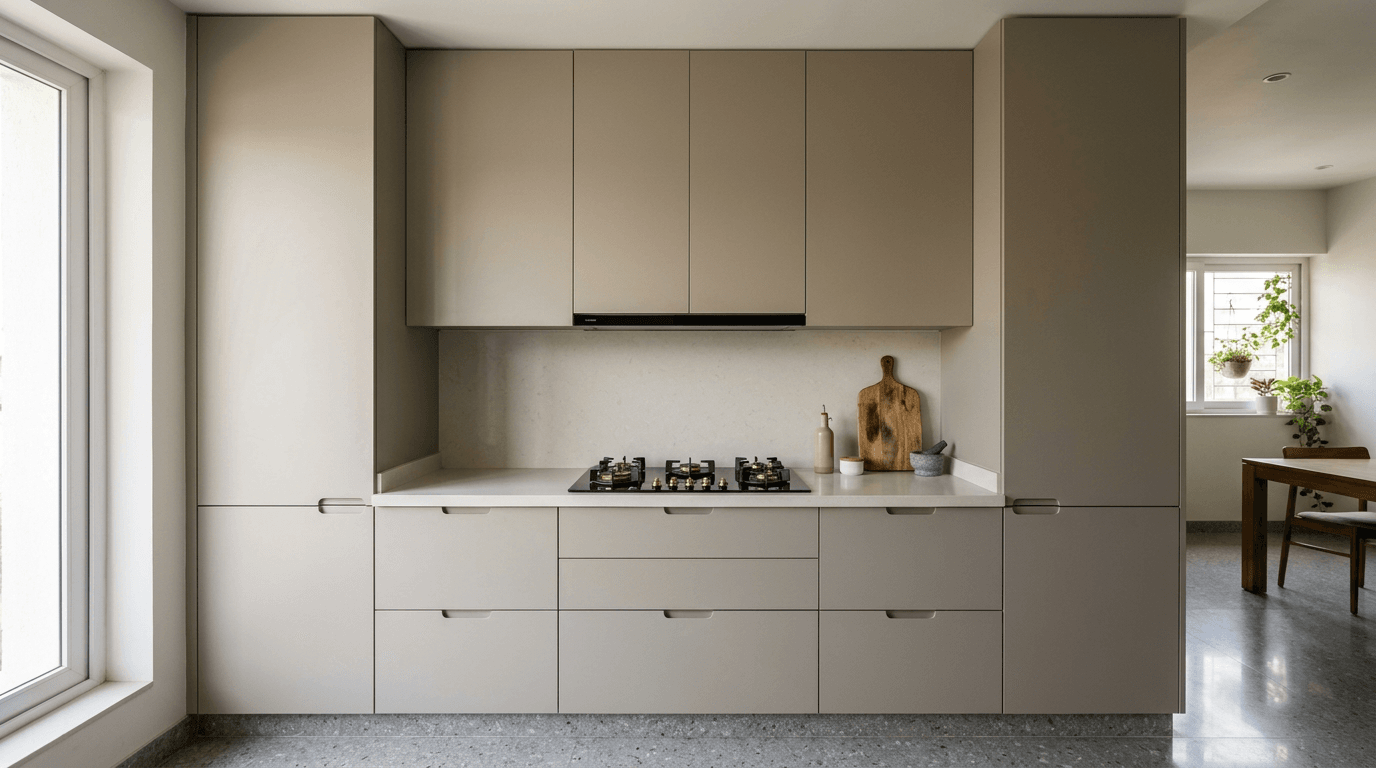
6. Slim under-cabinet chimney
A shallow unit that tucks under an existing wall cabinet, usually 60 cm wide with a pull-out visor. It's the retrofit answer, and the small-kitchen answer, because it takes almost no volume out of the room. Suction is modest by definition, so treat it as a boiling-and-sautéing chimney rather than a frying one. In a rental or a compact flat where you can't rebuild the cabinet line, it's a sensible compromise.
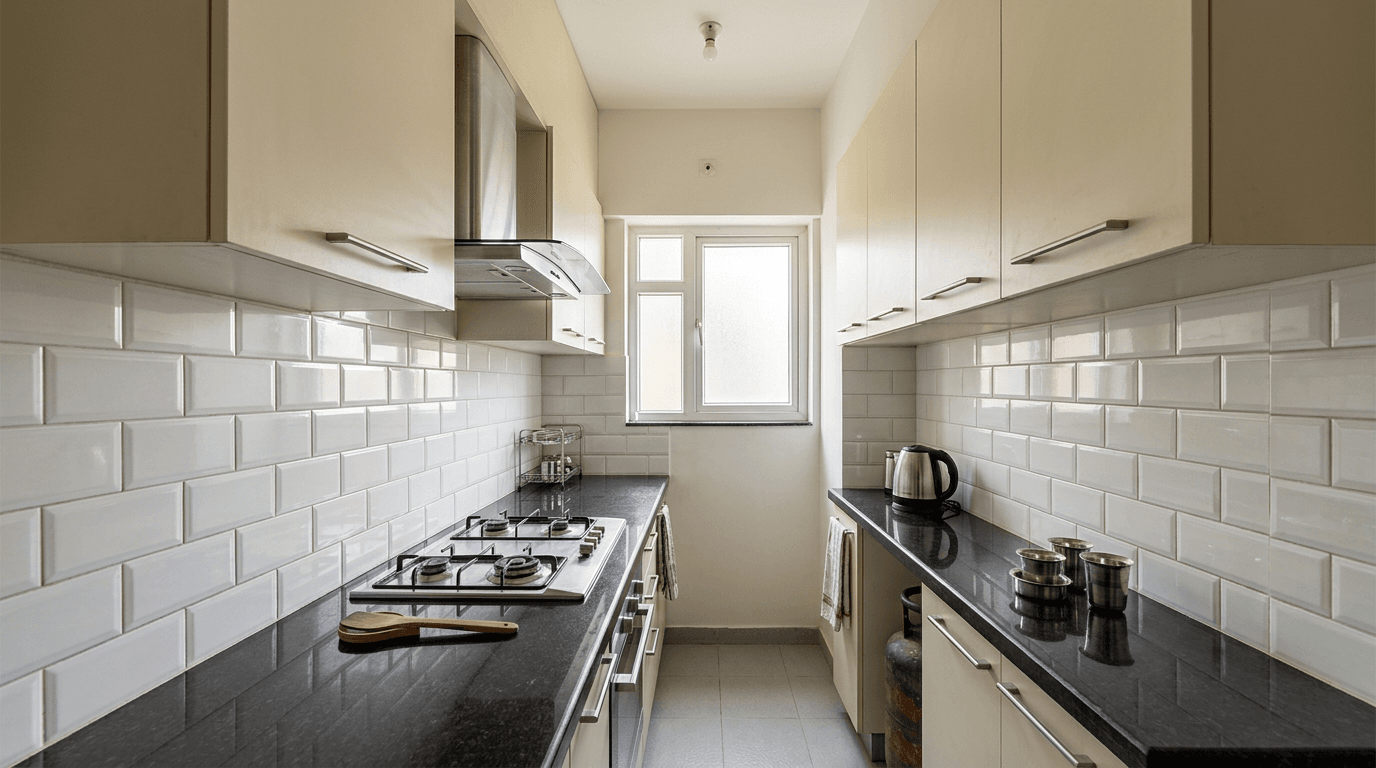
7. Downdraft chimney
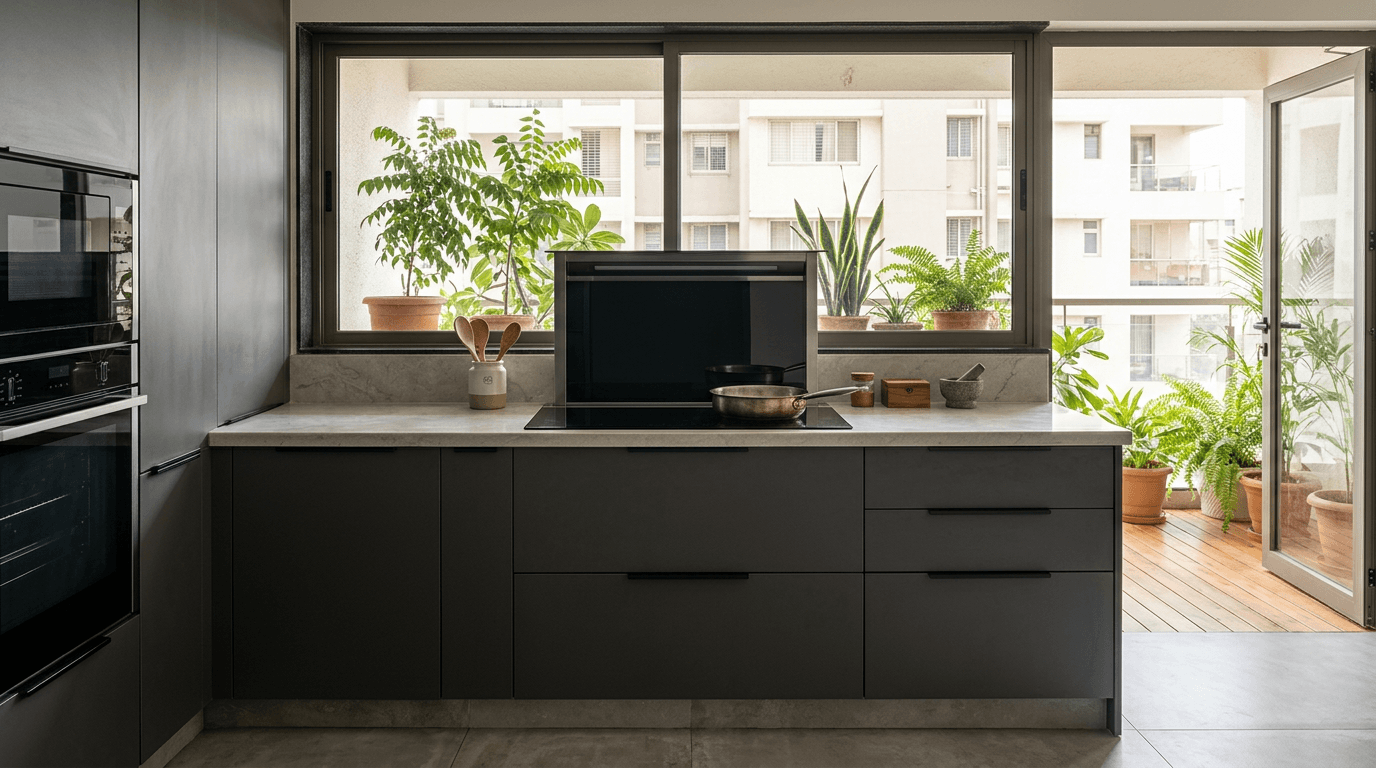
The extractor rises out of the counter behind the hob and pulls smoke sideways instead of upward. Downdraft chimney models are the only option when there's a window directly above the hob or a ceiling you cannot touch. They're also the most demanding install, because the motor and duct run below counter level and eat a base cabinet. Physics is working against you here, since smoke wants to rise, so specify generously and expect it to underperform a good wall hood.
8. Corner chimney for an L-shaped kitchen
When the hob lands near the junction of an L, a standard rectangular hood either clips the return wall or leaves half the hob uncovered. A corner-mounted chimney is angled to sit into the corner and cover the diagonal. It's a less common spec, so check availability early. Better still, move the hob out of the corner during planning. We'd rather redraw a layout than buy an awkward appliance.
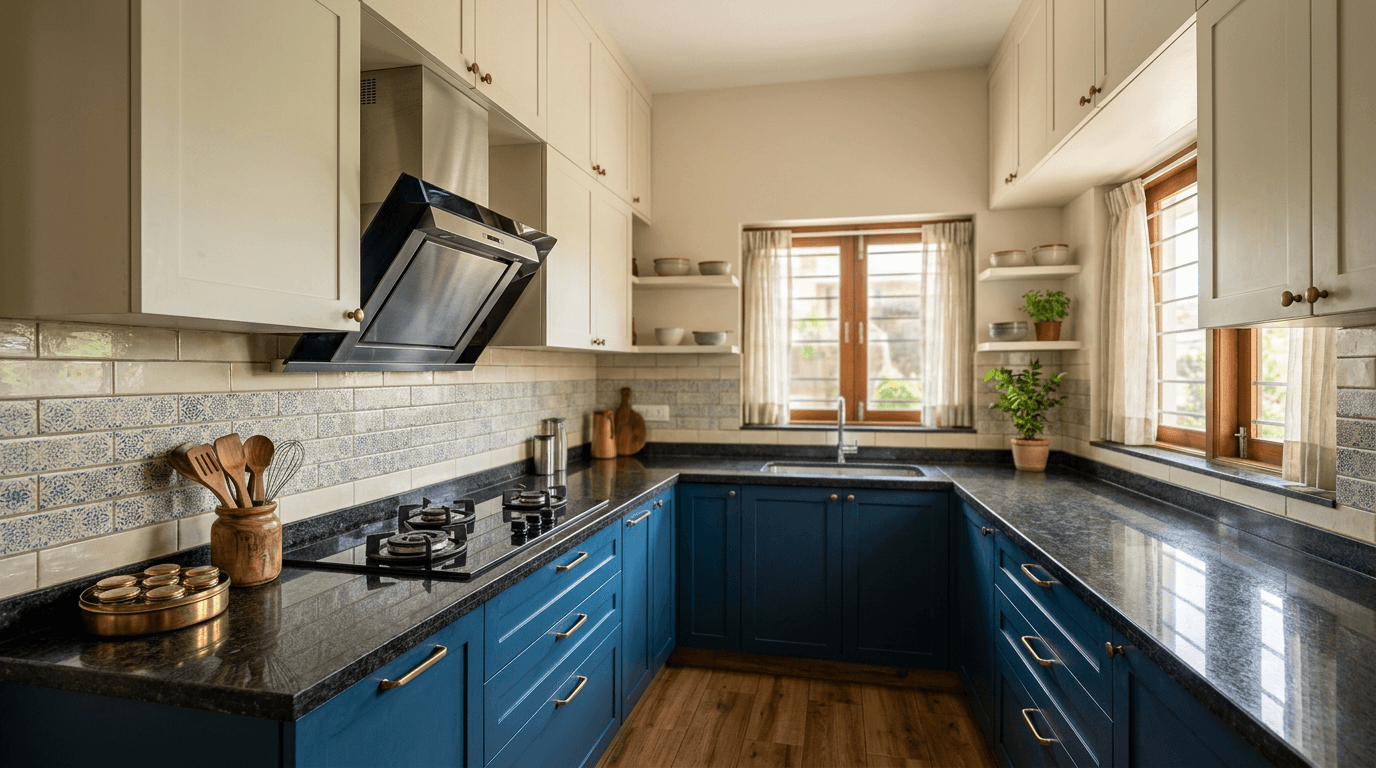
9. Filterless auto-clean kitchen chimney
No mesh, no baffle, no panel to scrub. A high-speed blower flings oil outward by centrifugal force into a collector cup, and the auto-clean cycle melts what's stuck inside the housing. A filterless chimney gives you the lowest routine maintenance of any type and holds suction better over time, because there's no filter slowly clogging. You still empty the oil cup, roughly monthly if you fry often. This is our default recommendation for clients whose brief is "keep it clean and don't make me think about it".
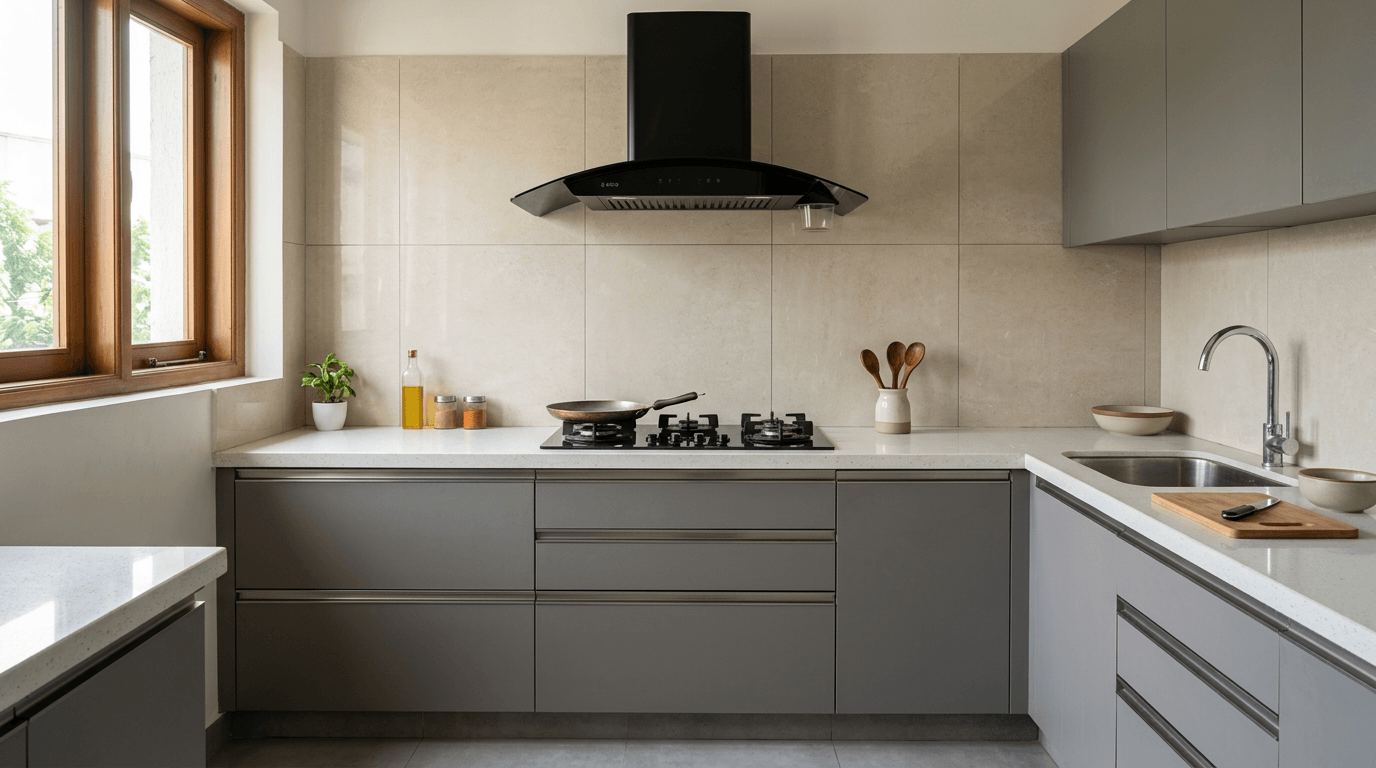
10. Heavy-duty baffle filter chimney
Curved steel baffles force the incoming air to change direction sharply. Grease, being heavier than air, can't make the turn and drops out onto the panel. It's a beautifully dumb mechanism with no moving parts, and it's still the most reliable way to handle oil-heavy Indian cooking. The price is labour: you unclip the baffle panels and wash them every 15–30 days. If somebody in the house will actually do that, a baffle filter chimney outperforms most alternatives for the money.
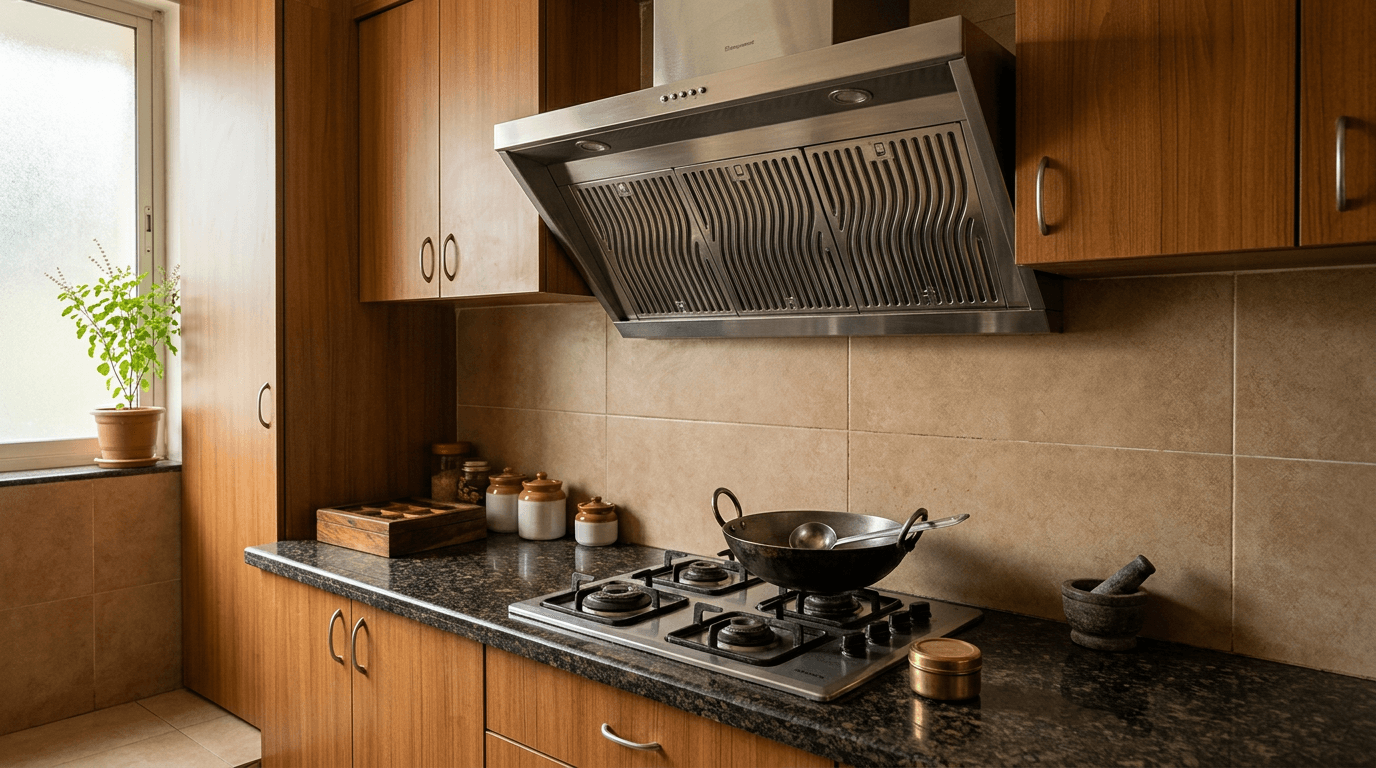
11. Compact 60 cm chimney for a small kitchen
For a two or three burner hob in a compact flat, a 60 cm chimney is correct, not a downgrade. Going wider than the cabinet module just to buy a bigger number forces an awkward filler panel and buys you nothing. What matters at this size is suction and duct length, not width. We used exactly this logic on a 600 sft studio apartment in Tarnaka, where the brief was maximum storage, easy maintenance and a rental-ready finish, and every millimetre of wall unit mattered more than a wider hood.
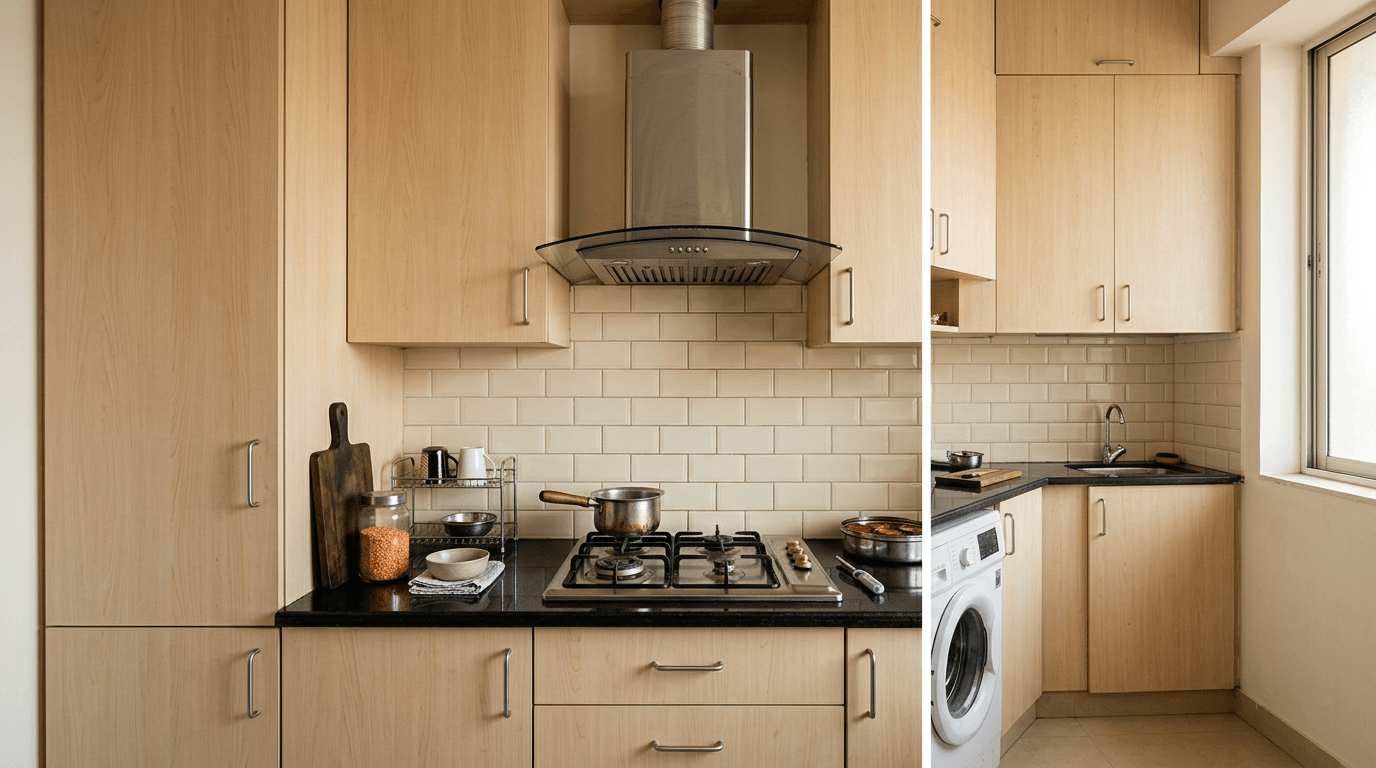
12. Wide 120 cm chimney for a 5-burner hob
Big hob, big hood. A 5-burner or professional-style hob throws smoke across a wider footprint than a 90 cm chimney can cover, and the outer burners are exactly where the tall stockpot goes. A 120 cm chimney also lets you drop the suction slightly for the same capture, which means less chimney noise. Plan the cabinet run around it early, because a 120 cm hood usually removes a full wall unit from your storage tally.
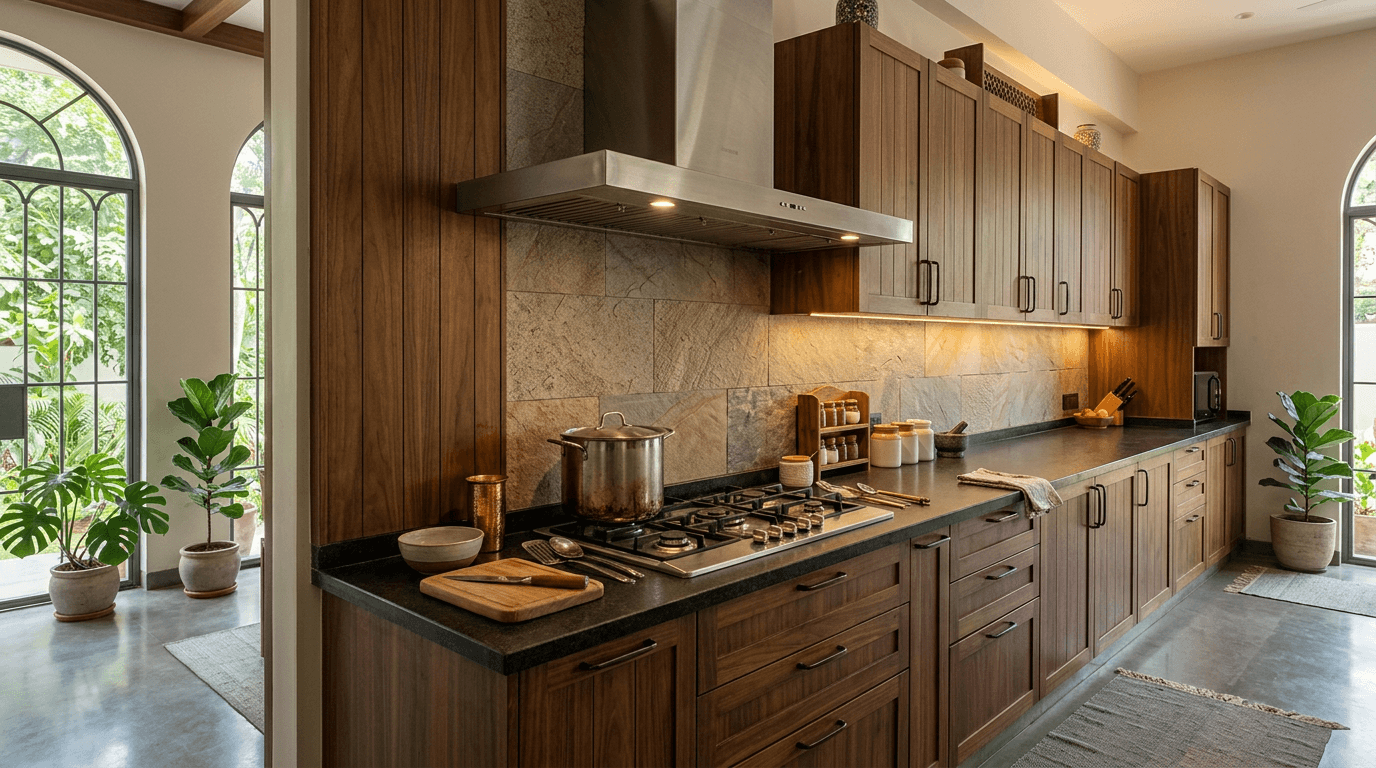
Wall-Mounted vs Island vs Built-In Chimneys
| Mounting type | Best for | Duct route | Typical width | Watch out for |
|---|---|---|---|---|
| Wall-mounted | Hob on an external or near-external wall (most Indian flats) | Straight through the wall behind | 60–90 cm | Duct length once the hob moves inboard |
| Island | Hob on an island or peninsula | Up through the false ceiling, then across | 90–120 cm | Air escapes on four sides, so buy more suction |
| Built-in | Kitchens where the chimney must disappear into joinery | Through the cabinet, then out | 60–90 cm | Lost wall unit, harder servicing |
| Under-cabinet | Retrofits and small kitchens | Short duct or recirculating | 60 cm | Modest suction, not a frying solution |
Two kitchens in one home makes this a double decision. On a 4,000 sft apartment at My Home Bhooja, Dr Kirti Goud's brief included a wet kitchen and a separate dry kitchen, with the main kitchen finished in glass with an aluminium frame. Wet and dry kitchens don't get the same chimney: the wet kitchen carries the frying load and the dry kitchen mostly needs odour control and a smaller hood.
Ducted vs Ductless Chimney: The Non-Negotiable for Indian Cooking
A ducted chimney pushes grease, smoke and steam out of the building. A ductless chimney recirculates the same air through a charcoal filter and blows it back into the room. Charcoal handles odour reasonably well. It does not handle heat, it does not handle humidity, and it does not handle much grease.
For Indian cooking, ducted wins, and it isn't close. If there's any viable route to an outside wall, take it.
Ductless is worth it in exactly one situation: when ducting is genuinely impossible. No external wall within reach, a society that won't allow a wall penetration, or a rented flat you can't alter. If that's you, go in with clear expectations. Charcoal filters need replacing every 6 to 12 months, the kitchen stays warmer while you cook, and you'll wipe surfaces more often.
Duct rules that decide whether your chimney works:
- Use a 150 mm (6 inch) duct. Narrower chokes the motor.
- Keep the run under about 3 metres where you can.
- Minimise 90° bends. Two gentle bends beat one tight elbow.
- Terminate outdoors, at a wall cap or a dedicated shaft. Never into a false ceiling void, and never into a shaft that feeds back into the building.
- Don't let the duct sag between supports. A drooping flexible duct traps grease and kills airflow.
Layout changes rewrite duct routes, which is why this belongs in the design conversation and not the shopping one. On Pushpa Nilayam G2 we converted Mrs Padmavathi's L-shaped kitchen into a U-shaped kitchen and cut a new window from the kitchen through to the living area. Both moves changed where the hob sat and therefore where the duct could go. That's the normal order of events: layout first, chimney spec second, purchase third.
Chimney Filters Compared: Baffle, Mesh, Filterless and Charcoal
Chimney filters are where most of the confusion lives, partly because "filterless" is itself a filter strategy. Here's the honest comparison.
| Filter type | How it works | Grease handling | Maintenance | Verdict |
|---|---|---|---|---|
| Baffle filter | Curved steel panels force a sharp direction change; grease drops out | Excellent | Unclip and wash every 15–30 days | Best for oily, high-fry Indian cooking |
| Mesh / cassette | Layered aluminium mesh traps particles | Poor once clogged | Weekly wash, degrades fast | Avoid |
| Filterless | Centrifugal force throws oil into a collector cup | Very good | Empty the cup roughly monthly | Best for low-effort households |
| Charcoal | Absorbs odour molecules from recirculated air | None | Replace every 6–12 months | Only for a ductless chimney; not a grease filter |
Is a filterless chimney better than a baffle filter? They're different trade-offs, not a straight upgrade. A baffle filter chimney gives you a mechanically simple system with excellent grease capture, at the cost of a fortnightly scrub. A filterless design shifts that work onto the machine, holds airflow more consistently between cleans, and usually costs more. If your household will genuinely wash baffles on schedule, baffle is superb value. If it won't, filterless is the honest choice, because a neglected baffle panel is worse than either.
One thing both share: neither filter type reduces the amount of grease your cooking produces. They only decide where it ends up.
Auto-Clean Chimneys Explained: Thermal vs Water Auto-Clean
An auto-clean chimney runs a cycle that loosens collected grease and drains it into a removable oil cup, so it doesn't bake onto the inside of the hood.
Thermal auto-clean heats a plate inside the housing. The grease liquefies and runs into the cup. Fast, simple, and the more common auto-clean chimney mechanism in India.
Water auto-clean adds a heated-water wash cycle, so warm water circulates through the housing and carries residue out. It's gentler on stubborn deposits and generally sits at a higher price point.
Two honest caveats. First, if the model has baffle filters, auto-clean does not clean them for you. You still wash the panels. Second, auto-clean is a maintenance reducer, not a maintenance eliminator. Run the cycle about weekly if you fry regularly, monthly if you don't, and empty the oil cup when it looks half full rather than when it overflows.
Placement and Height Rules Above the Hob
- Height: 65–75 cm (26–30 inches) from the hob surface to the base of the chimney over gas. 60–65 cm over induction, because induction sends up less heat. Too high and the capture cone widens past the hood edge. Too low and you have a fire risk plus a headache risk.
- Width and centring: the chimney must be at least as wide as the hob. Ideally it overhangs by around 5–10 cm on each side. Centre it on the hob, not on the cabinet module, if those two don't coincide.
- Keep the hob off the corner and away from a window or door that creates a cross-draught. A breeze across the hob defeats the strongest suction power you can buy.
- Power point: chimney installation needs a 5A or 16A socket behind or beside the hood, positioned so it's reachable but not sitting inside the duct box. Mark it during the electrical layout, not after the carcass is up.
- Noise: a standard chimney runs somewhere around 45–65 dB. Higher suction usually means more chimney noise, and in an open kitchen you hear it from the sofa. If quiet matters, compare the dB figure across chimney models the same way you compare suction.
Integrating the Chimney Into Your Modular Kitchen
This is the part shopping pages never cover, and the part no kitchen chimney buying guide written by a retailer can tell you: a modular kitchen chimney is joinery as much as it is an appliance. Your kitchen layout decides the duct route, and a good kitchen design either absorbs the chimney or fights it.
The visible chimney is only half the object. Above it sits a duct box, a boxed-in enclosure that hides the flue between the hood and the ceiling. Get its depth wrong and you lose an entire wall unit. Get it right and it reads as a deliberate break in the cabinet line, with filler panels on either side that match your shutters.
A few rules we work to:
- Decide the chimney model before the cabinet drawings are frozen. Hood widths and flue positions are not interchangeable.
- Keep the duct box as shallow as the flue allows, and align its front face with the wall units rather than proud of them.
- Leave a service gap. Someone will need to reach the motor eventually.
- Coordinate the electrical point during carcass work.
- Treat the wall behind the hood before the woodwork goes in, not after.
That last one comes from a Banjara Hills duplex we did for the Vikas Goud family, who ran a third-generation dental clinic in the same building and had a persistent pest and termite problem. We treated the walls behind all the woodwork and added a layer of tiling before installing anything, working in phases while the family stayed in the house. A chimney recess is exactly the kind of warm, greasy, hard-to-reach void that rewards that discipline.
Appliance integration also has to be planned as a set, not one unit at a time. In Hamsini's five-bedroom joint family home, the refrigerator was integrated into the kitchen and dining space and the crockery unit was built under the staircase, with dedicated ventilation designed in for the inverter. Once you're placing three appliances and a chimney duct in the same joinery, sequence matters more than product choice.
For the wider planning picture, our modular kitchen design guide covers layouts and the work triangle, and kitchen cupboard designs covers the cabinet run the hood has to sit inside.
Kitchen Chimney Price Guide 2026 and What Maintenance Really Costs
Chimney pricing in India spreads across a wide band, and the 2026 price you'll actually pay depends on width, suction, filter type, auto-clean mechanism and brand positioning. Use these as orientation bands for budgeting, then check current retail listings before you buy, because appliance pricing moves with festive offers and model refreshes far faster than any guide can track.
| Tier | What you typically get |
|---|---|
| Entry | 60 cm chimney, mesh or basic baffle filter, around 1000–1200 m³/hr, manual cleaning |
| Mid | 60 or 90 cm chimney, baffle filter with thermal auto-clean, 1200–1500 m³/hr, touch or motion controls |
| Premium | 90 cm or wider, filterless auto-clean, 1500 m³/hr and above, water auto-clean, quieter motors, island chimney designs |
Installation is usually quoted separately from the appliance, and a long duct run, a core-cut through a wall, or an island ceiling route will all add to it. Ask for the installation scope in writing before you pay.
What maintenance actually costs you:
- Baffle filter wash every 15–30 days. Free, but it's your time or your help's time.
- Oil cup emptying, roughly monthly on a filterless or auto-clean chimney. Free.
- Charcoal filter replacement every 6–12 months, but only on a ductless chimney. A recurring consumable cost.
- A professional service visit once or twice a year for a deep clean, priced per visit and varying by city and model.
- Product warranty is commonly around a year, with longer cover on the motor. Warranty terms vary by manufacturer, so read the specific card rather than assuming.
If you're building the whole kitchen budget rather than just the appliance line, our modular kitchen price guide breaks the rest of it down per square foot.
Best Kitchen Chimney Brands in India: How to Compare Them Fairly
We're not going to rank brands or hand you top picks, because we don't run a test lab and inventing ratings would be dishonest. Every listicle promising the best chimneys in India is ranking on affiliate margin at least as much as on performance. The names that come up most often in Indian kitchens are Faber, Elica, Glen, Kaff, Bosch, Sunflame and Hindware — and a Hindware chimney and a Faber chimney at the same price point usually differ more in service network than in specification. Any of them can be the right answer or the wrong one depending on the model.
What we can give you is the checklist we apply to any chimney brands before we specify a unit. Use it on whatever shortlist you build:
- Where is the suction measured? Some figures are quoted at the motor and some at the hood. Ask which, and compare like with like.
- Filter type and spare availability. Can you buy replacement baffle panels or charcoal filters for this model in your city, three years from now?
- Auto-clean mechanism. Thermal or water, and does it work with the filter type fitted?
- Declared noise in dB. If it isn't published, treat that as information.
- Service network where you live. A reliable brand in Hyderabad may have no technician in a tier-2 town. This one decides more real-world satisfaction than the spec sheet does.
Buy the model, not the logo. A brand's flagship and its entry model often share nothing but a badge.
Chimney Mistakes We Fix on Site
- Chimney narrower than the hob. The outer burners smoke straight past it. No suction power fixes a geometry error.
- Ducting into a false ceiling void. Grease-laden air with nowhere to go, condensing above the client's head. We've opened these up. It isn't pretty.
- Buying suction and ignoring duct length. A 1500 m³/hr unit behind four bends loses to a 1200 m³/hr unit venting straight out.
- Mounting too high because a tall cook asked for headroom. Above about 75 cm, capture falls off sharply.
- No power point, or one that lands inside the duct box. An avoidable rework every single time.
- Choosing ductless when an external wall was a metre away. Usually because nobody asked the question until the appliance arrived.
- Specifying a finish nobody will maintain. Manikantha's brief on his My Home 3 BHK was explicit: zero open shelves, optimum storage, keep it clean and spacious. In a kitchen designed around low maintenance, a hood that shows every fingerprint is the wrong hood, no matter how good it looks in the render.
FAQs
Why are baffle filters recommended for traditional Indian cooking? Baffle filters use curved steel panels that force air to change direction sharply. Grease is heavier than air, so it can't follow the turn and drops out onto the panel. That mechanism handles the heavy oil load from frying and tempering far better than mesh filters, which clog and choke airflow within weeks.
Is a 60 cm or 90 cm chimney better for a 3-burner gas stove? A 90 cm chimney is the safer choice for a 3-burner hob. The chimney should be at least as wide as the hob and ideally a little wider on each side, so it catches smoke rising from the outer burners rather than letting it spill sideways. Choose 60 cm only if your hob is genuinely narrow and the cabinet module can't take more.
What is water auto-clean technology in modern chimneys? Water auto-clean runs a heated-water wash cycle through the chimney housing, loosening accumulated grease and draining it into a removable oil cup. It's gentler and more thorough on baked-on residue than a thermal plate alone, and it sits at a higher price point. It still doesn't wash baffle filters for you.
How high above the hob should a kitchen chimney be installed? 65 to 75 cm above a gas hob, measured from the burner surface to the base of the hood. Over induction, 60 to 65 cm works because there's less rising heat. Mount it higher and the smoke spreads wider than the hood can capture. Mount it lower and you create a fire and head-clearance risk.
Is a ductless chimney worth it if my kitchen has no outlet? It's better than nothing, and it's a genuine compromise. A ductless chimney recirculates air through a charcoal filter, which controls odour but leaves heat, humidity and most grease in the room. Before accepting it, check properly whether a duct can reach any external wall or approved shaft, because a short duct beats the best ductless unit.
Conclusion: Your Kitchen Chimney Spec Sheet to Take Shopping
Choosing the right chimney isn't a brand decision, it's six numbers. Copy these into your notes app before you open a shopping app, and you'll cut a forty-tab comparison down to a shortlist of three.
- Width: match or exceed your hob. 60 cm for 2–3 burners, 90 cm for 3–4, 120 cm for 5 or an island.
- Suction power: 1200 m³/hr minimum, 1500+ for heavy frying or an open kitchen, one band higher if the duct is long or bendy.
- Filter: baffle if someone will wash it, filterless auto-clean if nobody will.
- Duct: 150 mm diameter, under 3 m, minimum bends, terminating outside.
- Mounting height: 65–75 cm above gas, 60–65 cm above induction.
- Auto-clean and noise: thermal or water, and a published dB figure you can live with.
Get those six right and almost any reliable brand will keep your kitchen breathable for a decade. That's how you choose the best kitchen chimney for your home: not by hunting for the perfect kitchen chimney, but by matching six numbers to one room. Get the duct wrong and the most expensive chimney in India will still leave a film on your shutters.
If you're planning a new kitchen rather than replacing an appliance, the chimney should be decided alongside the layout, not after it. That's the part we do. Book a free design consultation and we'll size the hood, route the duct and draw the cabinetry as one piece of work. Pricing depends on your city, kitchen and spec, so we'll give you a project-specific estimate on the call.
Roomantic is a design-build architecture and interior studio with 30+ projects across 7+ cities in India, including Hyderabad, Bangalore, Machilipatnam, Srikakulam, Darjeeling, Punjab and Giridih. We design and execute under one roof, with every project visualised in 3D before work begins.