Written by Karthik M, Chief Designer at Roomantic. IIT Guwahati Design alumnus focused on interiors, 3D visualization and design-build workflows.
Choosing the Right Modular Kitchen Accessories: The Essential Modular Kitchen Accessories List
The right kitchen accessories are the ones matched to how you cook, not the ones that look clever in a showroom. Start with tandem drawers, a cutlery tray, one slim pull-out near the hob, a corner solution for dead space, and an under-sink bin. Everything else is optional.
We're a design-build studio, so here's our bias upfront: we don't sell accessories. We specify them, install them inside carcasses we've built, and then hear about them from clients for years afterwards. That changes how you see this category. In the modular kitchens we've delivered, half the accessories list in a typical quote earns its keep every single day. The other half gets opened twice a year.
This guide is for the moment most homeowners hit mid-project: a quote arrives with fifteen line items you've never heard of — tandem box, swing-out corner mechanism, slim larder, SS wirework — and no way to tell the essential from the padding on that list. Search "kitchen accessories" and you mostly get shopping listings. Useful for browsing. Almost useless for choosing the right kitchen accessories for modular kitchen setups, which is a specification problem, not a shopping problem.
So this is the designer's version: what each organizer actually does, who needs it, what to skip, and how the pricing works. Smart storage is nine-tenths of kitchen organization — get those calls right and the clutter problem mostly solves itself.
It comes down to daily use, so here's the short answer, then we'll go item by item.
Top 5 Must-Have Modular Kitchen Accessories to Organise Your Kitchen
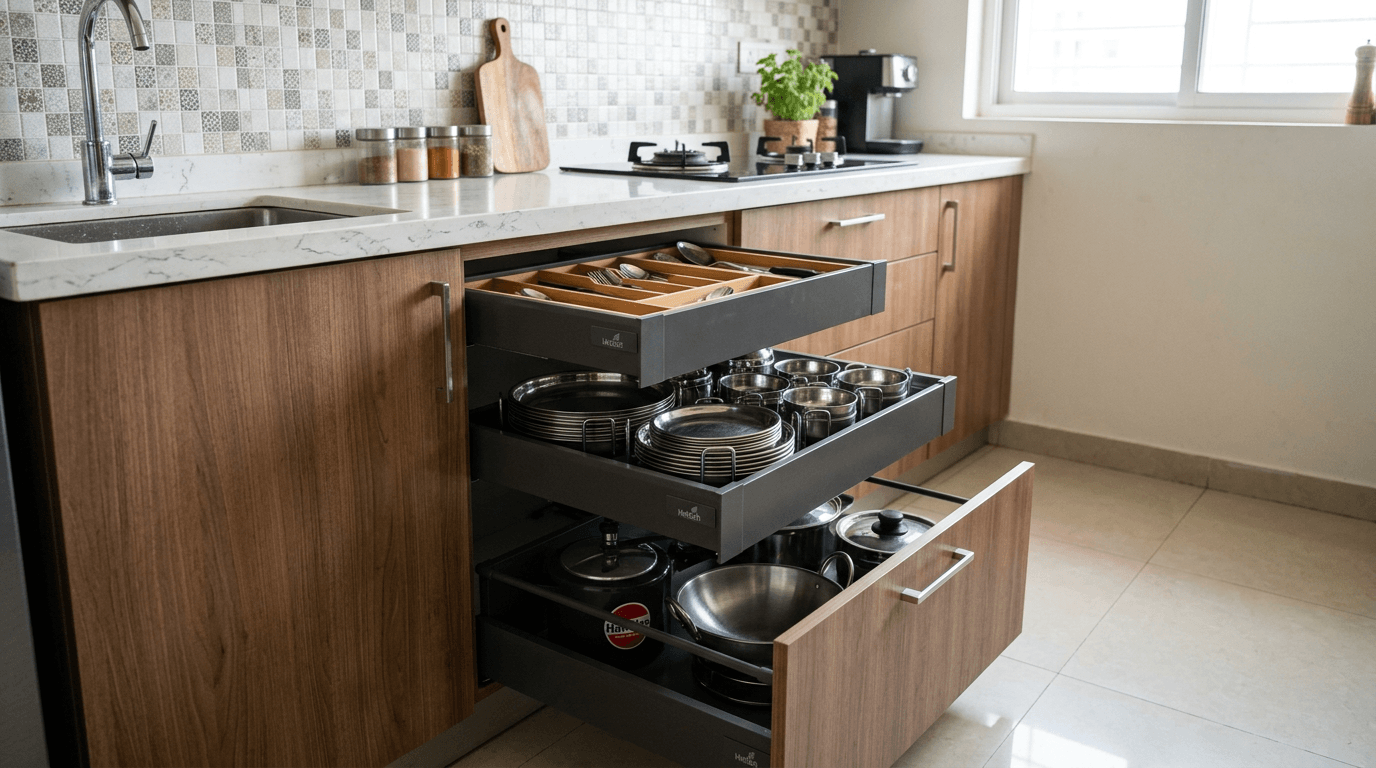
- Tandem drawers: deep, metal-sided boxes with soft-close runners that carry heavy pots and grocery tins without sagging.
- Cutlery tray inserts: compartmentalised dividers that keep knives, spoons and spatulas in order inside the topmost box.
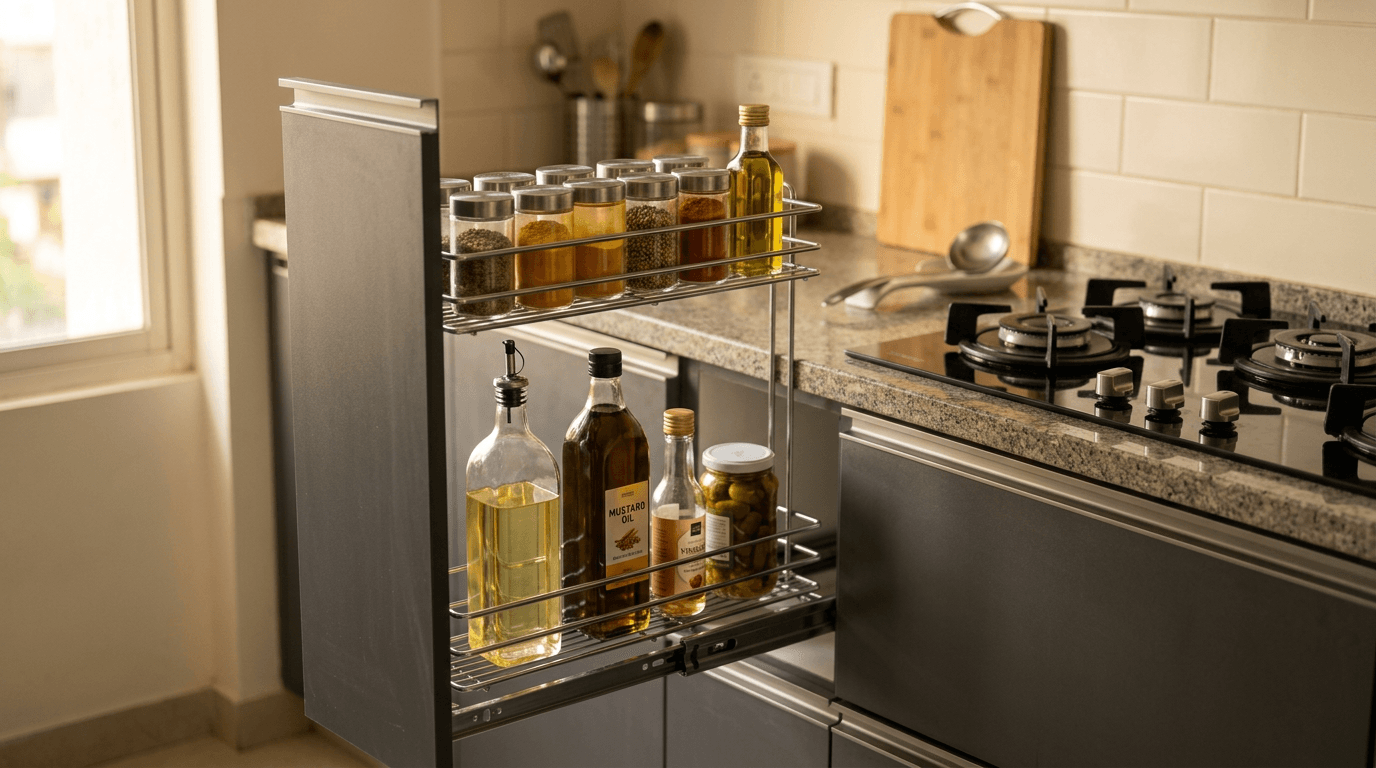
- Slim pull-out larders: 150–200 mm vertical units for oils and daily spices, fitted right beside the hob.
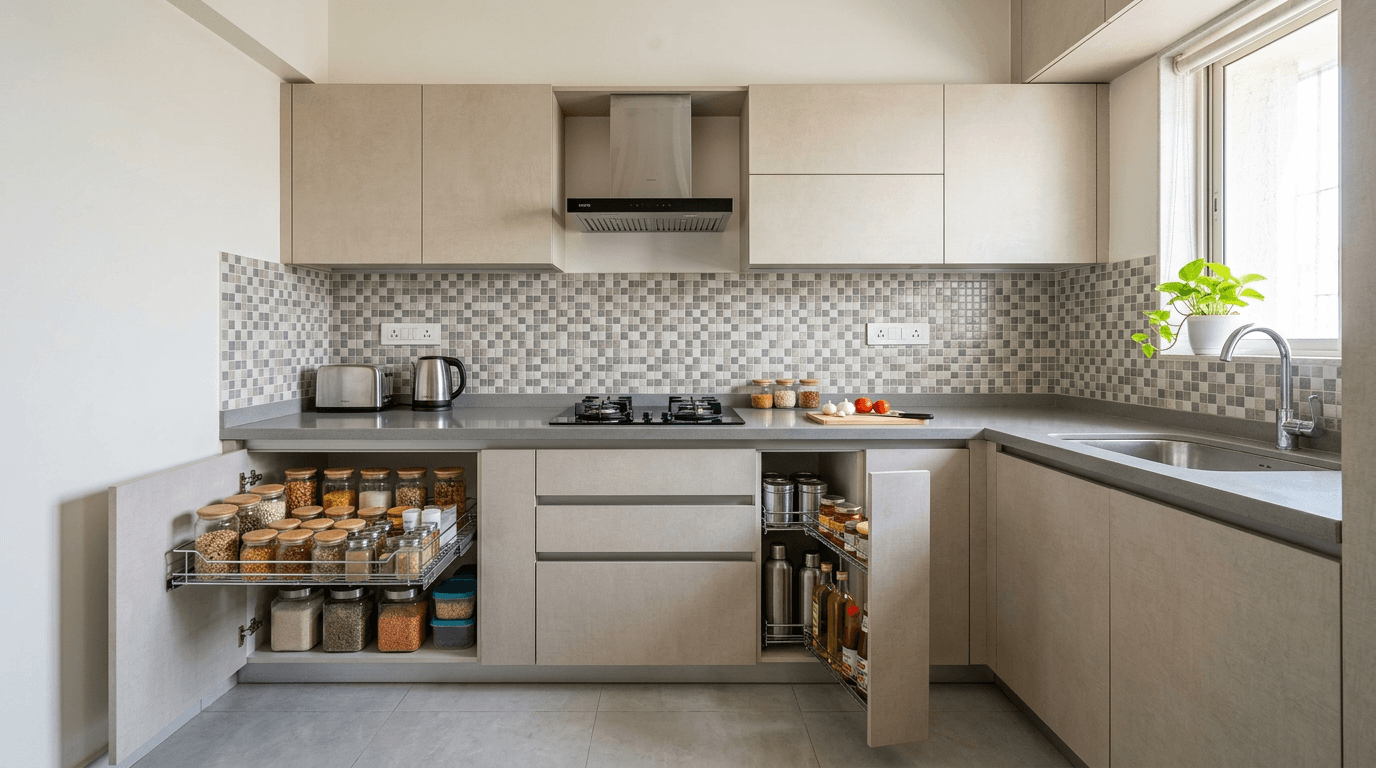
- Corner mechanisms: swivelling or swing-out shelves that make dead corners usable.
- Under-sink waste mounts: containers fitted to the cabinet door so waste disposal doesn't mean bending into a dark cabinet.
10 Space-Saving Modular Kitchen Accessories Every Indian Kitchen Needs in 2026
These are the accessories we specify most often across our projects, ordered roughly by how hard they work in daily Indian cooking. Between them they cover almost every kitchen storage job a home throws up.
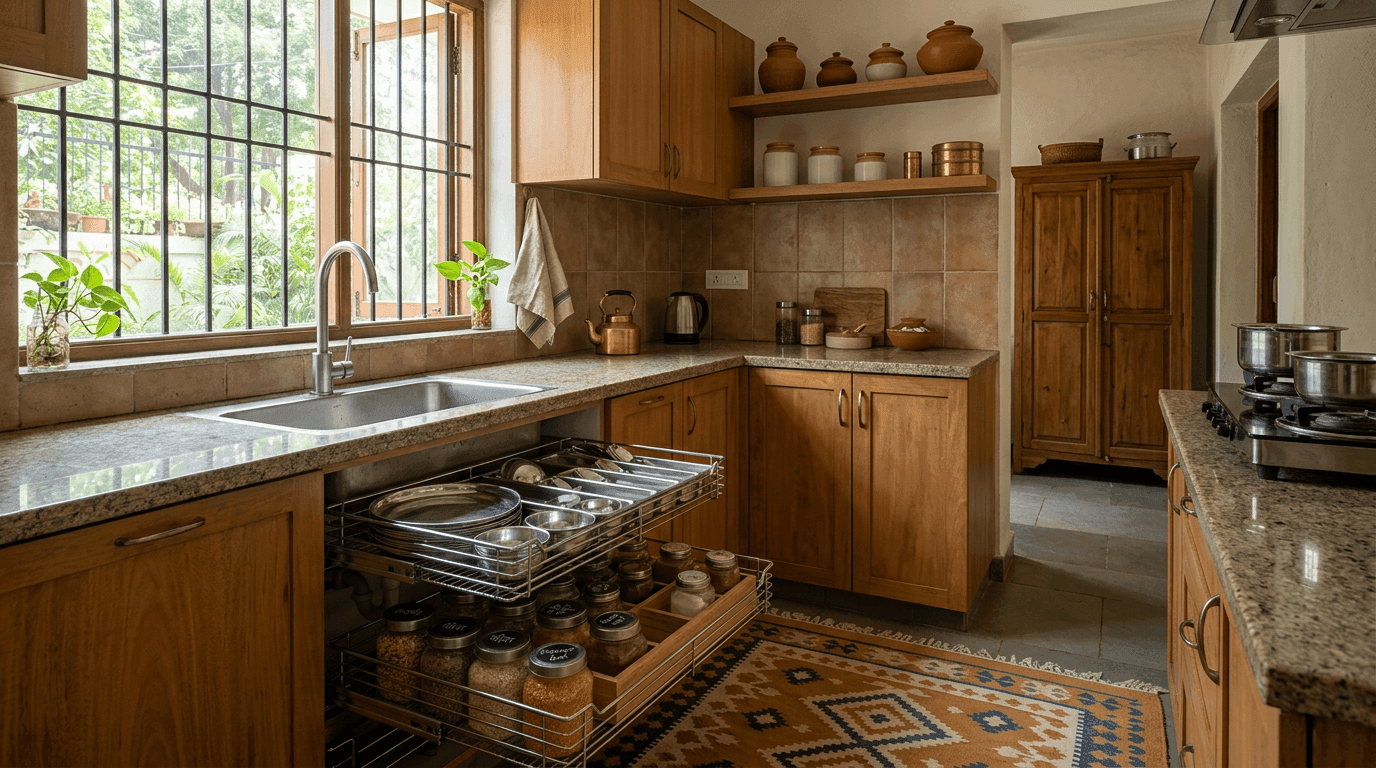
1. Tandem drawers. The single biggest upgrade over hinged shutters. A sliding box brings the back of the kitchen cabinet to you; a shutter makes you kneel and excavate. Deep tandem boxes hold pressure cookers, kadhais and 10 kg atta containers on full-extension, soft-close channels — pots and pans that would bend ordinary runners. If the budget forces a choice, put drawers in the base cabinets below the hob first.
2. Cutlery tray inserts. Cheap, unglamorous, used forty times a day. Get one sized to the box, not a loose plastic insert that slides around.
3. Bottle pull-outs. A slim 150 mm or 200 mm vertical pull-out beside the hob for oils, vinegars and daily masalas. It turns the narrow filler gap — the strip most modular kitchens waste — into the most-used shelf in the house.
4. The corner mechanism. L-shaped and U-shaped modular kitchen layouts create a dead corner where two runs of units meet. One mechanism spins shelves around the bend; the other swings the rear shelves forward when the door opens. More on choosing between them below.
5. Under-sink bin pull-out. Mounts the waste container on the door with a bracket, sometimes with a second one for dry waste. Wet-dry segregation is standard in most Indian cities now, and this is the tidiest way to live with it.
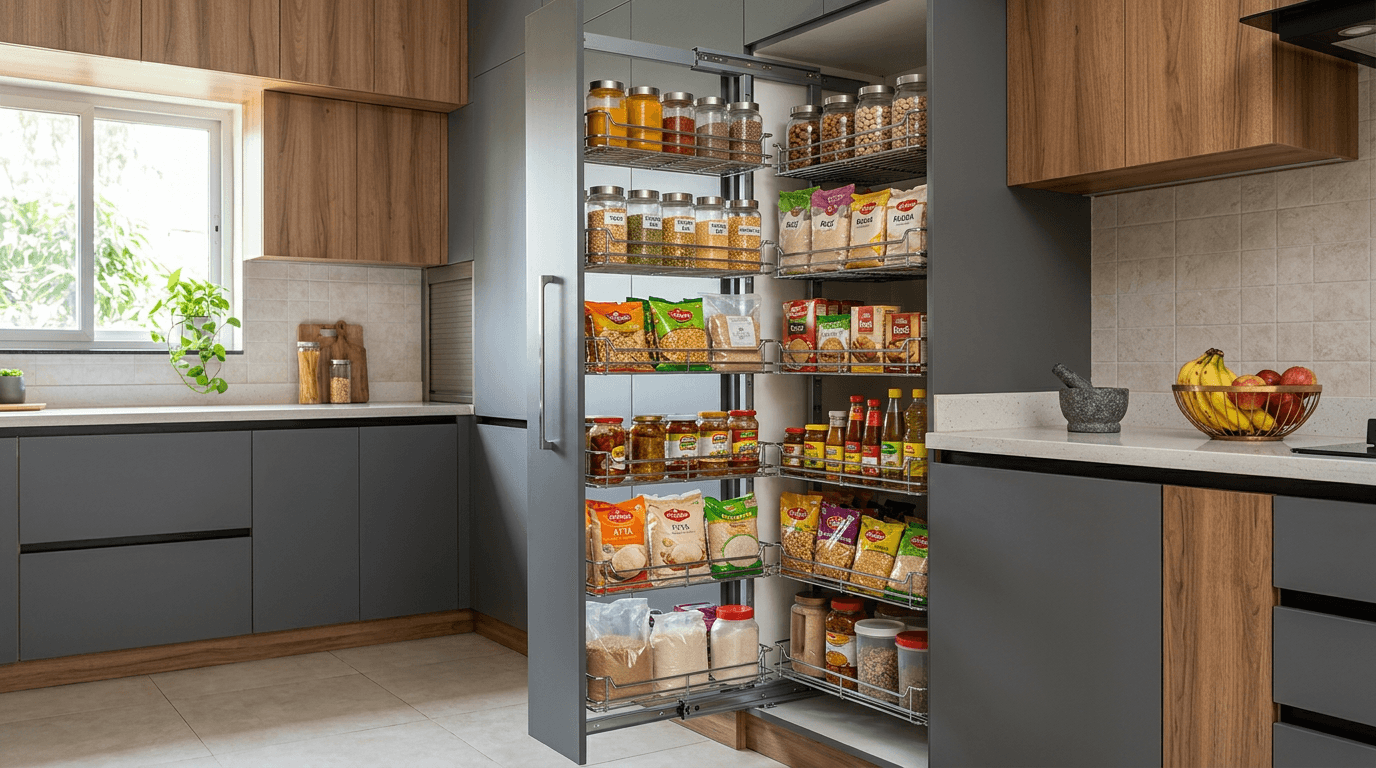
6. Tall unit / sliding pantry. A full-height larder that stores a month of groceries in one column. Genuinely transformative in bigger homes; oversized for small ones. We'll argue about this one properly in its own section.
7. Plate and thali baskets. The classic wirework: stainless steel with vertical dividers that hold thalis, plates and lids upright. The default internals of most Indian modular kitchens — useful, but don't let wirework do jobs a tandem box does better.
8. Rolling-shutter appliance garage. A counter-level cabinet with a shutter that rolls down over the mixer-grinder, toaster and kettle. Keeps daily appliances plugged in but out of sight — instant visual order, nothing crowding the counter. This is how we delivered a "zero open shelves" brief for one Hyderabad client — a couple who wanted a clean, low-maintenance 3 BHK with nothing on display and optimum storage behind shutters. It still looks new years later.
9. Pull-out spice rack near the hob. Overlaps with the bottle unit; pick one or the other for the hob zone. If you cook with a large masala collection, a two-tier spice rack wins. A utensil rack in modular kitchen drawers (peg-board style dividers for ladles and whisks) rounds out the same zone.
10. Wicker basket for onions and potatoes. A ventilated unit in the base run for the vegetables that shouldn't see the fridge. Small thing, but it ends the loose-basket-on-the-floor situation permanently.
That's the ten. Notice what's not here: wine holders nobody fills, dish-drainer towers that fight the chimney, and motorised gadgets. A clean cooking space comes from disciplined storage, not from more mechanisms — organise the internals first, decorate later.
The Corner Unit Decoded: Magic Corner vs Carousel for Dead Storage Space
A magic corner pulls the rear corner shelves out toward you when the cabinet door opens, so nothing hides at the back. A carousel spins circular shelves inside the corner instead. The swing-out type holds more and presents it better; the rotating tray costs less and suits lighter loads.
Every L-shaped or U-shaped kitchen has this problem: where two runs of units meet, there's a deep bend you can reach only by half-climbing inside. Ignore it and you lose roughly a full module's worth of storage.
The carousel (also called a lazy Susan) is the older fix — D-shaped or full-round shelves that rotate. It's simpler mechanically and kinder to the budget, but items can fall off the edges, and the centre pole eats capacity.
The swing-out mechanism is the better one: wire shelves attached to the door swing out, and the rear pair slides forward into the opening. Everything comes to you. It carries more weight, so it's where the extra kadhais and the stock of steel containers usually live.
One honest caveat from site experience: any corner mechanism needs its adjacent fronts and doors planned around its swing. We've re-sequenced kitchen layouts at the design stage more than once to stop a swing-out door colliding with a dishwasher. This is why accessories should be decided during kitchen design, not after the carcasses are made — a point we cover in our modular kitchen design guide.
The Tall Unit and Sliding Pantry: Is a Full-Height Larder Worth Buying?
A tall larder unit is worth buying if your kitchen is at least medium-sized, you shop for groceries in bulk, and you can spare 450–600 mm of wall run. In compact homes, the same money does more in tandem drawers and a good corner mechanism.
The tall unit is the most impressive accessory in any showroom — a full-height column where five or six loaded levels glide out together, holding a month of pantry stock at eye level. Families who buy groceries monthly, or run a joint-family kitchen, use every inch of tall storage like this.
Tall storage without the tall unit: vertical storage for a small kitchen
But it's also the accessory we most often talk clients out of. In a compact room, a tall pantry swallows precious countertop length and can make the space feel like a corridor. The vertical instinct is right; the full-height larder is just one way to act on it. Deep tandem boxes plus overheads running to the ceiling often store nearly as much without sacrificing workspace.
Where a tall pantry earns its place, it really earns it. For a joint-family home we designed in Hyderabad — five bedrooms, three generations, one very hard-working kitchen — the storage brief went beyond the kitchen itself: the refrigerator was integrated into the kitchen-dining line, and the crockery unit was designed under the staircase with ventilation planned for the inverter beside it. When a family that size runs one kitchen, pantry volume isn't a luxury.
If you're weighing the tall column against more shelving, our kitchen cupboard designs guide covers the cupboard side of that trade-off, and the storage logic differs across modular kitchen layouts — an L-shape rewards the corner mechanism first, a parallel kitchen rewards tandem boxes.
Drawer Systems vs the Modular Kitchen Basket: Cutlery Tray, Utensil and Kitchen Cabinet Internals
Indian modular kitchens historically ran on stainless steel wirework behind shutters. It's sturdy and washable, and for plates and thalis the dedicated basket is still the right call. But as a default for everything, wirework loses to drawers: small items fall through the gaps, you still open a shutter then pull the wirework out, and that shutter-plus-wirework combination costs close to what a proper tandem box does.
Our rule of thumb when we design cabinet internals:
- Drawers for cookware, every utensil and knife insert, containers and anything heavy. How we organise the hob zone starts here.
- Baskets for plates, thalis, lids and vegetables that need airflow.
- Shelves only inside larders and overheads, where sliding internals can't go.
When storage baskets still win
Grade matters more than brand here. Ask whether the wirework is 304-grade stainless steel (the rust-resistant food-safe grade) rather than 202-grade, and whether the channels are soft-close and rated for the load. A front that slams or a basket that rusts at the spot-welds is what "cheap kitchen hardware" actually means, a year in.
We learned some of this the hard way. Our first executed project was a 3 BHK modular interiors job in Hyderabad, and it taught us more about hardware specification than any catalogue — including which internals survive daily Indian cooking and which look fine on handover day and loosen within months.
What Kitchen Accessories Cost: How to Read Your Modular Quote
Accessory pricing in a modular kitchen quote is driven by four things: the hardware brand tier, the mechanism's complexity, the steel grade, and the module width. Read the quote line by line — each accessory should name its brand, size and mechanism, not just say "SS basket".
We won't print a price list here. Hardware prices move with steel costs, import duties and festive-season discounts, and a number that's right this quarter misleads you the next. What stays stable is the structure of the pricing, and that's what lets you compare quotes intelligently:
- Brand tier. European mechanisms (Hettich, Hafele, Blum) sit at the premium end; established Indian brands and unbranded local hardware sit below. The gap buys smoother channels, higher load ratings and longer warranties — most visible on the internals you cycle daily.
- Mechanism complexity. A static shelf or basket is the cheapest internal. Sliding units cost more, corner mechanisms more again, and full-height pantry systems the most. Complexity should follow use: pay for movement where you reach every day.
- Material and grade. 304-grade stainless steel over 202-grade, powder-coated steel versus chrome-plated wire, solid-base boxes versus open wire — each step changes the line item.
- Width and count. A 900 mm module costs more than a 450 mm one; five sliding units cost more than three. Obvious, but it's where quotes quietly grow.
How to choose the right accessories from a quote
Two practical checks: ask for the accessory brand and model in writing on every line, and ask which items carry a manufacturer warranty versus the fabricator's own. For how accessories sit inside the overall kitchen budget, see our modular kitchen price guide.
Kitchen Accessories for a Small Modular Kitchen: Bottle Pull-Outs First
In a compact kitchen — say a 70 sq ft L-shaped layout — prioritise in this order: 1) tandem drawers under the hob, 2) a slim bottle unit beside it, 3) a corner mechanism for the L-junction, 4) a cutlery insert, 5) an under-sink waste unit. That sequence maximises daily-use storage before spending on anything tall or decorative.
Compact rooms punish poor accessory choices hardest, because every wasted centimetre shows. The logic of the sequence above: the hob zone works hardest, so it gets the sliding storage first. The corner is the biggest single block of recoverable dead space, so it comes third. The last two cost little and remove daily friction. That's the whole small modular kitchen design playbook: recover dead space, then speed up the hob zone.
What we don't recommend in compact modular kitchens: tall larder units (they eat counter run), wide 900 mm modules (two 450s are more flexible), and appliance garages (in a compact home the microwave lives on an open shelf or in a unit — accept it). Light shutter colours and handleless fronts do more to make a small kitchen feel bigger than any mechanism will.
We've seen how much a compact kitchen changes when the storage logic is redesigned. In one 1,000 sft Hyderabad apartment, the client bought a flat from a retired couple and the kitchen simply didn't fit her family's cooking — so we converted the L-shaped kitchen into a U-shape, which added a full third run of base units and the sliding storage the family actually needed. In another project, an open kitchen had to work inside a small transitional kitchen space, and the internals did the job walls couldn't: every centimetre behind the shutters was specified, including a concealed bar unit.
Trending Modular Kitchen Accessories for 2026: Sleek Kitchen Upgrades
The strongest 2026 accessory trends aren't new inventions — they're quieter versions of proven ones: handleless fronts, solid-base boxes replacing wire, integrated waste units, and appliance garages that keep counters bare. The trend is invisibility, not gadgetry.
Where interior design trends meet modern kitchen design
A few directions we're seeing across modern modular kitchens this year, and our honest read on each:
- Solid-base boxes over wire baskets. The latest kitchen accessories catalogues have quietly shifted from chrome wire to powder-coated solid-base systems. Deserved: they're easier to clean and nothing tips through.
- Handleless everything. Push-to-open and integrated-groove fronts give modular kitchens that flush, seamless-front look. Fine for lower units; think twice on greasy hob-zone shutters, where push-to-open means palm prints.
- Built-in segregated waste. Two- and three-compartment systems matched to city waste rules. This one's a keeper in modern homes.
- Smart kitchen add-ons. Sensor lights inside the internals are cheap now and genuinely useful. Motorised shutters, in our experience, are a service call waiting to happen.
- Warm minimalism. The design mood of 2026 — wood tones, fluted glass, matte finishes — changes the kitchen look, not the internals. Don't pay a premium for a trend colour on a mechanism you'll hide behind a shutter anyway.
Should you upgrade your kitchen this year?
Treat trend lists as design ideas to steal selectively, not a checklist. If you're planning that upgrade this year, spend on mechanisms first and moods second — that's the interior designer's honest answer, whether it's a modest galley or the massive wet-plus-dry kitchen we fitted with glass-finish aluminium-frame shutters for a 4,000 sft rental-ready apartment: timeless modern kitchen design choices outlast trending ones.
Mistakes to Avoid When Buying Accessories for Modular Kitchens
- Buying accessories after the kitchen is designed. Corner and larder mechanisms and door-mounted waste units all have swing and clearance requirements. Decide them with the kitchen layout, not as an afterthought.
- Paying for movement you won't use. A motorised lift-up or a servo-drive waste unit is lovely engineering. If nobody in the house wanted it before the showroom visit, nobody needs it after.
- Ignoring load ratings. Indian cooking is heavy — literally. Pressure cookers, stone mortars, 10 kg grain containers. Channels rated for light European loads sag here.
- All baskets, no drawers. The classic 2010s spec. If your quote is a column of SS baskets, ask why.
- No maintenance thought. Every mechanism has moving parts. If the family won't wipe and re-oil channels annually, choose simpler internals — a brief we've executed deliberately for clients who wanted zero-fuss kitchens.
- Forgetting the chimney interaction. Hob-zone accessories must coexist with chimney clearances; our kitchen chimney guide covers those rules.
- Treating accessories as furniture shopping. They're fitted hardware, not kitchen furniture you can swap later. Retrofitting a corner mechanism into a finished carcass is somewhere between painful and impossible.
Kitchen Organization Maintenance: Keeping Every Organizer and Bin Working
Accessories fail at the moving parts, and almost all of it is preventable:
- Wipe channels monthly. Flour, masala dust and oil vapour are the abrasive paste that kills soft-close runners.
- Don't overload beyond the rating. Full-extension channels list a load rating for a reason; the atta box is usually the one that exceeds it.
- Re-level doors and fronts yearly. Hinges and fronts have adjustment screws; five minutes with a screwdriver keeps gaps even.
- Dry the under-sink module. The waste unit lives in the wettest spot in the kitchen. Fix drips fast; check the plinth for swelling.
- Spin the corner mechanism empty once a year. Listen for grinding — these mechanisms warn you before they fail, and a bearing is easier to replace than a bent frame.
Well-maintained branded hardware routinely outlives the shutters around it. It's the least glamorous way to save money here: keep what you bought working, and everything stays organised.