Key Takeaways
- Direct answer: The best aquarium position as per vastu is the north-east direction (Ishan corner) of your living room. North and east work as second choices.
- Avoid: South, south-west, the bedroom, the kitchen, and the space under a staircase.
- Number of fish: Nine, traditionally eight gold and one black fish.
- Our verdict: Treat the fish tank as a design decision with plumbing consequences, not a lucky charm. Where you place an aquarium changes the light, movement, and energy of the whole room.
Why Aquarium Placement as per Vastu Shastra Matters
Vastu Shastra is the ancient Indian science of architecture that gives every direction a governing element and a purpose. Water in vastu belongs to the north-east, the corner the texts call Ishan, and an aquarium is the most common way an Indian home brings the water element indoors. That one fact drives almost every rule on this page.
Two more terms are worth knowing. The Brahmasthan is the centre of the house, which the principles of vastu keep open and unloaded. The water element (Jal tattva) governs the north-east and, in the traditional reading, carries flow, clarity, and opportunity. Anything significant in vastu about aquariums, fountains, or wells traces back to that element in vastu being parked in the right corner of your home.
Most vastu shastra tips about water come back to one idea. The energy flow of a house is thought to follow its light and its water, and both are supposed to enter from the north-east. Block that corner with something heavy and the tradition says the energy stalls. Fill it with clean moving water and the energy in the room is said to circulate freely, carrying positive energies through the rest of the plan.
Here's the quick-reference version we sketch for clients who ask about a fish aquarium mid-project.
| Parameter | What Vastu Recommends | What to Avoid |
|---|---|---|
| Best direction | North-east (Ishan), then north direction or east direction | South, south-west, south-east |
| Room | Living room, drawing room, entrance hall | Bedroom, kitchen, pooja room, under stairs |
| Number of fish | Nine, eight gold plus one black fish | Even counts, a single fish kept alone |
| Condition | Clean water, healthy fish, working filter | Murky water, dead fish left in the tank |
| Mirror nearby | North or east wall, reflecting the tank or locker | Facing the bed or the main door |
What Vastu Says an Aquarium Actually Does
Before the directions, the claim. In vastu shastra, moving water is associated with wealth and with the flow of money through a household, so an aquarium in your home is believed to attract financial opportunity and steady it. Kubera, the god of wealth, is placed in the north of the vastu grid, which is why an aquarium on the north or north-east side is said to bring in wealth rather than simply decorate a corner. Vastu experts also link a well-kept tank to calmer moods, on the reasoning that the water absorbs negative energies and releases positive energies back into the room.
The vastu benefits usually listed for a fish tank, in the order you will meet them:
- Financial prosperity, through the association between moving water and the flow of money
- Fewer obstacles, because the water is thought to soak up negative energies before they reach the family
- Calmer, more sociable energy in the living room, where the tank sits
- A supposed boost to careers and new opportunity, from the north-east being the corner of clarity
We report all of that as tradition, because that's what it is. What we will vouch for as designers is smaller and completely real. A lit tank puts light, colour, and slow movement into a corner that was doing nothing, and rooms with a focal point of movement genuinely change how people sit in them. If it also happens to bring prosperity and abundance, nobody will be more pleased than us.
Best Aquarium Position as per Vastu Shastra
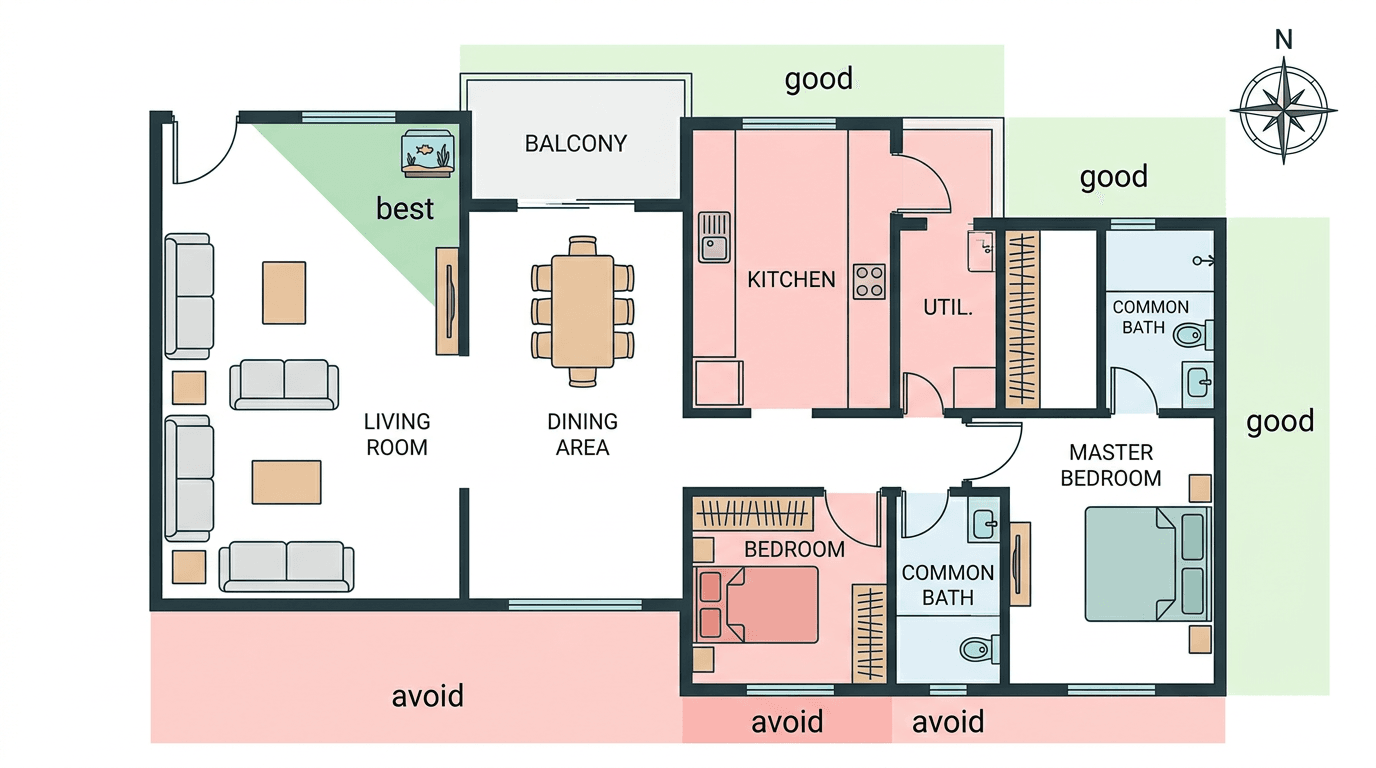
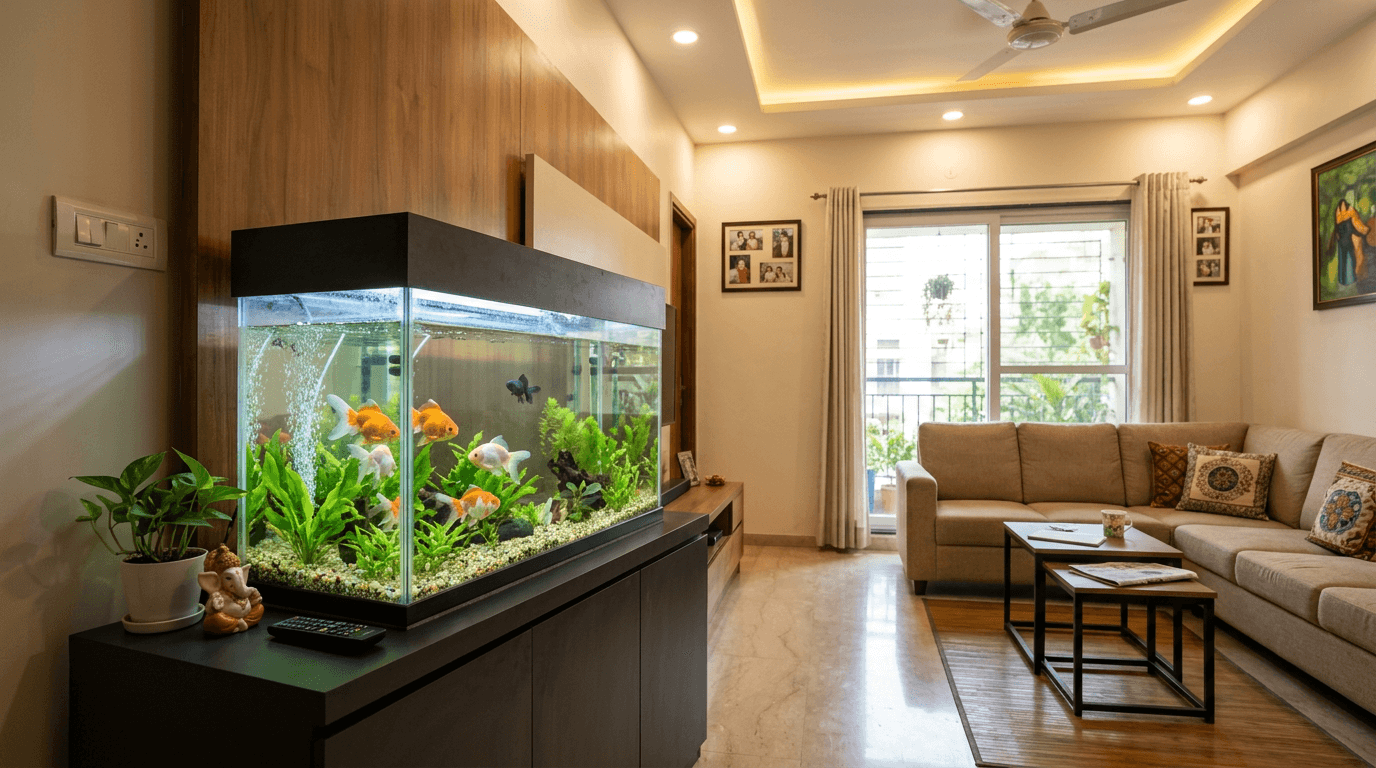
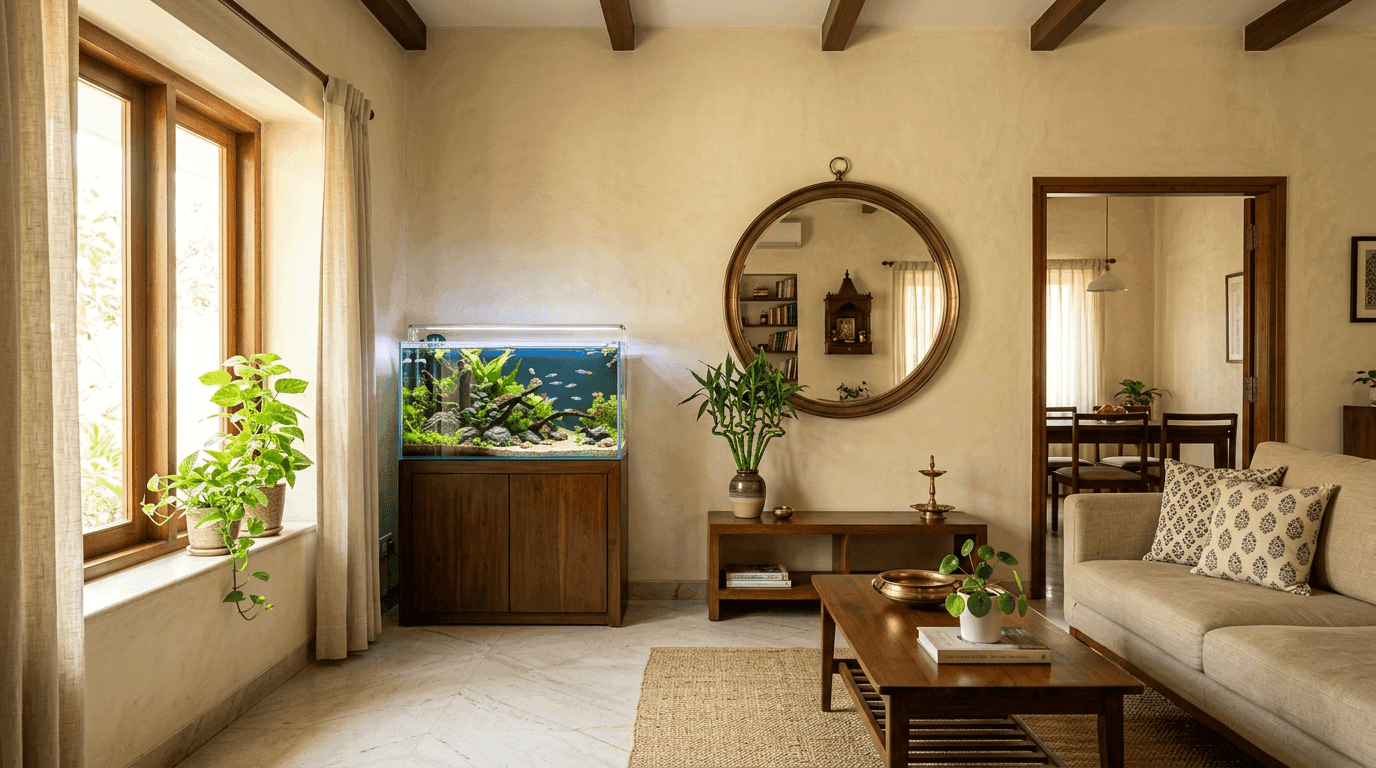
Place the aquarium in the north-east corner of your living room. The north-east is governed by the water element, which makes it the corner traditionally linked with wealth and good fortune. North and east are the next best options. Keep the fish tank at chest height or lower, against a solid wall, with clear space in front of it.
The reasoning is elemental rather than decorative. Vastu loads the south-west with mass and keeps the north-east light, bright, and watery. Put a heavy stone-clad wall in that corner and the tradition objects, because it dams the energy that should be entering there. Put a glass tank of moving water in the same spot and it agrees enthusiastically. That is the whole of the best aquarium vastu advice in three sentences, and everything below is detail on how to apply it per the vastu grid of your particular home.
Where to Place an Aquarium in the Living Room
The living room is the correct room, and inside it the north-east is the best place to keep a tank. A few practical rules we apply on drawings:
- Keep the tank against a solid wall, never a partition hiding plumbing or a shaft.
- Leave walking space in front. A tank you squeeze past stops being pleasant within a month.
- Do not put it directly behind the main seating. Vastu wants water in view, and so does anyone who just bought a fish tank.
- Do not put the aquarium near the pooja unit. Water and the sacred fire zone do not share a corner comfortably, and the two kinds of energy are meant to stay distinct. Our pooja room vastu guide covers that side of the plan.
When we planned Nitesh's eight standardized villas in Machilipatnam, the brief was living, dining, kitchen, puja and one bedroom on the ground floor of each unit, all placed as per vastu, on an awkward trapezoidal plot. The north-east of every living room stayed light and open by design. That corner is exactly where a tank would go later. The owner never has to ask, because the plan already answered.
Aquarium at Home in Flats and Small Apartments
Most people reading this live in a flat where the north-east is occupied by a window, a sofa, or somebody's bedroom door. Do what you can. Get the compass reading right first, using a phone compass held flat and well away from the TV, because guessing the correct direction is how half of these mistakes start. If the true north-east is unavailable, the north direction is a genuine second choice and the east direction a third.
In a compact hall, a slim 60 to 90 cm tank on a low console does more for the room than a large one wedged into the only walkable corner. And if the flat gives you nothing usable in the north or east, a partition can manufacture the wall you need. In Aravind Shetty's 3BHK in Hyderabad, we extended an existing wall with a wooden partition to separate the drawing room from the living, which created the surface the TV unit needed. The same trick makes a placement wall out of thin air.
Aquarium Vastu Direction by the Direction of the House
The direction of the house changes the entrance rules, not the water rules. In an east-facing or north-facing home, the north-east is usually generous and the tank lands easily. In a south-facing or west-facing home, that corner is often the smallest, and you end up choosing between a cramped ideal spot and a comfortable north wall. We pick the comfortable north wall. A tank nobody can reach to clean fails on every reading, traditional or practical.
Planning a whole house as per vastu is a different exercise from placing one object inside a finished one, and the compass is the only thing the two share. For how facing changes the rest of the plan, see our house facing vastu guide.
Where Not to Place an Aquarium in the House
The prohibitions matter more than the recommendations, because a badly placed aquarium in the house is what people come to us to fix. In each of these zones, the tradition says the tank stops circulating energy and starts trapping negative energies instead.
- South and south-west. Heavy fire and earth zones. Water here is read as a clash that leaks the home's stability.
- South-east. Governed by Agni, the fire element, and already spoken for by the kitchen.
- Bedroom. Restless moving water and restless energy in a room meant for rest.
- Kitchen. Fire against water again, two kinds of energy that vastu keeps apart, plus grease on the glass.
- The west direction, generally. Not forbidden outright by every school, but no vastu guidelines call it a good place to keep fish.
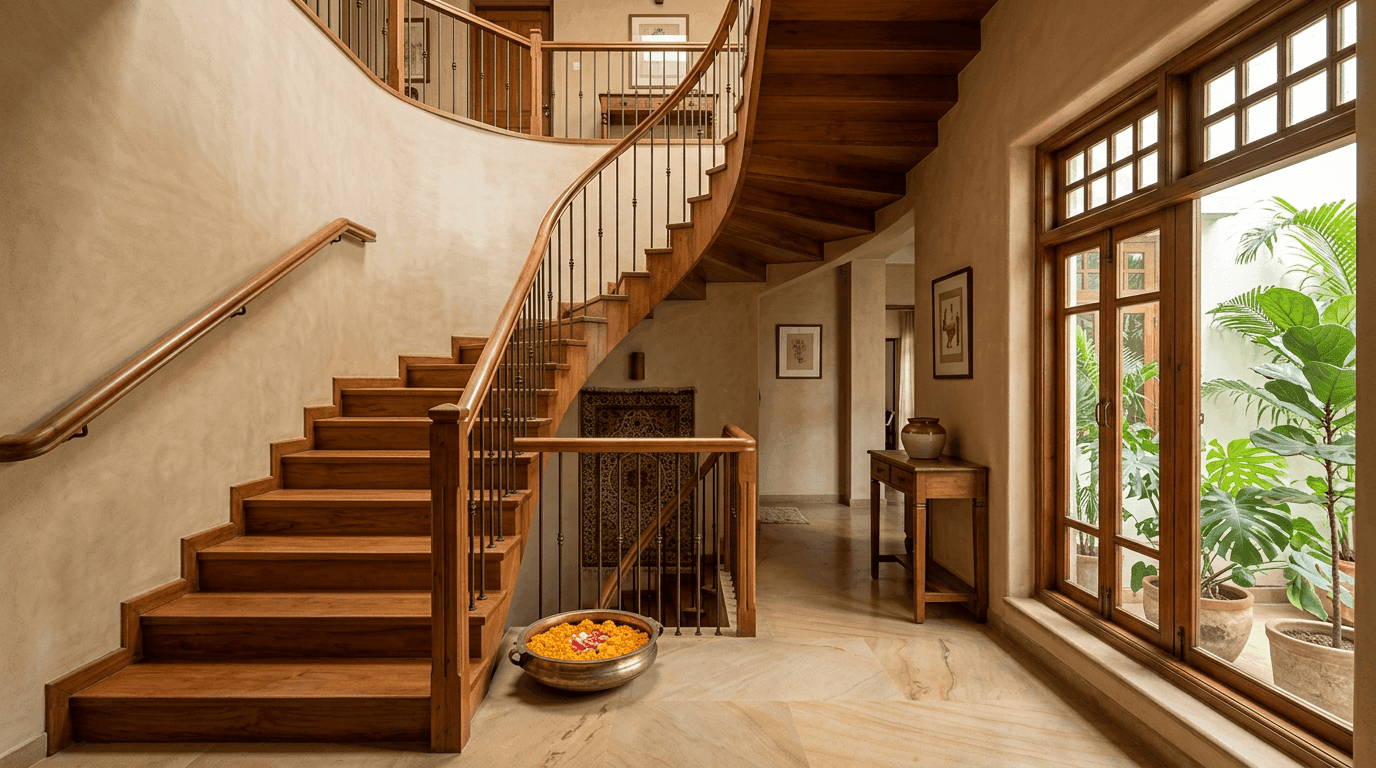
- Under a staircase. A pressed, traffic-loaded volume. Our staircase vastu guide covers what does belong there.
- The centre of the house. The Brahmasthan stays open, always.
Is the South Direction Bad for a Fish Aquarium According to Vastu?
Traditionally, yes. The south and south-east quadrants are governed by fire, and vastu shastra reads a water body there as an elemental contradiction that unsettles a family's finances and blocks the flow of positive energy through the plan. That is the traditional position, stated plainly.
What we can add from the drawing board is narrower and still useful. The southern side of most Indian homes takes the harshest afternoon heat, and heat is the enemy of a stable tank. Algae blooms faster, water evaporates quicker, and the heater or chiller fights the room all day. The correct direction, on both readings, is the cooler one.
Can We Keep an Aquarium in the Bedroom or Kitchen?
No, on both counts, and vastu is unusually firm about the bedroom. Active water in a sleeping room is said to introduce restless energy and disturbed sleep, which is the opposite of what that room is for. Set the tradition aside and a filter pump still hums all night. For where the bed itself belongs, see our sleeping direction as per vastu guide. The kitchen objection is elemental, fire against water, and also just practical.
Number of Fish to Keep in an Aquarium According to Vastu Shastra
Nine fish in an aquarium. Eight gold or bright coloured, one black.
- 8 gold fish, said to carry prosperity and abundance
- 1 black fish, said to absorb negative energies aimed at the household
- Koi fish and the dragon fish (arowana) are considered auspicious in vastu, and both count among the best fish to keep
- Avoid keeping a single fish alone, and avoid aggressive species that fight
The vastu fish rule is one of the few in this tradition with a memorable shape, which is probably why it survives so well. Whatever you keep, keep fish that suit the tank size and each other. A crowded tank is a sick tank.
What if a fish dies? The traditional belief is generous: the fish absorbed an obstacle meant for a family member, so it is not treated as a bad omen. Remove it and replace it promptly with a healthy fish of the same kind. The unromantic version is that fish die from ammonia spikes, overfeeding, and a filter nobody cleaned. Both readings end at the same instruction, which is to keep the tank properly.
Aquarium Care Rules That Vastu Treats as Non-Negotiable
A neglected tank is worse than no tank at all, because a dirty one is said to hold negative energy exactly where you wanted positive energies. These important vastu tips are refreshingly concrete.
- Keep the water clean and clear. Murky water is the single biggest defect, and it converts your prosperity corner into a chore.
- Keep the filter running so the water keeps moving. Still water is dead water in this tradition, and stagnant energy is exactly what the tank was meant to fix.
- Light the tank, and do not park it in a permanently dark corner of your home. Vastu tips about light and water always travel together, because a dark corner is read as dead energy.
- Remove a dead fish the same day. Nothing in this tradition turns positive energies sour faster.
- Feed on schedule, and do not let the tank become a job you resent.
Vastu and Feng Shui on Aquariums: Where the Two Systems Differ
People blend vastu and feng shui constantly, and the two disagree on the most basic point. Vastu places the aquarium in the north-east. Feng shui typically puts the wealth tank in the south-east, sometimes the north, using a completely different mapping of the home.
Pick one system and follow it. Placing the tank in the south-east because one article said so, inside a house you otherwise planned by vastu principles, gives you neither. Two contradictory energy maps in one living room is not a hedge. This page is a vastu page, and a vastu aquarium goes in the north-east.
What We've Learned Placing the Water Element on Real Plans
We design and build homes, so a water body on a drawing is a coordination problem before it is a spiritual one. When Surapaneni Residency came to us, the brief for that ultra-luxury six-bedroom home carried a swimming pool, a party area, and a bar. A pool, a fountain, and a 200-litre aquarium are the same decision at three scales, and vastu treats all three as the same water energy: fix the zone early, then run power, drainage, and waterproofing to it. Our home swimming pool designs guide takes that up at the larger end.
Waterproofing is the word nobody on this topic mentions. During the renovation of Om Sri Padma Nilayam, a 30-plus year old apartment building in Hyderabad, a serious share of the work was chasing a water seepage problem and redoing the waterproofing. Standing water against old plaster finds a way in. So when a client wants a large built-in tank against a shared wall, we ask for a service gap and a tiled, drainable base behind it. Tradition says north-east. Building science says give it a base you can drain.
One honest opinion, since we get asked. If a home is being furnished to let out, we would skip the tank entirely. Dr. Kirti Goud's 4,000 sft apartment in My Home Bhooja was designed on an explicit least-maintenance, timeless brief so she could rent it out and stay carefree. A live tank is the opposite of carefree. It is a lovely thing in a home somebody actually lives in.
You also inherit somebody else's walls, which is normal and fixable. Mrs Padmavathi bought her 1,000 sft flat from a retired couple with completely different needs, right down to a permanent Last Supper painting we converted into a storage unit, and a showcase we removed to open a window from the kitchen to the living. Nothing about a resale flat is fixed forever, including the wall your tank wants.
Mirror Vastu: Placement Tips to Attract Wealth and Prosperity
Mirror vastu is the other half of the wealth-corner question, and it runs on the same compass logic as the tank.
Place mirrors on the north or east wall, positioned so they reflect your locker, safe, dining table, or the aquarium itself. Vastu holds that a mirror multiplies whatever it reflects, which is how it is believed to attract money into the house. Avoid mirrors directly opposite the main door, which are said to push arriving energy back out, and avoid any mirror that reflects the bed.
The underlying idea is the same one running through this whole page. A mirror is treated as an energy amplifier, so what sits in front of it decides whether you get more prosperity or more clutter.
A few rules we actually enforce in interiors:
- North and east walls first. Those two directions are the auspicious ones for reflected energy. South and west mirrors are the ones consultants ask to be covered, moved, or removed.
- Never opposite the main entrance. Offset it to a side wall in the foyer instead.
- Never facing the bed. If your wardrobe has mirrored shutters, angle or screen them.
- Keep them clean and uncracked. A cracked mirror is a defect in every school of vastu, and it looks terrible besides.
- Do not hang a mirror facing the toilet door. Our toilet direction as per vastu guide handles that zone.
For mirrors as furniture rather than as remedies, our dressing table designs and bathroom mirror designs guides cover the pieces themselves.
Money Plant and Other Vastu Tips for Money in the Wealth Corner
The tank rarely travels alone. If you keep a money plant, the common advice is to place it in the south-east and train it upward rather than let it trail along the floor, since a climbing plant is read as rising fortune. A tulsi plant is considered auspicious in the north or north-east, near the same corner as the tank, where its energy is said to reinforce the water's.
Neither plant is this page's subject, and vastu for money runs much wider than greenery anyway. For the full list of what actually survives in Indian homes, see our best indoor plants for the home guide.
Aquarium Placement as per Vastu: Your Wealth Corner Checklist
These placement tips condense everything above into the order we would actually do it.
- Take a compass reading of your living room and mark the north east direction.
- Confirm the corner has a solid wall, a power point within reach, and room to stand in front.
- Choose a tank size the corner can hold with walking space left over.
- Stock nine fish, eight gold and one black, avoiding aggressive species.
- Set up filtration and lighting before the fish arrive.
- Give the tank a drainable, water-safe base if it sits against an older wall.
- Add a mirror on the north or east wall reflecting the tank, if you want the traditional amplification.
- Book a fixed weekly cleaning slot and keep it. Clean water, healthy fish, good light, and the energy question takes care of itself. Every powerful vastu benefit in this tradition assumes a clean, living tank.
Common Aquarium Vastu Mistakes to Avoid
The common vastu errors we hear about, in rough order of frequency:
- Buying the tank first and hunting for a corner afterwards.
- Getting the aquarium placed in the bedroom because that is where the free wall was.
- Mixing vastu and feng shui directions inside one house.
- Letting the water go cloudy and assuming the direction still does the work.
- Mounting a heavy tank on a cantilevered balcony slab without asking a structural engineer.
- Hanging a mirror opposite the main door to make the entrance look bigger.
- Treating vastu tips for money as decoration rather than as planning. The best vastu decisions get made on a drawing, before anything is bought.